Monday, 27 October 2008

Calling International Rescue....Discovery 1 is Go

Not a wildlife safari this time. We left Base Camp at dawn and headed to the Yorkshire Dales. After a whole day and night of torrential rain the River Lune had broken its banks in many places.
Ribble Head viaduct is a feat of 'navvy' engineering.

Water was gushing out of the hillsides all over the place, what were normally little rivulets had become torrents.

This small spring being a perfect example.


Deeper into Yorkshire the River Ure beyond Hawes had also broken its banks.
This lady from Holland was trying to get to the Newcastle ferry and come to watery stop. We gave her a lift back to the nearest village shop, bearing in mind it was still before 8 o'clock on a Sunday morning. Hope she found someone to help and got going again.
Eager to reach our rendezvous we surged through the flood - only to reach another where it was impossible to tell where the road was and where the river was - nothing for it but to turn back and find a detour. This bow wave is on the return and is not as neat as my first pass. Maximum depth of water was just above the bottom of the door! At this point one of only two raptors we saw all day flew over - a Buzzard.

From the higher vantage point of the detour lane we could see the small linear fields each with its own barn that typifies the Yorkshire Dales.The start of our Green Lane drive took us in to a disused quarrying area. easy enough driving but I haven't had the opportunity to try out the biodiesel on anything other than tarmac until now - 'how would it fare under pressure?'
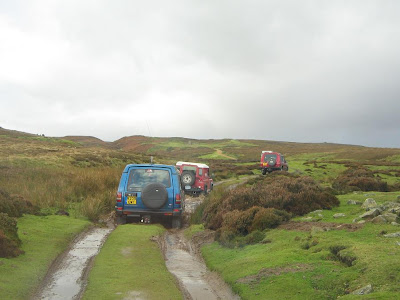
So far so good no worries about the bio it has plenty of power, perhaps a bit too much as I was consistently catching up the car in front despite driving mostly just above tick over. He did have extra passengers which would have made him heavier but I think it more likely that the bio is more calorific than normal diesel.


The start of a long steep climb with a tricky rock step at the top, all the group managed it without too much problem. One disadvantage of having a tow bar is it hangs low and catches rocks with horrible crunching sounds.

The tricky bit was just above this beautiful spring.


Lunch stop was at this stunning viewpoint. Looking down (or is it up?) ??dale because, by now, not having sat nav and not being familiar with the Dales, I was totally lost.

The picture below shows a perfect example of an old farm lane formerly used by horse and cart or for droving stock. The walls show the 'through' stones (the dark line half way up) very well. These support the upper portion of the wall. It is A shaped being about 3 feet wide at the bottom tapering to 1 foot at the top. The walls were encrusted with lichens and in damper areas moss. Our favourite was a particularly splendid bright reddy orange lichen. Also shown well is the divide between the fell top and the 'inbye' in the distance. The inbye is the managed farmland with field boundary walls showing the signs of improvement where it is green as opposed to the rough grazing higher up.

River crossings are always fun but this one was much less tricky than the flood we'd already encountered on the way. (Twice!)


The overnight rain had created plenty of opportunities for big splashes but driving to rashly can cause unnecessary erosion so it was gently gently through the puddles. If you want to make a splash go to your nearest 'pay and play site.


We had the distinctive flat top of Ingleborough Hill in our sights. We had it surrounded, it was to our left, our right, in front of us and behind. The only place we didn't get was to the summit - no vehicular access and rightly so.
This very steep rocky decent ended as you will see in a bit of a drop off.Mind the step. If your 4x4 is fitted with side steps take them off, they will be broken off when you come across an awkward bit like this.


Side slopes are probably the most hair raising bit of the drive. This one is quite moderate. My co-pilot and photographer in chief had her eyes closed and hands tightly gripping the grab rail on the more extreme ones. Black mark for letting go of the camera. The 200 foot drop on her side didn't help matters


The last river crossing of the day was watched over nonchalantly by this pair of geese.


Many thanks to Colin and all the team at UKLandrover Events (see links on right hand side) for a great day out. And big thanks to to the other participants a day of great camaraderie...and not forgetting star of the show, Lucy the Labrador.
No problems what so ever with the biodiesel. Total mileage for the day 200 of which about 40 off tarmac in low ratio. Fuel used c.30litres - 5 litres normal (26kg CO2) 25 litres bio (6.5kg CO2). Footprint for the day = small (Less than most of the ramblers out that day probably). Other people out enjoying the sunshine and showers (including a bit of early sleety rain) a few ramblers, three guys on trials bikes and some mountain bikers one of whom gets the medal for fastest man of the dales - I've never seen a cyclist go so fast...he was whizzin'.

Where to next? Local trip probably...but there is still the Ross's Goose on the south side of the Ribble.
In the meantime let us know what you have seen or where you have been in your 'outback'.

Monday, 20 October 2008

What the Dickens - A tale of two woods!

A twin safari at the weekend to report on today.


First up was a short visit to Witch Wood in Lytham. 'Witch' probably refers to the Wych Elms, not old dears with tall black hats - I could be wrong, but there were several Wych Elms in the wood and fortunately looking to be free of the dreaded Dutch Elm Disease that is rife a few miles away in Blackpool. Of all the Elm species Wych Elm seems to be the most naturally resistant to the disease.

The wood itself is perhaps a little over managed with very little shrub layer...we'll come to a much more natural woodland later on. However dead wood is left in situ and turning over a large log revealed a rather fat Common Frog.


Dead wood encourages fungi but this unknown species was growing at the base of a living but perhaps unhealthy tree.


Very few flowers are still open now but we did come across this Red Campion and a pink version of Bramble.


The second site was a few miles to the north west, a Semi-natural ancient woodland. This means there has been continuous tree cover here since at least 1600AD although it has at times been modified by man. At this site species such as Scots Pine, Beech and Horse Chestnut have been planted and in areas felling has taken place as parts of the site were an early industrial cotton mill in the late 1700s. The remains of mill workers' cottages can be seen as piles of stones and there are a few old broken ovens from the kitchens lying around.


You shouldn't be able to see far into (Semi-)natural woodland as a thick shrub layer will obscure the view within a few yards. This low down vegetation is important for lots of different species of breeding birds in the summer and creates a still, moist micro climate suitable for mosses and ferns to thrive. These were missing in Witch Wood as it was much more open.


The fern is Mother-in-law's Tongue. I'm not a Bryophyte expert so I have no idea what species the moss is.


Again at this woodland there is plenty of dead wood, both standing and fallen. Birch Polypore fungus is a common sight anywhere where there are Silver Birch trees, being found on standing trees and fallen trunks or boughs.


Below is a Hazel bush with a picture of the only Hazelnut we could see on it. The Grey Squirrels will be hungry this year. We did see one at both sites but alas they were too quick for the photographer...shame they weren't Red Squirrels. I did read this week that some Reds may be resistant to the Squirrel Pox Virus carried by the Greys; hopefully there may be a resurgence in their numbers - hope so....damn Yankees!


This Hazel bush shows the obvious multi stemmed form that indicates it was probably coppiced at some time in the past.

There are few flowers showing again at this site but some of the typical woodland plants are still in evidence. This one is Wood Sorrel and will have large white flowers in the spring

This rather small one goes by the enormous name of....wait for it.... Opposite Leaved Golden Saxifrage.

There is plenty of Ivy in the woods and it is in flower at the moment and attracting large numbers of Drone Flies, a species of hoverfly. Sorry about the blurredness...doh me and that macro.....


I will leave you with a few arty autumnal shots. Not quite New England or the Appalachians in the fall, but Lancashire in early autumn just as the leaves are starting to turn.

All say "Ahhhh, ain't that pretty.

Well folks as this epic comes to an end we have to ask "Where to next?" Oh yes.... next week is an adventure with an early start....and possibly a better photographer.

In the meantime let us know what you have seen in your outback.


Friday, 17 October 2008

What a beautiful day!

Not a safari as such, just a beautiful dawn I was lucky enough to catch this morning.
Pretty spectacular stuff to wake up to.

At lunch time there was a big 9.5m high tide and I was able to get an all too brief 10 minutes look over the sea wall. A little choppy but not bad visibilty....How many Common Scoters?....I guestmated at 2,500 but there could have been twice that many; they were stretched out for miles across the horizon. Despite the good light I couldn't find anything unusual among them (unlike Bazzo yesterday who seemed to catch every seabird in the book - see Mersey birdblog comments in links on right for 16th Oct). I was just on the verge of giving up when a Great Crested Grebe and a Red Breasted Merganser whizzed past together. That was going to be my lot so back to the desk it was.

And not Porpoise in sight - none seen now for ages - where do they go????

Where to next? Lets see what the weather does before we make a decision.

In the meantime let us know what you have found in your outback.


Sunday, 12 October 2008

Mists of mellow (un)fruitfulness

The safari received two tip-offs this week. The first was of a Long Eared Owl, the other, from the incomparable Anno, of a mysterious Red Kite. So two targets for the safari to aim for....AND there was a morning high tide after a couple of days of offshore breezes....promising....very promising.


First off we hit the Prom. It was draped in a thick mist. Meadow Pipits were going over in some numbers and the 'chisick' calls revealed Pied Wagtails in amongst the Skylarks.


Out on the flat calm sea we scanned hopefully for Porpoises without any luck. There were a few Common Scoters in the distance, a female Eider was much closer in; only a few feet offshore with a Great Crested Grebe. With the tide in there were the usual flock of Redshanks and Turnstones was on the seawall, obviously oblivious to the racket of the neighbouring go-karts.


As we watched a flock of about 75 Pink Footed Geese going south to Martin Mere WWT Reserve we heard the familiar screech of Sandwich Terns, there won't be many more of these this year.

One of my biggest bugbears is litter. This plastic bag could be floating round the currents for years before a turtle or some other marine animal mistakes it for a jellyfish and eats it - with dire consequences....TAKE IT HOME.


On a lighter note but still sort of serious if you're ever at the Gynn in Blackpool have a look at our superb fossil collection. There's all sorts of creatures poking out of the ornamental rocks. It's just a shame that these rocks were someones best Limestone Pavement at one time - now a really rare and precious habitat!


Next stop was the brilliant (but misty) Marton Mere Nature Reserve.


(Not to be confused with Martin Mere mentioned above) The early morning mist was lifting and it started to feel more like midsummer than autumn. The sun brought out a good selection of insects. The dragonflies included many Common Darters and Migrant Hawkers (pictured - look for the 'wine glass' just behind the wings).


The butterflies included a Wall, a surprising find as these seem to have become very scarce in recent years, a couple of Peacocks, Speckled Woods, and a Red Admiral - not a bad haul for mid October and better than most of the summer!


A Buzzard eased itself overhead and a flock of about 30 or so Pintails circled above the mere. Despite a thorough scan of the usual suspects we were unable to find the reported Long Eared Owl. Never mind; if they're not there yet they will be soon - a sharp frost is needed to drop the leaves for a better look into the bushes.


Looking over the water I managed to pick up a first winter Mediterranean Gull, supporting cast included Wigeon, Little Grebe and a rather disturbing crashing deep in the reeds nearby accompanied by a low croaking grunt - was it a Bittern? We'll never know - whatever it was didn't show.

Tufted Ducks look fine at this time of year.


Most of the plants have finished flowering now but the Evening Primrose is still going strong. This is a great plant for attracting moths as it releases its fragrance at night.


I'm no expert at fungi etc but this cup fungus on its bed of moss with a Liverwort close by caught my eye.


As for the Kite, well sadly we ran out of time. We hope to get more information and nail the fella down next week.


If anyone is interested in the birds of Marton Mere I still have a couple of copies of Pauline McGough's excellent book which gives details of the 216 species recorded to the end of 2001. Only £5.00 each including p & p. If you would like one drop me an email or contact me at the Solaris Centre.


Where to next? The Kite is currently top of the list! Superb birds - effortless fliers, good looking and charismatic - great to have one in our area - lets hope we can track it down.


In the meantime let us know what you have found in your 'outback'.


Saturday, 4 October 2008

Standing in the teeth of a gale...or The return of the hooley!


I knicked the title from the opening line of a Runrig song...seemed very appropriate for this afternoon. (I was at Donnie Monroe's farewell concert at Stirling Castle a few years ago now...brilliant...beyond brilliant...very emotional)

But that is not what this blog is about. Leach's Petrels is where we are at. After a top up of the Land Rover with recycled cooking oil and donning the waterproofs it was time to head down hill for the tide. A savage wind was blowing from the south west and finding decent shelter on Blackpool's north promenade is like trying to find shade in the Sahara. The safari tucked in behind a huge stone lighting tower, the steel lamp post a couple of metres away was doing an Irish jig.

For those of you who don't know what the fuss about Leach's Petrels is, John Dempsey (see Song of the Leach-less 4th Oct, Merseybird blog in links on right) describes them as enigmatic, mysterious, awkward, indestructible and ridiculous. If you've never seen a picture of them John's blog features some fantastic shots by Rich Steel and Fylde Bird Club's Chris Batty also has a superb picture on 1st October (see blog links on right)

Trying to watch from behind the column was not easy. Sand, salt and cold wind in the eyes, buffeted binoculars, salt spray on the lenses all made it difficult. Even following a bird as large as a Herring Gull through the waves was proving hard. Passers-by gave us looks which suggested we 'weren't quite right'. But we knew they were walking past probably the best, most spectacular wildlife sight Blackpool has to offer. The waves crashed against the sea wall throwing spray and foam 50 feet in to the air, the surf was wild (pictures and video to follow). In the gloomy distance the Isle of Man ferry struggled to make headway in to the wind. It was only a mile or so away but we could barely see it - how were we going to see a bird no bigger than a Starling in all this mayhem.

The pictures mentioned above are great but they don't give the sense of absolute awesomeness of something so tiny battling its way through such a hostile and enormous environment.

A bit of black amongst the waves and spray!...only a piece of seaweed tossed from the crest of a wave...doh the heart was going...

Two hours we had been stood there getting knocked around by the wind, imagine spending your whole life out in those conditions with only the crashing waves to shelter you from the fierce wind! That's why these little birds have such devotion and following amongst birders - they are tough beyond belief; dancing their way across the sea; almost defying the waves to cover them in spray or dunk them under.

A lump of drift wood is thrown 15 feet in to the air by the wind.

There...THERE...300 yards out just beyond the worst of the surf - a glimpse, a tiny angled wing, a flick of black, the hint of pale rump. That was it! That 1/2 second, or even less, was it - a Leach's Petrel. Up and over one wave and into the trough behind, perhaps not to be seen by another human being for years. I saw it...my soul is fulfilled...for this season. Luckily the binocs were pointing at that patch of sea at that particular moment.


Why are they so good? I think the Blackbird singing before dawn in spring is beautiful, the exotic birds of foreign holidays are - well - exotic, the rarity you find on your 'patch' is exciting and the big twitch to see someone else's rarity makes for a good day out but Leach's Petrels have to be EARNED - that's why they are special.

I can feel a tear coming to my eyes...

What else did we see...not a lot, a few Herring Gulls, a single Black Headed Gull and the stiff wings of a Fulmar or Manx Shearwater (impossible to tell in the gloom).

Before the driving rain arrived we cleared the crust of salt spray from the windscreen and pointed the Land Rover towards a welcome hot cup of tea.

Where to next? More of the same perhaps.

In the meantime let us know what you have seen in your outback.


video

Friday, 3 October 2008

One of these might be nice. Update 5th Oct

The safari has not been able to leave the shelter of the bunker this week - that's the trouble with 'real' work. The conditions have been ideal for a couple of days to get out and look for Leach's Petrels but sadly the wind seems to have peaked now that the weekend approaches. Hopefully the wind will ease enough for these little chaps to get busy again (Arachnophobes look away now!) It has already dropped enough for a Sparrowhawk to be seen over Base Camp this afternoon, it's very rare to see these soaring along in foul weather.


This is a Garden Cross Spider. The reason I like them is they make their webs in advance of calm weather. A westerly wind is only any good when it's raging an absolute hooley, anything less than that is a bit duff.

These spiders are the ones that build the typical cobwebs of children's picture books all over the garden; for some reason they seem to like washing lines - maybe just to scare the living daylights out of laundry hanger-up-ers. The ones defending their chins with a pair of 'boxing gloves' are the males. The females have a decent set of fangs - good job they don't bite people!

Fine weather can mean cold clear nights. Then it is time to listen out for migrating Redwings, small thrushes from Iceland and Scandinavia. Stand outside quietly and listen for their thin 'seep' calls as they pass overhead in the darkness. As they arrive so do other species and the safari is waiting for news of the local Long Eared Owls - they can't be too far away.... this week.... next week.... who knows....watch this space...

Where to next? What the weekend will bring?

In the meantime let us know what you have found in your outback.

PS. This morning (5th Oct) it happened - the first sunny morning since this blog and guess what - I was nice and clean fresh out of the shower and hanging out the laundry then walked straight through a web - poor old spider has to build another one now - sorry.