Sunday, 12 July 2009

Tales of Domestic Disaster and Dastardly Dutch Elm Disease

The safari is pig sick of the letter 'D' at the moment. Remember our Damaged Drain...well there's more. Now our Dishwasher has Decided to give up the ghost Due to a Dodgy capacitor and we Discovered a Damp patch on the floor by the front Door, (which is new but the Double glazing has been manufactured back to front with the lead lights on the inside and the frosted pane on the outside - how can they make a mistake like that?). The Damp turned out to be caused by an un-Detected Drip from the water stop-tap. Lifting the floor revealed wet rot in the joists which need to be replaced. As they were being Dismantled we Discovered Dry rot too...a further Disaster followed when our brand new friDge went on the blink. Oh, and one of our new gates has split a post in the hot, Dry weather and Dropped on its hinge. Doesn't pose any problems to Extreme Photographer come Extreme Demolition expert/joiner, Raf.
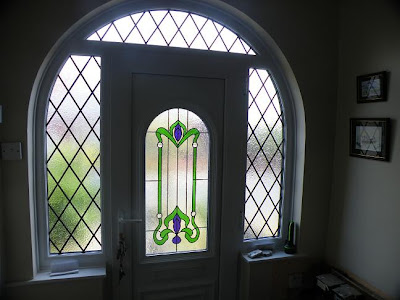
Not having much luck at the moment so if anyone has any to spare please, please, please pass some over to the safari.

So what Does all this alliteration have to Do with Dutch Elm Disease. Well our local patch, the park, is on Devonshire Road and is home to the increasingly scarce White Letter Hairstreak butterfly whose caterpillars feed on Elm trees and Elm trees are the favourite food of the Elm Bark Beetle which carries the Deady Dutch Elm Disease, a fungus that clogs the trees water transport system which eventually kills the tree.


The park has been under attack for some years as can be seen from these galleries of the beetle on a long Dead tree and the stumps of felled victims, but this year there seems to have been a particularly virulent outbreak. Dead and Diseased branches are showing bare amongst the summer foliage of the other unaffected species. The trouble is the WLH caterpillars only feed on Elms so this tiny population could be Doomed.

I Did manage to get a photo of one...not the best shot in the world but it was one - honest! Well it was a long way up and in to the light and sort of facing me...lucky to find it really let alone photograph it. Its onlt ther size of your thumbnail.
I remember the first one I ever saw. It was in a Different local park and I was giving a guided walk to a group of Disabled children. One of them called out he had caught a butterfly from his wheelchair. I was showing others in the group a Meadow Brown and assumed he had caught another - Rule One: Never Assume Nuthin'!!!! - He was calling me over quite excitedly as he knew he had Done well but when I got to him...YIKES WOOOOOOOOWWWWWWWW WOULD YA LOOK AT THAT!!!!!!!!!!!!!!!!!!!!!!!!!!!!!!!!!!!!!!!!!!!!!!!!!!!!!!!!!!!!!!!!!!!!!!!!!!!!!!!!!!!!!!!!!!!!
You have to remember this is a species that normally spends most of its Days feeding on honeyDew (aphid poo - yummy) at the top of tall trees and this young chap caught it only a couple of feet off the ground. Some feat.

Back at the park there are some young Elms which are small enough to escape the attentions of the beetles but might also be too small to flower so are no use to the WLHs either. There are also a couple of Small Leaved Elms which have haven't been attacked (yet?), perhaps they are distasteful to the beetles, it was on this tree I got the shot.
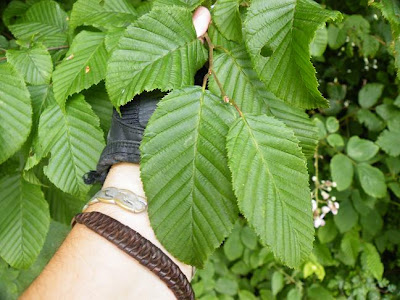
Also got the Banded Snail 'Double', Black Lipped and White Lipped. The large Buddliea (Butterfly Bush - Buddliea davidii - getting very tenous, or Dubious now!)) is in full flower and played host to a fairly fresh Painted Lady. Nearby was the Great Spotted Woodpecker's nest - they won't be in it next year as those Dang Grey Squirrels have totally Destroyed it. Did see something new today - the Display of Small Skipper butterflies which buzz their wings at each other like moths Desparate to warm up and escape from photgraphers Do. I never knew that! Talking of moths I looked Down for no good reason and spotted this Large Yellow Underwing 'Dancing' (couldn't find a more Descriptive 'D') on my boot. Did I mention the Duo of Common Darter Dragonflies?
Bizarrely Pete (why can't his name have been Dave or Don or Dan?) at Birds2Blog has featured Common Mallow and Black Tipped Soldier Beetles on his posts, must be common round our way at the moment cos I got em too, without realising he'd already snapped em.

Enough of the 'D' nonesense; where to next? Got some more guided walks to Do this week and then next weekend it's National Whale and Dolphin Watch During which I will be found staring at an empty sea in Dreadful weather - hopefully not! Also got some bizarre, tricky bird behaviour to show you if I can get it on film (can Digital be Described as film?) - something I've never seen before anyway.
In the meantime let us know what has been seen in your outback this week.
(Pictures will be aDDed tomorrow cos this Dumb-ass Donkey of a computer Doesn't recognise my camera) Another thing - why am I inside typing away when there is lovely sunshine outside and the wind has Dropped a bit????????? Better get out and try for some better WLH shots

Tuesday, 7 July 2009

In praise of privet

The safari with Frank in tow passes a superb Privet hedge several times everyday.


This is the 'normal' introduced Japanese species rather than the native species but in this instance it matters not.
There are literally thousands of miles of this stuff planted up and down the country. Only rarely are they allowed to grow tall and flower. In my last home my next door neighbour was always berating me for allowing my half of the hedge to grow rampant and not be kept clipped and 'tidy'. Tidy is an outdated Victorian concept of the human 'domination' of nature - there is no need for it anymore we need to cut the apron strings from our 'illustrious' past and soon.
This particular hedge was alive with moths at dusk a couple of evenings ago and this morning was full of bees. I dare say with a bit of sunshine at mid-day there would have been a sack full of butterflies too...but I'm not there at that time of day to check it out.
So for anyone out there in blogland with a privet hedge, or any other hedge for that matter have a rest, take it easy, relax, chill out, leave the clippers in the shed and sit down and enjoy the wildlife that uses your pride and joy instead...it's far more fun and much less hard work.
As for me due to all the recent overnight rain I've not been able to get the moth trap out very often so I think I put on a thick skin and wave a net around on the main road hoping to ignore the vacuous comments from the drivers passing by.
Today's rant is now over and I'm looking forward to a safari tomorrow - windy but not windy enough for Storm Petrels.
In the meantime let your outback be and leave your clippers to go rusty in the shed.

Monday, 6 July 2009

Just around the corner

The safari is lucky enough to have a rather splendiferous butterfly site literally just around the corner. Nothing special but on a good day shed loads. The field used to be where the parks department cut turf for the sports fields and hasn't been fertilised or anything for years, so is effectively a couple of acres of unimproved grassland right in the heart of town. Because of its history for turf it is a little lacking in wildflowers and thus nectaring opportunities slightly reducing the numbers and variety of butterflies. But today there were plenty about in the warm humid conditions and because there was no sun they were slow enough to photograph.
Here we have a mating pair of Small Skippers - thankfully no Essex Skippers here yet to confuse the issue...give it a few years!) . They are on one of my favourite grasses, Timothy - what a great name for a grass. Love that purple colour of the flowers - beautiful.

This is the male with the little black scent brands, wonder what that aftershave smells like?

Another male this time by Extreme Photographer, Raf.

This is another of Raf's, but this time a female Large Skipper. Not that they are actually any bigger than the Small Skippers. Well there might be a millimetre or two in it.

Through the paper thin wings you can see the chequered pattern of the upperside.
My effort at a male Large Skipper. Again note the black stripe of the sex brand. Obviously a different flavour of aftershave otherwise there would be lots of mix-ups.
Total counts were impressive; over 150 Meadow Browns but not a single photo - how did that happen? Nearly 100 Skippers of both species and including the ones to quick to be identified. Four nice and fresh Small Tortoiseshells was a good find as there is some serious concern that their numbers have been serious reduced by an introduced parasitoid fly.
In addition to the butterflies the migrant moth Silver Y was present in decent numbers. Although this one is in warming-up the muscles buzzing mode you can still see why (no pun intended) it is called Silver Y.
A small number of Burnet moths were also on the wing, but we didn't get close enough to discover if they were 6-spots or Narrow Bordered 5-spots. There were obviously more to hatch as this cocoon proved.
One of the Burnets was attacked by this Emperor dragonfly in mid air. They may well be distasteful as the dragonfly dropped it and allowed it to fly off to where-ever it was going.The dragonfly promptly did a circuit of its territory and then disappeared. Amazingly Raf found it laid up in the grass on his transect - almost trod on it!
The supporting cast included interesting species like this grass bug, you can tell by its small wing cases it is not quite a full adult. Not sure of the species.

This Yellow Dung Fly is another of my favourites - don't ask me why cos I have absolutely no idea, I just like em despite what they eat! Crackin' pic by our Extreme Photographer.

The warm, moist weather was great for insect but also brought out a few amphibians too. This Frog is either diseased or injured, hard to tell which although the later would be preferable.
Wouldn't mind putting some mammal traps (Elliot or Longworth - not old fashioned mouse!) out to find out what mammals are living in the area. Occasionally we see Kestrels but they could be after something as mundane as beetles or worms.
Rain stopped play on the butterfly survey front and soaked by a downpour we walked home. As soon as we got back to Base Camp the sun came back out, how annoying is that. But the little rest and a nice cup of tea and a bun in the garden had us looking around to see what there was. Good numbers of Blue Tailed Damselflies over the pond, and plenty of Red Tailed, and White Tailed Bumble Bees. This Hoverfly is doing a good sneaky impersonation of a WTBB. (Sorry I got lazy and couldn't BEE bothered spelling it out again!)

Nearby lurking in the Gladioli was this rather stunning little Spider.

After the rain had stopped we got back out to finish the butterfly survey but unfortunately there wasn't enough prolonged sunshine to see if the local speciality the White Letter Hairstreak was on the wing...and now the forecast has gone rotten for the coming week....dohhhhh. But walking through one of the smaller areas of longer grass was like being in butterfly heaven as myself and Frank ambled through the long grass there were butterflies popping up in front of us like there was no tomorrow, possibly nearly 50 in the air at any one time right under our noses...simply wonderful and a spectacle I will remember for a very, very long time, so much so that anyone passing nearby might have thought I was some sort of nutter talking to myself but actually I was telling Frank how fantastic the sight was!
Sun will have to come out soon though and when it does we'll be surveying those butterflies again.
Where to next? Could be anywhere this week, depends somewhat on the weather..a good blow would be nice to bring in some Storm Petrels - one of the few British breeding Birds I've somehow successfully avoided seeing so far.
In the meantime please let us know how many butterflies you have seen in your outback this week.
PS Watched a documentary about the 'Best Job in the World' - you know that island thingy on the Barrier Reef in Queensland - the other day...I very nearly put an application in for that but it looked to good to be true. Have to keep up with the winners blog and see what I missed out on!
Still no news of that TV programme I had to turn down - wonder what has happened to it....having said that it'll appear in the TV mags next week I bet...looking forward to it anyway!

Sunday, 5 July 2009

While we're on the subject of dolphins

This week as people look forward to their summer holidays some of them will be hoping to swim with captive dolphins - - PLEASE DON'T

World Week of Action for Captive Dolphins
01 - 07 Jul 2009
World Day of Action for Captive Dolphins (4 July)

Don't let your dream holiday become part of a dolphin's nightmare.
A week of action to highlight the suffering of dolphins and whales in captivity.
Cetacea Defence came up with the concept of organising a World Day of Action for Captive Dolphins (4 July) in 1992, and the following year the last dolphinarium in the UK closed down. However, many British tourists still visit whale and dolphins shows while on holiday abroad and, in addition to supporting campaigns in countries where dolphinariums exist, Cetacea Defence is encouraging people to act as 'compassionate travellers' and avoid funding animal cruelty while on holiday.
Behind the dolphin's 'smile' lies a world of horror. Most dolphins in captive shows have been taken from the wild, ripped from their families, often as part of the notorious 'dolphin drives' where some dolphins are killed for their flesh and others sold live to zoos.
Once in captivity, the dolphin's whole life is reduced to performing in concrete tanks that prevent them from communicating or diving properly.The opportunity to swim with dolphins in captivity causes even greater risks to the animals as well as to people.
World Day for Captive Dolphins is on July 4th each year - find out more here.To learn about the cruelties of dolphinariums and swimming with captive dolphins, see Marine Connection's informative website.
Sir David Attenborough once said, "It seems to me that the natural world is the greatest source of excitement; the greatest source of visual beauty; the greatest source of intellectual interest. It is the greatest source of so much in life that makes life worth living."
Lets try not to reduce our appreciation of the natural world to a few lonely, captive individuals in an artificial environment, or worse; pictures in history books.
Right political rant over, the safari is off out to survey the local butterfly populations before it starts raining again and hopefullly before the Horse Flies (aka Cleggs - Tabanidae) have got hungry!!!!!!!
In the meantime let us know what's biting in your outback.

Thursday, 2 July 2009

The wanderer returns

Well the safari has returned to civilisation if you can call traffic jams, mobile phones and emergency services’ sirens civilisation.
Our remote location in a deep wooded valley in the heart of South Wales lacked all these…it was a hidden piece of tranquil heaven. Apart from the loudest Song Thrushes I have ever heard that is! The entrance gate is about a 5 minute drive from the cottage along a narrow woodland track.

The alternative way in involves a steep overgrown decent and crossing a narrow ford.
Putting out a crayfish trap overnight in the stream at various points either side of the ford revealed no crayfish. We were hoping for the native White Clawed Crayfish and not the dastardly North American invader, Signal Crayfish (which, had they been found, would have ended up on the BBQ) but could only find young Brown Trout despite a variety of tasty baits being offered.
What about the Red Kites?...missed them! Saw plenty on the drive down through the Cambrian Mountains, more numerous now than Buzzards which are more common than Kestrels, how times have changed! But the only one I spotted whilst not driving I missed taking a picture of as I was waiting for a Spotted Flycatcher to visit its nest site. Snap and be damned; there won’t always be another one soon.
The Spot Fly itself was a nightmare. First photo of the trip, through an old and dirty pane of glass but at close range. It took another couple of days to get another half decent shot, not through the glass this time but at a greater distance. I think the first shot is actually the best.
We had a few trips out. The first to Pendine Sands, home of the land speed record for many years where Donald Campbell broke the 150mph mark 84 years ago in July 1925 (a record that would only last a few months being broken at Southport, just over the river on the safari’s South Side). Frank was never going to break any speed records as he lumbered after his ball through the thousands of Lugworm casts.
A lone, but rather large jellyfish, turned out to be an Octopus Jelly, a species I’ve never come across before. Apparently this isn’t a big one! This Hermit Crab is a little beauty, what a superb pincer. We found him trundling quietly along the beach.
Having never been there before I hadn’t realised there were cliffs and rock pools to explore. The cliffs held a small colony of Fulmars, their stiff winged albatross-like gliding flight easily picking them out amongst the Herring Gulls. A family of Peregrine Falcons could be heard yikkering in the distance and gave brief but distant views.
In the rock pools there were a fair number of these little Cowrie like shells which we don’t get on our beach. They look almost tropical, but are in fact something quite different – the internal shell of a Sea Slug, Acteon. These bizarre strappy horseshoey type thingies are broken bits from a spiral of Sea Slug eggs maybe from Acteon, maybe not as apparently there is no key to Sea Slug eggs – you do surprise me! Many thanks to Kathryn at the Fylde Coast Marine Life Survey for the IDs I struggled with.
On the north coast of south Wales is the small town of New Quay, famous for its connection to the writer Dylan Thomas, and more importantly to the safari, Bottle-nosed Dolphins and other marine mammals. A boaty ride had to be taken. While we waited for the boat to be brought to the harbour wall we were lucky enough to see two, possibly three, Dolphins messing about round the boats right in the harbour itself. Impossible to get photos of, lots of shots of out of focus boats but not a sniff of a cetacean. I need to get some tips from expert dolphin photographer Monika .

Don't blink or you'll miss it!


Boat ride took us past very interesting rock formations were you can see the stresses and strains of the millennia in the twisted and buckled strata. The cliffs provided excellent nesting ledges for Guillemots, Razorbills and Kittiwakes. Once again my photographic skills were sadly lacking and this Guillemot is the only decentish pic I got – I blame the heavy swell for rocking the boat and spoiling my aim.
This Cormorant was in perfect position until it decide to take flight when I pressed the shutter. Fortunately a Gannet, from the big colonies further west, was much more obliging. My first and only attempt at a picture of this species.
Did we see any more Dolphins?...of course we did. Blink and you’ll miss it! There was a small calf with this female and they put on a splendid show of synchronised swimming for about five minutes…excellent stuff indeed. Poor Frank got rather hot on the way back and a way of trying to keep him cool had to be improvised. A couple of Grey Seals were seen briefly but the swell made spotting them difficult.
Back at (temporary) Base Camp a young Song Thrush started sunbathing on the shed roof while a young Robin picked insects from the moss. Unfortunately they didn’t offer a decent shot of them in frame together. Not easy this wildlife photography m’larky!
Around the fishing lakes the warm sunshine brought out a selection of dragonflies and damselflies. The bright blue damsel is Azure Damselfly, look for the ‘Honda’ logo on the segment below the thorax, Common Blue has Barrett’s, the builders, oak tree logo instead. I wish we could get a pair of Large Red Damsels doing this back at our base camp pond! This teneral Darter dragonfly could be Common Darter, but could just as well be a species I’m not familiar with…anyone any ideas/confirmation? Pairs of a rather large species of Pond Skater were enjoying the hot sunshine. Much bigger than the puny ones we are used to up in Safari land.

Finally, one of my favourite bugs, the iridescent, and well named, wasp Chrysis ignita, the Ruby Tailed Wasp. Ruby Tailed Wasps are 'parasitoids' meaning that they eventually kill their hosts: the larvae of burrow-dwelling solitary bees.
What happened to the promise of Badgers…those mythical beasts are just that. Although a sett was on site close by seeing them proved impossible. A concerted effort one night just led to a multitude of bites from a field guide’s full of insects. One morning the BBQ was not where we left it, but later, baits put out to attract the stripey faced critters weren’t touched. As for the Otters…even more mythical but the owner, another David, reckoned one had been active most nights in one of his fishing lakes as every morning it was well churned up. But we didn’t find any evidence of fish being taken and eaten.
Eventually it was time to repack the Land Rover and say good bye to our little piece of Welsh paradise. As Arnie sort of said…’we’ll be back’!
And no more Kites on the way home…shoulda took that photo when waiting for the Spotted Flycatcher.

Reading this back it looks like we didn't see much, but that wasn't the point - it was to go somewhere new and have a mooch round and enjoy what we found, which is exactly what we did...brilliant stuff!
Where to next? Back to more familiar haunts…butterflies to survey near to Base Camp…National Whale and Dolphin Watch is coming up soon, closely followed by National Marine Week...so there will be lots of goodies to report on.
In the meantime let us know what you have found in the outback you have visited for your hols.