Monday, 20 July 2009

National Whale and Dolphin Watch – day 2

Yesterday’s best sighting was a Land Rover Discovery 3 with a very sleek and snazzy snorkel fitted, must be new on the market; not seen one before. That’s how good the wildlife watching was!
Today the weather was a little more promising with a lighter wind and the sea much calmer although still a little too choppy to see any Porpoises well.

But we ended up staring fruitlessly at an empty sea in the pouring rain. Eventually the rain stopped and people started to wander about and ask the usual questions; "surely it’s too cold for Dolphins", or the other favourite, " isn’t the water too dirty?" Neither are true with Bottle-nosed Dolphins being found in the, much colder than here, Moray Firth in NE Scotland and our water is cleaner now than it has been for the best part of 150 years. The persistent over-fishing might be more likely the reason we don’t see so many but the position of Blackpool right at the innermost point of Liverpool Bay doesn’t help much either and our very shallow water will keep out most of the larger species which would be longer than the water is deep!
A small flock of Common Scoters bobbed about in the middle distance to break the monotony.
Later in the morning we were joined by the youngsters from a Wildlife Watch group from out of town and they were lucky enough to see a Grey Seal bottling just behind the surf only a few yards away from some boys playing in the waves. Maybe the water wasn’t as cold as it looked. A distant flock of Common Scoters flew south along the horizon as did a Gannet and that was about it in the four hour watch! Thrilling…not.
The group then went rock pooling on the beach. Great fun as pots were filled with Brown Shrimps and the tiniest juvenile Green Shore Crabs I’ve ever seen, the smallest no more than a millimetre across. A juvenile Blennie looked like a miniscule Flying Fish with its overly large pectoral fins sticking out sideways. Further out on the beach we found a few Compass Jellyfish with their lovely rich brown markings.
Back home it was time to venture out to pastures new and see if there were any Salmon leaping at the falls about an hour’s drive north. But when we got there the roar of water immediately told us that the river was far too high.

Right enough getting down to the riverside we saw the water was torrenting through the falls.

The first bird we saw was a Dipper,

sorry about the pic quality it was pretty dark in the gorge, but this is my very first attempt at this species. Apart from a very brief Grey Wagtail, Dippers were the only birds we saw, four in total, probably a family. On the cantilevered walkway under the road bridge we came across a very interesting scat from a Mustelid, looked too much for a Stoat but no obvious fish scales so probably not Otter or American Mink, hmm Polecat? Pine Marten?? Whatever did it it had a few small stones in it – residue from the stomach contents of its prey? On the drive back down the motorway a dead animal on the hard shoulder looked very Polecatty unfortunately it is impossible to do a U-ey on the motorway to go back and check it out.
The wild flowers were nice with Hemp Agrimony just coming in to flower,

along with some Monkey Flower and Meadowsweet,

whose leaves smell like the pink Calamine Lotion when bruised.
This part of the rapids is known for its peculiar holes in the rock where hard pebbles have been washed around and around by the torrent wearing away the softer limestone.

Some of the holes go right through the rock!

Ever daring our Extreme Photographer is trying to get a shot looking UP through the hole!
The rock formations are impressive with spring water flowing from cracks all over the place.


A large old Oak tree can be seen growing precariously out of a crack in the strata. Worryingly this plastic bag was caught in the base of the tree by flood water. It is about 10 feet (3m) above the level of the river, that’s a lot of water!!!


Nearby the roadside verges were full of wildflowers. Not sure what species this Allium is as it’s not something I’ve seen for a long time.

Hardheads are common everywhere and a favourite of bees and butterflies, like Hogweed which is being visited by a Hoverfly for its nectar.

Never noticed those pink sticky up things on the flowers before, obviously wiping the face of nectaring insects with pollen – fascinating and another new thing learnt.

Where to next? More NDWD tomorrow.
In the meantime let us know what is in the pools in your outback.

Saturday, 18 July 2009

National Whale and Dolphin Watch - Day 1

The safari took off to the sea side to start the annual National Whale and Dolphin Watch. Not a good start - the wind was up and the sea was rough. Looks like we were going to be flogging a dead (sea)horse (Not a Dead Sea Horse - ahh the Dead Sea; I have swum in it and can confirm it is as salty as they say). Worryingly I had been told of a dead Porpoise being washed up last week and other reports of it, or some more, one of which may have been a dead sheep? More of the sheep later - I may have found it. But dead Porpoises are not good news especially just before the national watch as we don't have many to start with.
The sea was rough, the Isle of Man boat went out and I could see the waves breaking high over the bow. Then I noticed a sailing yacht leaving Fleetwood...hardy souls, or should that be foolhardy. They were being tossed about like...well like a boat in a storm; which is exactly what they were. Ended up having great fun tacking up and down the coast with the spinaker flying.

As it turned out it was diabolical, thoughts of exposure entered my head with the knowledge that I was going to be stood there for four hours. A brief but very distant Gannet broke the monotony. Hardly a soul was about; a, because it was still quite early b, the weather was [suger lumps] and c, with the tide in there was nowhere for the dog walkers (aka bird scarers) to go...more on that later too. Eventually a man came past and had a word; apparently he was waiting for tractor training as part of his boat club duties..which he eventually got.

After driving down the slade and back up again he and his mate are now a fully fledged boat-launcher-with-a-tractor-ers.
As the tide dropped and the beach was starting to be revealed a nice flock of Turnstones dropped in just a little too distant for a good pic.
They didn't stay long, with the beach growing by the minute the dog walkers started to appear en-masse and their pooches soon began stalking/chasing this flock and it left probably to be disturbed somewhere else.
A pair of Great Black Backed Gulls were having fun on the wind - putting the wind up all the other gulls on the beach. No we weren't having an earthquake at the time!
Look at the beak/axe on that.
A few Lesser Black Backed Gulls came to see what goodies the receding tide had left behind. Some of them had recently fledged youngsters in tow. One of them was ringed with a Darvik ring but infuratingly it would omly stand still when it was up to its knees in water. When it did eventually rest on a sand bank guess what...yep..a dog almost immediately rushed at it and it did one in to the distance. The ring was black with yellow/dirty white lettering I think W(or N)L2Y but I could be miles out!

Note the smokey grey mantle of the Lessers compared to the black of the Greater pictured earlier.
I noticed a bloke and his girlfriend taking pictures of something just off the sea wall. Ever the curious one I just had to go and investigate. A long dead and strangely headless Grey Seal...what a smell...wish I hadn't prodded it with my boot! The blubber was breaking up in to a fringe of rotting strips...could this be the wool from the 'sheep'?
In the first picture you might be able to make out some lost fishing line but I'm pretty sure the carcass pre-dates that as it still has a fairly fresh lugworm bait on the hook. Happen a fisherman hooked in to it whilst reeling his tackle back in.
Seals have big claws!
But only little tails.
That was it, just another slightly less distant Gannet to report. Wind is forecast to remain strong and Pete over at Heysham Bird Observatory (see blog links on right) reckons we could be in for some Storm Petrels tomorrow or Monday - - ohh I hope so!!!
Watch over domestic duties beckon..the first is to take Frank out for his walk and so we set off with the camera in to the Butterfly Zone...(Warren prepare to eat yer heart out!) Nothing like a bit of friendly rivalry; and that was nothing like friendly rivalry. So Warren no offence mate but you have been getting some mighty fine butterfly pics recently. Edit- just had a thought about your snail dilema...your tap water might have a snail unfriendly additive in it and your rain water will be calcium carbonate therefore no snails.
The field is wet with all the recent downpours and Frank being a Labrador was quick to take full advantage of any puddle no matter how shallow. Look at that flying jowlly cheek on the right and those quality ears.

But the sun was shining and we soon tallied up over 50 Meadow Browns and about 25 Small Skippers. The latter are beginning to fade now, looking washed out and pale compared to their flashy orange/coppery bronze of last week. A small number of Large Whites were lazily flitting about the field. The second brood of Common Blues has also hatched in the last day or so.
But in the copse is where the real action is. Speckled Woods are appearing again although this individual looks like its been around for a long, long time, don't think I've ever seen such a faded and battered specimen before. We did see a couple of Holly Blues too.
Commas are always nice to see, big, bright and brash.

A rather large bee, looks like a White Tailed Bumble Bee, caught my eye resting, or cooled, high in the canopy of an Elm tree, somewhat unusual. Now here's the fluke. As I was getting a few shots off a little pale, bronzy butterfly flew past it and seemed to land in the leaves nearby. OOHHH interesting...and I had no binoculars. But I did manage to pick it out with my naked eye hanging underneath a leaf...how lucky was that!

AND at long last I got the picture I've been waiting for
Not brilliant so far but full size its fine by me! Just a shame that the twig is obscuring the white 'W' but you can just about make out the 'eye' and the tiny tail...will I better this pic this season?
Where to next? More NDWD news for you tomorrow and we have a group of kiddies coming to do some rock pooling once the tide has fallen. An interesting post coming up!
In the meantime let us know what's swimming about unseen in your outback.
BTW the TV programme I had to turn down has appeared. Wildest Dreams (BBC1 Wednesday 7.00pm) it is called and will probably be at www.bbc.co.uk/wildestdreams If only I was 30 years younger, footloose and fancy free - well mortgage and pension free. Will be interesting to see who the contestants are and how they get on?...I woulda won it...yeah right!

Wednesday, 15 July 2009

Never been there before

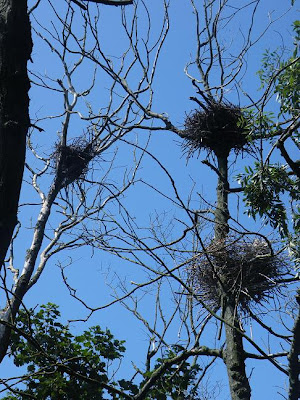
The safari has had the trip of a lifetime to...wait for it...the island with the heronry in the park lake...WOW.
Walked round the lake a thousand times, driven past the lake a million times, been on the lake a fair few times but I've never been on the island.

It's only a few square metres and has some largish trees, the Elms have died or are dying but the others are doing well. There are about 25 Herons nests. We discovered that there were nests in all the reasonably large trees except the Sycamores. It didn't matter if the trees were alive or dead although some of the Elms may well have been alive when the nests were started. The bare ground is the result of thousands of ducks and geese feet trampling any vegetation that dares to put a leaf up out of the soil.

I would have thought that it was a bit late in the season for there to be young still in the nest but something quite unpleasant narrowly missed us as we were standing under the tree. Looking up we saw movement through the twigs. Snapped a couple of photos against the sun and looking at them back at Base camp discovered there were two chicks in the nest.
It doesn't bode well for those chicks that don't take care in high winds.
I can almost see Archaeopteryx lying there. Only 145 million years to go.........
The island is home for refugees from the Mutant Ninja Turtles craze a few years ago. The demonic aliens are resonsible for all manner of nasty things from eating all the fish eggs - not true; there are loads of fry and small fish, the successfully breeding Great Crested Grebes prove that - chewing the feet off ducks - not true never seen a duck with no feet on the lake; there is a Woodpigeon with only one foot but that is because it got tangled in discarded fishing lne.
This large one has lost a scute, probably shed it rather than lost it in an accident. I never knew they could do that - you see you learn something everyday.


Where to next? Got a cunning plan for later in the day after my National Whale and Dolphin Watch duties at the weekend (see you there?)...still got that new, to me at least, bird behaviour to report on if I can get close enough for a photo.

In the meantime let us know what is ageing in your outback.

Tuesday, 14 July 2009

Time for a dip

Last night the 41st Blackpool Scouts descended on our pond armed to the teeth with pots and nets. Fortunately for them by the time they had arrived the torrential monsoon, thunder and lightening had just about finished – I have never seen a downpour like it in the five years we’ve been here. The rain coming off the roof missed the gutters by a good foot or more!
But the storm passed and the scouts eagerly got stuck in. They pulled out a tubfulls of snails, sticklebacks and other wriggly things.


In one of the pots ther was a bit of excitement as large male 3-spined Stickleback attacked and tried to cannibalise one of this year’s tiny fry.

It grabbed it amidships and seemed to be trying to turn it headfirst to be swallowed but the little fella wouldn’t go despite being killed, maybe it was those spines doing what they are supposed to do. The deceased fish, showing its erect spines and a bite sized chunk out of its belly, can be clearly seen in the top right of the photo. But what is most interesting about this tale is that in all my years of keeping sticklebacks in jars, tanks etc I have never seen them try to eat each other. Is this ‘normal’ behaviour, was it brought about by them being in the confined space, why pick on that particular one – it wasn’t the smallest in the pot?…Questions, questions, questions…wouldn’t life be boring if we’d seen everything and had all the answers. Any one ever seen this behaviour before?
Other stuff included a rather fat Diving Beetle that was far too agile to get its photo taken. Both front swimming and back swimming Water Boatmen were duly netted.


Snails included the Common Pond Snail, a lot of the small Bithynia snails and just three Keeled Ramshorn snails.
A Damselfly nymph was centre of attention until someone else copped for the exuvia of a Dragonfly to howls of terror and/or wonder.
After they had gone all was quiet in the garden and a Dunnock could be heard giving its autumn long ‘seeep’ call. Warren is right about autumn being just about with us.
And if anyone was wondering what on earth we were trying to photograph on our recent trip to Bowland (you probably weren’t) then take a look at Mike Watson’s header on his blog, a far superior effort than our brownish blobs in the very distant distance.
Where to next? Leading a Brownie pack looking for butterflies this evening…monsoons permitting.
In the meantime let us know how much of your outback has been washed away.

Monday, 13 July 2009

Pictures now added to yesterday's 'D' post

Howdy folks yesterday's post is now full of fabulous, fun filled photographs and some are even in focus.
Later dudes, got a load/gaggle/posse of boy-scouts to try to avoid getting struck by lightening...now who's hidden my fork???