The Safari is laid up after another hand operation at the mo so we've not been able to get out into the wider world and we've only just about been able to manhandle the small macro lens. For much of the time we've been incapacitated the weather has been pants, more like the middle of March than the end of June...and yes our heating came on early morning on 2nd and 3rd of July - that shouldn't happen, it's supposed to be summer!!! But for a few short days the sun shone and the wind didn't blow too hard.
A couple of days before going into hospital we were up early and spotted two Coal Tits on the feeders, an adult and a juvenile, where had they come from they don't nest nearby, and were the first of the year here and only our fourth record at our new Base Camp. They left to the south and we weren't expecting to see them again but a couple of hours later the juvenile returned on its own.
After all the bad weather the warm sunny days brought out a multitude of insects in the garden. Solitary bees have been very few and far between this year, indeed our 'bee hotel' has no occupants at all, so it was good to see a tiny Furrow Bee, one of the Lasioglossum morio group of very similar species that need more than 'normal' macro photos to identify them to species level. This one is in a Common Catsear flower.
Another one resting on the nearby fruit bushes had alraedy been busy collecting pollen. It's having a drink of something too, nectar?
Also on the fruit bushes was a black and orange blob which on closet insection turned out to be a ladybird, of unknown species as it hadn't yet aquired any spots, which had just emerged from its nymphal skin - we've never seen that before
Also nearby were several froghoppers were secreted in the base of the leaves, probably Common Froghoppers.
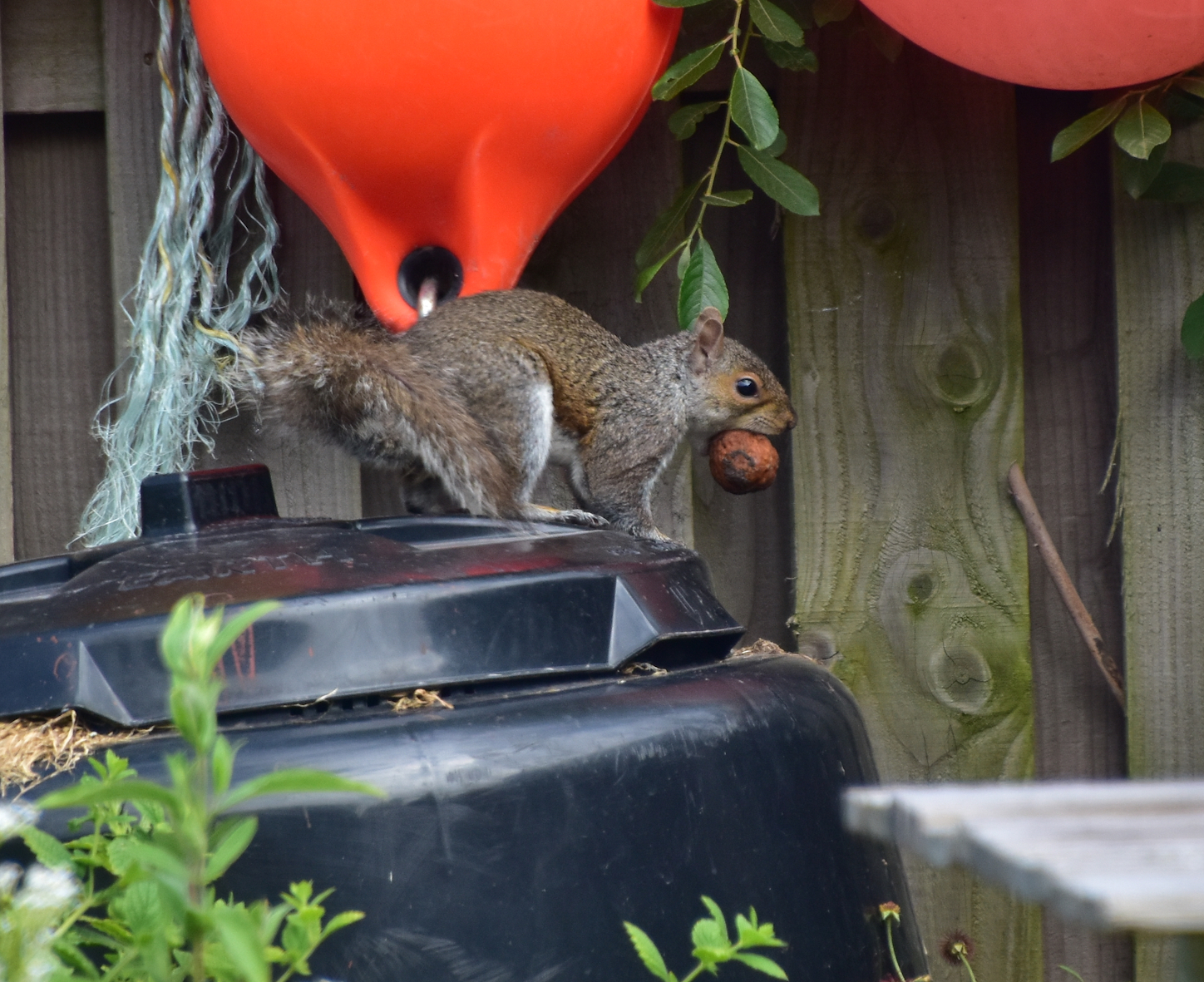
When we say nearby we do mean very close by as the vegetated part of garden is only about 40 feet long and twenty wide. At the back of the garden there are some overhanging twigs and small branches from our rear neighbours garden which we are very thankful for as they provide landing sites for 'our' House Sparrows; and Coal Tits - see above! Our neighbours to the left have 'inherited' that awful plastic grass and have no living stuff at all, our neighbours to the right have a well vegetated garden but we are separted by the thickness of two garages. An unknown neighbour feeds the local Grey Squirrels all manner of good things which they bring to our lawn and flower boarders to cache for later.

As much as we don't like
Grey Squirrels and would much rather there was a local population of
Red Squirrels, which is never going to happen, we do prefer them to next door's (left) plethora of flamin cats, they've got a sh*t load of them...and most of them do their sh*t in our garden digging up our cornfield annual meadow in the process - we hate them and so does the Mutt.
Moths have been in very short supply this year, we've only had the trap out twice and caught precicely nowt. Now that we're incapacitated it's not likely to come out for some time so we've tried wine ropes for a change - this plan has gone awry as an mothds they atrract will be on the wing long after we've gone to bed seeing as how it's mid-summer, we'll keep them refreshed and as the days shorten see if anything is attracted to them. Mothing is no restricted to finding dayflying species or chancing upon roosting ones. Our dayfliers include the tiny but lovely
Mint Moth, shame they aren't the same size as a
Red Admiral butterfly.
Our other dayflier is a much more specialised species and is listed as Nationally Scarce, the
Currant Clearwing.Despie the bad weather most of the year we found our first one on exactly the same day as last year - allowing for the 29th of February - how mad is that. We usually see just one or two basking on the
Blackcurrant bush's leaves.
But this time found one sucking nectar from the adjacent
Blackberrry flowers. We weren't sure if they were one of those species who's adults have no mouthparts and can't feed - obviously not!


We even found a pair mating - it's amazing what you can see if you lurk around the shrubbery for long enough!
Still taking random pics of whatever settled long enough to focus on w got a Broad Centurion, one of the Soldierflies. There mere many more of these in and around our little mini-meadow than in the shrubbery.
There are very few large hoverflies about and we were pleased to get a shot of Myathropa florea, the ammusingly nicknamed 'Batman' Hoverfly.
Bumble bees do our head in, we never seem to be able to get a good pic, is it because they never stay still and their eyes are so black and lacking contrast with the rest of their head you often don't get a highlight in them...and then theres the identification nightmare of some very similar species. This one is
Buff Tailed Bumble Bee.
While concentrating on this bee something much smaller under a leaf beneath the flowers caught our eye
It looks like an aphid crossed with some other type of true bug. We only got this one shot and can't tell if those thick black things are part of its forelegs or antennae. It's obviously actively moving, it moved quite quickly, normally aphids sit fairly still...any ideas anyone?
Just a bit too high up in our
Apple tree we found an old favourite
Pimpla rufipes on the hunt for moth caterpillars to parasitise.
Meanwhile back lower down we saw another ladybird emerging from its nyphal skin
The
Bramble flowers were pulling in most of the insects including this
Common Yellow Faced Bee, you can just about see a bit of the yellow face in the top pic. They are miniscule compared to the nearby bumble bees, only 5mm long at most.
The
Bramble and
Blackcurrant bushes' broad leaves make idea look out perches for a variety of flies including the very numerous
Greenbottle, Lucilia sericataAnd another similar species we don't know the name of which is a stunning bronze colour. We don't recall seeing this one last summer.
Could they be male and female? If so why have we never seen the bronze ones before??? The do have a greeny sheen in some lights but in dull conditions they are definitely bronze.
As alluded to earlier most of the hoverflies were seeing are the smaller species and even then not that many of them. We think this one is
Syritta pipiens...about 8mm long.
Out on the hunt for hoverflies was a species of predatory wasp
Ectemnius cavifrons with it's distinctively weird antennae
Another predatory wasp we came across turned out to be the Nationally Scarce
Gorytes laticinctus.
Look at those eyes! What and how do they see compared to our eyes, we're sure we wouldn't recognise the seen in front of us if we could see through their eyes.
It's munching an unfortunate victim
Thi species has apparently been expanding its range northwards this century and we've added a dot to the most up-to-date map, the second most northerly so far and the most northerly on the western side of the country, the most northery being on the other side of the pennines somewhere around the York area. We're sure they're overlooked and there are many more to be found well to the north of us - eyes peeled folks!
What a fantastic couple of days on safari no more than 50 feet from the back door. Look after the little things and they'll look after the bigger things. And we all need to start looking after the little things, there's an Insect Apocalypse underway and if they go down they'll take us with them. Something many of us can do is as easy as not mowing some of your lawn. Take part in #NoMowMay, follow it with #letitbloom injune and then our new hashtag #HelptheBeesflyinJuly. We keep a mown edge around our wildflower area so you can tell it's managed and supposed to be like that. With the aid of a paper bag we go out in the local parks and countyside areas and collect wildflower seed to sow once we've cut the meadow at the end of the summer making sure we let the hay dry and any seeds fall to the ground before raking it up and composting it. The more different species you have the better as some will flower in some years and not others, a wider diversity will mean it won't look the same two summers running and that's part of the excitement - what's going to come up this summer?

, being a hemi-parasite, is good for reducing the vigour of
the grasses and we would recommend getting some in your meadow.

Those few days were the end of summer, it's now back to unseasonally cold, sometimes wet and very very windy the latter being very damaging to the garden. Please can we have some warm calm days back please...the sooner the better.
Where to next? Our hand is recovering from the operation nicely so we might be able to get a bit further afield next week - physiotherapy appointments permitting.
In the meantime let us know who you've discovered hiding in plain sight in your outback