Saturday, 23 May 2015

Back on home turf

The Safari was back on much more familiar territory at the nature reserve this arvo. We'd had an offer from CR to join him earlier this morning but we couldn't go as Frank was at his hydrotherapy again mid-morning.
The first thing we noticed as we left the Land Rover was the change in wildflowers the predominantly yellows of early spring had been joined by other colours and dome of the grasses on the wetland were looking lush and flowering. The very first pool had a big splash of bright pink from the Ragged Robin at the far end.
There were Sedge Warblers singing all over the place, Swallows swooping and Reed Buntings flitting and singing too. The Cetti's Warbler exploded loudly from its usual place. We had a look for Bee Orchid rosettes at the old compound site without success but the Germander Speedwell is beginning to open, it'll be stunning in a couple of days if the sun shines.


The Yellow Rattle is coming on too

While we were photographing it a Lesser Whitethroat rattled away nearby. It's close relative the Whitethroat appear to be healthily numerous this summer which is good. There was plenty of song and churrrs coming from the scrubby areas. Wandering on we had a good look at the scrape, no waders but if the water level continues to drop over the next few weeks it'll be looking good for autumn passage waders, we could do with a dryish summer please. It'll be even better in a couple or three years when it has more of a layer of silt and rotten vegetation for the waders to probe in.
At the bridge we had a look in the channel to see if we could see any Elvers but we didn't although a nice bright 3-spined Stickleback was lurking close to the bank. 
An idiot on one of the camp site's hire tikes decided to ride it through the channel, marvelous! It was then we noticed that a fair bit of the Elver mitigation 'brushes' had been pulled up and chucked around - marvelous, the site's only been busy for a couple of weekends and the season hasn't really started yet - how much will be left by the start of September?
We'd seen a Buzzard with a primary missing drifting about and thought it was the regular one that hangs around the area. It had landed on the pylon by the channel and we got our best ever Buzzard pics this arvo.


We're sure we can improve on this in the coming months. But it was disturbed by a particularly persistent Carrion Crow which made it fly off and we saw it had no missing wing feathers so there are two in the general area.
The gulls went up several times, once we found a Heron was the culprit and once it was a Helium balloon - aka high flying littter - doing the damage but the other times we missed whatever it was although there was a Great Black Backed Gull on the water for some of the afternoon so it could have been that at least once or twice.
Turning back rather than doing the full circuit we came across some vetches, both Common and Bush Vetch coming into flower. This is Bush Vetch.
While we were photographing this a right dog-walking ar*e came past with three unleashed mutts that had obviously been in the water. One of them almost trod on the subject as it came so close - we looked at him in almost despair and all he could say was "Oh fu*k off - you 'naturists' are all the same". We hadn't said a word. Charmed we're sure! Then one of his charges did a sh*t right next to the path which he totally ignored - really should have taken a pic or video but by then we were unsuccessfully trying to get a pic of a Whitethroat doing its song flight.
Which bit of 'Dogs must be on a lead' do these ar*eholes not understand? Seems that far too many people get a dog and mysteriously lose the ability to read. Come on Cameron you want to tax the minions more - a dog tax wouldn't go a miss. 200 quid and a compulsory chip would sort out those that really want a dog from those that don't and the chip would give local authorities the opportunity to get owners info from them with a reader to fine the feckers when they accidentally forget the rules.
Our last flower spot of the day was yellow one but not one of the early yellows, Creeping Cinqufoil.
We bumped into PL on the way out and passed an hour putting the world to rights which made us late for Wifey and nearly got us into trouble...not his fault though.
In other news we saw that the Gooden's Nomad Bees are out in the neighbours dry stone bank near Base Camp, if we don't get out tomorrow...
Where to next? Should be able to get out somewhere later on.
In the meantime let us know who's wearing all the colours in your outback.

Friday, 22 May 2015

Back on the west coast

The Safari had a trip over to Holy Island yesterday. We checked at the tide tables and they said they there was plenty for us to cross. The causeway is covered by several feet of water at high tide and you really don't want to get caught out - time and tide and all that. So over we went and ended up at the already quite full enormous car-park. 
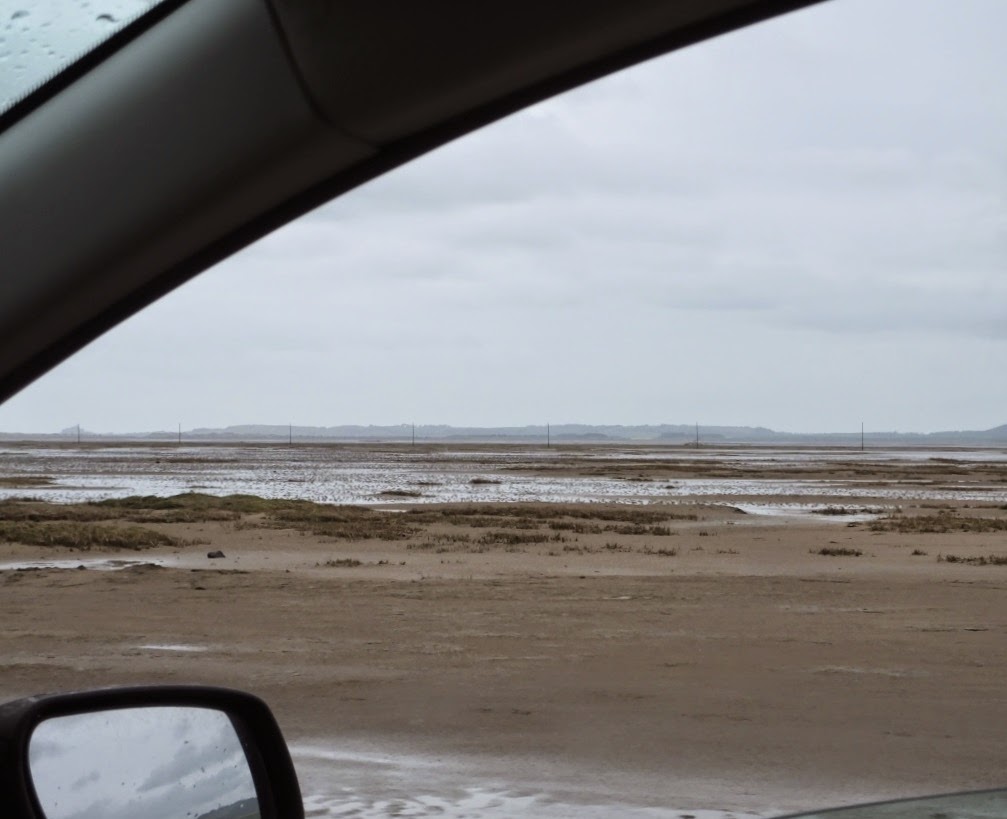
The posts in the middle distance show the walking route across the flats and it's not often you drive along a road with seaweed strewn all over it!
The Castle is only 400 years old and much modified in the early 20th C
The car-park was so big that Frank would never be able to get out of it so we turned and went back to another smaller car-park on the nature area away from the hullabaloo. It was cold and windy but there was a Little Egret (the only one of the hols). The top of the dunes gave a view of the not so ancient castle.
Heading back to the mainland
The Priory that remains today is Norman in origin being founded 300 years after the Viking raid on the original priory but not in the same place, the Parish Church stands on that site. 
That raid was the very beginnings of our ancestry as our hand problem is a genetic condition linked quite closely to the Vikings; although there is now some evidence that Vikings had at least visited and possibly settled parts of Britain a few years earlier and the raid had prior knowledge of what they would likely find by way of defenders and treasure. Despite our genetic make-up we don't condone chopping up defenceless monks with axes
Our journey back to Base Camp took us past the extensive planting on the hillside again and we got to thinking wouldn't it be great to have a National Forest - no not like Sherwood Forest or the New Forest but a real continuous wild-space covered in regionally native trees (where appropriate ie not on flower-rich grasslands or wet peat) from Land's End to John O Groats and Holyhead to Lowestoft for starters. It would ideally be no less than a mile wide at any one point and there would be no gaps of more than a mile every 50 miles. The forest would be an invaluable wildlife corridor, for recreation - the good of our souls and offer employment opportunities like coppicing, bodging and other woodland products/crafts. It could be started by linking all the existing patches of woodland and shelter belts.
Something like this for starters - sure the farmers and other land owners will head over heels with the idea!
That swathe is well less than the 'obligatory' mile
Who's going to pay for it? Us the tax-payer - we already give those farmers and land owners loads of our taxes as it is. If there's a benefit cap of £26,000 for 'normal' people then the Single Farm Payment should be capped at that too and the rest used for public benefit. Wouldn't it be great to see some extensive upland reforestation! Don't all start screaming (or dreaming) at once; can see it happening - we need to re-wild ourselves before we think about re-wilding the landscape and what should be living in it.
Where to next? We might get an hour out somewhere tomorrow.
In the meantime let us know who's planting all the trees in your outback


Thursday, 21 May 2015

That scrape came up trumps

The Safari was out early again and this time the scrape delivered the goods and we hit the jackpot.
A very fine drake Garganey (163)
Musta been hungry didn't lift its head from the water much
Also there was a Willow Tit (164) in the most unusual place, not deep in woodland cover but on the exposed fence on the side of the road. An excellent bonus bird to just about end our east coast sojourn with.
Where to next? Might just be able to sneak in an early morning nip out.
In the meantime let us know who dropped in for the day in your outback


Wednesday, 20 May 2015

More from across the water

The Safari's best find yesterday on the islands was a Collared Dove on the outermost island, Longstone the one which Grace Darling lived on and rescued folks from. We thought it might have been a Turtle Dove when we first saw it but it proved to be otherwise when it landed on the seaweed near the lighthouse.Sadly we wonder if we'll ever see another one in Britain, it's been long enough since the last.
A small number of Fulmars (162) were cruising around the islands.
Everyone goes for the gaudy Puffins for their souvenir photos but we tried and failed to get a pic of the Rock Pipit it was in almost the exact same spot as our last visit a couple of years ago. There was one on the harbour wall that evaded the lens too as we waited for the boat.
Some pics from on the island.
OK now for the Puffins
So just how close are you allowed to get?
Great to see school groups getting on there to view the exceptional wildlife a close quarters - even if they weren't over keen on the pong!
Another early morning wander round the pools gave us a Barn Owl by the Tin Church, which had Frank got us up as early as he has been we'd have had splendid views and probably some photo opportunities. A (the?) pair of Grey Partridges flushed from the long grass beside the track but this time they were kind enough to land in full view in a short rougher area of the adjacent field. What stunners they are and what a real shame they are now so scarce. It must be time to ban the release of non-native Red Legged Partridges we think. No-one has to do an Environmental Impact Assessment of jump through a million consultation hoops to let these things go in the countryside unlike the conservation groups have to do with formerly native or even locally extirpated species.
The wader count on the scrape had increased to three whole Lapwings. A group of Swallows and House Martins were gathering were gathering nesting mud from one particularly favoured patch. 
The pool too was quiet but 'new in' were a couple Little Grebes. They successfully dived for Sticklebacks several times until one surfaced too close to the other and a skirmish ensued sending them both skittering in to the reeds in different directions.
There was no sign of the Marsh Harrier again.
Back at the scrape we scanned for the Roe Deer and soon found the doe browsing along the hedgerow then the buck walked into view to join her and they both went to hole up for the day.
Digiscoped at a distance
A familiar teu tue tue call had us whip the scope back round to scan the scrape, there at the back was a fine Greenshank. It called several times more before heading off to the south east. 'Bird of the Scrape' so far!
A trip down the coast saw us on the beach opposite Coquet Island famed for its Roseate Tern colony. Too far away for us to see any with just our bins and all the terns fishing nearby were Sandwich Terns. There was a feeding frenzy to the south of the island - if only we could have got out there.
We took Frank down to the surf for a paddle and while we were there a tiny wavelet left something fluttering around on the sand. At first we thought it was a bit of plastic but the wind didn't blow it away. On closer inspection it was a Weaver Fish. We rescued it with our boot - not going to pick one of those poisonous spined things. So we flick-kicked it back into the sea. It reappeared on the beach on the next wave but one more deft flick-kick had it further into the water and it recovered enough to swim into the deaths.
We weren't expecting that - isn't nature great!
Where to next? Yet more eastern promise tomorrow.
In the meantime let us know who's left the waters in your outback.


Tuesday, 19 May 2015

Life on the ocean waves

The Safari was back at the pools just after 06.00 this morning to have a longer mooch about. There was nothing in the horse paddock. In the woods behind the little Tin Church the usual summer suspects were in song.
We walked through the field below the Lookout and flushed two more Grey Partridges before we spotted them. There is a good view of the ruined castle from there.
Through the village we saw a House Sparrow going in and out of one of the several nest boxes so we waited camera in hand.
At the scrape there is a wacky bench made from recycled beachcombed finds.
The scrape itself had a new wader on it this morning, an Oystercatcher, but otherwise it was much the same as yesterday. A Mute Swan was giving a Canada Goose some serious aggro and there were actually three broods of Grey Lag Geese.
In the hedge behind the cattle was a Roebuck and several yards to his left laid down in the long grass and hidden apart from eyes and ears was a doe.
The pool was quieter than yesterday too with far fewer hirundines swooping about. The light was much better today so we hoped the singing Swallow would be back on his reed, no such luck but a female Yellowhammer poked around where the Goldfinches were yesterday, it was joined briefly by a male. 
They left moments later and she was replaced by a female Reed Bunting.
A Swallow came nearer than the reed - into the hide it came to add more mud to its nest.
Linnets were all over the Gorse which was strongle scented in the warm sun. It was cold out of the sun, you could see your breath in sheltered places that shouldn't be so in mid May.
There was no sign of the Marsh Harrier and a Lapwing was seen displaying over the scrape from the hide but had left by the time we got back there. Beyond the hide there were loads of Cowslips, it seems to have been a really good year for these lovely plants. Just coming into bloom were the first flowers of Bulbous Buttercups.
Back at the carpark we spotted a gate to nowhere.
Don't think they'll be taking  a tractor through there again
This afternoon we took the boat ride out to the islands - here's a few pics from the boat as we travelled across the increaingly rainy stretch of water and were taken around the furthest islands before coming back to the neareat and landing for an hour.
Bamborough Castle in the gloom
Guillemots in the rain
A bridled Guillemot
Kittiwake
It's coming our way!
Passing showers
Puffin (161)
Just a few of the Grey Seals in the colony


Harbour Seal - cuter face and V shaped nostrils (as opposed to nearly parallel)

Where to next? Should be another day out somewher tomorrow and and early dart perhaps back to the pools to see if this evening's thunderstorm has dropped anything new. There'll be some pics from the island too.
In the meantime let us know who's not going through the gates in your outback.

PS We hope the pics are OK for you as we are working off Wifey's laptop and old softwareit's hard to tell if they're processed properly.