Friday, 17 March 2017

Spring is still trying to sprung

The Safari hasn't had many opportunities to get out an about this week. On the odd occasion we have we've been out we've been on the look out for a Wheatear or two. No such luck. We have seen a flock of about a dozen Siskins (114, P2 #31) fly over the work's garden. We thought they looked like they might drop on to the feeders and join the local House Sparrows but there were too many people around so they circled round and left towards the coast.
A quick look over the wall the other lunchtime had us watching a drake Eider drifting past on the dropping not too far out, legging it back for the camera we hoped it would be still there when we got back. It was but quite away further down the prom, took some catching up that tide runs a lot quicker than you think. By the time we did catch it up it was a little further out, right on the limit of our lens, shame we didn't have the 600mm with us that day. Eider became the 96th species photographed on our Year Bird Challenge so the initial target of 100 shouldn't be too much trouble and not too far off but how many over the ton do you think we'll manage - we've a new target in mind, some of the other challengers are already very close to that number!
Earlier in the week we had a look through a new improved up-graded scope. We were able to compare it with our old stalwart and the wee one we won in the competition a few months ago. The little one retails at almost only 1/10 the price of the one we were thinking of getting but on a cloudy evening it held its own way past the point we expected it too and it was almost dark by the time it 'failed', out birding you'd have probably packed up by then unless you were deliberately staying out for a crepuscular or nocturnal species.

So did we or didn't - well actually we didn't but we do have a bit of a plan for a slightly different upgrade ay some stage in the future.
Closer in the future we had a sunny lunchtime trip up towards town on the trail of an individual gull, an old friend of ours. Armed with a few slices of slightly mouldy bread we pulled a few bits off scattered them around and waited for the fun to begin and our friend to arrive. Within seconds we had a horde of expectant Herring Gulls surrounding us. More gulls came in but our friend wasn't with them. The only non- Herring Gull to come for a slice of white was this rather bolshy Lesser Black Backed Gull, it didn't like any  other birds near it grabbing them and giving them some serious feather pulling pecks if any came too close.
Spring is still trying to sprung with both Tree Bees and Buff Tailed Bumble Bees being seen this morning.
Where to next? This weekend it seems winter is coming back with a vengeance but we've got to go to the nature reserve for a meeting so we have to have at least a quick look round while we're there, be rude not too!
In the meantime let us know who didn't turn up to the party in your outback.


Sunday, 12 March 2017

Migrants, drugs, sun and rain

The Safari hasn't been able to get out much this week, work has got seriously in the way. There are signs of spring springing up all over the place now, including the works garden where we found this little snail seeking shelter from some dawn frost under a Daffodil petal.
Yesterday we had family business on the South-side and it took us to within a mile of the regular Cattle Egrets (113, YBC #93) you know the ones that are so regular that they weren't there last time we stopped at the site. Most people have seen them just over the hedge in the horse field. Today they were miles away across the fields...just typical of our luck lately. This is by far the best of c100 pics, but at least this local scarcity is on the list and the Year Bird Photo Challenge too.
Today we had a quick walk with Monty passing this very early opening Red Valerian on the neighbour's wall which also has the colony of Gooden's Nomad Bees.
We didn't get out again until the early morning sun was about to be lost, typical of our luck again! We headed out to the Nature Reserve, we've hardly been there this year. It was quiet-ish, but we did hear two Cetti's Warblers at the wetland but couldn't find the Stonechats that have been about recently.
Walking on through the reserve is was almost birdless, we were hoping for an early Chiffchaff and over the water a Sand Martin but neither put in an appearance. There was a nice selection of ducks on the water and a good number of gulls, no sign of the Iceland Gull again - has it left for colder climes already? 
We had an unsuccessful look for Bee Orchid rosettes finding this little Puffball instead. 
Moving on we saw a Kestrel hovering across the other side of the reedbed. By now it was drizzling and the light grotty but it was just about gettable for the YBC (#94). Can't really believe this is the first photo opportunity we've had of this species so far this year.
And if you thought that was bad have a shuffy at this Fieldfare (YBC #95) again the best we could do in the dark drizzle at serious range.
Lots of Cetti's Warblers were singing and we stopped and waited for a few of them but saw nothing. Our best hope was either the FBC hide where on sung several times but didn't show, we did hear a Snipe too but couldn't find it in the sky. Our next bet was Ice Station Zebra, which wasn't too cold today. There was one singing and not showing but we decided not to stay long as we were sharing the hide with some foul mouthed teenage scrotes smoking weed, one of them could only have been 13 or 14. Monty wasn't happy with them and wouldn't settle and we had to hold him which wouldn't have made photography easy. That neighbouring caravan site has some lovely customers - NOT!!!
Making our way back to the car the Feeding Station was quiet and we couldn't find the Stonechats again although we did hear a Cetti's Warbler and a Water Rail by the bench at the Wetland - of course we saw neither.
So no migrants there for us, they'll come we just have to make sure we're able to get out to see them!
Later in the afternoon the sun came out again and we thought we'd have a quick sprint down Chat Alley to see if there were any Wheatears down there, there's been a few here and there along the coast during the morning so there just might be one or two still moving through.
We were out of luck, the only small birds we saw were the local pair of Pied Wagtails.
We looked on the way back but there was nothing of note so we spent a few minutes trying to get some pics of the Herring Gulls riding the gentle up-draughts from the cliffs, most of them were going the 'wrong' way  but every now and then one came our way at the right height nicely illuminated bu the low sun.
So that was that, some success but not totally overjoyed about the weekend's safaris. Mustn't grumble though at least we got out and did see some sunshine.
In other news a couple of Buff Tailed Bumble Bees and a Tree Bee have been seen at Base Camp - sping is deffo a-springing.
Where to next? Hopefully we'll get out on Patch 2 at least once or twice this week.
In the meantime let us know who's springing in your outback.

Saturday, 4 March 2017

A bit of warmth in the sun at last

The Safari arranged to meet up with CR for an early morning jaunt in the big park.We arrived a few minutes after 08.00 and walked straight to the lake as CR was after getting some pics of the Great Crested Grebes doing their weed dance. However we couldn't see any grebes at all.
The sun was peeking over the trees on the other side of the lake and lit up the woods we were looking into. Before we set of we had a bit of a list of target species to add to our Photo Year Bird Challenge. It wasn't long before we came across a photo-opportunity of one we should have had on our list already. This morning we'd already heard several but not seen them tucked up in dense patches of vegetation. This one kept moving from song perch to song perch keeping a wary eye on us all the while. This must be one of the few Wren (YBC #89) pics in which its tail is stuck up at a jaunty angle.
We wandered as far as the big logs where kindly folk have put up loads of feeders, unfortunately they were all empty today so we retraced our steps expecting to bump in to CR somewhere along the lakeside. We hoped to find a couple of other woodland specialists but we had no luck, didn't even hear a peep out of them. At the bridges CR txtd to say he was down by the Heron Island. Passing a lively but 'unpicable' Goldcrest on the way. There was a Great Crested Grebe down there but you need two to tango.
Up in the trees on the little island we counted 27 nests although we doubt if all were occupied. Some had birds sitting tight barely visible over the edge of the large structures. Others were still standing around in their pairs, not having laid any eggs yet.
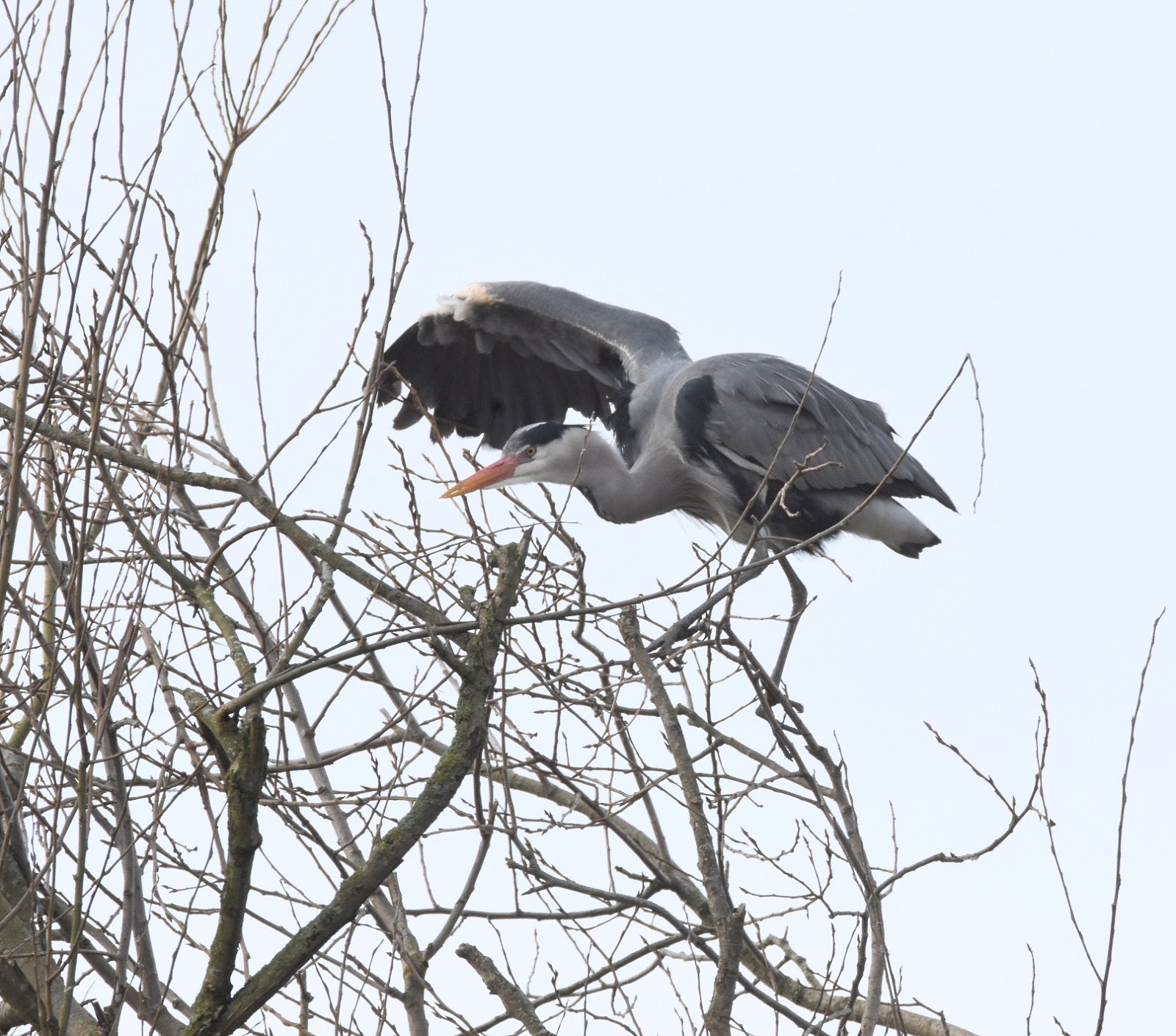
They're quite ungainly in the trees and sometimes get tipped over by odd gusts of wind requiring a bit of urgent re-positioning to regain poise and balance.
With no grebe action we moved on spying a Mistle Thrush (YBC #90) fly across the road and landing in the top of a tree.
A few Shoveler were nicely lit up in the morning sun but a little distant so we carried on round hoping to catch up with our woodland target. C had brought a bag of seeds and laid them down in small handfuls to see who might approach, mostly the Feral Pigeons. 
Eventually we did manage to attract some Blue and Great Tits, many are now paired up and food isn't the only thing on their minds. Several pairs of Blue Tits were investigating holes and crevices in the few remaining older trees, far too many seem to have been cut down recently which could be the reason we were struggling for some of target species. So far we had two out of five of the hoped for ones.
While waiting for the woodland birds the sun was positively warm on the top of our shoulders for the first time this year and very welcome it was too, Looking the other way across the lake the bright sunshine made for interesting silhouettes like this Moorhen.
By now we'd run out of time. C was starting to head back to the Heron Island and we were going back to the car he saw a Great Spotted Woodpecker, we'd expected to have heard one drumming by now but there hadn't been so much a s a single peck from them. It landed high in a tree and wasn't seen again. Then we heard a Nuthatch calling in the distance and we both headed towards the sound. After a good deal of searching we found it, or rather them - there were two.
Even though we'd walked a good way they were still a long way off and well up in a big Poplar tree.
Poor we know but never mind they all count. After enjoying the Nuthatches (YBC #91) we went our separate ways. Almost back at the car we heard a Goldcrest singing and went to look for it. Minutes later we found it in a small Fir tree hunting spiders and the like just above head height. Goldcrest (YBC #92) was the fourth addition to our YBC tally and a bonus as it wasn't on our list of five hoped-fors.
So in to the first week of March and we've photographed 92 species out of 112 seen/heard, a strike rate of 82% but we've probably got way more than half of our final total.
In other news we dipped on the local Iceland Gull at the waste depot again yesterday - not a gull in sight! And again yesterday in the park with Monty we saw a Moorhen (P1 #24).
Once back at Base Camp this morning a commotion by the gulls had us racing outside bins in hand to find the first Buzzard (Garden #19) of the year circling high northwards roughly over CR's place. A Pied Wagtail (Garden #20) passed over while we were out too, migration has started at last. On the way back from th park this afternoon with him we had Patch 1's first Lesser Black Backed Gulls (P1 #25) of the season.
All good stuff, we could get used to this birding m'larky - apparently having birds nearby is very good for you.
Where to next? Might try to the nature reserve tomorrow.
In the meantime let us know who's not seeing the wood for the trees in your outback.


Monday, 27 February 2017

Our year bird photo tally creeps ever upwards

The Safari nearly had our eyeballs blown out of their sockets on Thursday lunchtime as the much vaunted Storm Doris blew through with a vengeance. There was no chance of keeping the scope still to see if there was anything out on the sea. It was well past high tide but the fierce wind had kept the ebbing tide tight against the sea wall. It was a good job it was a very low high tide, had it been a 10m+ one then things along the prom would have got just a tad wet!
A quick look on Friday gave us reduced numbers of Common Scoters and a nice male Eider (106, P2 #24) heading north in the middle distance, far too far for a pic. 
Saturday was a family day and the only thing of note we saw was a flock of Canada Geese (Garden #17) over Base Camp and a few Buzzards on posts along the motorway.
At last Sunday came round and late morning we were able to head out with Monty. Once again we headed over the river to 'mop-up' everything we missed last week, once again it was grey and miserable but at least the threatened rain held off. Our first port of call was the ferry terminal and its adjacent posh new apartment block and at last after about a five minute wait we caught a distant glimpse of our quarry, the long-staying Black Redstart (107, YBC #82) poking around on its favourite piles of rubble below the concrete sea defence of the posh flats' garden.
With that success under our belt we set off further north to a site for whatever reason we've managed never to have visited before. We followed local birder MF down the lane and parked up. We walked together along the embankment until Monty managed to slip his collar trying to grab a dollop of sheep sh*t. MF walked ahead and got the essential gen from returning birders. Luckily he had a scope with him as the two Shore Larks were half way across the marsh and took him quite a while to find; there's no way we could see them with just our bins. He was kind enough to let us have a look at the three yellow dots on show, two Shore Larks (108) and a Grey Wagtail (109), they were so far away we could only just make out the difference between the two species!
From there we traveled a short way to the little estuary where it took no time at all to find the Spotted Redshank (110, YBC #83) we couldn't find last time. It was roosting on the bend with a dozen or so Redshanks.
We knew the tide was dropping and the mud would be exposed shortly and the bird would drop down to start feeding on the mud.
Next up was a journey back don the main road to the farmland feeding stations, the first was full of Collared Doves and little else, the second was busy. Lots of Tree Sparrows, Chaffinches and a couple of Corn Buntings.
They were flighty though and kept popping up into the nearby bush. It was there we spotted the first Yellowhammer of the day and a Brambling (111, YBC #84).
There were a few Yellowhammers but quite wary today and didn't spend much time down on the seed.

The Brambling(s - there were two there but we only saw the male) were even more wary not coming down until a couple of Woodpigeons and Stock Doves (YBC #85) proved the coast was clear.
The next field held a massive flock of crows most of which had to have been Rooks. By now it was trying to drizzle and very gloomy so we had to step up the ISO on the camera to 'Stupid+. We parked the car by the old pumping station where we hope we'll hear Quails calling later in the year. The Rooks (YBC #86) were a little way across the field and no doubt we'll get better shots of them in due course but for this challenge any old pic will do to get another species on your scoresheet, they can be improved upon later if necessary.
We had a rendezvous with GB again but made the fatal error of not stopping at the 'reserve' we stopped at last week - there was a Glaucous Gull on the sands across the river.  Never mind! We met up with GB and had a walk along the prom where we soon saw a small flock of Skylarks really close but with the threatening dark sky we'd not brought the camera out with us. At the furthet point of our walk there were some Linnets but we didn't bother to get camera-close, they'll have to wait until next week when fingers crossed there might be a hint of sunshine.
The rest of the afternoon was spend chewing the fat over a coffee with GB and JH watching Monty and his new friend Alby battling it out for possession of the bean-bag.
Not a bad day out on safari despite the gloomy conditions. But where were all the geese - we didn't see a single one all day!
Where to next? We might get a look or two at the sea this coming week.
In the meantime let us know who's all dull and blurry in your outback.

Monday, 20 February 2017

And so on to that frustrating fog

The Safari met up with the Community Arts team again on Saturday to do a bit of a history talk followed by a wander round the park to see what we could see. They had all sorts of activities planned too, one of which was 'seed bombing' and we were to look out for a suitable area for their wetland mix of seeds during our walk.
Filling a seed bomb - more like a seed scatterer actually
As with Thursday's event we were on the look out for interestingly shaped and/or patterned trees. We found a large Small Leaved Lime tree we didn't know was in there, it was a giant but the trunk forked too low down to be able to do the measuring the age with a tape measure trick. Hawthorns often have good bark and trunk shapes, these two are right by the children's play area.
Did you spot the litter between the trees? fortunately some of the group were armed with bags and pickers so it was collected along with quite a lot of other rubbish that had been strewn about. Why are we so messy??????
The park was probably laid out in the early 1920s but few of the original trees remain, perhaps the big Lime and a few Sycamores, there were likely to have been Elms but these have long since succumbed to Dutch Elm Disease. From measurements of some of the other trees we'd guess they were about the same age as us being planted in the late 50's or early 60s. More recent planting has taken place too, like this Jubilee Wood from which Jubilee we're not sure and even more recently in the year or so there have been some groups of trees planted under the Woodlands From Waste scheme.
The wooded future of the park looks rosy!
At the wettest point we tore away at the thatch of grasses, bring a rake would have been a good idea, to reveal about a square metre of clear soil on to which the youngest member of our group sprinkled her seed bomb. We all helped press the seeds in by gently trampling the ground and then hoped for rain. Wit ha bit of luck more similar patches would be done in the afternoon to create a nice colourful area buzzing with bees and butterflies later in the year, or probably next year.
The end point of our walk was a half buried lump of 13500 year old Bog Oak which was dug up when the field was tried to be drained. The Arts group had heard about it and as a piece of local history wanted to lift it from its dumped area and display it on a plinth with some interpretation for all to see.
It wasn't buried as badly as we thought, just covered with a good growth of grass which was soon pulled off. It was however a lot longer than we realised.
Never the less with a bit of muscle and teamwork it was soon released from it's grassy grip. As it was lifted off the ground we saw our first Frog of the year.
Turning it over to find out how much it had started to rot on the underside revealed a horde of hibernating Yellow Slugs, Limacus flavus
They weren't too happy about being woken from their slumbers and slithered off to find somewhere else to lay their heads.
After a little pulling and shoving, puffing and panting the Bog Oak was wrested on to a couple of smaller pieces to keep it clear of the ground so it could dry out properly. The local rugby team who play on the field from which it originally came will lift it to its final resting place near their clubhouse. Where it will get a more detailed permanent sign too.
Mission accomplished and all good fun.
On Sunday we set off back over the river in an attempt to mop up some of the species we missed last weekend and went a little further to find some more. We had to stop of the marshland car park again and in the field at the entrance there was a flock of about 100 Pink Footed Geese.
At the very back of the flock we're sure we got a fleeting glimpse of a Barnacle Goose with them, but we waited and waited and waited much to Monty's impatience but it never showed again, if indeed it was ever there in the first place...why are the odd-balls always at the back of the flock when we look???
From there we headed to the northernmost point of our day out, the little estuary with the creeks. Here we had a walk along the old railway-line passing an unseen Goldcrest and a couple of Chaffinches in the hedge, the tide was well out so the river was out of range of our bins and camera.
Moving round to the pool we had cracking close up views of a Curlew and a couple of pairs of Teal.
With not much else on the pool we had a look in the creeks. Here there was a good assortment of birds, Shelducks, Teal, Wigeon, a couple of Black Tailed Godwits (102), a lot of Redshanks but no sign of the hoped for Spotted Redshank. A heavy drizzle was beginning to fall so we moved around the lanes to find some wild swans which we soon did. We'd heard there was a flock of about 400 Whooper Swans in the area with a few Bewick's Swans mixed in but before we found them we came across a much smaller herd of Whooper Swans (103) some distance across a large field. we stopped and pointed the camera out of the window.
It was just as well as a few bends further down the lane we saw the large flock miles away across the fields and without a scope we'd had no chance of looking through them. On we went to the marsh where by now a think mist was settling over the river and snaking its way towards us. We saw a Collared Dove that didn't sit long enough for our Year Bird Challenge and had to drag half a rotting Shelduck from Monty's gullet - yuk!!!
With the river still low there weren't many birds close up to shore and with the wet gloom rapidly approaching we didn't want to stay out too long and get the camera soaked so we fired off a few shots at a group of Black Tailed Godwits. Just another 'banker' really, we should get much better and closer pics of them in full summ plum later in the spring.
The rest of the afternoon was spent driving along lanes through dense fog not seeing much at all apart from the odd suicidal Blackbird darting across the road in front of the car at the very last minute. We expected the Lesser Snow Goose to be where it had been all week but could hardly see the field and only saw one Grey Lag Goose, we later learned it had moved half a mile or so away - cruel, so another trip over the river will be needed.
We decided to give the dipped last week Black Redstart a miss too as we'd arranged to meet GB (not the Aussie one!) for a bit of a walk with Monty who he's not met yet.
On the way we briefly stopped off at the nature reserve that is really just a dogs' toilet in the hope of seeing either or both of the Glaucous Gulls that have been frequenting the adjacent tip, we could barely see the river or the tip so gave up on that one and went to pick up GB.
A few minutes later were were walking to the point along the prom and stopped to look at the sign about the pebbles on the beach. now GB was a geologist and the next half hour was spent on the beach having a good close look at many of the fascinating pebbles there. We were careful to keep Monty away from the roosting 40 or so Ringed Plovers we could just about see about 50 yards away through the murk.
It must have been a low murk as we could hear a couple of Skylarks (104) singing over the golf course behind us. Actually its not year bird 104 as we'd neglected to put one flying over the garden (Garden #16)  on our spreadsheet on 5th of Feb.
With both of us getting hungry we took GB home and set off Base Camp. Once ensconced at the computer downloading our day's pics we spotted we'd got a bonus Bewick's Swan (105, YBC #80)
Where to next? Dunno yet but we do hope the heating engineer comes soon as it's freezing in here with the boiler on the blink - hope it's not terminal it is a bit of an old thing...
In the meantime let us know who's hiding in plain sight in your outback.

Sunday, 19 February 2017

A busy week followed by frustrating fog

The Safari had a few opportunities to look at the sea this week but there wasn't much doing. On Thursday we joined up with a local Community Arts group to see what natural materials and things wild we could find for their project. We started off at the chapel at the entrance to the old cemetery 
We measured some trees, finding out their age with a tape measure and a clever piece of card and a friend to discover their height. One some of the trees have had a garnish of bat boxes placed around them.
Anywhere where there's old(ish) trees we look for faces in them. This one's probably no the best we'll ever find.
Beneath the trees we found a few fresh fungi coming up through the grass.
We found a Holly tree which had been attacked, like almost all Holly trees, by the Holly Leaf Miner fly. This one has hatched rather than the larva within the leafbeen predated or parasitised.
Well if we've got Holly, there must be Ivy nearby.
Ivy has lots of good shapes, patterns and forms
And there even some berries left for the birds. 
The group we were with were trying to identify the trees from their twigs and buds. So what's this one folks?
Close by was an Ash tree with its distinctive chocolate brown buds and flattened twigs. So for a bit of a clue we told them the old adage about which of the pairs' leaves coming out first will determine if we have a splash of a summer or  a soak of a summer to come. No sign of any leaves on either of the trees yet.
A nice Wild Cherry tree stood all gnarly on the intersection of to of the avenues.
Some trees around the cemetery have had to be felled and they have left some interesting stumps like this one with a big see-through hole in it, possibly the reason why it was felled.
Along with twig collecting our group were also doing some bark rubbing. Another one for you, what;s this snap from?
A very pleasant couple of hours out. On the way back to the office we stopped off at the waste depot but there wasn't a single gull on the roof.
The following day we were entertaining a half-term holiday group rockpooling on the beach, our first of the year. We thought we'd best do a recce to see the lie of the land - well the sand anyways - and what was about. Good job we did as we found a huge tangle of fishing line with a massive hook in it right where the children would be exploring and no doubt their eagle eyes would have been attracted to the bright colour.
We put it out of reach but somewhere we could show them and tell them about the dangers of marine litter. Then we spotted something else in the pool. On closer inspection it was a large bullet! Where'd that come from?
Having seen corroded live ordnance before we thought it best to call the police. They came and took it away...in his pocket, so much for it being unstable and deadly dangerous!
With the beach all safe and well the kids came and had a great time. A flock of about 100 Pink Footed Geese flew over but they didn't notice they were concentrating too much on hat was around their feet.
Tiny hands soon filled our tubs with all manner of goodies gleaned from the pools and sands.
 Catch of the day was left to us, with this Dab.
Actually we cheated as we knew where it was because it was buried in the sand attached to the fishing line we collected earlier. We' cut the line but there was no chance of removing the hook so we don't reckon much for its chances. When we let it go the children were fascinated watching it wriggle to bury itself.
The enjoyed that more than the fossils we found them, Crinoids aren't as impressive as dinosaurs even if they are much older
After work we took Monty to the park and had a surprise on the way in the form of a couple of rather early 'blooms' of Meadow Foxtail, anyone else seen any spring grasses in flower yet? Sorry about the grotty pic it was almost dark and a  bit breezy.
Far more expected in mid-February are the Snowdrops in blossom around the base of several of the trees.
Where to next? Our bad hands have got tired of typing so we'll have to tell you about more community fun and all that frustrating fog next time.
In the meantime let us know who's very early in your outback.