The Safari has been wearing a track along the promenade in the hunt for an early Wheatear for days now. The weather has been mostly pants for migration but in between the bouts of rain and strong winds, usually from the 'wrong' direction, there have been short interludes of decent weather. Our 'cliffs' with their (artificial) rocky face are an ideal stopping off area for any hungry Wheatears to stop and feed after passing the habitat free zone of the town centre promenade.
 |
| Looking South |
 |
| Looking North |

They like to perch on the upper wooden rail and the concrete sea walls but are very rarely spotted perched on the steel handrail for some reason. The grassy areas provide the foraging area, obviously. Twice a day, day after day we've searched to no avail. What we have seen is somewhat disconcerting; the cliffs are designated a County Biological Heritage Site on account of them being some of the only remaining soft cliffs in Lancashire and having a unique and county-wide scarce vegetation community and that's despite them being cut off from the beach so their natural processes of erosion and re-deposition has been stopped. In the pre-seawall days erosion meant there was continual slumping and a corresponding dynamisism (is that word?) of the vegetation. Now the vegetation community is fairly stable...until earlier this year when someone has started encouraging their dog to dig massive holes. Some areas of Sea Thrift and Yellow Meadow Ant nests have been almost totally destroyed.


 Some bio-purturbation is a good thing, breaking up the sward allowing the seed bank to germinate or new incoming seeds to settle and providing different niches for a multitude of invertebrates, like solitary mining bees, and even basking areas for reptiles (if only we had some along this bit of coast). But if this dog is digging say 10 holes a day, that's 3500 a year and it tdoes this for (assuming it's a young dog) another 7 years thats 24,500 holes on an area only a few yards across and a mile and a half long, some will recover in that time but how many won't? We've never seen the culprit and it remains to be seen how well any areas recover and which do and which don't, certainly some of the badly damaged Yellow Meadow Ant nests will be decades old. We know it's probably a case of 'forgive them as they know not what they do' but it's still Ecocide.


Anyway rant over, did we see any Wheatears in all the miles we've walked up n down there...yes, we spotted two on a grotty day when we had no camera and a few days later caught up with a very flighty male when we did have the camera with us. #126 for our Challenge.

Later in the week we did another stint of volunteering at Marton Mere, coming in from the north east again. A good walk in with lots of Chiffchaffs still singing, and we almost got on a Cetti's Warbler out in the open.  It was perched in full view but someone approached from behind and distracted us for a fraction of a second and when we eventually pressed the shutter button the bird had flown. Drat! Our spirits were lifted a bit further on when we heard our first Blackcap of the year, their fluty rich song is a joy to hear. Couldn't find it in the trees though and there's still no foliage for it to hide behind.


Coming into the reserve we heard another unseen one and then another, they'd arrived in force and a WhatsApp message told us there was a Willow Warbler singing at the top end of the reserve, which we wouldn't be visiting but it's all starting to happen now!
We joined the volunteer group and started to get stuck in to the last of the dead hedging of the year. A guided walk was being led by other volunteers and they even caught us working when they passed by, blue jumper. We must have been really grafting - our sleeves are rolled up!
 While we were working a Jay called a few times from the scrub on the other side of the path behind us but never showed itself. What did we say about them being this year's bogey bird? A gull commotion over the mere drew our attention to a north-bound raptor which turned out to be a Buzzard rather than the hoped for Osprey. The gulls at Base Camp have so far ony been able to find us the local Sparrowhawks too.

The following day started well in the garden when a male Blackbird showed up and began to find some worms.  They have a nest in the shrub just over our back fence so we're hoping for some good worm collecting shots in due course, assuming the local cats (of which there are far too many), Grey Squirrels and Magpies don't find them.
Then we set off up the coast to Rossall Point to see what might be about, including some more Wheatears, fingers crossed. The tide was coming in but there was still enough beach for the new sea defence works to continue, at least for another half hour or so. After we passed the noisy machinery we saw the first of the morning's Wheatears perched on the next groyne along the beach but too far away for a pic. Skylarks sang from high above the golf course but other than that it was fairly quite, no Stonechats, no Meadow Pipits, no Linnets to be seen nor heard. We tried to get a pic of a Wheatear on the beach at our furthest point of our walk, there were two there but both were very flighty spending much time flying up to catch airborne insects on the breeze so we failed miserably. Far easier to get a snap of was a flock of Sanderlings that flew in from the east and landed on the beach.

Then we set off up the coast to Rossall Point to see what might be about, including some more Wheatears, fingers crossed. The tide was coming in but there was still enough beach for the new sea defence works to continue, at least for another half hour or so.


83 of them all told. We counted them back at Base Camp from the photograph.
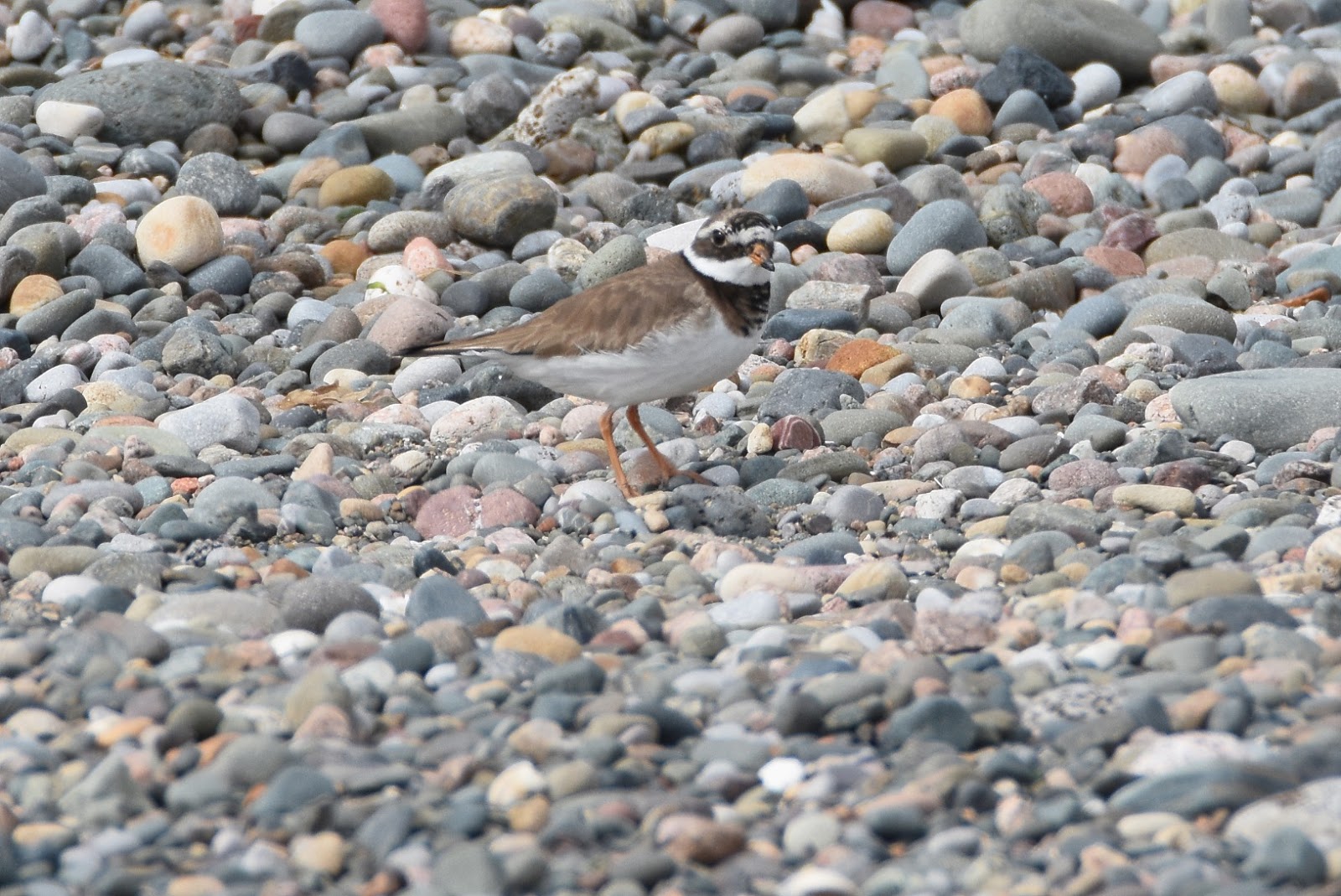
A few more yards furtheron a small group of Ringed Plovers were very vocal and doing display flights as well as displaying on the ground, lovely to watch. One of them broke away from the group and came much closer.  We really hope they'll be able to nest this summer with all the disturbance going on.

That's about it for now apart from to say we were out on the prom with the camera again this morning hoping for another Wheatear after the rain had stopped and the sun had come out but no luck...however we did get our first Sandwich Tern of the year, and we think the first for the Fylde coast - we've not seen any other reports so far. We did get a pic but you really don't want to see it it was beyond awful.
Oh and we got our first butterfly of the year this week too, a Small Tortoiseshell nectaring on a neighbour's Dandelions so it's a good time to remind you not to get the hoe or sprayer out, our bees and butterflies, and a whole host of insects need the early nectar provided Dandelions, they're not weeds but very important wild flowers.
Where to next? A safari with CR is coming up tomorrow, venue still weather dependent at the mo.
In the meantime let us know who's digging the holes and witrh what in your outback.