Showing posts with label carrion crow. Show all posts

Thursday, 10 January 2019

At last a sunny day

The Safari has eventually got round to downloading and processing a few more pics of the recent Snow Buntings for you to enjoy. Not sure if anyone has been to look for them since but it seems we might have been the last person to see them,; no we didn't flush them when we left they were still happily feeding away on the lower strandline when we walked off.
Yesterday we were blessed with blistering sunshine as CR drove in to the car park at the marsh hides at Leighton Moss. Stuffing a variety of snacks in to our pocket we set off eagerly down the track wondering what the sunshine would bring through the day.
At the Snow Buntings we hadn't had any lens issues but today the darned thing wouldn't auto-focus for love nor money so we had to flip the switch to scary ie manual! A Redshank was feeding close in blow the hide and we tried to get a shot of swimming, a good 'different' 'pose' for the challenge but failed miserably. C pointed out a Greenshank along way left and this time we had a little more success.
But that was about it of note, there were few birds on the pools and almost all of those were to our left looking right in to the low sun so little more than silhouettes and we ran the risk of burning out our retinas in the glare of the sun. Without further ado we decided to abandon going down to the Eric Morecambe hide and head for the main reserve tout suite.
A mid-week day and still quite early but the car park was already bursting at the seams - there's just too many of those retired folk with time on their hands...oh hang on a mo!!!
Our second big decision of the day was to forego the delights of Lillian's hide and go directly on the long march to Lower Hide and beyond to try to find the very elusive Great Grey Shrike. On the way we called in very briefly at a 'standing room only' Causeway hide, there's got to be a case to be made for a second similarly large (or even larger) hide to be built along the causeway.
Through the gate there was the usual Robins waiting to mug passers-by of their bird seed. We had half a bag of sunny seeds in our pocket but we managed to sneak by without incident. We did get a couple of birders on to Marsh Tit that was hanging around some seed placed on the arm of a bench.
Further on we came across a Jay feeding like a thrush right out in the open in the field adjacent to the reserve, not often you see them so far from cover. Fortunately it wasn't too bothered by us stopping on the path and lifting the camera, still on manual focus...result - one we didn't get for our challenge last year.
By now those snacks in our pockets were making their presence felt and a good scan of the field along with a chat with one of the volunteer wardens who'd been looking for an hour showed there was no sign of the Great Grey Shrike so off to the hide we went. Pretty full in there - not too many years ago you could have that hide almost to yourself all day long, not as many people on the reserve full stop and most of those didn't make the long trek round there.
Most obvious were a small group of Teal haled out on the wet margin of the pool, then one of our already ensconced compatriots pointed out three sleeping Snipe fairly well concealed a little nearer.
After a few minutes a fourth, previously unseen, Snipe was spotted waking up and beginning to move around by someone down the line to our left. A Jack Snipe had been there all the time mostly obscured by its larger cousins. For the next half hour or more we enjoyed our best views of this secretive species we've ever had here - only really bettered by the views we've had at the fabulous Canal Scrape hide at Spurn.
Now you'd better have some ordinary Snipe pics for comparison, for those not familiar with the two species Jack Snipe are smaller, shorter legged, shorter billed and have a different head pattern.
And this is where our idea of a YouTube channel for The Safari fell flat on its face. Rule One - know your equipment!!! We thought we'd have a little go at filming it bob bob bobbing along only to find we didn't have a clue how to set the video rolling on our camera - what a numpty - - any one know a decent film crew?
Worse was to happen there was an Otter fishing half way across the pool while the Jack Snipe was still in view and then a Great White Egret flew across the back of the pool and landed in a dead tree.
Would have made a great bit of footage even if the Otter was a bit distant as it did catch two small Eels while we were watching it. We didn't take a pic of it as it was too distant and spending a lot of time under water so second guessing where it would come up with the camera on manual focus was a no-no. No pic but brilliant to watch for ages.
In the hide we were recognised by one of our readers, thank you very much for saying hello.
Time was now moving on so so did we, back to thee track to look for the Great Grey Shrike again passing on the way the pile of sunny seeds we'd put out earlier. They'd done the trick, a couple of Marsh Tits were taking advantage of the freebies.
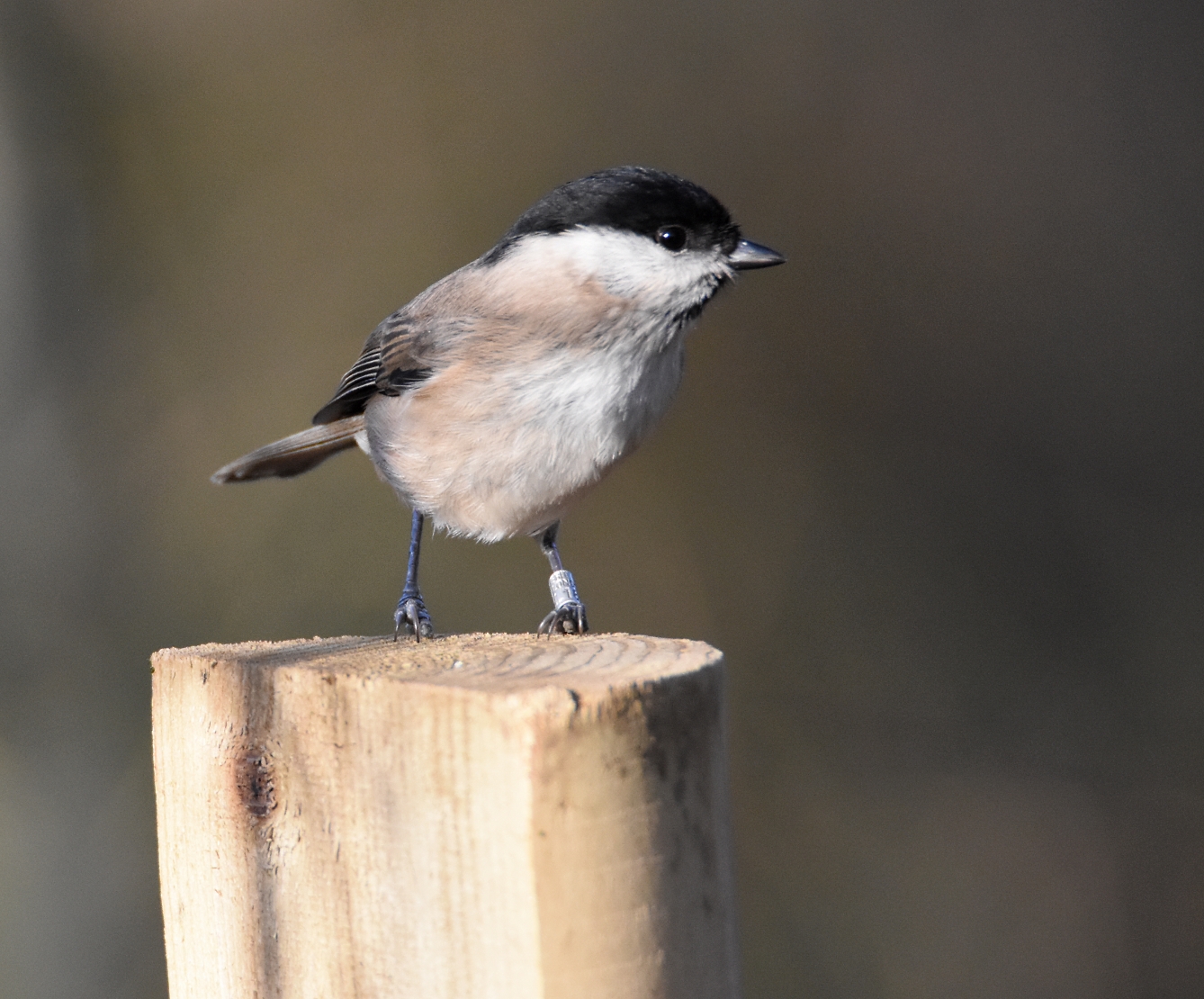
The new rules for the challenge mean no ringed birds (or at least no birds' legs with rings in the pic) and certainly no posts so we cleverly hid a stash of seeds at the bottom of the tree but in the intervening time the sun had moved round and our stash was now in the shade.
Job done - no ring and no post
As we walked along the track birders coming back were regaling us with tales of negative news of the shrike and as we neared the end of the trail another birder did the same so we cut our losses and turned tail aiming for the Grisedale Hide running the gauntlet of a myriad of Winter Gnats on the way, the 'warm' sunshine must have brought them out for the afternoon, time to breath through your teeth!
 Can't remember a visit when we've not looked in at Lillian's Hide before - ever!
The afternoon light at Grisedale Hide was lovely with reflection from the reeds casting a golden hue over the proceedings.
A Little Egret fishing caught our attention and we waited for it to come into some open water to see if we could get some reflection pics.
Missed!
Photobombed!
The egret's favoured way of fishing by shaking a leg to stir out prey doesn't make for the best reflections unlike the Heron above which stood motionless but had grassy bits in the way of its reflection.
Of the supporting cast of  ducks the Wigeon were the nearest and most photogenic, even if they spent most of their time with  their head under water.

And when they emerged they gave the weed they'd just dragged up a real good shake to get rid of any bits of mud and debris.
After only seeing one Marsh Harrier all day, a very brief fly-over view along the causeway we really hoped one would appear in the last half hour we had on site so the pressure was on! Would one come out or not? We had expected the lovely sunshine would have had them on the wing all day but it was proving to be a rather raptor free zone so far.
While we waited a couple of Carrion Crows flew past, good to get that 'different' shot for the challenge and good to know that for some inexplicable but very welcome reason the auto-focus had decided to work again.
We hoped a couple of distant Ravens would come closer and do some of their impressive barrel-rolling display but after a few minutes they went their separate ways never really coming any nearer. A couple of Buzzards got up out of the distant woods and started soaring around and calling, as this activity the cue for the Marsh Harriers to wake up?
Yes it was, distant at first.
And then nearer
And nearer again.
And nearer still.
And finally...not quite overhead
And all that fun and games meant time was now up so we hit the trail back to the car and thence on to Base Camp passing a Barn Owl on the way, a good end to a great day in the sunshine.
Once again many thanks to CR for doing the driving.

Where to next? Not sure yet and it'll no doubt depend on the weather.

In the meantime let us know who's left to the last minute to put in an appearance in your outback


Thursday, 13 December 2018

A one day road trip

The Safari picked up CR last Monday and off we went down the motorway towards Bolton. Many years ago we used to do a bit of work out that way at Anglezarke reservoir and up towards Rivington Pike but we'd never heard of the little reservoir just a couple of miles beyond, High Rid. Our reason for going out that way was to twitch the Velvet Scoter that had been hanging round on the res for the past couple of weeks. With news that it was still there on Sunday come Monday morning we felt we just had to have a trip out.
The weather wasn't great with low cloud and a lot of drizzle but on arrival at the reservoir it didn't take long to find the bird - it was only 10 yards out from the bank right in the nearest corner.
Our 194th species for the year and number 177 on our Photo Year List Challenge - not many days left now and the front runners are around 100 species ahead so we'll never catch up but it's all about the taking part and challenging yourself to get better/different/more interesting photos not just the 'winning'...Honest!
Our quarry was feeding in the margins and sailed past us working it's way towards the far end of the res so we tucked ourselves below the crest of the embankment and and tried to get ahead of it. Our plan nearly worked but the bird had other ideas and flew off to the furthest corner, nothing for it but to walk round that way taking in the drizzle and scenery. Also on the lake was a flotilla of Tufted Ducks a few Mallards (aren't there always) and a handful of Goldeneyes. Small numbers of Black Headed and Common Gulls drifted in and out and we picked up a Little Grebe too.
We'd just reached the nearest corner of the res when the scoter decided it was going to fly down to the other end again....dohhh but the exercise is good for you! We retraced our steps and caught up with it as it fished close in along the edge at the top end close to where we'd first seen it. This time we were able to get closer pics by peeking our head over the embankment so as not to flush it seeing as it was so close. If only the 600mm lens wasn't in dock but it was still close enough for the 300mm, shame the light wasn't a bit better.
A good bird to see close up, normally we only see them miles out to sea as a dot in the telescope and even then not that frequently. We also saw it do its little shimmy lift out of the water without stretching its wings as is diagnostic with this species; our much more frequently seen species, Common Scoters stretch their wings out when they do the shimmy thing. We hoped we'd get a pic of it but it only did it once all the time we were there.
Our tummies were now telling us lunchtime was rapidly approaching so it was back to the car for the second leg of the day's safari over to Lunt Meadows just north of Liverpool.
45 minutes later we were chomping our butties in the reserve car park having passed two Jays on the way - a species we still haven't been able to submit to the SD card for the Challenge.
Here we hoped to see a Short Eared Owl or two and possibly some Grey Partridges as on our last visit here without a camera we'd seen several large coveys, the most we've seen in one day for a great many years. However it was the large number of Lapwings constantly taking to the air that caught our attention first. They were up and down all afternoon but we never did get to see what was spooking them - probably nothing!
No sign of any Grey Partridges in the fields as we approached the first pool, where we'd seen most of them last time but a pair of very active Little Egrets caught our eye. There was some argy-bargy going on with one chasing the other hither and thither around the pool. Eventually the action drew close to the screen we were approaching and from there after a cautious approach they gave good views. One, presumably female, just wanted to get on with the job of catching some fish but the other, presumably male was chasing her around something rotten and wouldn't let her settle. We think he was wanting to get amorous but she was having none of it.
Come back and stand still for a minute why don't you
If I have to fly after you one more time!!!
She was still trying to resist his advances over an hour later after we'd moved to the next screen and chatted to a trio of birders who told us a Short Eared Owl had been seen on the far side of the river earlier in the day. With not too much space and not a lot going on at the screen we decided to walk up to then along the river. A good move as it happened. About half way along the embankment heading south a Short Eared Owl picked up form the side of the embankment not far in front of us. Whether it was going to anyway or whether it saw/heard us coming we're not sure but it flew away from us a few yards and then settled on a post. we took a few pics of it in the distance and then edged 10 yards closer took some more pics and had a good bins look before edging another 10 yards closer and repeating the performance. Our next attempt at edging 10 yards closer didn't work, we must have reached its zone of tolerance and it flew off crossing the river, doubling back behind us and dropping down behind the embankment on the far side of the river and out of sight.
Job done though, PYLC number 178.
But we hoped if we hung around another hour or more we'd get closer views as it/they came out to hunt nearer dusk.
In the meantime we waited around the pumphouse area ready to shoot off either north or south along the river embankment should any owls reappear. The supporting cast was good with a lot of Black Tailed Godwits on the Pumphouse Pool with a developing gull roost, about 100 Pink Footed Geese were in a cropped field on the far side of the river, the Lapwings were up and down like  yo-yos and a Cetti's Warbler sang briefly. Not so welcome was the American Mink that swam past us.
Then we spotted in the distance the Short Eared Owl as up and hunting again, back where we first saw it so of we went. It was quartering back and forth along the side of the embankment so we reckoned if we got to a spot just in front of where it was coming too and waited we'd be quids in. And as luck would have it the plan worked.
Again we could have done with a bit better light, an ominously dark black, thick black cloud had settled right in front of the setting sun, and the 600mm. Once again the owl did as it had done before and scarpered across the river not to be seen again. 
We waited and waited for it to come out to no avail but then there was a call of Barn Owl from another birder. It was miles away at the far end of the reserve but in time came closer passing in from the the mew and still under construction hide...don't think it's going to be big enough to fit all the potential owl photographers in.
The Barn Owl did come within range...just - and it as getting darker by the minute.
Great stuff! Always a pleasure to see Barny.
In other news we've had a couple of visits to Marton Mere this week. Somehow we've managed to miss the Otter which has been seen every day. 
A panic by the gulls alerted us to something interesting but we were unsighted under the big tree you're probably not supposed to be under but which could use a bit of screen making out of the living Willows on the water's edge. A Bittern emerged from behind the twigs and branches and flew high above the gulls. We probably got a bit excited and didn't let the camera do its thing but it was a fair way off for the 300 and that has focused on the trees beyond - darned thing!
And it was only seconds before it was hidden behind the trunks of the trees we were hiding under.
Unfortunately we couldn't find anything unusual in the gull flock. The Bittern and then a very loud jet flying just above the low cloud frightened all the duck out in to the open, there were at least 500 Teal, no Green Winged Teal as far as we could tell, and 170 odd Wigeon, a good count for here.
Earlier we'd noticed a big flock of Fieldfares numbering at least 30 flying over Lawson's Field before turning back towards the reserve. We re-found them 'round the back' where we hoped to spot a Long Eared Owl secreted in a former 'usual' place - no such luck this season.
Typical twig ridden view
A better but all to infrequent view - crackers aren't they
A few yards further on this nice Bracket Fungus caught our eye. The Fylde coast is pretty lacking in fungi, there's precious little mature woodland and the prevailing westerlies along the coast prevent spores from inland reaching us and colonising. But there's always an exception and this lovely purple job is one of them - no idea which species it is but it's very gaudy in a subtle sort of way for a Fylde coast.
The Feeding Station has been quite busy, mostly with a sackful of female Pheasants - refugees from - the shooting woods a mile or so away they always seem to find the free food!
On a more serious note it's high time there were some restrictions on the number of Pheasants that gett released, over 40 million of them annually with a total weight of far more than the weight of all the native breeding birds combined and all without some much as a by your leave. And yet there's so many hoops to jump through to re-release a former native that in most circumstances became extinct due to the same huntin shootin fishin types - we're thinking about the recent proposal to bring White Tailed Eagles back to the south coast on the Isle of Wight - bring em on we say, would we go for a look at them in a lowland setting you betcha!!! 
On our second visit there was little food left in the feeders so we snuck in - naughty - and moved the only feeder with some nuts left in it to a branch closer to the windows.
You'd travel a long way to see a Blue Tit if they were rare - little stunners, never take them for granted
Back at the car a speckly looking Carrion Crow was working the verge across the road.
An afternoon wander round Stanley Park with our group of young children in a very chilly and blustery wind gave us this flock of Pink Footed Geese flying over us as we set off.
A chilly afternoon wasn't conducive to seeing a lot of birds but the kids did enjoy seeing the Ring Necked Parakeet popping in and out of its nesting hole - not that it's nesting at this time of year just doing a bit of house keeping. 
In other news the local Bluebells are showing well in the Rock Gardens - WHY??? It's still only early December to crying out loud.
And turning round we saw these red berries, we think they're a plant we'd never heard of until the other day when we were shown a pic of one from Stanley Park, Stinking Iris.
A bit of research suggests they are a native species of damp undergrowth - that figures, so our thought that they might have been planted in the early days of the parks is probably way off the mark. The way to tell is to crush the leaves and sniff then for a hint of roast beef - it doesn't stink at all, another of those wildlife misnomers! And now we have to check we haven't been told about it before at Marton Mere and had forgotten about it.
 
Where to next? Another safari with CR tomorrow up north.

In the meantime let us know who's