Showing posts with label great shearwater. Show all posts

Monday, 23 September 2024

A nautical safari on the high seas - Part 3

The Safari has met up with RL, our Extreme Photographer, in Poland, almost did so in Perth, Australia, and now he was waiting for us at the dock gates in Porto, Portugal - well Leixoes actually as the city of Porto isn't quite on the coast but a little way up the Douro river. Close enough for the 'P's we guess - where next, Papua? Paraguay? Palau would be good! 

WE nearly didn't make it to the dock gate and almost certainly wouldn't have done had we had our scope with us as there were thousands of gulls of all shapes and sizes to scan through. Tempting as they were we didn't stop for more than the briefest of perusals. Beside the dock gate there was a tiny garden with a shrine in it. RL had already seen a good variety of birds while waiting for us to walk up from the ship. He soon put us onto Spotless Starlings, unphotographable again, a couple of White Wagtails, Serins, several Pied Flycatchers, Black Redstart, a Spotted Flycatcher and a Chiffchaff...a busy little corner or greenery and suggestive of a bit of an overnight fall before the morning mist descended. RL had found a park close by worthy of exploration, he'd already seen a Night Heron in there when walking throughdown to the docks to meet us, so off we went along the beach. The mist was pretty thick so we didn't stop to look at the big gull roost on the sands. Making our way to another old fort sat out on another rocky promontory we found an out of context Pied Flycatcher and yet more busy Black Redstarts, do they ever sit still? The outer rocks by the surf held a small number of Turnstones.

Once in the park we passed a lake, one of several in the park, the recently planted saplings along one side of it held yet more Pied Flycatchers.
Skimming around the lake were several Swallows, a species we'd so far seen very few of. Deeper into the park we'd discover that Pied Flycatchers were probably the most numerous bird with Spotted Flycatchers someway behind in second place.

On a small patch of dry lawn something small and white caught our eye, not a tiny scrap of paper but a Vestal moth. This species is resident here but a usually scarce migrant to southern Britain but can occasionally occur in large numbers.

On our travels to a second lake we bumped into JC who put us on to an Iberian Green Woodpecker feeding alongside the path 50 yards away, while watching that a Kingfisher sped across the lake beside us. Somewhere in the reeds sounding this lake was the Night Heron RL had seen earlier but there was no sign of it now.

So far this trip we hadn't seen any lizards, mainly due to the nightmare cat situaution in the previous places. RL is a lizard finder extraordinaire and it was his mission to show us some. Apparently he'd seen very few since travelling around Portugal since the spring. A likely looking wall in the distance was aimed for but on the way we got side tracked by a the number of Jays flying to and fro collecting acorns. They came out of the trees without warning and soon disappeared behind intervening foliage so getting a pic was nigh on impossible until one landed low down on a tree not too far away but annoyingly in deep shade.

The sun had now mostly burnt off the mist but cool sea frets still wafted their chilly dampness across the park from time to time making everything very atmospheric, not the best conditions for finding lizards. A sunny wall was scanned from a distance, RL had said that the few lizards he had seen so far were all very skittish and unapproachable. And just like that he found one, a small juvenile having a good play at being Spiderman.
And then just a yard or so beyond that one he found another in the grass at the base of the wall - how'd he spotted that???
Walking quietly along the wall but well away from it gave us more sightings, trying to creep closer for a definitive view was very difficult, any hint of movement and they bolted into their favourite hidey-hole. Occasionally one would get caught out too far from the safety of a crack in the blockwork and would freeze for a few moments before deciding to make a dash for it.
Eventually, after numerous failures, we did get a reasonably close up pic.
There are several similar species found in this area and we may have got pics of more than one of them but they are all very variable and very hard to tell apart.
After a brew and butties back his van we carried on our search for more reptiles. It was warmer now the mist was completely gone and butterflies were on the wing, and mostly not for settling. There were many blues, many very tatty coming towards the end of their season and most not able to be identified as we couldn't get a good look at their underwings. With persistence did find most to be Lang's Short Tailed Blue and Geranium Bronze. No idea what this very tatty one is though.
Most of the other butterflies were Large and Small Whites and we had at least one Red Admiral and several Speckled Woods

Around a smaller pond we came across another reptile, a fallen long reaching into the water just screamed 'terrapins' and sure enough a quick check with the bins gave us an Iberian Pond Turtle exactly where we would have expected one to be.

Also around this pond were a few dragonflies and damselflies. Emperor dragonfly was also seen at several other ponds but Blue Tailed Damselflies, an unidentified species of damselfly, the really bright Scarlet Darter and stunning Violet Dropwing dragonflies were only seen here.
And showing how it got its name.
The second best bird in the book was also on the pond, or is it third best now we've seriously upgraded Sabine's Gull?
Other ponds had large populations of feral geese, Grey Lags, including farmyard types, Canada Geese, including some dodgy looking hybrids, and several Egyptian Geese which we don't see very often.
We did our utmost to avoid the pair of Muscovy Ducks, out of the 10,000 or so species of birds these come in at 11,000th in our list of favourites, other than being bloody awful looking things we don't know what they've done to deserve that accolade. A Common Sandpiper flitted around the pool too.

A much larger lake was visited next and here we saw another non-native horror, many huge Koi Carp.

No wonder there were few dragonflies on the other pools any living thing will have long been sucked up by these monsters. And they were breeding, warm shallow areas had tens of thousands of fry, far too many  for that Kingfisher we saw earlier to make a dent in their numbers. One stretch of the margins of this pond had a reasonable fringe of emergent vegetation and on our drier side a lot of Spearmint plants, giving off a lovely scent as you we walked over it. Marsh Frogs jumped out of way as we walked along the banks trying to find a Grass Snake (any snake would do) sunning itself. The last time we saw these we were in Poland with RL all those years ago. At last we came across one that didn't jump out of our way.
A sunny shorter patch of grass had another species of blue butterfly. Another very fluttery one that we kept getting brief views of the underside of but it wouldn't stay still enough with its wings up for a pic. We got an upperwing pic but then all blues look very much the same from above. Checking in the field guide we'd brought with us back on the ship later it transpired to be a female Mazarine Blue.
Another pond/lake gave us more turtles, this time though they were almost all introduced American species, namely Red Eared Slider/Terrapin and Eastern Painted Turtle (in some books Eastern Swamp Slider). There were a couple of native turtles in the mix too but now we know there are two possible species we're not sure which we've seen, they are quite similar, Iberian Pond Turtle and Stripe Necked Turtle.

Walking back by the big lizard wall we had another look but now the sun was off it and the lizards already warmed up there were none to be found. The day was warm now and the bird action had died down too, hardly any Pied Flycatchers were to be seen. Time to head back to the ship and say our goodbyes and thanks for a marvelous lizard spotting day to RL. Going through the last much more open bit of the park there was a low wall, more a row of blocks of stone hawkeyed RL spotted the last lizard of the day basking on the top of one of them.

We left RL at the dock gates and walked back to the ship but seeing far fewer gulls on the quayside, he went back to his van in the park to drive up the coast towards the Spanish border to find a campsite for the night before his next leg of his Iberian adventure into the hills and mountains of Galicia. It had been great to catch up.

The following day was a full sea day across the mouth of the Bay of Biscay. There was a stiff breeze in our face and as the day wore on the sea became rather, lumpy, unpleasantly so for some aboard.
It was hard work watching, too windy and workmen on the forward observation deck, forecastle closed, and one side of deck three being covered in spray. Not that there was much to see. Finding whale blows among the trillions of whitecaps was never going to be easy. There were a few and JR even managed a pic of a close Fin Whale.
Blows from Sperm Whales and Humpbacked Whales were also seen, a couple of each. JC had a brief view of a Beaked Whale but too brief even for his very experienced eyes to determine which species. Seabirds were few and far between too with only the shearwaters making any kind of showing.
At breakfast JC told the rest of us that soemone had reported a brown moth somewhere on the ship. What we din't expect is for someone to come up to us and say "is that a moth?", pointing at the floor behind us. Yikes - who's smuggled a dog on board? - we'd better go back to the cabin and get a poobag (we never travel without a pocket full). No a dog wasn't on board. It was 'just' a Deathshead Hawkmoth. We've never seen one before, narrowly missing a dead one on the prom at the end of last summer was the closest we've got to one.
It stayed put for ages and became very popular with the guests, so much so that a deckhand had to come and rope it off. But not before hundreds of pics just like this one of ours had been taken.
As the weather worsened we had the dilema of what to do with it. Spray was flying everywhere, if we put it in a safe place it would no doubt be attracted to the ship's lights again and move. The final decision was that one of us would have to take it home for release in NW England where it might stand a bit more of a chance than it would a 100 miles or more out to sea. So it was duly potted up, only just fitted in the pots JC had brought, and fridged until it was time to disembark in a couple of days time. The log call in the bar that evening didnt take very long!
The sea was, shall we say, 'interesting' overnight but not as bad as our Canada trip a couple of autumns ago, only reaching beaufort 8 going on 9 rather than 10 going on 11+ but we awaoke to the amazing sight of hundreds of shearwaters slipstreaming the boat. Mostly Great Shearwaters but also Cory's (no Scopoli's so we couldn't add them to our British list), several Sootys and a couple of hundred Manx Shearwaters accompanied us - a proper real life 'Attenborough moment'.
BT called a flock of Storm Petrels but unfortuantely we couldn't pick the tiny scraps of feathers up in the heavy sea. And still more shearwaters came...
As we were now in the Celtic Sea we expected dolphins and sure enough several pods came into the ship but picking them up at any distance was impossible so they were upon us before we had much of a chance to react. We eneded  up 'firing from the hip' just pointing the camera hopefully in their direction and holding the shutter button down until they'd gone and hoping for the best...and this was the best we got.
Once again the evening log call wasn't a protracted affair.
We reached as far north as Bardsey Island and the Lleyn Peninsula as it went dark, in the morning we'd awake back in Liverpool.

All that remains to be said is a huge thank you to the other members of the OWE team, the guests who chatted with us through thick n thin and especially those who kindly allowed us to use their images. We can't forget Fred Olsen cruise's crew and staff who always look after us so well. But mostly to IH who put us forward for the trip after he'd had to withdraw for unfortunate family reasons. 
It's back on terra firma for us for the foreseeable now.

Oh and that one species short of our Challenge target??? There were two Black Terns a minor detour away on the way back to Base Camp but we were too knackered to take advantage of them. Thankfully they were still there in the morning so we picked up CR and headed out.
165 species of birds photographed within 75 miles of Base Camp - Target reached we can relax for the next three months...oh no we can't we've upped the target to 170.

Where to next? We've got a couple of safari's lined up to tell you about next week.

In the meantime let us know who's racing up undetected in your outback.


Monday, 18 September 2023

A little bit of ice and not a lot of green - Part 2

The Safari continued northwards as part of the Ocean Wildlife Encounters team aboard Borealis heading towards Isafjordur in the Fjordlands of NW Iceland.It was a sunny day with a cool breeze but very nice when in the sun and out of the wind. From the ship in the harbour there were lots of Arctic Terns buzzing about back and forth fishing and then taking said fish over the town to their nesting area and then flying staright back for more fish.

Town itself was a modern, utilitarian affair with a few old buildings scattered around the older parts of the harbour.

Around the harbour Kittiwakes loafed around on the warehouse rooftops. A bit different to the more usual Herring and Black Headed Gulls back home.
And instead of Carrion Crows hanging out around town it was Ravens cronking from the rooftops.
Just outside the ship's berth a small dock for fishing boats held a flock of between 30 and 40 Purple Sandpipers, easily the most we've ever seen together and probably more individuals than we've ever seen before too.


There was a rather large Lion's Mane Jellyfish in the dock too, we tried to get a pic but without a polarising filter it proved impossible.
Outside the dock gate was a sandwich board advertising a two hour afternoon whale watching trip...yes! But would we get back to Borealis before she set sail, 'all abourd' time was 15.30. The very helpful young lady behind the desk in the adjacent lodge assured us the skipper knew about our timings and 'promised' we would see whales as there were about 60 in the local fjords. Too good to miss - out came the credit card!
We had a little time to kill so when to find some more onshore wildlife, some snacks for lunch and a mooch around town. All the Arctic Tern activity naturally attracted the attention of the local Arctic and Great Skuas and every so often there would be a commotion as a gang of terns mobbed an approaching skua, the nearer the skua got to the nesting area the more terns joined in and the louder the commotion became. But all of a sudden the terns began making a very different agitated call and dozens of them went skywards a hundred or more feet and continuing to rise. We put our bins up and just caught a large falcon streaking away from us beneath them...no terns were mobbing this one, far too risky? We'd just seen the back end of a Gyr Falcon and later confirmed by a passenger who'd had better views of it going the opposite way back towards the cliffs on the other side of the bay to the ship.
One type of bird we'd expected to come across by now was a diver of one species or another, if only we'd looked in this bay as one of the passengers, a young (by cruising standards) birder had a cracking summer plumaged Red Throated Diver.
Butties were scoffed by the dock waiting for our ride which duly arrived on time off-loaded a family that looked like they'd been on a camping expedition somewhere up-country, once they were off we were on.
And soon out into the fjord leaving Borealis and a Viking cruise liner far behind and where, hopefully, whales awaited us.
As you can see this far north there was bits of snow and ice still lingering on the higher more sheltered parts of the hills, hence the blog title a little bit of ice (in Iceland).
It wasn't long before our keen eyed skipper spotted a distant whale blow and he put the hammer down to get us in good viewing range 'tout suit'. Wow - could that boat motor!
The next hour and a half were spectacular, dreams come true time.


Spectacular and well worth bending the credit card for. We reckon we saw somewhere between 15 and 20 Humpback Whales altogether. And all against the spectacular backdrop of Iceland's rugged scenery.
Not bad for 90 minutes watching, certainly won't see that in any 90 minute watch off Blackpool promenade no matter how hard we try.
Also out in the fjord were lots and lots of Puffins and we certainly tried to get an in-focus snap of one/some and failing miserably. The ones on the water dived before we got close enough and those flying past laden with Sand Eels were fast so very tricky from a very wobbly small boat - there was quite a bit of swell out there.
We did get one flying close by but just as the camera was about to lock on to it it changed its mind and locked on to the huge photobombing Humpback Whale that surfaced in front of it instead - how annoying...Not.
Just in case you'd fogotten what Puffins look like when they're close and properly focused here's a lovely pic by passenger Karen Burns taken on a sightseeing boat down a different fjord.

What a fantabulous boaty ride and as guaranteed we were back aboard Borealis just in time for afternoon tea and a very welcome cuppa.

As the crew pulled up the anchor and we started to move away from the dock IH noticed that the moon was in a very photogenic postion against the cliff opposite.

The Viking ship left minutes before us and they should have got fantastic views of a Fin Whale just off their port bow just a bit too far ahead of us for decent pics. There was plenty of other whakle acticvity too with a couple of big breaches from Humback Whales but unfortunately very distant.
Before we'd got to the mouth of the fjord AB picked up a Grey Phalarope fairly close to the boat and a guest reported a Minke Whale that we'd all missed. Once out of the fjord the Viking boat went north along the coast and we headed south west into the open ocean. Close to the coast there were a few more auks including Brunnich's Guillemots and Razorbills, we missed both...grrr - we would have liked pics of them for our Photo Challenge as we would have of the several small parties of Little Auks too.! Further offshore shearwaters came back into play with plenty of Manx Shearwaters, a couple of Cory's Shearwaters, another speciers we failed to get a pic of, and four Sooty Shearwaters but, maybe strangely considering how many we'd seen so far during the voyage, no Great Sheatwaters. All too soon it was sunset and the last chance to find a whale blow'
The following day was cooler with some cloud and a sea state 4, lots of white horses making spotting dolphin splashes difficult to see and the wind moving whale blows around making them difficult to discern as from which species they came. It was a long slow day that improved as the afternoon turned to evening, although guests had reported both dolphins (probably White Beaked Dolphins) and a Minke Whale before breakfast. Our notebook says we had a Humpback Whale at lunchtime and Sperm Whales and Fin Whale blows after dinner. Birdwise it was shearwaters again. The Big Four had been reduced to a Big Two as there were far fewer Puffins and only a couple of Gannets seen all day. We spotted a distatnt petrel which can only have been a Leach's Petrel up this way. IH found a flock of 'probable' Grey Phalaropes and AB saw a juvenile Sabine's Gull. A Dunlin called as it flew round the ship a couple of times without landing and a flock of Golden Plovers went past us early in the morning. Another lost Black Headed Gull was also seen. Once again the day belonged to the shearwaters and now we were a bit further south Great Shearwaters were by far the most numerous.
With a supporting cast of fewer than 10 Cory's Shearwaters, several Manx Shearwaters including a weird pale one that might have been a leucistic individual, a trick of the light or something else altogether and a single Sooty Shearwater. The only other bird of note was an Arctic Skua giving one of the many Kittiwakes a whole load of grief right above the ship.
The best thing of the day was saved until last though and was something we'd never even heard of before. Once it had got too dark and too cold to stay on deck our entourage of enthusiatic wildlife spotting guests had ebbed away it was time for a well earned pint in our regular music bar. Only tonight we found someone else was sitting in our favourite seats - I mean how very dare they!!! That meant we were 'forced' to sit elsewhere and this time with the band out of sight round the corner we sat facing the windows and as the sun set AB said "Did you see that?"; "The Green Flash", and he didin't mean the iconic tennis shoes from yesteryear. We saw it too just as the last millimetre of sun was above the horizon the orange glow turned to green and then was gone. Apparently it's a refractive trick of the atmosphere and the air has to be incredibly clean which is probably why it's rarely seen from land where there is dust, smog, smoke etc
We awoke the following morning to calmer seas, blue skies and the greenland coast.
Not very green and a lot more snow and ice than Iceland despite being only slightly further north than the northern tip of the Shetland Iseles at this point. We alsways thought that there was an outside chance we'd get to Iceland after all it's a fairly popular destination, not too distant and several friends have been and told us how good it is if a tad on the very expensive side, but Greenland - no; never in our wildest dreams did we think we'd ever get to Greenland and yet here we were not far off the coast and sailing right towards it. Not only that but we had our first ever iceberg, a Humpback Whale, Fin Whale blows and a Leach's Petrel all before breakfast - what else would the day hold?
More big icebergs was the answer.
Well what do you expect - it is Greenland and sort of famed for its ice after all.
At sea the Big Four was still only the Big Two with only one Puffin and no Gannets seen but plenty of Black Guillemots close to the coast.
Then it was into Prince Christian Sound we went...oh wow...more scenery than you could shake a sweaty stick at
In the sound we had Iceland and Glaucous Gull, Great Black Backed Gulls and shed loads of Kittiwakes.
But really it was the scenery that took centre stage. Glaciers, glimpses of the icecap, intusive volcanic dykes and other rock formations, waterfalls; the Sound had it all, a veritable geographers and geologists paradise...
and icebergs that looked like swans.
All this spectacularness was broughth right down to earth when we sailed past this perfectly formed glacial U-shaped valley staright out of a school geography text book.
One of the passengers, a keen geologist, had been through here five years ago and this valley was then filled with a glacier, as you can see there's nowt left of it and a significant sign that all is not well with our planet.
Whilst in the sound we got a brief view of a couple of Harp Seals and hoped for the iconic sighting and subsequent photo of one hauled out on an icefloe. It would have happened but when the passengers saw it from the bow of the ship we were otherwise engaged at the stern helping our OWE colleagues give a binocular and telescopes workshop. We did however see the White Tailed Eagles that flew over.
The only negative we could find to say about Greenland so far is that it wasn't very green.
Leaving the sound we sailed north and had a slight change of plan, we would be visiting the furthest north of the ports first rather than last. So up to Nanortalik we headed arriving overnight.
No town in Greenland is of any real size and Nanortalik is one of their bigger places but still only manages a population in the high hundreds. The port area was small and it was a tender ride from the ship to the dock. It had the feel of a frontier town about it once we'd got ashore. We wanted to see some Snow Buntings so followed the calls we heard through and industrial estate until we found them up on a bluff by a comms tower.
On the way we passed some familiar looking orchids but a new species for us, Northern Green Orchid. Similar in form to our marsh and Common Spotted Orchids but differing in having green flowers rather than the purple of ours.
A spalsh of blue was provided by Arctic Harebells and there was a new species of willowherb for us too, Arctic Fireweed whose pinky flowers were all over the shop.
The town could hardly be described as pretty but it did have a feature church and interestingly many of the houses had paineted on windows rather than the real thing, mabe the price of windows is prohibitive with everything needing to be imported or glass loses too much heat in the winter???

There were a small number of butterflies among those buttercups but we never got close enough to get an ID on them, precious few other insects around doing any pollinating but therewere midges doing the biting thing!

In the harbour we had both Iceland and Glaucous Gulls.

Now Nanortalik means Place of the Polar Bears but we'd have to have been very lucky to arrive when one was present as apparently they're not that regular or frequent a visitor despite the name. There had, however, been one about three weeks earlier, some passengers were shown video of it ambling menacingly around the outskirts of town. The nearest we got to one was on this mural down the main drag.
Mid-afternoon was sailing time so it was back to work spotting wildlife from the decks. The harbour area had a little island with a massive glacial eratic rock sat on it. Ooh we do like a glacial eratic...
Sailing out we had more White Tailed Eagles, Humpback Whale blows, Minke Whales, three pods of Harp Seals and Long Finned Pilot Whales were reported by a guest. Wheatears and a Redwing were also seen by some of the guests.

Our next stop was 'just around the corner' a very big corner, Narsarsuaq, home to a former US military hospital for soldiers wounded during the D-Day Landings. This place was tiny compared to the metropolis of Nanortalik. During the sail in we had a couple of Humpback Whales and two Sabine's Gulls of which we managed to see one. Other good birds included, Arctic, Pomerine and Long Tailed Skuas, the latter we could not get on for love nor money. We also missed a Red Necked Phalarope which was too close to the ship oin the wrong side.

There's not much to Nanortalik just a huge runway, with a conference centre, a few distressed and repurposed industrial buildings a smattering of houses and a cafe/tourist information centre/museum and a hill with a comms tower. But it also has the Greenland Arboretum aka a hill with some proper trees on it and a glacial lake in a valley of wildflowers.

An Arctic Fox ran across the road in front of some guests close to the top building, lucky so-n-so's. We had to put up with 'just' lots of Wheatears and Common Redpolls.
Abandoned American paraphinalia was spotted along the wildflower valley including a fire hydrant and an old chimney from a long gone house overlooking the lake.
We were with IH on this walk and between us reckoned we both fit up the chimney if a Polar Bear appeared as there was nowhere else to run and we hadn't taken advantage of the rifles on offer at the hire shop!
Bees and insdeed other insects were few and far between in the flower valley so we were lucky to find this solitary bee which has the look of a leaf-cutter bee but we could well be miles out on that tentative ID. We also had two species of hoverfly and later back on ship a bumble bee flew over the stern.

The agricultural land opposite Narsarsuaq was the only agricultural land we saw and was home to the first Viking settler of Greenland, Eric the Red. Who's reconstructed house you can visit for a fee. 

The bright blue iceberg we learned was composed of very very old compressed ice probably drifted down from the nearby ice fjord Qooroq

On our wanders IH found this rock covered in whatb we now know as Elegant Sunburst Lichen, if you're going to be a lichen why not be bright orange and have a awesome name too. What he didn't know when he picked it up is that said lichen grows on rocks which have had their nutrient status enrichedby animal pee...hmmm cue lots of subsequent hand washing!

From the bus back to the harbour we spotted a Great Northern Diver in one of the roadside bays but couldn't reloacate it for a very distant pic once back aboard.

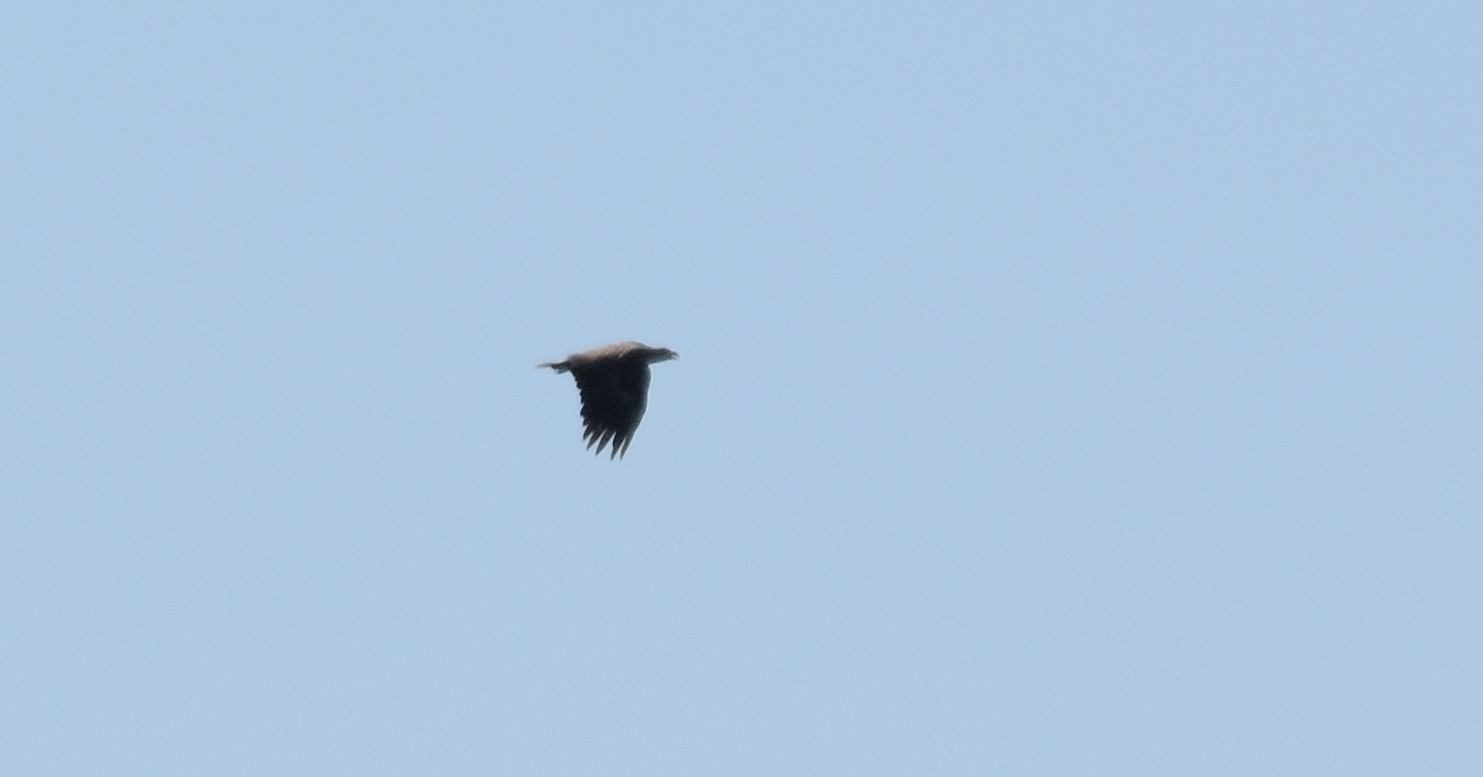
While waiting for the ship to set sail a White Tailed Eagle flew across the harbour and landed almost out of sight behind some tall vegetation where it looked to be eating something, indeed a Raven was sat close by eagerly awaiting some scraps. And if you're ging to watch eagles and whales on a mild day in remote Greenland you might as well do it with a cocktail in hand as this guest did.

The sail back down the fjord towards our final destination in Greenland was full of icebergs and Kittiwakes with Arctic Skuas patrolling for the chance of a stolen meal.


Iceland Gulls were also numerous and guest John Riley got some good shots of Harp Seals.


As dusk fell more icebergs were in evidence.
And there were yet more icefloes that looked (if you use your imagination) like swans
That night passenger Karen Burns was alerted to the possiblity of an aurora from her phone app and went out for a shufty.

We had a look the following night at around 02.00 but it was cloudy...ah well maybe next time.

And that ends Part Two.

Where to next? Part three takes us to our final destination, Quaqatoq and then back across the Atlantic to Blighty.

In the meantime let us know who's watching what with a cocktail in their hand in your outback.