
The Safari has reached one of those life moments - we've just gone and taken early retirement! With the pretty rotten last twelve months we've decided that life's too short and having just missed yet another close encounter with the surgeon's scalpel we felt it was time to ditch the daily grind and enjoy some quality Safari-time and look after Monty while Wifey continues to bring home the bacon...well we really hope she will cos being a poor pensioner now if she doesn't we'll starve.
And so ends an era...and sadly it is also the end of Patch 2 as we won't be down that way very often from now on, our seawatching will be done much closer to home from the cliffs at Chat Alley from now on. Patch 2 ended on 56 species.
Talking of seawatching we came across this little snippet from the Cornwall Bird Watching & Preservation Society
Lizard Point, Introduction to Seawatching 08:00 – 10:00:
6 Cory’s Shearwater, 3 Balearic Shearwater, 9 Sooty Shearwater, 1700
Manx Shearwater, 650 Gannet, 1 Storm Petrel, 1 Greenshank, 1 Ringed
Plover, 4 Sanderling, 1 Black-tailed Godwit and 3 Chough.
Blimey that's just a two hour 'introduction' to seawatching - that lot would take us two lifetimes and more to come across at Patch 2 or Chat Alley!
Our first assignment as a retiree was to lead a moth and bat night for a local Friends group at their park. We've done them there before around this time of year but have been dreadfully unlucky with the weather. Last night it seemed the curse would continue, rain threatened, the wind howled and it wasn't very warm. But the gods were with us, the train kept off and the crowds turned up eager to learn about the bats and even hopefully get to see some. At least they'd see a couple as we'd brought along our rubber 'Halloween' bat help point out all the animal's salient features, we also had a our mummified Pipistrelle Bats that have been donated by a couple of friends over the years so that they could see how small bats are and how velvety soft their fur is.
Here's a pic of young E demonstrating how his patent bat-attracting-stick works. We had to use a length of rush as there wasn't any suitably long grasses nearby and were worried that the greater thickness of the rush's stem would keep the bats away...should we even find any.

As the darkness gathered we switched on the bat detectors and led the group to the most sheltered area of the park down by the big hedge. There's a bit of a ditch too which helps as it's a breeding ground for all those little midges the bats feed on. Fortunately it didn't take long before the first clicks of a passing bat were heard on the detectors. Then more were heard and the first bat seen. By now excitement was rising and almost all the group got to see bats close up as the patent bat-attracting-sticks we'd given to the children came in to play and did what they are supposed to do. It's magic - pure and simple! Better still with more sophisticated bat detectors available now between the group we managed to determine that both Pipistrelle and Soprano Pipistrelle Bats (our 10th mammal species of the year) were present.
 |
| We're led to believe there's definitely a bat in this pic - Thanks to @OhNoItsSteve for this and the pic above |
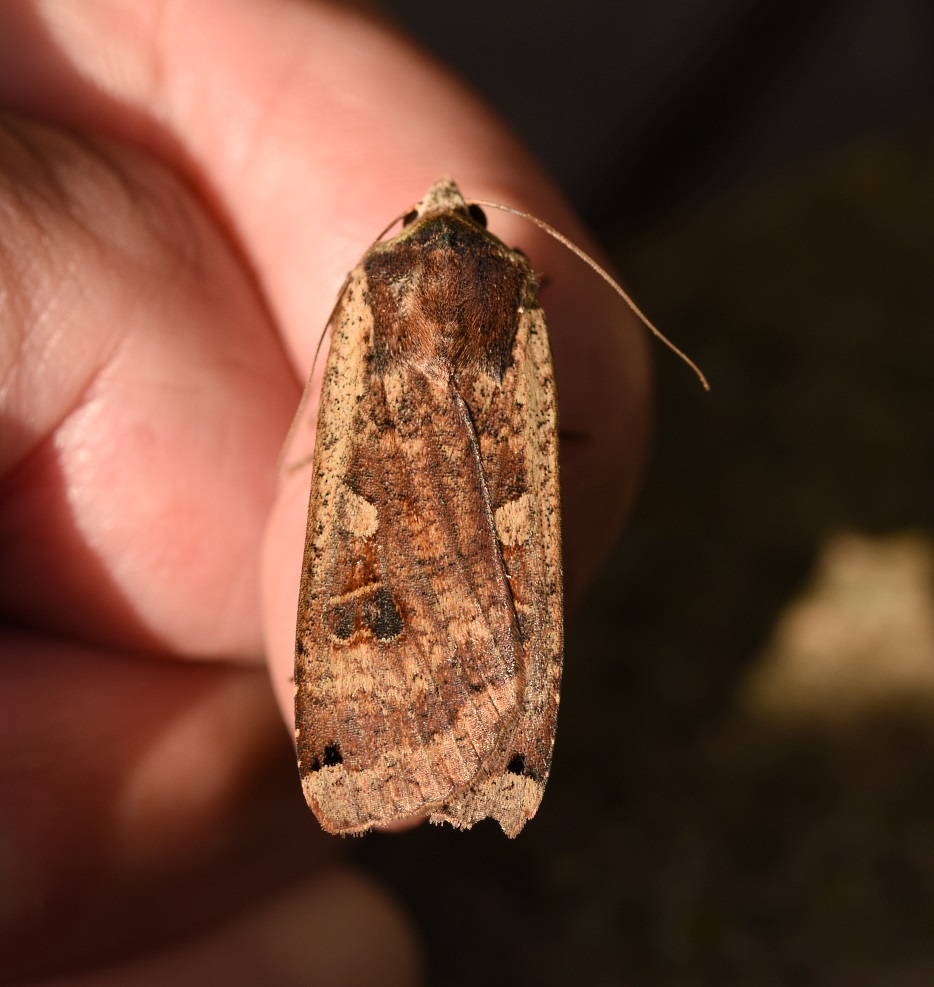
Once we'd had our fill of bats it was time to turn the bat attracting lamp on and wait to see what it might bring in. Large Yellow Underwings didn't disppoint, the children loved them - big and gaudy so far superior to the many dowdy Common Rustics and slightly more interesting Flame Shoulders. Catch of the day was a cracking Burnished Brass sadly no photo for you as we forgot to take either our camera or phone.
The following morning the trap was checked - we'd taken it out of the car overnight - but not having put a cover on it there had been a mass exodus leaving just a single Large Yellow Underwing behind.
A morning trip to the nature reserve felt birdy, in fact it felt like an Osprey sort of a day. But after a couple of hundred yards it was evident it was going to be a rather unbirdy sort of a day. Autumnal with Dunnocks peeping and Robins ticing but other than that it was very quiet, even the now laden with ripe berries Elderberry bushes were devoid of birds. A Sparrowhawk drifted south and Mallards sat quietly on the water as a single Snipe did a quick fly round before plummeting back in to the reedbed. No sign of the recent Otters or the Bittern this morning.
Down at the far end a female Reed Bunting posed nicely.

In the scrub even the normally hyper-active Whitethroats were keeping a low profile until this one popped up in front of us and stayed on its perch long enough for the camera to be pointed at it.

Back at the Elderberry bushes there was still nothing happening and we were thankful that this lovely Small Tortoiseshell came to the nearby Buddleia bush for a refuel on its abundant nectar.

Arriving back at Base Camp for breakfast we were please to see a lone House Martin (Garden #28) swooping around over the garden and after breakfast we heard the gulls making a commotion while we were doing some chores so we grabbed the bins and dashed outside hoping to see an Osprey going over - close but no cigar, 'just' a Buzzard being seen on its way by those gulls.
That afternoon we took Monty to his favourite riverside walk and he was taught to swim by a friendly black Labrador. It was very busy with humans and their dogs and not very busy with any wildlife at all. But where some children were playing in the river we had a brief sighting of a Dipper (166) fly past them so a result, a dog that can now swim and a new bird for our year list - no chance of a pic of it for our Year Bird Challenge though.
So all in all not a bad day after all.Where to next? Could be anywhere the world is now our oyster! But it'll probably be back to the nature reserve for starters before we get too adventurous.
In the meantime let us know who's been swapped for lesser goods in your outback.


