Showing posts with label murmuration. Show all posts

Friday, 22 January 2016

A look-see on the beach

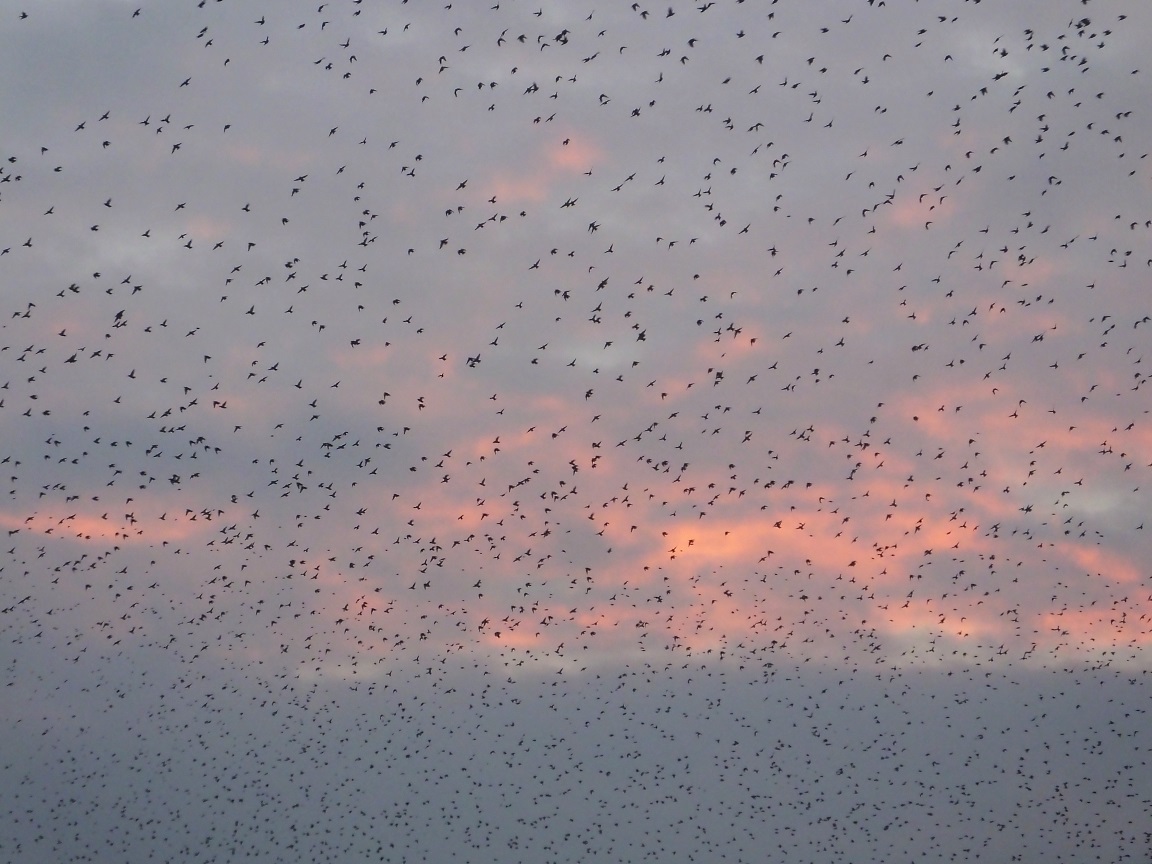
The Safari has had a look through hundreds of rubbish pics of murmurating Starlings, this one is one of the few keepers, like we said that Peregrine needs to earn its keep and get them to bunch up tighter.
We've also been looking at some of the climate facts n figures for town now that the year has rolled on. It's important to realise that one place doesn't represent the whole planet so don't be going drawing any conclusions about your own neck of the woods from our figures.
We'll start with daily maximum temperatures - and we're only doing temperatures we don't have enough rainfall figures to do the comparisons.
Also be aware that we shouldn't be comparing 30 year time-spans with a 10 year time-span.
The most obvious thing is how similar the last 10 years have been to the late 20th Century - no sign of any warming. In fact if you look at August and are over 30 years old it's true that summers were warmer in the old days.
The daily minimum temperatures are completely different and we'd say statistically significantly so! Apart from March there's no overlap at all!
So why aren't the night-time temperatures leading to warmer daytime temperatures - cloudier so that more heat is trapped at night but also meaning the sunshine can't get through during the day??? Your guess is as good as ours as to what's going on. What's going to happen in the next 20 years, where will those green lines be then?
Today we had a look for the potential nestling-feeding Blackbird but it was nowhere to be seen in the heavy rain this morning. 
The sea was a washout early on we lasted only two minutes before deciding it was too wet and visibility too poor in the low drizzly cloud. Lunchtime was drier but now there was a crazy 'heat' haze going on - it was worse than summer! But we did feel a bit of warmth in the sun which helped make our mind up about getting down on the beach.
Wellies on and off down the steps we went.
The strong low sunlight was very harsh. We soon came across some of the goodies left by the ebbing tide. First onto the memory card was a clump of Hornwrack, looks like seaweed but is actually a Bryozoan, a tiny colonial animal - you can see the empty individual holes of each animal in the second pic
A few paces further on we found a Mermaid's Purse, the egg case of a Lesser Spotted Catshark, we didn't see it at the time but from processing the pic it looks like there might well be an embryo inside.
A movement in the nearest pool made us squint for a closer look and we saw a flock of a dozen Redshanks roosting up. They are wary birds and wouldn't allow a close approach, if we'd have had a bit more time we might have laid down an inched closer on our belly for better shots.
We pushed our luck an foot too far and they flushed up on to the wall some yards further down the beach.
We were now close to the reason we wanted a look on the beach in the first place. To have a look at what the pipe engineering works have left behind and it wasn't good. The beach sand level is well down and has exposed a large amount of rubble and shingle.
It doesn't bode well for our school groups coming down to investigate the rockpool wildlife. All the lower pools are filled with shingle. We don't allow the little ones to climb the wall for obvious reasons.
Where there was life has been scoured clean by the action of the shingle in the waves, the stonework has been scrubbed clean, even the Barnacles have been removed.
And if a rock is thrown higher up onto the Sabellaria mounds it doesn't do them any good at all, they act like grindstones.
To say we're not happy about this sate of affairs is a big understatement - how can it be rectified, the sea might be able to fill the pools very easily but it's not going to be able to get the stones out is it?
To take the edge off our extreme disappointment we continued to look along the strand line. 
It didn't take long to find something a little different, a Blunt Gaper - don't see too many of these so after getting pics we pocketed it for our collection.
Also found was a fresh Rayed Trough Shell, still with both its bivalve halves stuck together and still its original unbleached pink colour.
Pretty good for a 20 minute saunter, shame about the ecological calamity, that wasn't foreseen or mentioned in the Environmental Impact Assessment document we've got on our desk.
Where to next? We'll be somewhere out on safari at the weekend and then there's the small matter of another Goldfinch survey.
In the meantime let us know who's to timid for a close approach in your outback.

Wednesday, 20 January 2016

Murmuration magic

The Safari has just seen the final results for last year’s Patchwork Challenge Inland North sub-group. We didn’t do too badly in the end coming in at 17th and only really visiting with any regularity after the demise of poor old Frank in the summer and even then only really once a week – some folks must be visiting their patches (or working at them) much more frequently making it slightly easier to record more species.
Our final position (the league being contested by number species) was 17th with 109 species earning 124 points working out at 1.138 points per bird (PPB). 
Turning it around a bit if the league had been contested by PPB we’d have come in at a slightly higher 14th.
We missed a few species but probably all those would have been 1 pointers so perhaps could have maybe increased by one place in the main league (bearing in mind everyone else will have missed stuff too) but we’d probably have dropped in the PPB league had such a thing existed.
For this year we’ll just have to find a couple of three (or more) pointers to keep in with a shout.
Today we were at Patch 2 again but there was little on a rather murky sea and as far as we could see there were fewer Redshanks today with only 25 counted, but there could have been some out of sight below us at the base of the wall. There weren’t very many gulls and even fewer Oystercatchers.

Back in the office a Blackbird out on the lawn outside the window caught our eye – was it really carrying a worm? We went out for a better view but didn’t see it. Later, once back inside we saw it again and with a colleague confirmed it was taking beakful’s of worms back to a nest – in mid-January…what’s going on??? While we watched we also saw a Robin, a pair of Dunnocks and a site record two Wrens together in the hedge! Certainly an interesting and exciting couple of minutes.
At lunchtime the sea was similarly dead to earlier but we did find a small flock of 12 Turnstones and saw a distant flock of nine Sanderlings land on the freshly exposed wet sand as the tide ebbed further down the beach. With little to enthuse us to stay longer we went for another look for the Blackbird but again didn’t see it but there were a few dog walkers about now. Back in the office we looked through the window after an hour or so at our desk and there he was again and once again had collected a load of worms, the female was out foraging too. With milder and wetter weather forecast in the next few days it’ll be interesting to see how the nest fares, it would seem that the eggs/young have survived the coldest days of the winter so far. At least they should have no problems with collecting worms from frozen ground for the foreseeable future. We’ll have to see if we can we locate its whereabouts, we think it’s in the hedge just round the corner along the side street just out of view of the office window. Further and more detailed investigations are required. Might even take a bucket of water out there to rinse the windows and we need to remember to take the camera to work, the range is just a bit too far for the phonecam. 
We did take the camera to work today and almost got the first ever pic of a Song Thrush at work but a dog walker appeared and flushed it an instant before we pressed the shutter.
The sea gave us nothing, although DG informed us that the fishermen are catching Whiting so there ought to be a Harbour Porpoise or two about. She also told us the Peregrine was back on the church tower this arvo.
That was enough to send us back to Base Camp early so as we could get back out to the Starlings - we were there yesterday too, with CR. There was a grey out with no hint of horizon betwixt sea and sky.
The Starlings began to come in in huge flocks of several thousand at a time - this is a small part of one of those flocks.

A fair crowd had gathered to watch the spectacle, on our side of the pier there were at least 20 folk with cameras, no idea how many if any were on the south side. 
It was a great spectacle 
Today couldn't have been more different, not a cloud in the sky!
 And a bit of a sunset began to develop illuminating the little shrimping boat working the tide.
 The Peregrine was still on the tower in the town centre too, a little too far away for a proper pic.
It stayed up there, wasn't interesting in the huge amount of meat on the wing, probably already stuffed full of Feral Pigeon or catches the Starlings when they leave the roost at first light - Once again there were a few people gathered for the evening's performance. 
More Starlings came in than yesterday, perhaps as many as 50000! But the murmuration was quite small, most of them landing on the beach as the tide was out. Until they were flushed by a dog walker that is.
Sunset mode on camera for this one and the one above
 We were even serenaded by a wandering minstrel this evening - it all happens here!
Didn't know you could play the guitar with frozen fingers - it became really cold once the sun had gone down!
Tell you what though- there must be some tonnage of Leather-jackets being consumed in farmers' fields around the county at the mo to keep that number of Starlings well fed


   Where to next? School group attacking the pond tomorrow, hopefully before the rain starts and we'll have another try for that worm collecting Blackbird.
In the meantime let us know who's got their breeding season all about face in your outback.

Tuesday, 24 November 2015

Short changed

The Safari has had the best views of Short Eared Owls (MMLNR #105) at the nature reserve since the early 1990's when that was the 'default' hunting over the rough grassland that is now the golf course. Now the default owl are the Long Eared Owls that sit quietly all winter tucked up in the scrub but which are unfortunately notably invisible so far this this season.
Yesterday we had a look for the one seen at the weekend with no success and not seeing very much else either apart from a good number of Fieldfares.
As darkness grew we trundled off head down against the chilly wind until we got to the wetland were we stopped for one last look for the Stonechat and BOOM - a Shorty flew though our field of view. It quartered back and forth across the wetland and then over to the rough fields further away before coming back and passing within a few yards of us, we could almost have reached out and grabbed it as it flew by looking at us with its bright yellow eyes. SU-flippin-PERBBBBBBB.
We went back today for another look. Again the reserve was fairly quiet apart from fewer but still plenty of Fieldfares and Blackbirds. Looking over the water we found two male and a female Pochards as well as a doubling of Goldeneye numbers to four, the two females being joined by our first adult male of the season and a 1st winter male.
A pink Rose has burst into flower at the back of one of the scrubby areas.
The afternoon passed and a bit of a sunset began to develop while we were at the far end so we got into the reedbed to try some arty shots, sadly the hoped for red hues didn't materialise, but you get the gist
We had a chat to the Ranger who was packing the kit away after a day's hedgelaying with the volunteers when the moon began to rise...a Goldcrest nearly landed on his head just after the pic was taken, he hadn't seen it but moved and it jinked away landing in the bushes some distance away.
As we chatted some Starlings came in and did a mini-murmuration, others had already come in and gone straight into their reedbed roost without any flying around kerfuffle. It was quite dark by now and we thought we'd left it a bit late for spotting any owls.
Off we went back towards the car past the wetland where we stood for a few minutes without any sign of the Shorty, we were just about to give up when two 'crows' started interacting high over the treetops at the corner of the reserve. We put the bins up to watch their antics only to see they weren't crows at all they were TWO Short Eared Owls. They cavorted with each other in twists and spirals well above the tree tops for several minutes before they split up and went their separate ways - those ways didn't include coming down to hunt the wetland though. 
Where to next? Last day of sick leave tomorrow so we'll try to get out somewhere.
In the meantime let us know who's doubled their numbers in your outback.