Showing posts with label perch. Show all posts

Saturday, 20 October 2018

Another morning at Marton Mere

The Safari and CR were going to have a day out on the Southside but news on the street was that where we were going to head off to was going to be seriously disturbed due to large machinery beginning work on some extensive habitat modifications - going to be really good when they're finished. However it did mean that had we rocked up there might have been little to see so Plan B was activated - go to Marton Mere, where else! Saved a few bob in petrol and a good hours traveling time too.
On the walk in through the wetlands it was three mornings out of three for the Cetti's Warbler but this time it was on the allotment side of the path rather than in the second pond along.
A Redwing called high above us and then dropped like a stone in to the adjacent scrub, also in the scrub was a flock of Long Tailed Tits which held a Coal Tit too. Then we bumped into RC and while chatting a couple of Siskins (MMLNR #85) went over us. From there we entered the reserve proper and we aimed for the Feeding Station. It was livelier than the previous couple of days with a whole pack of female Pheasants, several Chaffinches, Dunnocks, Robins, Blue and Great Tits. Mammal activity was provided by a flurry of Grey Squirrels.
A quick scan from the new Bittern viewing area didn't give us much other than a lot of Coots and certainly no Bitterns, the nearest we could get to a Bittern was a Heron stood motionless on the reed edge away on the far side of the mere.
Moving on to the Fylde Bird Club hide a pair of Mallards were asleep on the 'goalposts' and a nicely moulting through drake Teal swam past a little way beyond them.
A movement through the tops of the reeds to our right had us squealing 'Bittern' (191, MMLNR #86) in a very overexcited voice. CR fired off a burst of shots but was too eager and didn't let his lens focus on it we on the other hand fared even worse - for some inexplicable reason our camera refused to do anything.
Too eager a Bittern by CR - he won't thank us for posting this image!
The darned thing flew right past us almost giving us a wave as it went - why oh why did our camera throw a moody??? We had a little fiddle with some of the knobs and buttons and not two or three minutes later pointed the lens at a passing gull - no problems, Common Gull committed to the SD card - now why didn't that happen earlier????? So concerned were we with the state of our camera we didn't realise it was a Common Gull until we reviewed the pic to check all was hunky dory, wrongly we'd assumed it was a Black Headed Gull. But then we've told you a hundred times never assume nothin unless told to in a Maths or Physics exam and now you know why!
Two Water Rails scuttled their way through the reeds and across the gaps between them but too quickly, two Cetti's Warblers argued loudly with other either side of the hide but as ever declined to show themselves. 
We'd been hearing Skylarks all morning but some louder calls from lower birds had us looking skywards to find a flock of 10 birds coming towards us.


A couple more each of Cetti's Warblers and Water Rails were heard along the embankment but still no sight nor sound of any Bearded Tits yet.
Further round CR's keen eyes picked out a few ladybirds and then cluster of Harlequin Ladybirds sunning themselves on a fence post.
We found a few more scattered around on the surrounding vegetation too. We'd been reading about the 'Invasion of Killer Ladybirds' all over the nonsense press and social media but these are the first we've seen for some time.
It was sunny and warm by now, warm enough to bring a few butterflies, at least three Red Admirals and a couple of Speckled Woods.
Great Spotted Woodpecker and Buzzard best of the rest on a relatively quiet morning.
With time to spare and the sun out it woulda been a sin to waste it. But where to go? CR suggested Stanley Park and why not it was less than a five minute drive away. 
We walked round the lakeside looking for any Mediterranean Gulls roosting up on the rail, none again - not seen one there for far too long now, where are they all? 
Perhaps more unusual was the almost complete lack of birds along the woodland part of the lakeside walk. Out on the lake there's a huge ominous swathe of Azolla. Monty fell through it thinking it was solid 'grass' when he tried to reach someone's lost football - oops he won't be doing that again - - frightened himself he did. In the bits of open water we saw some sleeping Shovelers, several Gadwall and some Tufted Ducks.
Along the roadside we came across a Great Crested Grebe which started fishing.
And at last it was close enough when it caught a Perch for us to get our best shot of one with a fish so far.
The grebe must have still been hungry after its meal as it continued fishing for some time all in a very small area but sisn't catch anything else.
It was then we heard a Ring Necked Parakeet call from the other side of the lake so off we went. By the time we'd walked round there other birders/photographers told us it had flown off and they were interesting their lenses with a couple a couple of Grey Squirrels tucking in to food they'd pout down for them. They are very habituated to people and dogs showing no fear so we were able to frame fillers from as close as the big lens would allow, shame the sun wasn't reaching this shady area low down under the trees now.
They might be unwanted aliens and some Pine Martens and Goshawks might not go amiss but lots of folk love em and are able to interact with them on a very personal level so maybe they're not THAT bad.


Also horrendously popular are those other aliens the Ring Necked Parakeets which reappeared while everyone was concentrating on the Grey Squirrels. Yes we really do have bright green aliens - no really we really do have real aliens that are really really green.
Almost arty bright green framed by the red leaves of the maple tree
Best of the rest was a Great Spotted Woodpecker that kept itself mostly high in the tree-tops and round the wrong side of the woodwork.


Where to next? A safari up north again tomorrow.

In the meantime let us know who the well loved aliens are in your outback.


Sunday, 30 September 2018

More twitching tales and a safari to the Southside

The Safari has been a bit pre-occupied tidying up and decluttering in advance of the Base Camp move to get out as often as we would have liked but when a couple of opportunities for a twitch came up we were able to take them.
We were a little disappointed to have dipped all the Leach's Petrels during the gales the week before last so when news of a flurry of late stragglers in the form of Grey Phalaropes turning up all over the country started to appear on social media it was inevitable one would appear not too far away. So when the news broke that one was showing well at Newton Marsh just this side of Preston off we went - we'd seen pics of others showing well on Twitter and F/B which more or less meant crawling into the camera lens! This one wasn't so obliging but at least it wasn't at the same range as the Semi Palmated Sandpiper we'd seen a couple of weeks previously. A great bird to see again, our last one being in 2010 and again superb scope views but just a little too distant for great pics.
A lovely little bird that just wouldn't keep still, frantically picking flies of the surface of the water or occasionally dipping its bill right under for some morsel or other. It spent most of it's time on the far side of the little island but when it flew further down the pool and in to a clump of rushes it  was time to say bye to the fair throng of local birders and head back to Base Camp for more tidying up. It brought our tally for the year to 180 and our Photo Year List Challenge up to 163, a great little 'bonus bird' that was never on the 'radar' - we're still being stuffed by the front runners who are now about 100 species ahead.
But that afternoon news broke of another lost waif, this time just down the road at Marton Mere. A couple of juvenile Black Terns had been reported for a couple of days until one had been re-identified as a juvenile White Winged Black Tern. Fortunately it was still present the following day and in the late afternoon we were able to nip down for an hour for a shuffy. It ranged widely about the mere often hugging the Yellow Water Lily beds on the far side and then disappearing for extended lengths of time when it was discovered to have settled on the lilies. Take your eye off it for a moment and it was lost, its seemingly languid flight being surprisingly fast. 
On the odd time it did come into range we snapped away but only really got one rubbishy pic that shows hints of the diagnostic white rump and the lack of  smudgy neck mark.
Another one well off the radar coming in at 181, PYLC #164, and the first we've seen anywhere in the world in this plumage and the first since the adult we found at the same place in the summer of '93.
It was being reported as being 'not quite right' and some observers say and posting pics of it drooping one of its wings when at rest but it did seem to be flying OK and picking plenty of invertebrates from the water surface. But right at the last of the light we managed this fuzzy pic when it settled on some reeds not too far in front of us.
It shows the left wing drooping while the right wings looks fine and also the left leg is held up and might not be quite as bright red as the right one. In lots of our distant out of focus and too fuzzy to show you shots you can see both legs dangling, whether they do that habitually using their feet as extra air brakes we don't know but it could also be a symptom of an unseen injury/illness. Whatever it might have been the bird was still there the following morning but we were unable to better our rubbishy pics and the following day there was no sign so we assume it was fit enough to continue on its migration.
Also passing overhead but slowing and not dropping on to the water were two fresh in from Iceland Whooper Swans, our first of the year here (MMLNR #81) - really can't believe we didn't see any in the early part of the year! And had we stayed but a few more minutes we would have seen an Otter too.
With summer giving way to autumn and the weather following suit there has been nothing of real note on Patch 1 or in the garden at Base Camp. Until one morning in the week when we heard the loud calls of an agitated Peregrine. Looking out of the bedroom window we could see two crows on its favourite ledge but looking closely they looked big and we thought we heard a Raven cronking. Grabbing the bins a proper look revealed they were indeed two Ravens and the Peregrine was sat above them on the comms masts giving it hell - really unhappy with them in its space.
We'll miss sights like this from the bedroom window when Base Camp gets moved but no doubt there'll be other equally awesome wildlife sights to be had at the new Base Camp- we just don't know what they'll be yet...or where!
And so to Friday when we picked up GB and CR early doors and set off to meet JG at Lunt Meadows down on our childhood birding grounds over on the south side of the Ribble. We arrived first and the short wait in the car park ave us a few Jays flying over to and fro to collect or bringing back Acorns to cache for the winter. Recently arrived Pink Footed Geese could be heard murmuring in conversation the distant fields and Lapwings called their wheezy calls from the wetland between us and the geese. A serene and peaceful morning but just half a dozen miles from one of Britain's busiest city centres.
Annoyingly we couldn't get a pic of any of the Jays for our challenge - becoming a bit of a bogey bird in that respect but while looking up at one flying by we saw a weird object high up in one of the Willow trees around the edge of the car park.
A something we don't recall ever seeing before which we've discovered is Mossy Willow Catkin Gall and now we know that we're quite certain we've never come across one before never having heard of them until now. They are probably a viral infection of a catkin (caused by agents unknown) and are often green rather than black as in this case.
It was a glorious day with warm sunshine and light winds and no appreciable recent rain meant dry footpaths too. However looking at the first pool into the harsh morning light wasn't so good. But it did highlight all the spiders' gossamer trails lain across the rushes over night. The pic doesn't really do the scene justice, there were hundreds of them draped across the fronds shimmering in the gentle breeze when the light caught them.
Turning round to view the pool behind us the light was much better. Here we could see the vivid colours of the Lapwings, rue the eclipse plumage of the Teal and pick out the nuances of the speckley Ruffs.
All looking sup-duper in the bright light. 
Something disturbed the Pink Footed Geese from the fields and all of a sudden their quiet conversation became louder and more intense as the flock took to the air - what a sight, about a thousand of them, but more than a sight what a sound as they wheeled round splitting in to sub-flocks and going off in different directions - truly wonderful.
Just a few of them, couldn't fit the whole flock in the frame
Wandering on we had a look at the next pool but it was quiet there, just a handful of Mallards and a couple of snoozing Teal. The main attraction here, often very showy Short Eared Owls and Stonechats haven't arrived for the winter yet and there was no sign of any Roe Deer either, the vegetation is still a bit too summery for them to able to be easily seen yet. GB got cracking views of what sounds like a pristine Small Copper butterfly and we caught a glimpse of a Weasel darting between clumps of reeds below the hide - no amount of 'pishing' would entice it to break cover unfortunately. Far easier to photograph were these showy and stationary mushrooms sitting among the grass at the side of the steps up to the screen.
One we ought to know the name of but honestly can't remember it just now
As we were moving on to the next screen we heard the call of a Spotted Redshank and swinging round quickly and scanning with the bins caught sight of a small wader dropping on to one of the pools we viewed earlier. As luck would have it, or rather ill-luck, it was located on the one looking into the sun and was very flighty and we didn't manage a pic before it was up and away. We watched it go high to the north but it swung round and came back, we didn't see where it landed but hoped it was on the well lit pool, a long look there didn't find it and when it called again the sound came from the same place as before. We were able to get just a couple of pics of it as went up and away again this time never to be seen again.
Spotted Redshank (182, PYLC #165)
Going...going...gone
And with that so were we - back to the cars for a bite to eat. At the car park it was all go with the Jays again with no less than eight being seen in quick succession heading northwards towards the favoured Oak trees. Yet again we failed to get the camera on to any of them - bogey birds indeed!
Butties scoffed it was time to hit the road to another Lancashire Wildlife Trust reserve Mere Sands Wood to see what we could find there.
At the first hide there was a good selection of waterfowl, all now in their eclipse plumage now. But scanning around we noticed a goose on the spit showing a lot of white and closer inspection showed there to be four Egyptian Geese (183, PYLC #166) snoozing away up there.
The fourth one is out of frame mostly concealed behind a clump of vegetation to the left of the left-hand bird.
With not a lot happening and no sign of any Kingfishers around this part of the reserve, and none mentioned by other visitors, we moved on.
The light at the hide in the bottom  corner was much better, once again showing the Lapwings off superbly.
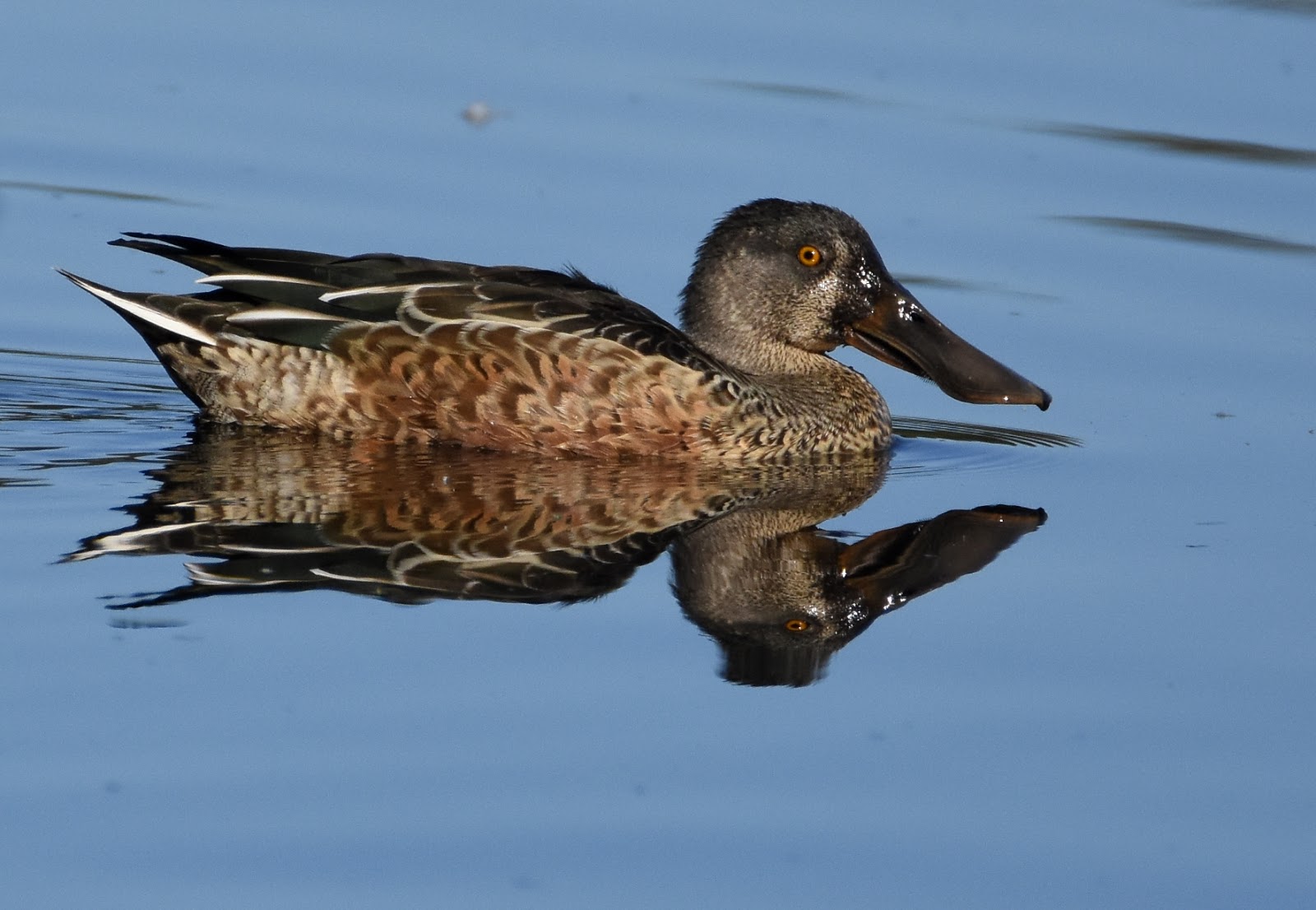
A drake Shoveler swan into view, of all the eclipse ducks these are probably the 'best' looking but that big orange eye gives them a worried look.
Again no Kingfishers for us and similarly so at the next hide, where other birders were already waiting for one to turn up and use the strategically placed perches. No such luck for us but one of the brders pointed out a Green Sandpiper he'd seen earlier when it came back out onto the open. We were pleased to get better pics of this seldom seen (by us) bird in much better light and far far closer than on our last visit here. We snapped away with gay abandon as they say.
Is the dark blob by its feet a dead vole???
Nearby a pair of Teal dozed the afternoon away.
On the way to the next hide there's  an open viewing platform overlooking a smaller pool, here we stopped in the hope of seeing some dragonflies whizzing around in the afternoon warmth but instead our attention was taken by a shoal of fish right below us. Lookin closely at them it would appear that the dorsal and ventral fins are just about level with each other and the one eating a leaf from a water plant seems to have an overhanging top lip these features would make at least some of them Roach.
A few were a little bigger than the rest maybe approaching 6-7 inches (15 - 18cm) long.
The keen ex-fisherman's eyes of GB picked out the striped back of a rather larger Perch lurking below the shoal, although the Roach weren't that bothered about its presence.
As we approached the last hide we told of lots of Migrant Hawkers at which info CR sped off passing a lovely cluster of Fly Agaric mushrooms (or are they toadstools?) in various stages of openness.
Once inside the hide we did see some Migrant Hawker dragonflies as well as at least one Brown Hawker and a couple of unidentified but probably Blue Tailed Damselfies. 
With a lot of luck one of the Migrant Hawkers settled in a hover in an open patch in the reeds long enough for us to get our best ever pic of a dragonfly in flight by a long way - still not perfect but we're well chuffed with it.
They rarely settled and when they did this was  often a 'good' view
A quality end to a perfect day on safari with great mates...but still no Jays submitted to the SD card despite several sightings and lots heard squawking  - getting beyond a joke now...

Where to next? Another further flung safari beckons.

In the meantime lets us know who's not allowing themselves to be photographed in your outback.


Monday, 25 July 2016

An afternoon in the big park

The Safari went over to the big park on Friday afternoon hoping to see some predation in action and get a few snaps of it. The main action was likely to happen up at the top end of the lake and to get there we had to walk past the 'rail of gulls'. Almost all were Black Headed Gulls and we couldn't see any wearing a ring, neither BTO type nor Darvik. Among them and standing out like a giant was this Lesser Black Backed Gull.
The Mute Swans and Mallards were as popular as ever with the bread throwing families, especially the cygnets.
We tried a few shots at the many Coots that were mostly ignoring the copious amonts of bread and concentrating on getting a proper meal of water weed. As ever they were pugnacious not letting any others of their species invade their personal space. When not eating they do seem to be in a permanent state of bickering.
Moving down towards the Conservation Area of the lake we stopped to watch a Brown Hawker dragonfly patrolling the bankside. It wouldn't stay still long enough for a pic, unlike the several Common Blue Damselflies that flitted around the overhanging vegetation when the sun came out from behind the clouds.
Even up at this end of the lake, where there is far less bread thrown, there are plenty of Mallards seemingly just loafing around chilling out doing nothing much in particular.
There was a pair of Moorhens too although these were busily on the move looking for whatever their beaks could find.
We'd come to see the Great Crested Grebe family and hopefully see the chick being fed. We found them tucked up by the island about as far from either bank as they could get. Well out of range for the 600mm lens.
We hoped that the male might come closer but for much of our time he too was fishing well out in the middle of the lake. We were patient and just sat and watched him and waited, sure enough after what seemed like an age he came within range.
After a dive he would often appear to be looking into the water directly beneath him. At first we thought he was preening but we never actually saw him touch his feathers so we assume he's looking to see where the fish are before making a dive.
He came very close a little later on.
But only caught a fish for the youngster when annoyingly he was really too far away again and making haste to give it to his hungry chick.
Near enough to be able to identify the fish he's caught as a Perch though.
For better results we'll have to spend much more time here but it was great to see the action even if our pics were pretty rubbish. 
Once junior was fed the family went for a nap under the overhanging branches on the island for a while so we wandered a bit further on. There are some regrowing young Elm trees and we secretly hoped we'd find a White Letter Hairstreak if we could find some nectar rich plants in flower. It's several years ago now but we have seen one in the big park before. We found a likely looking patch of Brambles with a few flowers still open and importantly was in good sunshine just out from the shadow of the tree canopy. We soon saw a butterfly come along, but it was a 'wrong one', a Green Veined White. We didn't mind as we've hardly seen any of this very common species this year.
It went on its merry way once topped up with nectar and so did we although we didn't go far. The next clearing has a fallen tree trunk rough hewn into a bench where a youngish lad was sat very quietly and patiently with a tub of peanuts waiting to see who might want a free handout. Well everyone and his uncle did!
BD had joined us a while back and pointed out a Black Headed Gull sat on the No Fishing sign.
It was only later once we'd gone our separate ways that we noticed the ring was from the famous Helgoland Bird Observatory in Germany.
Because the sign is a few yards out into the lake we weren't able to get the full code but between us managed to photograph enough to read 53510, there's probably another digit 'round the back'. We've reported it to the Obs so we'll let you know if we hear anything back from them.
Another Black Headed Gull was sat nearby on a broken dead branch.
Beyond him was a Heron staring intently in to the water at something obviously interesting.
A little further away under the rail two Red Eared Terrapins were basking on a chunk of driftwood. They were probably dumped as much smaller ones many years ago after the Mutant Ninja Turtles craze came to an end.
Both of them were almost the size of a dinner plate!
With the weather beginning to cool down and a hint of rain was in the air we started to make our way back to the car. We hadn't gone far when we spotted something struggling on the water, a Soldier Beetle. It was trapped by the surface tension and at any moment was likely to become fish food. After a struggle lasting well over five minutes it eventually did manage to completely unfurl its wings and break free flying off to safety before any fish sussed there was an easy meal on offer.
Under the trees we saw a commotion of small birds flitting around a tree trunk which turned out to be two Treecreepers. Was it a territorial dispute, male/female display activity or chasing off a fledged juvenile? It ended with a burst of song from one and the other hopping up the tree.
Not the best pic - heavily cropped and severely processed from camera settings looking out over the open water
Our last bit of news took us a by surprise...We have Walnut fruits this year, found on two trees we didn't know were in the park. We know of another but not near these. BD tried one - they aren't ripe yet - - 'nuff said!
The big question is will they ripen or not and can we get to them before the Grey Squirrels or BD if they do?
All this fantastic wildlife (and much more that we haven't documented) was seen in a just few hundred square yards in one part of the park and still people walked past us heads down staring at a screen trying to find imaginary creatures. Imagine if they spent that much time and energy how many real creatures with amazing super-powers they might find!
And this report from those great lads n lasses at A Focus on Nature is well worth a read to find out what direction the youngsters of today want our wildlife to go in...and it's not more of the downward spiral our generation has forced upon them!
Where to next? Back to Patch 2 tomorrow, where National Whale and Dolphin Watch has already been successful without us and a quick round up of our Scottish news.
In the meantime let us know who's keeping their distance in your outback.