The Safari was picked up by CR on dreary wet November morning last Tuesday and off we set north-bound on a twitch for a Yankee duck that had been resident on Pine Lake for a week or so. A convenient early port of call on the way to Leighton Moss. The drive up was hampered by a convoy of tractors going miles, long gone are the days when tractors only went between a few fields and the farmyard. But the slow journey did work a little in our favour as the heavy rain had just about stopped when we pulled up at the car park by the leisure complex's watersport centre.
Now where was the duck? We'd seen several pics of it against a backdrop of reeds and fairly close up too. But there were reeds along the far bank a long way away and there were flotillas of Tufted Ducks and Pochards there too as well as scattered across the large lake in all directions. It was good to see a decent number of Pochards but when we say 'decent number' it's probably only a fraction of the proper 'decent numbers' that would have been seen here 20 or so years ago.
We changed our vantage point a few yards back to wards the park's entrance to get a better view into the little bay tucked round the corner to our left. It wasn't long before C called out he was pretty sure he'd just seen and photographed the Ring Necked Duck in a small flock of Tufted Ducks, Pochard, Scaup and a Black Headed Gull. The gull would become invaluable as a marker a little later on.
Moving over to where he was stood a quick scan with the bins revealed the tell tale wide pale band just up from the black tip of the bill on one of the ducks - there it was, now to try to get a better view.
We walked round the back of the watersport centre and found ourselves between some chalets at the back of a little beach. From here we got some better views of the 1st winter male Ring Necked Duck.
It and its friends were continually diving and popping up here there and everywhere so the easiest way to keep a tab on it was to call out its position in relation to the only bird present that wasn't diving - the gull!
 |
| Ring Necked Duck (centre) PYLC #188 |
Always a little distant and the light was totally tosh we snuck closer to the water's edge during its dives using the shrubbery as cover taking care not to disturb any birds still on the surface.

That's the best we could manage before it was time to nip over the crag to Leighton Moss - will have to go back on a sunnier morning - now wouldn't that be a hardship!
So down to the saltmarsh we went. After a couple of visits when it has been a little quiet down there this morning it was busy. The Allen Hide was quickly abandoned there being little on offer but down at the Eric Morecambe Hide there was plenty of action. On our last few visits the substantial Black Tailed Godwit flock has been very distant but today they were much closer and a little agitated with them rising their heads in a state of alert and some of them readily taking flight and dropping back down again.

The reason for this unease soon became apparent when a young male Peregrine circled overhead and came whooshing down through the flock


 |
| Missed! |

Eventually, and probably knackered, it gave up and plonked itself down on a nearby fence-post whereupon the godwit flock soon relaxed and settled down to the important job of chilling out and saving energy. This gave us a good opportunity to have a rummage through them noting that some still had remnants of their rusty breeding plumage and one was sporting more bling than Wifey. Probably a regular visitor and often reported but we'll pass on the details and let you know its history when we get a reply from the ringing scheme.

 |
| Three species of wader in one pic |
Once the panic of the Peregrine had well and truly subsided some of the godwits started to mooch about feeding and one or two came close enough to point the camera at.


The Redshank had also settled down, recently a Spotted Redshank had been reported but we failed to locate it, if indeed it was still about. One of the Knot had a lovely pink suffusion on its chest, akin to the peachy wash a Curlew Sandpiper but would have been even more intense. Unfortunately by the time we'd noticed it it had settled down facing the wrong way and simply refused to cooperate!
 |
| It does have a rich pinky chest - honest |
It wasn't only that bird that wasn't cooperating - we couldn't get a 'four species of waders in one shot' as the Redshanks seemed to refuse to mix in with the Black Tailed Godwit flock.
All of a oneness there was panic again as the godwits rose en masse. This time it wasn't the Peregrine causing the grief, that was still on sat on its fence-post, but a squadron of three Marsh Harriers coming across the marsh a hundred feet or so up. Strangely the Redshanks were totally nonplussed and just carried on feeding or chilling, you'd think they were more on the size range of prey items a Marsh Harrier might prefer rather than the more frightened but larger Black Tailed Godwits.

Which brings us on to a bit of a mystery...we've seen Marsh Harriers catching Moorhen and Coot chicks, ducklings and young Black Headed Gulls to take back to their own nestlings and we're sure you have too. We've seen them taking carrion, dead swans and geese etc out on the marshes but when we think about it we've don't think we've seen one actually catch something for themselves...has anyone else and if so what. We hazard a guess it's because of their habitat; they drop on something like a Moorhen and eat it unseen in the deep cover of the reedbed when there is no need to carry it back to their own nest.
 |
| Unphased Redshank |
 |
| Two unphased Redshanks |
There was also a selection of ducks on the pool. One in particular caught our eye sleeping behind an one of the small islands. After the Peregrine had been through and shuffled them all around it was easy to relocate being so distinctive.

Initially it was reported as a Blue Winged Teal but later that afternoon that had been changed to a hybrid of some description. We can see why someone might initially think it was a Blue Winged Teal with a facial crescent like that.

Word on the street now is that it's a Shoveler x Cinnamon Teal hybrid and is from a well known duck pond across the bay. But we have a question, OK this bizarre mix is readily available from breeders of dodgy ducks so they can obviously hybridise easily and that may have happened over on the duck pond particularly if there aren't many Cinnamon Teals over there for other randy Cinnamon Teals to choose from, but, and it it is a rather big but...it appeared a couple of days before the presumed properly wild and fully American Ring Necked Duck and only a couple of miles separate them and it's not like we've been short of some properly wild westerly weather systems this autumn. The question is does this odd pairing occur in the wild over the other side of the Atlantic (and is there anything else in the mix like a Blue Winged Teal, it being a second generation hybrid) and could it possibly be from the Americas - unlikely but well...you never know...
Whatever its parentage and even grand-parentage is it's a bonny beast.


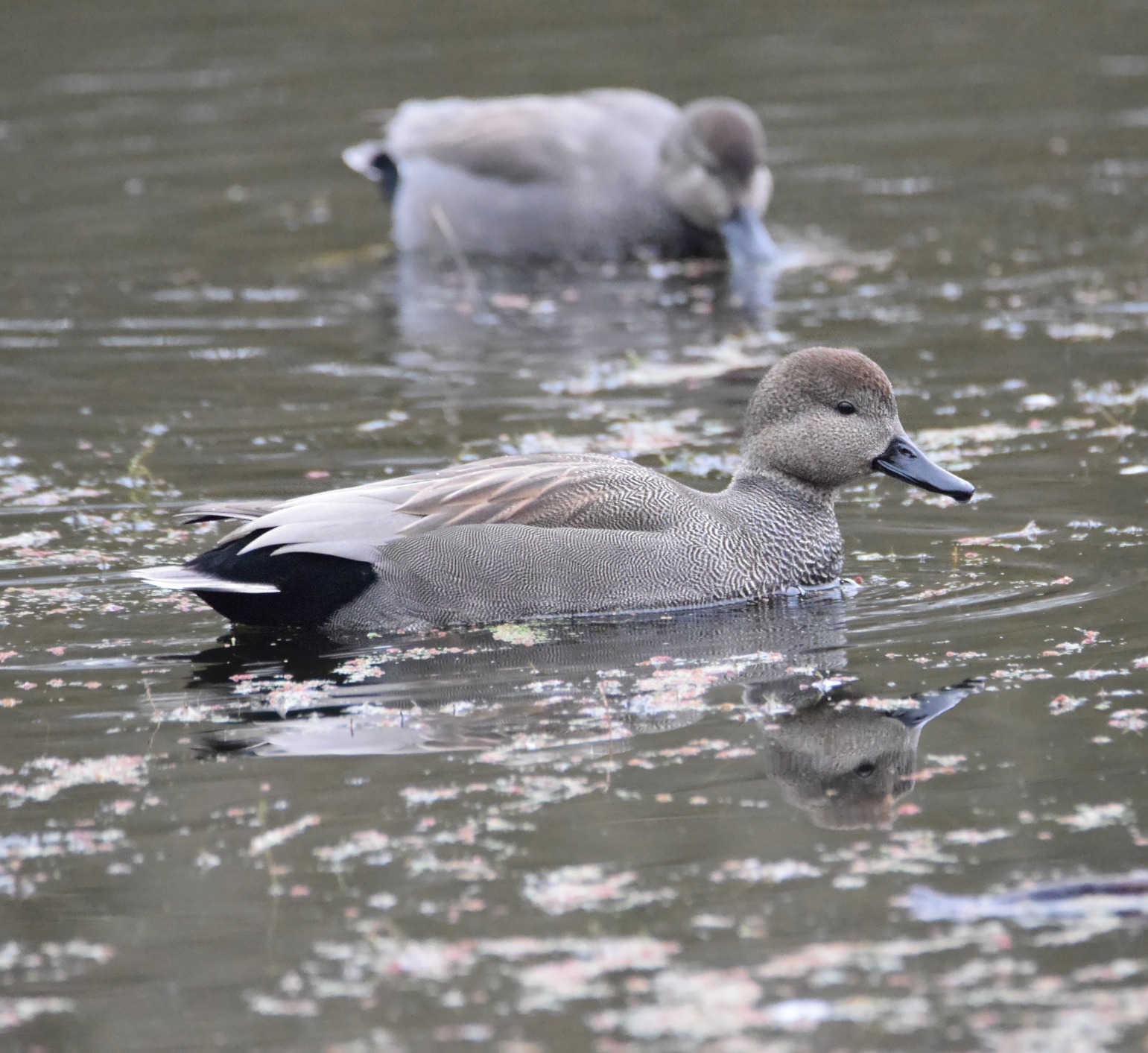
It wasn't the only dodgy duck on the pool either, lending far more credence to the duck pond theory (hypothesis) than the genuinely flew over the Atlantic theory.
 |
| Tigeon or possibly Malleon??? Take your pick |
Other birds included a very brief visit from a very distant Kingfisher and this Little Egret that fished as close to the hide as it possible to get for several minutes.

A most enjoyable stint at the saltmarsh but time to move on and have a look at the freshwater part of the reserve. We aimed straight for the Grisedale hide hoping for but not connecting with any Bearded Tits on the way, nor were there many birds around the two impromptu feeding areas along the track.
In contrast to the saltmarsh and our recent visits to this hide it was quiet even though the water level had dropped substantially since last week leaving much more muddy margins available, incredibly we could only find one Snipe!
Teal are always good value and although most were asleep odd brighter spells had them waking up moving round and even encouraging them to do some quick displaying.

The well marked male Marsh Harrier was sat on a dry patch of ground in the distance doing nothing much in particular. We searched for the Garganeys to no avail and hoped a Red Deer might put in appearance but when staff member JC came in to the hide he told us the rut had now ended and the deer were much harder to come across, many having moved off out of the reedbed and into the neighbouring woods.
Butties and pies were chomped as nothing much happened outside the window so once replete we moved on for a quick look from Tim Jackson Hide, bad light and few birds had us moving swiftly on. Just outside the hide a rather tame Dunnock mugged us for some seed. Normally they're pretty shy but not here where there's an almost infinite supply of free hand-outs if you can overcome your fear of the two-legged monsters
 |
| Only a foot from our toes...and it came even closer than that! |
Annoyingly from the path we heard a Marsh Harrier calling persistently but the tall reeds prevented us getting a good view of it, if only they would come that close when we're on the 'new' boardwalk with its elevated position giving a view over the tops of the reeds.
We stopped at the impromptu feeding station where C put down some some food he'd brought with him. Immediately birds appeared as if from nowhere. Mostly they were too quick for us, grabbing a seed and darting away. The dreadfully low light wasn't helping the auto-focus either. The only 'keeper' we got was this cute Long Tailed Tit armed and dangerous with a sunflower seed.

With the supposedly tame Water Rail being a no-show for us (AGAIN) we moved on after a few minutes. A very brief look from Lilian's Hide gave us more Gadwall than you could shake a stick at and a lot of Shovelers. We picked out a couple of female Goldeneyes but didn't try too hard to find the Scaup, after all we'd been watching some fine full adult males and well marked females at Pine Lake only a couple of hours earlier.
No luck with any Marsh Harriers from the boardwalk and no Stonechats in the field today either. Arriving at the Causeway hide we saw that good friends S & JB were already in there and gave us the low down on what was about. Mostly more Marsh Harriers and a distinct lack of Otters they said.

Once again we had three Marsh Harriers making at least five and possibly as many as seven for the day, not bad considering it wasn't that long ago that they were only summer visitors here.
When we were at this hide with the gang last week we picked up an owl pellet from just outside the door. Dissecting it back at Base Camp we found two vole skulls and a shrew skull suggesting it was probably from a Barn Owl. SB confirmed that was the most likely species as one had been seen in the vicinity in recent days.
After a good chat/reminiscence and catch up of the latest birding gossip from Leighton Moss we decided to spend the last of the light at the birdy bench just through the gate at the end of the causeway and it looked like the sun might just come out for a few minutes. C secreted seed in nooks and crannies close to the bench and we only had to wait seconds before all the usual suspects descended on it.
 |
| Blue Tit |

 |
| Coal Tit |
 |
| Marsh Tit |

The threatened sunshine didn't materialise and the light was ISO Awful (18000+) but one of the Marsh Tits kindly came and sat up higher in the bushes behind us in much better lit conditions.


And then a Robin appeared and bullied everything else out of the way, it was his/her seed now and no-one as getting a look in so with the light gone we were soon on the road back to Base Camp too.

Yet another superb day out on safari with CR and many thanks to him for all the driving today.
Where to next? Not sure yet - let's see what the weather holds, there's supposed to be a bit of serious cold snap coming our way
In the meantime let us know who's wearing all the bling in your outback