Showing posts with label solitary bee. Show all posts

Wednesday, 19 July 2017

Summertime bird lull

The Safari has been up to the nature field with Wifey and Monty in the evenings. By that time of the day most of the enormous numbers of butterflies have gone ot roost even Monty and his pals charging through the grass only manage to disturb small numbers of Small Skippers and Meadow Browns. The birds too are mostly inconspicuous except for the gulls flying over, the Woodpigeons flying about and the House Sparrows roosting noisily in the big Blackthorn thicket.
There's ususally something to point the camera at though.
And if you like beetles there must be trillions of these Red Soldier Beetles.
Ass the evening draws on small numbers of Swifts congregate loosely overhead catching the last of the rising insects. They are usually too high for the 300mm though.
Monty likes a game of rough n tumble with his doggy friends and if there's no-one about his ball will have to do.

A sunny Sunday afternoon in the garden was reallly too quiet for insects, hardly a hoverfly to be seen - where are they all??? At CR's just over the road apparently he's had Wool Carder Bees and Hummingbird Hawk Moths in recent days. We've really struggled to find subjects to point the camera at although there's always a few Lucilia Greenbottles around the bins which gave us a chance to experiment with the extension tubes.
Other than those we almost had to resort to arty pics of the flowers!
At last we found a hoverfly but it was the only one we saw all afternoon apart from a tiny black one that was being buffeted around in the wind too much for any chance of a pic.
While trying to get pics of the hoverfly a small bee was seen among its larger Red Tailed Bumble Bee brethren. Some kind of solitary bee, possibly Halictus rubicundus again.
Then 'Catch of the day' arrived. A bright yellow 'wasp' flew past and landed. Unfortunately it landed in deep shade and the camera was set up for sunny flower tops. We managed one dodgy shot and a couple of totally useless ones as it disappeared down a gap in the timbers around the pond with its prey. One of the Ectemnius species of wasps - but which one? Is that why there's no hoverflies???
It's always good to see the little flies that dance on the Water Lily leaves in the pond. They are Poecilobothrus nobilitatus.
Psyching itself up
Stretch and ready....
Going for it!
Trying to chase off a rival - the females don't have the white tips to the wings
On Monday we were office-bound but parking the car by a demolition site the rough grassy mound held an interesting variety of wildflowers and a couple of Meadow Brown butterflies, some solitary bees as well as the chirping calls of numerous grasshoppers, a great way to start a day sat in front of the 'puter.
Yesterday early morning saw us scoping Patch 2 with LGB for half an hour. We found our first Golden Plover (P2 #53) of the autumn but missed the Kestrel half a mile or or more out to sea. Otherwise it was quiet out there with just a few Sandwich Terns going back and forth seemingly struggling to find any fish although one did catch a decent sized Sand Eel right in front of us. Thinking we'd improve our Year Bird Challenge pic of a Sandwich Tern we got the camera out and they promptly disappeared leaving us the first returning Common Gull of the autumn to photograph badly instead.
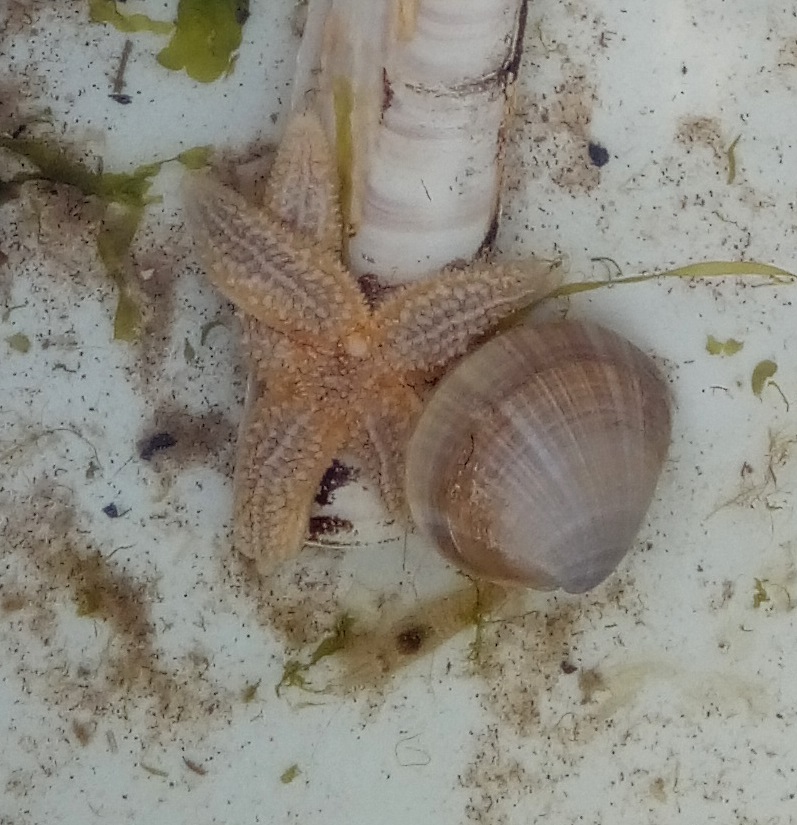
Later in the morning we played host to the local nursery kids and took them down on the beach to see what they could find. We didn't have long with them but long enough to get a few prize specimens in the bucket for them to have a look at.
At lunchtime we were joined by DW from a local beach care group and together we had a bit of a beachcomb collecting some more specimens for the afternoon's children.
All good stuff!
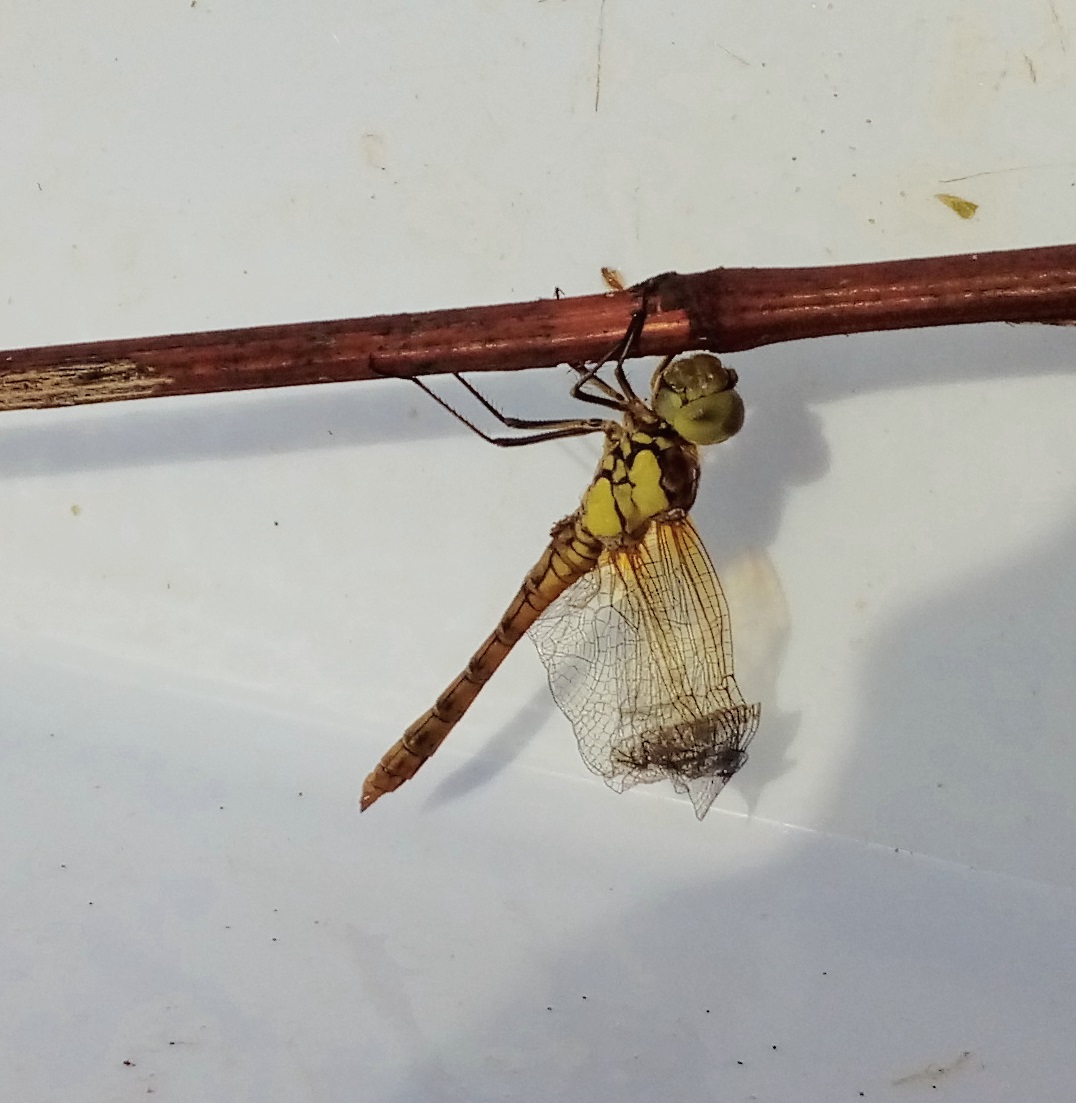
In the evening we had a group Rainbows visit the pond who found all the ususal stuff and then pulled out a dragonfly in real trouble. A strong wind had blown up in the afternoon and this poor creature must have been blown into the water while it was drying its wings. Duly rescued we put it in the last of the sunshine to dry out and then moved it to a sheltered spot where he morning sun would warm it -provided it didn't get blown away in the overnight gales.
Where to next? A day off work and a trip to the Southside on family duties but with the opportunity to do get some pics for our Year Bird Challenge.
In the meantime let us know who's on the way back in your outback.


Sunday, 25 June 2017

Rewilding in action or is it just abandonment

The Safari was out on a jaunt to the big smoke on an errand with Wifey the other day. As we were leaving we noticed something seriously odd in the town centre - the row of Rowan and Whitebeam berry-laden trees that attract Waxwings when they appear had been replaced by a length of green hoarding - we should be able to see the trees showing over the top of the boards so it looks like they've all been disposed of. Not good!
Once out of town we took Monty for a run on the dunes where he had fun and we enjoyed the plethora of wild-flowers. But where were the orchids we couldn't find a single one!
After a bit of lunch we went out to Patch 1 to see if we could find any butterflies. The wind was strong and cold so not at all conducive to butterfly counting.We found a few but not as many as we would have liked...seven Large Skippers, a 'possible' Small Skipper - had we been able to confirm this one it would have been the first of the year for us - three Meadow Browns, our first here but beaten by Monty's favourite field by a day and three Speckled Woods, no photos and no White Letter Hairstreaks either...yet.
We did find a medium sized dark solitary bee that we don't think we've ever noticed there before. If anyone has any clues as to what it might be we'd be grateful.
Unfortunately we only had our phone with us and this was the only pic of several that was in focus not being able to see the screen in the bright sunshine and all that.
This morning we had hoped to get to the nature reserve for the first time in a good while but when we got out of bad at 06.00 it was raining and blowing a bit. We did get out by lunchtime when the sun came out. We had a few targets in mind with one in particular. It was now warm but still breezy and keeping most birds in cover but some young birds were about including a family of Long Tailed Tits.

At the platform we heard our quarry but couldn't see it deep in the reeds. Moving down to the next hide we had a very fleeting glimpse so waited and waited a bit more before it, in fact they as there was a bit of argy-bargy going on,  came out again. Reed Warblers having a bit of a spat are tricky beasts to get a pic of.
Eventually, it was only a couple of minutes, we got a half decent shot for our Year Bird Challenge - Reed Warbler (YBC #141).   
One job done we set our sights on the other two targets. No such luck there though, one we saw briefly and the other we only heard singing briefly from deep in cover.
Other bits and pieces included the colourful Goldfinch.
and boisterous Reed Bunting.
As for the rewilding mentioned in the title we've got an interesting little bit going on. A while ago a development has changed the ground conditions making the Wet Fields drier and the lack of fencing not replaced by the developer has meant grazing by ponies (or anything else for that matter) has had to cease so that the vegetation is now left to its own devices...what will happen next, who will colonise?
It might have been Willows but the drier conditions my preclude them, it may be seed from the old Hawthorns but the tall False Oat Grass and Reed Canary Grass might stop any seedlings reaching the light.
It'll be interesting to watch what happens next and how long that will take.
Where to next? Back to work but we have school groups and Brownies in the pond and on the beach so there should be something to let you know about later in the week.
In the meantime let us know who's rewildling your outback.
Saturday, 3 June 2017

It's June so it's #30DaysWild again

The Safari has been struggling to get out as much as we'd like due to work and family stuff but when we have got out we have had some great sightings.
A brief look at the sea on Patch 2 the other lunchtime had us watching a flock of about 40 Gannets diving for fish. They were very distant though and the terns with them were little more than a couple of shiny white pixels in the telescope. Chasing them with ultra agility was a slightly larger dark speck, an Arctic Skua (161, P2 #51). Much closer in and away to the south was a bottling Grey Seal.
Last weekend we had a visit to the nature reserve to try to add some more species to our Year Bird Photo Challenge. We had in mind Blackcap and Reed Warbler with the hope for Swift if conditions were right. Standing nearr the end of the causeway at the wetland we had stereo Reed Warblers but in the damp and windy weather they were staying low in the reeds and we couldn't see them. The slightly iffy weather did mean there were parties of Swifts moving through most of the time we were there but trying to get a pic proved difficult especially as we were on the wrong side of the light for photographing fast moving dark shapes against a pale background. Male Blackcaps seemed to be singing from every other bush but again we didn't see a single one.
Along the reserve's embankment we managed a pic of a singing Reed Bunting but the numerous Reed Warblers down there still eluded us, one teased us by showing well at the edge of the reeds for a few second, until we raised the camera of course.
At the bridge we were slightly better positioned with regard to the light to get some Swift shots, which we did. (YBC #137)
Crikey they're tricky! So flippin quick!!! Eventually we got the pic we wanted but at ISO stupid it's still not perfect
With Swifts in the bag and little else doing we went round to the big park to look for the Treecreepers. We're not sure there's any left in there after so many of the larger trees full of nooks crannies and niches have been removed but word on the street is there is still one pair left. Of course we didn't find them but did see a few cheeky Grey Squirrels demanding peanuts from everyone passing by.
A trip out to the countryside with Wifey and Monty had us failing to find any of the hoped for Tree Pipits, although the time of day was wrong. There were lots of lens voiding Siskins but no Green Hairstreak butterflies, we might have missed those by a week or so, it was a lovely afternoon so they should have been on the wing.not far away there's a lovely riverside walk where we took Monty for a splash to cool off. While he was playing in the very low stream a Grey Wagtail dropped in on the rocks on the far bank to collect food fore its youngsters.
Back at Base Camp thundery weather brought screaming Swifts (Garden #27) into earshot but they were very very high. That is one of the quintessential sounds of summer but has sadly just about gone from Base Camp now. A decade ago it was heard daily with small flocks racing round the rooftop in the evening the last couple of years we've heard them  just once or twice a summer and the wheeling flocks are long gone - very sad and our home life is very much the poorer because of their loss. young children growing up round here now will never know them and think that is normal - all part of the Shifting Baseline syndrome and collapse of bio-abundance.
Best not get too maudlin as there is still some great wildlife to enjoy, what we need to do is appreciate and cherish it so that the baseline starts to shift upwards rather than downwards and the biodiversity we keep hearing about becomes ever more abundant.
At Base Camp male Greenfinches have suddenly appeared gorging on the sunflower seeds they've ignored all winter - there must be some broods of chicks not too far away.
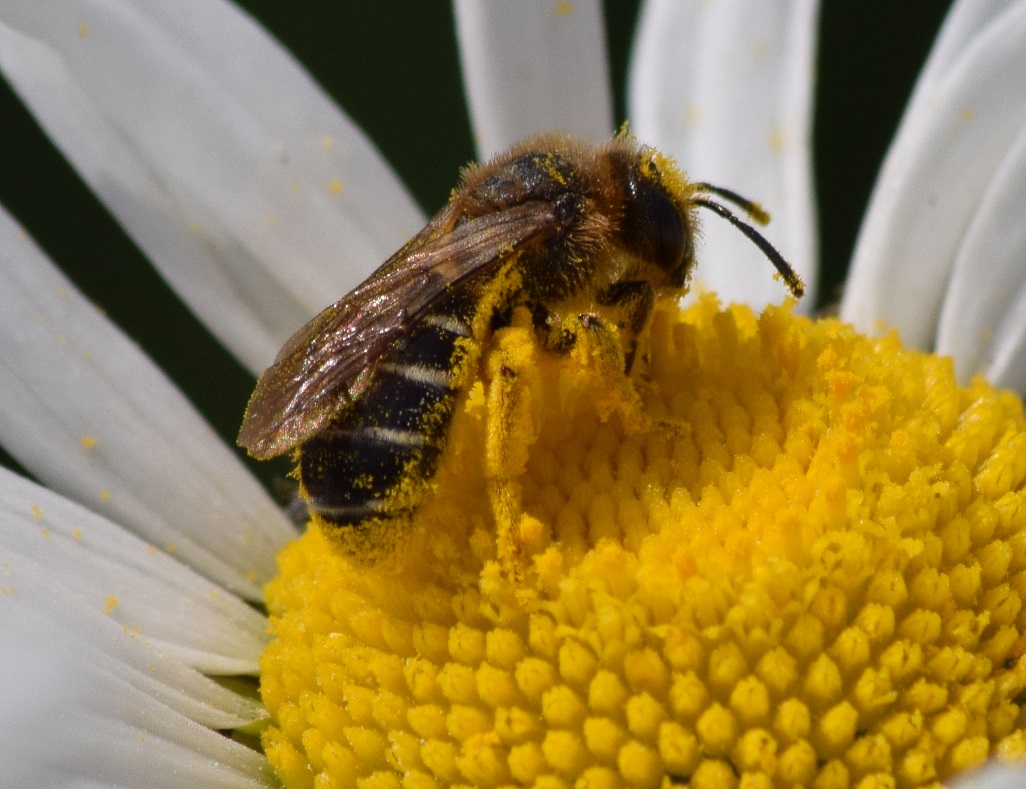
And at work we spotted a tiny Nomad Bee/Potter Wasp buzzing around the Ox-eye Daisies went to get the camera but it had gone never to be seen again by the time we got back. We did see a different solitary bee collecting pollen from the Ox-eye Daisies.And by eck did it collect a lot of pollen!
At first we thought it was probably Colletes daviesanus but it was eventually identified via Twitter as Halictus rubicundus by none other than Steven Falk, author of the recently published field guide to bees. Amid the drivel, nonsense and adverts on social media it's great to have almost instantaneous access to real experts who are willing to give their time and expertise to help out anyone who asks.
It's now June and once again the wildlife Trusts are asking us to find and explore our inner wild and share our experiences on social media. With all the guff around the General Election it's a blessed relief to have some uplifting posts about people interacting with wildlife braking up the time-lines. Only one of the parties mentions the environment yet without a healthy environment to support us all their other policies and especially GDP so loved by the tories (SPIT) are nothing - why can't they see that???
So show the politicians of all persuasions that the environment is important to you by getting stuck in to #30DaysWild and sharing your experiences.
Here's some of the suff we've come across so far
Mating Small Whites on Meadow Cranesbill in the work's wildflower area
What's round the next bend? Let's explore
This beautiful lady was!
Yes we do have a licence to molest them like this
There were also a couple of Toads and a single Smooth Newt under that piece of rubbish. Always worth turning over anything that's been lying around awhile but remember to turn it back once you've finished.
Yesterday afternoon we took a half term family group down onto the beach to do a bit of rockpooling, their best find was this huge Mermaid's Purse
Eggcase from a Thornback Ray
Where to next? We'll be out looking for something wild today - what will it be??? We hope you'll be out in your outback looking and sharing too.
In the meantime let us know what you've already #30DaysWild-ed