
22nd of May is International Biological Diversity Day. This year the theme is Alien Invaders.
From the Convention on Biological Diversity
“Invasive alien species are plants, animals, pathogens and other organisms that are non-native to an ecosystem, and which may cause economic or environmental harm or adversely affect human health. In particular, they impact adversely upon biodiversity, including decline or elimination of native species - through competition, predation, or transmission of pathogens - and the disruption of local ecosystems and ecosystem functions.
Invasive alien species, introduced and/or spread outside their natural habitats, have affected native biodiversity in almost every ecosystem type on earth and are one of the greatest threats to biodiversity. Since the 17th century, invasive alien species have contributed to nearly 40% of all animal extinctions for which the cause is known (CBD, 2006).
The problem continues to grow at great socio-economic, health and ecological cost around the world. Invasive alien species exacerbate poverty and threaten development through their impact on agriculture, forestry, fisheries and natural systems, which are an important basis of peoples’ livelihoods in developing countries. This damage is aggravated by climate change, pollution, habitat loss and human-induced disturbance.”
While the safari was out getting photos of the multitude of aliens found in these parts we came across this Robber Fly which looks quite alienesque, also looks like it has recently emerged as its wings don't appear to be completed inflated.
 As for real aliens probably the one people are most familiar with is the Eastern Grey Squirrel. A lively addition to the garden but has managed to displace all the native Red Squirrels in this part of the world.
 Many people don't realise that Rabbits are an introduced species. Recently it has been discovered that they were brought by the Romans in the early part of the 1st Century AD. The earliest remains being found in Norfolk and dated with pottery to c2000 years old. Previously it was thought that they were brought in shortly after the Norman Conquest in the 11th C.
 Are they a good or bad addition to the UK fauna? Farmers don't like them for obvious reasons but they do provide food for Red Kites, Buzzards, Stoats and other larger predators. Their grazing also keeps vegetation low allowing birds like the rare Stone Curlew to nest. But the can change the composition of wildflower areas by selectively grazing out the more palatable species.
Possibly the most destructive mammal that has been introduced is the domestic Cat...cute in the home but a killer outside and because they are full of Whiskers Supermeat. They rarely eat what the kill AND have caused the demise of the spectacular native Wild Cat by genetic extinction except in the wilder most remote parts of the Highlands of Scotland.
 All manner of species have been introduced. The Rainbow Trout is a popular sport fish but has escaped from fisheries and is now common in many lakes and rivers.


Amongst the introduced birds Pheasants are very common and despite huge numbers being released on shooting estates as game each year there would probably be a self sustaining population.
 My favourite introduced species is tha Mandarin Duck for several reason. It is from China hence the name but it also looks like a Mandarin Emperor, and face on it has the comedic look of Yosemite Sam with those huge gingery whiskers. Unfortunately it wasn't tempted by the loaf of bread I threw at it and stayed rather aloof from the ensuing melee of Mallards.
 The ornamental waterfowl theme continues with a grotty pic of a sleeping Egyptian Goose. This species hasn't taken off in such away as the Canada Goose has and probably has little environmental or ecological impact.
 On to plants. Below is the infamous Japanese Knotweed. Capable of growing through solid concrete including roadways and footings of houses...it'a almost indestructible! There are several patches on the local nature reserve but thankfully it seems to be spreading only very slowly.
 Himalayan Balsam, on the other hand, is a much more recent invader to just one waterway but has spread along it at an alarming rate. It has beautiful pink flowers which have a heady scent of honey and are well liked by bumble bees which are currently having a torrid time. The problem with Himalayan Balsam is that it out cometes the native bankside vegetation and quickly creates a monoculture. In the second picture you can see it has ousted a patch of Nettles, no mean feat but no good for native bugs...and it is currently Be Nice To Nettles Week. (16th - 24th May each year)

 With HB one years seeding is certainly seven years weeding!
New Zealand Stonecrop is the bright green plant smothering this pond. Again it is almost impossible to eradicate. The current view is to carefully dig a new pond nearby and use the excavated spoil to bury the invader - drasic indeed!
 The north American Water Fern was introduced as an attractive pond plant for gardens and very quickly escaped. This is only a small patch as a weevil has been discovered that eats it and is commercially available to control it. The pond where the pic was taken was infested with it last summer so the weevil must have done its work well.
 The last pic I have of an alien invader is one of the safari's favourite 'target' species Fallow Deer, how fickle we are! We like this one because its big! Brought in to be hunted by those Normans again now fasirly widespread across the UK.
 Where to next? That sea looks good today but I'm stuck behind the desk at work...doh...
My favourite introduced species is tha Mandarin Duck for several reason. It is from China hence the name but it also looks like a Mandarin Emperor, and face on it has the comedic look of Yosemite Sam with those huge gingery whiskers. Unfortunately it wasn't tempted by the loaf of bread I threw at it and stayed rather aloof from the ensuing melee of Mallards. The ornamental waterfowl theme continues with a grotty pic of a sleeping Egyptian Goose. This species hasn't taken off in such away as the Canada Goose has and probably has little environmental or ecological impact.
 On to plants. Below is the infamous Japanese Knotweed. Capable of growing through solid concrete including roadways and footings of houses...it'a almost indestructible! There are several patches on the local nature reserve but thankfully it seems to be spreading only very slowly.
 Himalayan Balsam, on the other hand, is a much more recent invader to just one waterway but has spread along it at an alarming rate. It has beautiful pink flowers which have a heady scent of honey and are well liked by bumble bees which are currently having a torrid time. The problem with Himalayan Balsam is that it out cometes the native bankside vegetation and quickly creates a monoculture. In the second picture you can see it has ousted a patch of Nettles, no mean feat but no good for native bugs...and it is currently Be Nice To Nettles Week. (16th - 24th May each year)
 With HB one years seeding is certainly seven years weeding!
New Zealand Stonecrop is the bright green plant smothering this pond. Again it is almost impossible to eradicate. The current view is to carefully dig a new pond nearby and use the excavated spoil to bury the invader - drasic indeed!
 The north American Water Fern was introduced as an attractive pond plant for gardens and very quickly escaped. This is only a small patch as a weevil has been discovered that eats it and is commercially available to control it. The pond where the pic was taken was infested with it last summer so the weevil must have done its work well.
 The last pic I have of an alien invader is one of the safari's favourite 'target' species Fallow Deer, how fickle we are! We like this one because its big! Brought in to be hunted by those Normans again now fasirly widespread across the UK.
 Where to next? That sea looks good today but I'm stuck behind the desk at work...doh...
In the meantime time let us know what aliens have invaaded your outback.


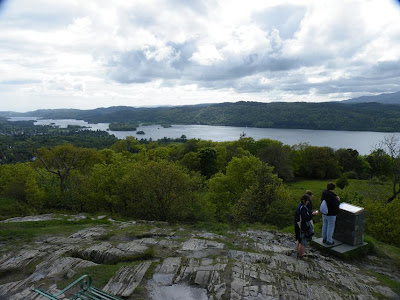
 The highest point of the hill behind is Todd Crag a minor summit on the low fell Loughrigg, but a stunning vantage point despite its lack of feet and inches.




 Predatory Frog eying up its next meal.
 Me n Frank - not allowed to enter the field of sheep to check out a pond so we take a well earned rest instead.


 We have had anti-glare mirrored film fitted to the windows and he could see his reflection in it and was distinctly unhappy - attacking 'himself' every so often, hence the futtering.


 And Mr Linnet was keeping a watchful protective eye on her.


 This is the brand spankingly newly refurbished Western Train tram immediately after its official (re)-inauguration. Can anyone else remember Casey Jones and the Cannonball Express...a steamin' an' a rollin'... whhoooo...whhoooo...
