Monday, 1 June 2009

No need to go far

The safari was unfortunately trapped at Base Camp due to a vehicular malfunction (still unresolved!). We did have a treat for you but you will now have to wait until the end of July. We had to stay at home and look after Frank and the Pipster.
The garden at Base Camp is only small but is still a fine and dandy place to watch all manner of wildlife.
A hot sunny day with a clear blue sky and a slight breeze; the hum and murmur of bees and hoverflies were the only sounds. Couldn't hear the multitude of planes going over five miles up.


A Large Red Damselfly held territory over the pond seeing off the smaller Blue Tailed Damselflies.
The Blue Tails manage to breed in the pond despite the four huge Golden Orfes and the three Goldfish.
The Large Red needs to find a friend but it still an unsolved mystery as to where they appear from. Someone not to far away must have them breeding in their garden pond.
The moth trap was fired up over night and although far from bulging in the morning it was the best haul of the summer so far. below is one of the two Clouded Bordered Brindles.


This one is Dusky Brocade - don't you just love moth names!


And this little beauty is a Dark Spectacle. A very nice moth we've not recorded at Base Camp before.
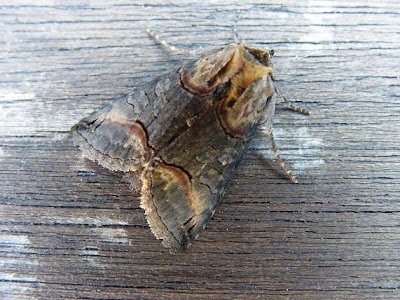
He has a super little tuft.


And yes; he does wear glasses!!!


Painted Lady butterflies continued to pass through and there was a succession of Large Whites with a few Small Whites thrown in for good measure. Best butterfly however was a Holly Blue which seemed to be attracted to my lolly-ice but which eventually after much flittering around landed not on the ice cream but my hand and proceeded to sip the perspiration from my finger tip with its tiny tongue...it was so delicate I couldn't feel it as it walked arounfd the end of my finger...wow - but no camera, although if I had have moved I would probably have disturbed it anyway. But all that time I was still nibbling away at the lolly-ice - well I couldn't let it melt 'cos that would have made me all sticky.
A short trip out with Frank revealed a few spikes of Common Broomrape, a parasitic plant which has no need of photosynthesis and so has lost its green chlorophyll.

Plenty of Bush Vetch was in flower.


But best of all was spotting this budding Bee Orchid...the first we've managed to find in several trips despite there being several rosettes in the winter months. Have to wait until next week when we'll find all the ones we've missed easy as wink when they are in full flower. There is usually a good show at this site.

Again there were a lot of Painted Ladies, a Green Veined White, a couple of Speckled Woods and the safari's first pair of Common Blues of the summer.
Back at Base Camp it was getting pretty hot by mid afternoon and the animals had flaked out.
Frank flattened the Thrift as he found the only bit of shade in the garden.

Three Swifts screamed around overhead but I don't think they have spotted their new nest box yet. They seem to be quite scarce this year so far.

The plastic Coot is the worlds best garden pond ornament. He was left all alone in the shop as everyone went for the more colourful ducks...but I like Coots, definitely one of my favourites.


And he provided a bit of shade for a new Frog. This one is much bigger than the usual one that lives in the opposite corner of the pond.

Nicely marked with those blotches.


So there you go - trapped at home but still lots to see..and there was loads we didn't bore you with.
Where to next? Vehicle permitting there could be some good midweek safaris coming up.
In the meantime let us know what's lurking in your back yard.

Saturday, 30 May 2009

Painting

Been painting the garage doors today watching the Painted Ladies wafting past. 'Hundreds' coming in off the sea while out with Frank both yesterday and still coming today. The biggest insect migration in living memory - glad to have witnessed it.
Sorry no photos - covered in paint so not picking the camera up.
Where to next? Nowhere Land Rover has pulled a muscle aka broken down....oooohhhh nooooo!!

Thursday, 28 May 2009

Extreme weekend

Some of Raf's Extreme Images from the weekend's safari.
We told you in the last post Broad Bodied Chasers were emerging all over the place!


Two on one Flag Iris stem is just too much. Note the wings in different stages of pumped-up-ness.

The lower one was asking to be gently handled.

This is the one the paparazzi were homing in on. Well we had to join in didn't we.

Mating Wall Browns.

Mating Robber Flies, Raf thinks they're Scorpion Flies...he could well be right.


La piece de la resistance....absolute stonker!!!!! You should see the full 8MB version of this...oh joy!!!!

Where to next? The safari still has something up its sleeve for the weekend.
In the meantime let us know what is out there in your outback that can be classed as stonkingly brilliant

Tuesday, 26 May 2009

Summer at last; but will it last?

A most enjoyable safari exploring the Morecambe Bay limestones on a warm, sunny, summery Sunday.
The day started well with a Bullfinch only a minute out of the car park and as we climbed higher out of the lower woods the wildflowers were superb.


This little fella is Rock Rose but most of the yellow in the picture is Birds Foot Trefoil.


Some extensive scrub clearance work we saw will benefit the rare Fritillary butterflies next season, but at the moment the bare area look perfect for reptiles. But despite the warm sunshine we saw no sign of the elusive critters. While we were looking for them we saw this stunning Cinnabar moth, its bright colours warn potential predators that it is extremely poisonous and they shouldn't be temted into an easy meal.


While we were get close up and personal with the Cinnabar a spanking Pearl Bordered Fritillary landed almost on the adjacent flower demanding our attention and lenses!


why do they have/need such a bizarrely patterned eye. During the course of the safari we saw a few Green Veined Whites and Large Whites, and this rather early Painted Lady - there seems to have been a huge invasion of these that day with many blogs all over the country reporting them in numbers -


Other butterflies included a mating pair of Wall Browns and the most Small Heaths the safari has seen for a good few years. This is one of the Walls.


Having said all that the most numerous butterfly of the day was the Pearl Bordered Fritillary and probably outnumbered all the others put together, excluding the abundant day flying moth Yellow Shell -very welcome news.
In the higher woods we were hoping to find Green Woodpecker probably the target species for the day after any reptiles. No luck, but we did come across this strange hard globular fungus called appropiately King Alfreds Cakes.

Throughout the woods there were individual Early Purple Orchids and the odd nice patch of them too.

A Sloe Shieldbug was a good find, probably looking for any Blackthorn bushes that hadn't been cut down to open the habitat for the bigger, brighter Fritillaries.

At the very top of the hill, which was an Iron Age fort, there is a beacon. This was erected in 1988 to commemorate the 400th anniversary of the defeat of the Spanish Armada. Before the Armada sailed hills across the length and breadth of the country had beacon fires built on them to be lit if the Spanish landed an invasion force - of course Drake made sure they didn't and the beacons were never lit.
This beacon is infamous in that years ago one of my mates thought it would be a great idea to climb in to it - no mean feat! It was only then he discovered it was much harder to climb out of! Great fun to watch his antics as he tried to extracate himself from his predicament without breaking his neck. Did we help? Did we heck - to busy rolling around laughing at him!
Moving off the hill and in to a damp meadow we found lots of Ragged Robin in flower.

The ditch running through the edge of the meadow looked perfect for Grass Snakes but by lunch time on a warm Sunday to many heavy footed people would have walked past and any self-respecting snake would have made itself scarce - that was our excuse for not finding any! We did see a mating pair of Robber Flies though.

Time to visit one of the UK's rarest plants, the Lady's Slipper Orchid. There were only two of these left in the country. The other, in Yorkshire, I visited slightly illegally many years ago - still got the photos - this one may well have been planted here in Victorian times (the same Victorians who 'collected' = dug up, all the others). There are moves afoot to make them as common in Lancashire, Cumbria, and Yorkshire as they once were. Excellent news!

It is an absolute stonker.


Along the path to the orchid a princess was giving the paparazzi somewhere to point their long lenses.
So where is it and what is it? Here...

And this...

A rather nice female Broad Bodied Chaser. Very nice. There were several flying around in the afternoon heat.
They were emerging from a nearby pond and were getting in to all sorts of trouble, this one nearly got trodden on...and was duly photographed from the driver's seat.

This is the furthest north I have seen this species...gee it's getting warmer all the time...
While this was being photographed a new species for the safari fluttered by...a Dingy Skipper, not the world's most exciting butterfly but a tick is a tick.
A chat with some locals revealed the presence of a small colony of Green Winged Orchids not far away. So the Land Rover was duly pointed in that direction...and well worth the detour.
Below is a pale pink form. The green wings refer to the stripes on the sepals.

A great day's safari-ing with a supporting cast of ultra close views of a Raven chasing off a Buzzard, Roe and Fallow Deer in the woods, but unphotographable thanks to hordes of holiday weekend daytrippers, and even a Great Spotted Woodpecker hopping around on the ground frustratingly like a Green Woodpecker.
Where to next? OOOOHHHH fun, fun, fun next weekend...you'll have to wait and see what we get up to.
In the meantime let us know how good your outback has been recently.

Saturday, 23 May 2009

World Turtle Day

Today (23rd May) is World Turtle Day.
A real treat to see one of those along our cost but they have occured in the 21st Century
We have had two, both were at the end of 2001. I can't remember the last time I noticed we had an influx of jellyfish but it could have been then. We must be due another one soon so keep your eyes peeling this summer.


The following is an extract of the information from these two strandings; the full document can be read at


UK & Eire Marine Turtle Strandings & Sightings
Annual Report 2002
R.S.Penrose. January 2003


A Loggerhead Turtle (Caretta caretta), that live-stranded on Preesall beach, Blackpool, Lancashire on the 29th November 2001 was driven to Weymouth for rehabilitation under the care of Julie Ions, Bio Services at Weymouth SeaLife centre.
Advice on rehabilitation techniques gathered by TIG, was forwarded to Julie and after nearly 4 months the turtle, now named ‘Shelly’, was successfully released back into the warmer waters of the Canary Islands on the 19th March 2002. Again, the kind assistance International and Gran Canaria state veterinarian Pascual Calabuig made the repatriation possible.
The event was documented by the TV programme “Pet Rescue”
'Shelly' being released back into the warmer waters of Gran Canaria by Julie Ions.
The photo courtesy of: Bournemouth News.


Originally reported and recorded as a Loggerhead Turtle (Caretta caretta). The carcass had stranded at Knot End near Blackpool, Lancashire on the 30th December 2001.
The turtle was kindly stored at -20 C at the Fleetwood Museum until collection for full examination could be arranged within the DEFRA led ‘Collaborative UK Marine Mammal & Marine Turtle Strandings Project’.
Under post-mortem examination at the Zoological Society of London, the carcass was found to be a Green Turtle (Chelonia mydas).

On further examination a fragment of plastic was found lodged in the oesophagus together with other items of plastic in the stomach including a large fragment (approx. 10cm x 5cm) of blue balloon.
The entrance to the intestinal tract was completely blocked by seaweed, feather shafts and fragments of plastic. Cause of death was given as oesophageal impaction and stomach impaction resulting from ingestion of plastic.
At the time of stranding this animal represented the fifth recording of this species since 1748.


Beach litter soon turns into marine litter and becomes a serious problem! If anyone is considering having a ballon 'race' please, please, please don't.

For any one wanting to know more about what is regulary seen on our beach please go to

http://www.fyldecoastmarinelife.btik.com/

Where to next? The sky is getting darker and squallier and lunchtime approaches..the sea is beckoning.

In the meantime let us know how many turtles there are in your outback.

PS did see one once - Shark Bay WA.