Tuesday, 18 August 2009

Hazy sunshine...clearing...20C

With a forecast like that the safari set off in the early hours for the Lake District National Park. The drive up was uneventful and very quiet on the motorway. The lanes near our destination had a lovely selection of wild flowers including Field Scabious, Meadow Cranesbill and lots of Meadowsweet. Not many birds about except for what seemed like half the world's population of Pied Wagtails. The woodlands in this area still have Red Squirrels but they either hadn't got up at this ungodly hour or were hiding from the 'hazy sunshine', not that we stopped to search for them but I have seen then cross the road using high level branches before.

In the car park, at Mardale, (where there used to be a village - under the water before the rocky outcrop with the trees on the left of the lake - the remains are exposed when the water level in the reservoir, Haweswater, is low),and at he start of Gatesgarth Pass (more about that later) brewing up for a cuppa at 8.30.Then we were on the hill before 9 o'clock but there was no sign of the promised hazy sunshine, hazy heavy drizzle more like it. Still the weather is set to improve so off we trotted towards the valley of the Golden Eagle, Riggindale.
A distant Raven's deep croaking broke the morning air...things were looking up...literally! Round the first corner a family of Stonechats who just would not sit still.
I apologise now for any more telephoto shots that are a bit dodgy and any pics with drips of 'hazy sunshine' on them. The field behind the wall he is sat on had a decent patch of Sneezewort.

Sorry there's no close up, but I wasn't prepared to jump over the wall in to the morass on the other side for you today so you'll have to look it up on Google Images if you so wish.

On with the trek and the path skirts the bottom of a very steep boulder and scree strewn slope with a few stunted but probably very old trees. This used to be a good place to look for Ring Ouzels but as their numbers have crashed recently I don't know if they are still here - not been to this site for over ten years!A couple of Meadow Pipits and Rabbits were all we could find on the hillside and we heard a Goldcrest in the conifer plantation on the lakeside. It was here that we discovered that Frank likes sheep and when he isn't allowed to chase them he eats their droppings- the dirty dog! Talking of dirty - first rant of the day coming up - why on earth throw away a disposable nappy up here on of he most ruggedly beautiful parts of England.

Why not let your little one do its business away from the path and let some fresh mountain air get to their little backside rather than all those nasty non-biodegradable chemicals. And what is the recommended way of combating Swine Flu? Yes sneeze in to a tissue and BIN it - not CHUCK IT ON THE FLOOR where the sheep will pick it up and infect us with a mutated Sheep Flu double whammy. If you brought it - in take it out!!! Sorry about that but there may be more rants to come - it was a good day - honest...

Much better than nappies were these Harebells.

Absolutely delightful in the 'hazy sunshine' don't you agree?

Continuing along the path we come in to RiggindaleWhere Golden Eagles fly - well only one hunkers down against the weather actually.There are at least six Red Deer in this photo - honest - they are on the far fell side above the highest part of the diagonal wall - you'll never see them they were difficult enough through the 'hazy sunshine' with the bins.

Up on the side of the valley there is more old woodland and still no sign of any Ring Ouzels. No sign of any anything really. If the sheep were fenced out of these woods they would probably start regrowing. Most of the bleak treeless landscape in today's pics was originally wooded and c(sh)ould be again.

The 'hazy sunshine' got much heavier so after only a short Eagle hunt we headed back. He wasn't on his usual perch under the Hawthorn bush high on the flanks of Kidsty Pike and you couldn't make anything out on the nearer left hand crags were the nest site has been in the past and there was no chance of seeing Twopenny Crag at the head of the valley so turn back we did. On the way we passed the old hut the wardens used to sleep in, but it now falling in to disrepair. It did have a nice Wheatear on what's left of the roof though.
We retraced our steps as far as the nappy but it was too early to consider leaving. We couldn't stray far as we had left a note in the car as to our whereabouts so we made a short detour and headed up the well made but seemingly little used track towards Blea Tarn to see what we could find. A Buzzard was the nearest we got to any Eagles.
Looking down at our feet - important in mountainous terrain - the wet boggy areas held patches of Butterwort, not in flower unfortunately. This is an insectivorous plant, and where it occurs there is a good chance of the other more bizarre insectivorous jobby...and there it was a Sundew. Going hungry by the look of it, not a stuck insect to be seen.

Anyone any good with Heathers? Is this Cross Leaved Heath? It was everywhere but I'm not so good at montane plants, I seem to have forgotten most of what I learned when I lived up this way 25+ years ago.That's the end of the wildlife shots - just scenery to follow. No shortage of it in Mardale. Gatesgarth Pass winds it way up and over the fellside behind the square block of conifers in the middle distance - got to be England's best road. At the moment it is closed to traffic for repairs - lets hope it does eventually reopen. I haven;t driven it yet and would like to take a safari over it to Kentmere via Long Sleddale one day - a cracking tricky technical drive. Used to be able to drive from Kentmere to Troutbeck over the Garburn Pass ( a track I helped repair in the early 80's for vehicles) but no longer its been closed. Might go up and have a look how its looking now some day soon.Meanwhile back in Mardale!
A beautiful little water chute in Mardale Beck.As the path climbs higher you get a good view of one of my favourite glacial features, drumlins - aka 'basket of eggs' country.You also get a view of where Gatesgarth Pass goes from this side of the valley.

I think it's on those zig-zags that the worst erosion has occurred.
The other pathway from Mardale leads over the Nan Bield Pass directly in to Kentmere. At the top of this pass are weird little bee-hive like shelters. Didn't get anywhere near them today so again if you're interested patch in to Google Images. The water is spewing down from a high level tarn, Small Water, set in a dramatic cwm, or corrie.In this telephoto pic you can just about make out some hikers - on the left hand side level with the big waterfall. 45 degrees above them below the bottom of the dip in the fell is the erosion scar along the footpath. No-one seems to be advocating banning pedestrians from the fells yet they do as much, or probably more, damage than a few 4x4s which use the area. Discrimination is a word that springs to mind. I used to walk all over these hills, and have even spent a very very cold night in one of those little shelters, but am no longer physically able to do it so why do those that can feel they have to stop me! Much of the alledged damage done by wheeled traffic is no doubt due to the fact that the CROW Act closed over 90% of green lanes so the remaining <10%> get all the vehicles.Rant over; enjoy this view of Blea Water in the hazy sunshine. Blea Water emanates from Blea Tarn, slightly bigger and slightly less dramatic than its smaller neighbour, but not by much. Wonder if I'll ever be able to make the climb up again now. no chance of driving as this route has never been for wheeled traffic, ponies yes so if I could learn to ride properly I might still be able to do it. (would need to borrow someone's horse as I don't have one - you don't say!)
Frank is still checking out those sheep in the 'hazy sunshine'.
But he does get to cool off in the icy Mardale Water. Why did he need to cool off the temperature barely reached 15C all day?
On the way back we chased a Grey Wagtail along the road through the woods. Plenty of Swallows around some of the farms still and a huge female Sparrowhawk speeding low over a field with its beady eye on some poor unfortunate.
Home at last and sound asleep in the hazy sunshine - no actually - this was taken in some real hazy sunshine yesterday afternoon - it's still raining outside!

Where to next? Somewhere a bit drier perhaps.
In the meantime let us know what's lurking in your mountainous misty outback.

Sunday, 16 August 2009

Grotty weather = short safari

Grotty weather indeed! Cool, windy and with a high probability of rain so the safari decided not to travel far, just a short walk.
Short but rewarding.
We soon came across this nest of Yellow Meadow Ants.

Continuing the yellow theme there was a large area of Autumn Hawkbit, or is it Hawkweed?
This late Cinnabar moth caterpillar is half yellow but wholly poisonous.Proper poisonous is this Ergot fungus growing in a Timothy head. Ergot poisoning gives the victim hallcinations, the active chemical is the precursor of LSD, and affects the peripheral circulation so much so that blood vessels are so constricted that gangrene occurs and the digits start to fall off, and then the victim dies. Very unpleasant and formerly fairly common in some areas.Continuing the 'black' and fungus themes we have Tar Spot Fungus on Sycamore leaves. An indicator of clean air.Red Admiral butterflies are more black than red. Don't recall ever having seen one basking high up in a pine tree before.
No theme suitable for the rather boring underside of a Small Copper butterfly. Not particularly numerous at this location and always nice to see. The upperside is much brighter.
Also had a small family party of House Sparrows but the photos didn't come out and a teneral Common Darter which was to alert for us to get anywhere near.
Where to next? A trip further afield if the weather is better.
In the meantime let us know what's just round the corner in your outback

The last day...

The last event of National Marine Week and more of the same. A bit of fishy family fun and games indoors. "Here's one I made earlier"

And then there was a whole shoal of recycled fish.
Then it was back onto the beach to have a good rummage in the rockpools. There are thousands to choose from, where do you start?
I climbed up to the higher levels hoping to find a Starfish for the kiddies but kept finding Beadlet Anenomes, they are far more common than we imagined.
Even found one open. Sorry about the picture quality, will have to go back with a waterproof camera for a proper underwater shot.
This afternoon's best shell find was this 3 inch (75mm)+ Common Otter Shell, no idea where it gates its name from. There were also a few contenders for the Longest Pod Razor competition - results next week.
Victory was snatched from the jaws of defeat in the Starfish stakes by one of the mums. Not the largest Golden Sand Star we've ever found but no a bad one by any stretch.
Then the weather closed in and it was time to make a run for it before the heavens opened.


And that was the end of the fortnight that was National Marine Week!
Where to next? Back to more terrestrial habitats and wildlife I think.
In the mean time let us know how wet the wildlife is in your outback.

Friday, 14 August 2009

What a difference a day makes.

The safari was back National Marine Weeking again today, the penultimate event. Like yesterday we started with a look at the SeaLife Centre’s rockpool they had kindly put together for us. Their staff had been busy finding a different set of creatures for us to look at including a rather large and fearsome looking Edible Crab.
Out on the beach the weather wasn’t as nice as yesterday and some idiot had put his shorts and sandals on so as he could venture in to the water net in hand. The southerly wind which you would expect to bring warm weather didn’t, rather the opposite today. The number of people enjoying a day on the beach was far fewer than yesterday. Just these hardy souls.

Although we were on the north side of the pier we were only a couple of hundred yards away from where we were yesterday but, somewhat surprisingly, the difference in the numbers and types of shells found on the beach was significantly lower today. There did seem to be a far greater proportion of Banded Wedge Shells, nothing like as many Rayed Trough Shells, very few Razor Shells and Pod Razors (competition is still open - there are two days left to find the longest on the beach...great prizes for the winner!) and only a small number of Common Cockles with no Prickly Cockles at all. This side of the pier had some Sea Gooseberries, something we definitley didn't find on the other side. How do you photograph something that is totally transparent?Top left - Banded Wedge Shell, top right - remains of a Whelk sp, bottom left - Striped Venus Shell, bottom right - Beadlet Anenome, bottom 'centre' - Baltic (Thin) Tellin.
In the sea we could only find Brown Shrimps, but there were hundreds of them and some a decent size, and a single small fish. Sadly, no sign of my new favourite crustacean, Iphinoe (see yesterdays post for a pic).
There had been reports of large fish, if you call 2-3 inches large, being seen in a pool left by the tide right under the sea wall. This had to be investigated. Yes there were a lot of small fish but could we catch them in the knee-deep water. They zoomed off in all directions, even diving into the sand in front of the nets.


Very few were actually caught and those that were were only very small ones. Again we netted a lot of Brown Shrimps. The submerged ‘steps’ (they’re not steps - they are in fact ‘wave energy dissipaters’) at the bottom of the wall was the most lucrative place to trawl. Green Shore Crabs of all sizes from tiny, millimetre wide, specimens to this full grown monster were dragged out of their hiding places.


Some had just moulted and were still soft, known as peeler crabs to the fishermen who would jump at the chance to have them for bait.
A reasonable sized clump of live Mussels had secreted about it this Beadlet Anenome,


not as colourful as the South Shore ones seen last weekend but another good find none-the-less. As was this Wendle Trap Shell,


which is listed as ‘rare’ along this coast in the first Fylde Coast Marine Life Project’s first guide book. It was the very last find of the day; just as we were putting every thing back in the water it fell out of the same clump of Mussels in which we found the Anenome.
Again we found small lengths of the Lancashire Biodiversity Action Plan species, Knotted Wrack. In fact there was very little seaweed on this section of the beach.
A cold day out compared to yesterday but still full of exciting new finds.


Where to next? More rock pooling tomorrow…perhaps the last of the summer.
In the meantime let us know what’s hiding in your sandy outback.

Thursday, 13 August 2009

A sandy expanse of nothing?

Before we hit the beach our good friends at the SeaLife Centre had put together a touch tank with a lovely variety of rock pool inhabitants for us to look at. Their knowledgeable assistant led us through the relationships between the different animals and possible food chains. After we had thoroughly explored the indoor pool it was time to hit the glorious summer sunshine outside. What a great day to be on the beach!
Armed with buckets, trays and nets are veritable army of young explorers were encouraged to search out as many different shells and other living, or at least was once, matter. The safari set about dispelling the myth that the beach is a just a sandy expanse of nothing.
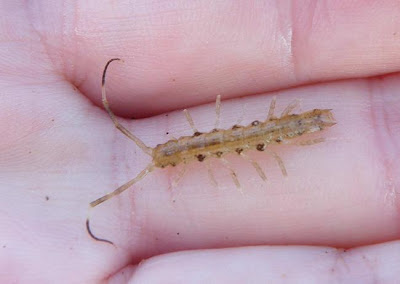
Before long the carrying net was bulging with ‘treasure’ plucked from the sand. Once we reached the surf the sampling nets were eagerly and expansively deployed. Large numbers of Brown Shrimps were hauled in along with a rather weenie Prawn and a tiny little fish, possibly a Blennie. To be honest I’d never heard of Iphinoe (I. trispinosa) before, yet countless thousands are living quietly in the sand only a few hundred yards from my desk at work.

The predatory antics of the Moon Shell were appreciated by the young audience to the cries of ‘euuchh’ as they learned how the animal drills its way in to another shell and sucks the dissolved innards out. There were plenty of shells on the beach showing the tell-tale small hole indicating the attack of the killer Moon Shell.


White Piddock shells aren’t at all that common but being so chalky white they are easy to spot.

A good selection of all sorts of shells was found.


As the tide was coming in one of our eagle eyed spotters saw this Masked Crab emerging from the sand, perhaps a couple of minutes too soon.

If we hadn’t have picked him up, it is a him – look at the length of those pincers – a seagull (no such thing - thay all have 'proper' names!) would have done and that would have been curtains for him.
The seaweeds included the Lancashire Biodiversity Action Plan species Knotted Wrack .

and one which we learned wasn’t actually a seaweed but a colony of tiny plankton feeding animals, a Bryozoan, called Hornwrack. Can you guess which one it is?

That’s right the colourless in the one centre. It’s colourless because being an animal it doesn’t photosynthesise.
Also in there is the obvious to spot Purple Laver which is the ingredient for the Welsh dish Lava Bread. My favourite is the bright green one bottom left, Enteromorpha intestinalis, or Gutweed, so called due to its flimsy tubular structure.
Altogether we found almost 40 species in the walk out to the tide and back amongst the holiday makers. A pretty good morning’s safari. The rest of the hundreds of people enjoying the sunny beach probably had no idea there was so much wildlife to be discovered under their feet. If only they’d looked more closely at this ‘devoid of life desert of sand’.
Where to next? More of the same tomorrow but this time we’re heading north on Central Beach rather than south. Will it be the same creatures or will there be significant differences?
In the meantime let us know what’s lurking in your deserted desert outback.