Sunday, 9 November 2008

You like the new logo?

Hi all, it's a miserable cold, wet and windy day in sunny Blackpool today. So it's time to change the safari's logo. Many thanks to Glen's sister from all the way Down Under for the design.
Where to next? If the rain lets up I could well be tempted to take the safari to see if the Long Eared Owl is showing at Marton Mere nature reserve.
Tomorrow I have the Porpoise skeleton to decapitate...someone wants the skull for their educational display. Probably have to let plenty of air out of the Land Rover's tyres to avoid getting stuck in the soft sand. Mud terrains tend to dig in to, rather than float over, soft sand.
In the meantime let us know what you have found in your outback

Friday, 7 November 2008

Life’s a beach and then something dies!

An impromptu safari today along the strandline. There were two Grey Seals, one of which was the first I’ve ever seen actually hauled out on the beach here. It had the ‘doggy baskets’ i.e. was fidgeting trying to find the comfiest position. In comparison to a nearby Great Black Backed Gull it appeared to be fairly small but was unlikely to have been a Common Seal as these are extremely scarce along our coast. A pack of approaching dogs had it quickly waddling back in to the sea, if a seal can move quickly. Just offshore were 12 Great Crested Grebes fishing behind the surf. That’s a decent count for our stretch of coast.

A Peregrine Falcon cruised past over the beach about 100 feet up then suddenly dropped and sped down the gullies between the sand banks hoping to surprise a wader. The waders it could have had a choice of were several Redshanks, more Oystercatchers and four Sanderlings.
Away from the sea wall there is an area of natural(ish) dunes. Some like the one below are in good condition showing good active growth of the Marram ( or Starr - as in Starr Gate) Grass.

This dune is damaged by the wind the Marram Grass roots have been exposed and will die off if the sand doesn't slump down and rebury them.

Marram grass can withstand being buried by upto a metre of sand a year. as long as the tip of the grass is poking out of the sand it will grow. The trouble happens when it gets trodden on and is broken. Then as itt lies flat it gets buried and can no longer grow and so dies off. If you're ever in the dunes take great care where you are putting your feet. In the words of generations of 'Park Keeepers - "Keep Off The Grass!".

If the damaged dune doesn't recover storms and further pedestrian traffic can allow a 'blow-out' to form. This one looks like a glacial U-shaped valley.


In areas which doen't get trampled at the 'toe' of the dune embryo dunes form.


It is not usually Marram Grass that is the pioneer species, this embryo is Sea Lyme Grass.


This one is Sea Couch with a bit of Marram at the back.


As soon as a small amount of sand buuilds up, in this case caught by a piece of dead Gorse one of the pioneer grass species can start to get established and a new dune is formed.


Moving along the strandline in front of the dunes there were a couple of Pied Wagtails pecking about after any insects they could find. The strandline mostly consists of small bits of driftwood, grass blown off the dunes during storms and loads of plastic bottles etc.


In amongst all the little bits are the odd large pieces of driftwood washed down the local rivers. This piece is riddled with Shipworm.


In the background is one of the marine nightmares, of which sadly there is a lot along the beach - nylon rope and fishing nets.

I came across these tracks in the sand. I've no idea what might of made them. The tracks of what was probably a Pied Wagtail is over the top of them so they may have been made during the night. The tracks either started from or finished at this little hole. Any one got any suggestions as to the maker.


Whelk's egg cases are a fairly common find.


This piece of unattached Marram Grass could be blown against an obstruction in the strandline and start building a new dune.


Back at the base of the sea wall there were few Meadow Pipits beadling about on the Bladderwrack (seaweed) I was unable to turn any of them into a scarcer Rock Pipit.

It was very peaceful with only the calls of a couple of Skylarks over the beach and a distant curlew out over the sea breaking the silence. In the runnels left by the tide there were hundreds of tiny Sand Gobies (see earlier blog ‘Salt & fresh today’ from 19th August). On the sea itself we managed to pick up a solitary Guillemot and somewhere in the region of 500 Common Scoters. These looked surreal as if they were floating in the ether of the ‘white-out’.


And well what died?


Sadly this is all that's left of a Harbour Porpoise.

If anyone finds a dead or stranded live cetacean along the Lancashire coast please let me know either through this blog or at the Solaris Centre.


Not bad for an unexpected safari.

Where to next? You’ll have to wait and see.

In the meantime let us know what you have found in your ‘outback’.

Wednesday, 5 November 2008

Autumn glory

Just had to share this superb Blackpool sunset from the other day with you all . It isn't often we get a perfect cloudless sky with the right atmospheric conditions that produces colours like this. The pictures are straight off the camera - no photoshop, no nothing - just nature in the raw.


The bird, a Black Headed Gull - which incidentally never has a black head, it's chocolate brown, and at this time of year is nothing more than a 'black' spot on the side of the head - would have made a better photo if it was flying in to rather than out of the picture; but that's possibly being a bit pedantic as I never even saw it in the viewfinder - smack on the artist's 'rule of thirds' - total fluke!!!

There was a Grey Seal about 200 yards offshore this afternoon. Anyone not following BBC's Autumn Watch can catch up with breeding Grey Seals on their website (see links on right). They don't breed along the Fylde coast so our chap today may well be a none breeder. (I'm not sure if they breed on Walney Island across the bay, anyone know the answer to this?)

Autumn is also the time for mushrooms and fungi. These are all growing in the raised flower beds at work quietly decomposing the woodchip we use as a mulch to retain moisture and keep the weeds down. I've no idea what any of them are I just like 'em.


The holes in this large white one were made by tiny black slugs.


This brown one is being ''eaten alive' by a blob of white mould - a fungus eating a fungus.


Where to next? The chance would be a fine thing but with the recent light north easterly winds set to continue the sea is flat calm and this gives the perfect opportunity to look for Porpoises if time allows during the day. Fingers crossed, I've not seen them since early September.
In the meantime let us know what you have seen in your 'outback'.

Monday, 3 November 2008

All muxed ip!

Today's safari was just a short afternoon trip out to Marton Mere nature reserve on the east side of Blackpool. There were a few plants flowering that really shouldn't be. These Dandelions are supposed to be spring flowering. If they come up in your lawn or flowerbeds leave them, don't 'weed' them out they are a superb source of nectar for bees and butterflies emerging from hibernation after the winter. Dandelions are so called because their leaves (bottom right of the right hand flower) look like lion's teeth - French for teeth = dents (the dan bit) French for of = de, the French for lion = lion teeth of the lion; 'nuff said! The French don't call it by this name but refer to its involuntary diuretic qualities! Wet-the-bed.
We also came across the grass Yorkshire Fog, a summer flowering grass.


We also found Timothy, another summer flowering grass - sorry about the earthquake if you live in Mere View or have you started to slide in to the bed of the old Marton Mere.


Ox-eye Daisy is another spring in to summer flowering plant. So called because the flowers are so much bigger than the daisy found in lawns and other short grassy places.

During the recent pond construction this chunk of Bog Oak was excavated from the peat. It is from a tree - not necessarily an Oak, possibly an Elm - that fell in to the swamp about 4 - 5,000 years ago.

Below is Field Maple. This small tree turns the most beautiful pure yellow in the autumn. This one is not quite there yet.

Some of the fencing rails at the side of the path have been up for about 15 years and are beginning to weather nicely; some have even started to become habitats in their own right. This particular one is providing a handy hold for this yellow Lichen.

Moving round the reserve there is evidence that there was actually some decent weather this year. The Apple Trees and Dog Rose bushes are covered in fruit; not indicating a hard winter to come but a warm spell when the bees could get out and pollinate last May. Below are the Rose hips. At school they used to be crushed to make itching powder, something that is probably seriously frowned upon in today's risk adverse, no fun world.


The Apples are a huge food supply during the winter for the birds and mammals on the reserve. Thousands of them get blown off the trees as windfall. These are eaten by Foxes and small mammals which can't climb into the trees. However, many are picked off the trees by people, there are tracks leading to every Apple Tree off the path. This is really stealing from the wildlife. The birds prefer to feed on Apples still on the trees as they have a better view to see if any predators are approaching. They have to last the wildlife until the insects start emerging next April! If you want apples buy them from the shops - don't steal them from the wildlife that needs them to survive the winter!
One of the species reliant on them is the migratory thrush the Redwing. There were a few about today along with Blackbirds.


Silver Birch trees stand out amongst their companions at this time of year. To the left is an Oak and to the right is an Ash. In amongst this stand of young trees was a small flock of Long Tailed Tits. Despite scouring the nearby bushes we could not find the Long Eared Owls. They are becoming something of a bogey bird for the safari.

Hogweed was another summer flowing plant still going strong. Gorse too is still flowering. Although 'they' do say that kissing goes out of fashion when the Gorse stops flowering! On warm sunny days the yellow flowers smell strongly of coconuts; but don't get your nose too close - its very prickly.

At one of the hides the water looked to be terribly polluted. Fortunately this isn't an oil spill from an engine but natural oil from decaying plants in the reedbed. A Chiffchaff briefly darted around the edge of the reeds

The reserve's feeding station was very busy with a good mix of birds and a lone Rabbit. The birds included Chaffinches, Great Tits, Blue Tits and a single Coal Tit.

As dusk began to fall we moved round to look over the water. a good selection of birds included the reserve's first Goldeneyes of the season. Little Grebes, a good flock of Gadwall and a solitary lost Pink footed Goose, flying over calling plaintively, were the highlights as we watched these Grey Lag Geese climb the grassy bank in front of the hide. In the fields to the east a huge flock of Starlings was gathering and eventually moved in to the reed bed to roost and was joined by others all the while. In the end we guestimated 89,000 had come in to the reserve to roost. Despite all that 'meat on the wing' there was only one Sparrowhawk that didn't hang around and a single Kestrel that was more interested in mice, beetles or worms. So we didn't get the awesome sweeping cloud formations of synchronised 'escaping being the unlucky one' flights!

Just before it got fully dark we moved on to the embankment hoping for a Barn Owl to show. They usually come out at that point when it is too dark for us humans to be able to see colour. Sadly it didn't appear, or perhaps we were a few minutes too early. We did have good views of a fine male Stonechat in the last of the light.
Making our way back to the Land Rover we were still hoping for a sighting of either the Long Eared Owl or the Barn Owl or even a Bittern flying over the reedbed towards the Starlings and a night time feast but we were unlucky. The sunset, however, was worth the trip out on its own!
Not a bad haul for a short, afternoon only, safari.

Where to next? That Ross's Goose is still flitting around Lancashire, and then there's the bogey Long Eared Owls, and I learned today that a Cetti's Warbler has turned up at Marton Mere so there's loads to go at.
In the meantime let us know what you have found in your 'outback'.

Monday, 27 October 2008

Calling International Rescue....Discovery 1 is Go

Not a wildlife safari this time. We left Base Camp at dawn and headed to the Yorkshire Dales. After a whole day and night of torrential rain the River Lune had broken its banks in many places.
Ribble Head viaduct is a feat of 'navvy' engineering.

Water was gushing out of the hillsides all over the place, what were normally little rivulets had become torrents.

This small spring being a perfect example.


Deeper into Yorkshire the River Ure beyond Hawes had also broken its banks.
This lady from Holland was trying to get to the Newcastle ferry and come to watery stop. We gave her a lift back to the nearest village shop, bearing in mind it was still before 8 o'clock on a Sunday morning. Hope she found someone to help and got going again.
Eager to reach our rendezvous we surged through the flood - only to reach another where it was impossible to tell where the road was and where the river was - nothing for it but to turn back and find a detour. This bow wave is on the return and is not as neat as my first pass. Maximum depth of water was just above the bottom of the door! At this point one of only two raptors we saw all day flew over - a Buzzard.

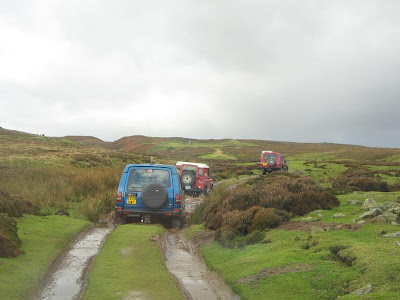
From the higher vantage point of the detour lane we could see the small linear fields each with its own barn that typifies the Yorkshire Dales.The start of our Green Lane drive took us in to a disused quarrying area. easy enough driving but I haven't had the opportunity to try out the biodiesel on anything other than tarmac until now - 'how would it fare under pressure?'

So far so good no worries about the bio it has plenty of power, perhaps a bit too much as I was consistently catching up the car in front despite driving mostly just above tick over. He did have extra passengers which would have made him heavier but I think it more likely that the bio is more calorific than normal diesel.


The start of a long steep climb with a tricky rock step at the top, all the group managed it without too much problem. One disadvantage of having a tow bar is it hangs low and catches rocks with horrible crunching sounds.

The tricky bit was just above this beautiful spring.


Lunch stop was at this stunning viewpoint. Looking down (or is it up?) ??dale because, by now, not having sat nav and not being familiar with the Dales, I was totally lost.

The picture below shows a perfect example of an old farm lane formerly used by horse and cart or for droving stock. The walls show the 'through' stones (the dark line half way up) very well. These support the upper portion of the wall. It is A shaped being about 3 feet wide at the bottom tapering to 1 foot at the top. The walls were encrusted with lichens and in damper areas moss. Our favourite was a particularly splendid bright reddy orange lichen. Also shown well is the divide between the fell top and the 'inbye' in the distance. The inbye is the managed farmland with field boundary walls showing the signs of improvement where it is green as opposed to the rough grazing higher up.

River crossings are always fun but this one was much less tricky than the flood we'd already encountered on the way. (Twice!)


The overnight rain had created plenty of opportunities for big splashes but driving to rashly can cause unnecessary erosion so it was gently gently through the puddles. If you want to make a splash go to your nearest 'pay and play site.


We had the distinctive flat top of Ingleborough Hill in our sights. We had it surrounded, it was to our left, our right, in front of us and behind. The only place we didn't get was to the summit - no vehicular access and rightly so.
This very steep rocky decent ended as you will see in a bit of a drop off.Mind the step. If your 4x4 is fitted with side steps take them off, they will be broken off when you come across an awkward bit like this.


Side slopes are probably the most hair raising bit of the drive. This one is quite moderate. My co-pilot and photographer in chief had her eyes closed and hands tightly gripping the grab rail on the more extreme ones. Black mark for letting go of the camera. The 200 foot drop on her side didn't help matters


The last river crossing of the day was watched over nonchalantly by this pair of geese.


Many thanks to Colin and all the team at UKLandrover Events (see links on right hand side) for a great day out. And big thanks to to the other participants a day of great camaraderie...and not forgetting star of the show, Lucy the Labrador.
No problems what so ever with the biodiesel. Total mileage for the day 200 of which about 40 off tarmac in low ratio. Fuel used c.30litres - 5 litres normal (26kg CO2) 25 litres bio (6.5kg CO2). Footprint for the day = small (Less than most of the ramblers out that day probably). Other people out enjoying the sunshine and showers (including a bit of early sleety rain) a few ramblers, three guys on trials bikes and some mountain bikers one of whom gets the medal for fastest man of the dales - I've never seen a cyclist go so fast...he was whizzin'.

Where to next? Local trip probably...but there is still the Ross's Goose on the south side of the Ribble.
In the meantime let us know what you have seen or where you have been in your 'outback'.