Showing posts with label Comma. Show all posts

Thursday, 30 August 2018

More deer

The Safari was able to meet up with CR again for a short afternoon safari out to Brockholes Lancashire Wildlife trust reserve the other day. Weather-wise it was a very pleasant late summer afternoon but there was a chilly breeze when you got out from the shelter of the trees, on the other side of the trees it still felt warm enough for mid-summer. 
We had a couple of target species we hoped to catch up with and in the lee of the trees in the sun out of the wind there were plenty of dragonflies on the wing which was a hopeful sign that there might be a Hobby about during the afternoon.
Common Darter


Our other hoped for species wasn't on show from the 'Visitor Village' so we had a look at the fish, either Roach or Rudd, showing well a foot or so beneath the feet of some inquisitive ducks close to edge of the deck. With no sign of our quarry we moved over the main track to have a look at the other large pool, it was here we discovered that the wind was rather nippier than we'd expected. Brrrr...
CR spotted that some of the nest holes in the Sand Martin nesting bank had been boarded up, a bit like the windows in our (now long gone) local pub when we lived nearby. But the reserve manager later informed us that the Sand Martins aren't hooligans but the plastic tubes holding the sand have collapsed and could trap the birds inside so it was decided to cover them over to prevent any accidents. Five of the holes were used this season with the bulk of the colony still using the natural bank on the river a few hundred yards away.
Looking the other way much of the Willow that had taken over the low islands has been removed by the volunteers, extremely hard work apparently and to keep said Willow at bay we spotted an unusual visitor to the island, a small flock of Hebridean Sheep.
They should be hardy enough to stay out there most of the winter and when they've eaten all the stuff they really like they'll get munching on the Willow and hopefully next spring the island will be in peak un(or lightly)vegetated condition ready for the onslaught of breeding waders.
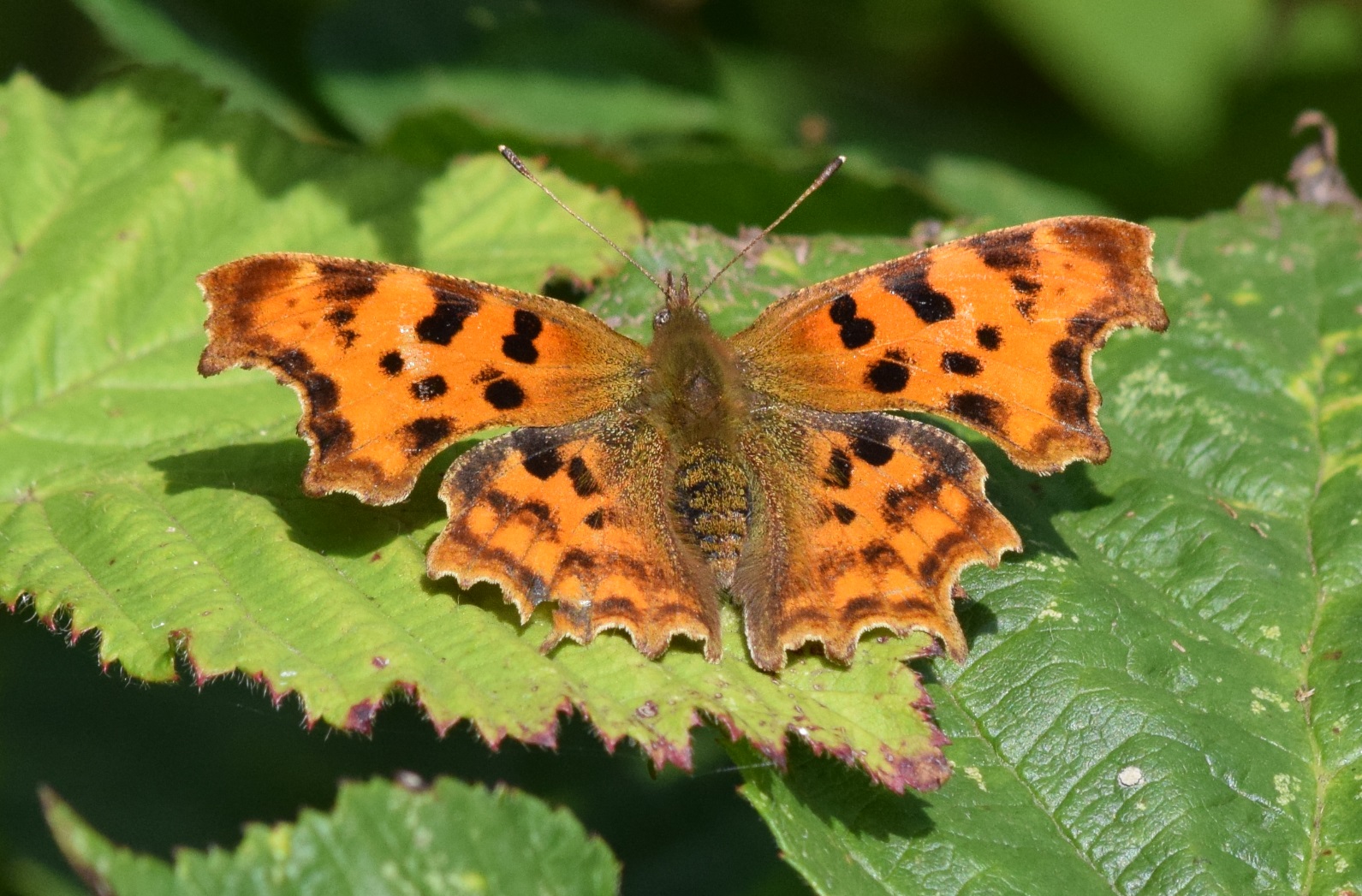
We'd soon had enough of the cold wind and got back to the sunny side to warm up. Here the glade was alive with butterflies and dragonflies including this Comma doing its best to look like one of the shriveling Bramble leaves.
 It did eventually open its wings, gorgeous aren't they!
A Green Veined White was close by too, making up for not being able to get a pic of earlier - well we got several pics but they were all bway beyond awful and the delete button was happily used.
Crossing the road we had a look at the main pool, sadly much of it is smothered with New Zealand Pygmy Weed, probably something the reserve team can do little about - effective biological control will be the answer if a suitable organism can be found, but on a drier patch we did see a couple of Little Ringed Plovers (174) scooting around some rocks close to the water's edge. We took a shed load of pics but at the range and with the heat haze the delet button was needed to excess again.
Something caught our eye to the right - how did we miss it earlier??? A Roe Deer was out grazing on a little island. We've not seen many of these lovely mammals this year so to have extended views of this one out in the open was a real treat.
It did however give us some cause for concern when it turned around and we saw large areas of missing fur, we're not sure if this is normal or not, it certainly doesn't look it but perhaps it is only moulting as the exposed skin doesn't look to have been broken or cut.
After a few more minutes it wandered off Stage Right and had we turned up then we'd have never have know it was there, it just melted into the thinnest of vegetation and out of sight.
A few yards further on we had another opportunity to get some more pics of the Little Ringed Plover, again serious squinting required and you'll just be able to see a hint of a white brow-line and pale eye ring.
Squint hard! Little Ringed Plover (PYLC 154)
As we walked a few more yards back towards the car park another distant movement caught our eye, another Roe Deer had walked out of the reeds on the far side of the pool. We lost sight of it in the thick vegetation on one of the islands then suddenly it bolted out of cover to cross the rest of the lake making for a clump of reeds and a bit of a Willow thicket right in front of us.
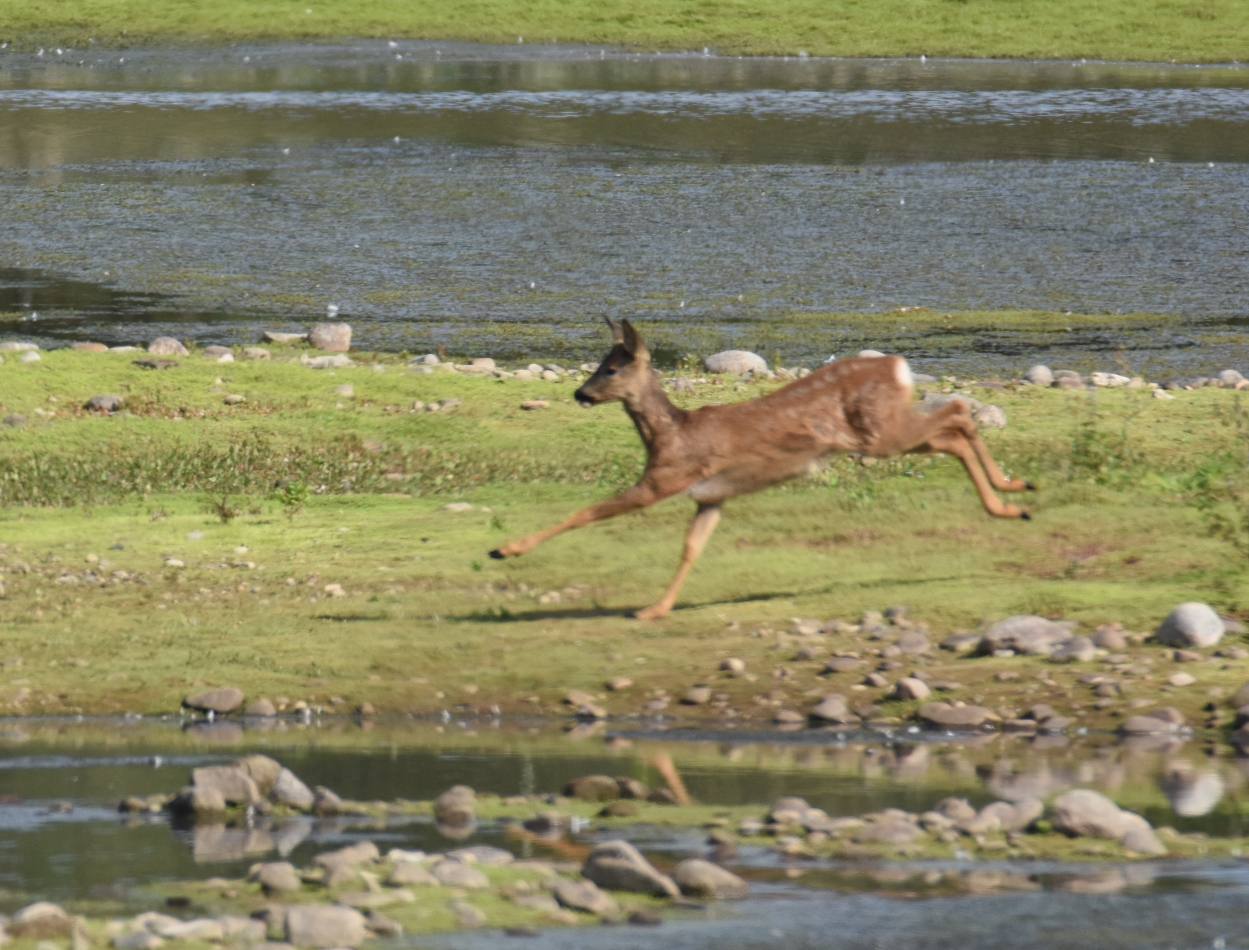
We anticipated where it would go to but didn't reckon on it being right by the side road lurking behind the nearest tree to the kerb. We saw its ears twitch as we approached which gave it away. We stopped and tried ever so cautiously to change the settings on the camera for dark things hiding in dark undergrowth but it saw us and was away back down the bank towards the water.
Wandering back through along the reedbed walk to the car we came across some sieve like leaves of Alder trees where a multitude of Alder Leaf Beetles had been hard at work.


Not a bad little visit and some great sightings, including nearly getting knocked down by a Brown Hare which came careering round a corner screeching to a halt then veering off at the last minute when it saw us.
We didn't spot the famous car park resident Kevin the extremely photogenic Kestrel though.

Where to next? A bit of a Safari southwards coming up.

In the meantime let us know who's boarding up all the holes in your outback.


Sunday, 8 July 2018

A morning's rampage through the Rock Gardens

The Safari apologises for being 'off-air' for so long. We have been out n about on safari but have had serious family stuff to deal with culminating in the not-unexpected funeral earlier this week.
With a bit more time on our hands we were able to join CR at the local park mid-week for a butterfly hunt and arriving there we found former colleague WM already searching for the White Letter Hairstreaks.
By eck it was hot and humid down in the 'Butterfly Zone', the rough un-managed bit of the park. Unfortunately with the recent hot spell all but a tiny few of the Bramble flowers have been pollinated already and are turning in to tasty Blackberries. This along with the total lack of Thistles this season meant there was no nectar to tempt the Hairstreaks down from their favourite tree top so we have no pics of them for you, They did emerge very early this year, looking back through our Flickr site we tend to see them on Bramble and Thistle flowers about now or even later!
Although our quarry wasn't for showing itself other than fluttering around the uppermost branches of their favourite tree we did find plenty of other insects to point the camera at.
Celypha laculana
Field Grahopper - or is it Common Green Grasshopper?
It seems to have hairs on the underside which would make it Field but we're not totally sure
Gatekeeper and common Wasp
The same Gatekeeper
Large Skipper - a male due to the scent lines on the wing
Meadow Brown
Leptopterna dolabrata - female
Leptopterna dolabrata - male
Small Skipper - female - - no scent lines on the upper wings
Definitely a female - she started laying eggs on the nearby grass stems
And then went for another refuel
Common Red Soldier Beetle - not sure hat the white stuff on it's face is
If the White Letter Hairstreaks are the animal speciality of the site then Ploughman's Spikenard must be the plant speciality. This year we can only find a handful of specimens but typically there's a dozen or more. Somehow this site was omitted from the huge and authoritative Flora of North Lancashire.
Our final tally was 13 species of butterflies, including Small Tortoiseshell, shich CR didn't see and Small Copper which WM had seen before we arrived. With a bit of luck we could have added Common Blue, Peacock and Green Veined White but were perhaps just between broods wit hthem on the cusp of emerging.
An Emperor dragonfly was good to see there too.
Pottering around in the garden later that afternoon we were lucky enough to be visited by a Comma, a species seen at the Rock Gardens but not keeping still enough to be photographed - well we made amends!
In other news we've moved our Photo Year List Challenge on by not a lot to 147, adding poor pics of
Red Kite
 and Green Woodpecker
Both a long long way away while on our sunny sojourn to south Shropshire. We failed to see, never mind get a pic of, the Yellowhammer that was singing from the hedgerows almost all day every day!

A wander out along the new seawall at Rossall with GB the other afternoon  gave us distant, but close for here, views of Manx Shearwaters....Stop Press...as we type this rubbish there's a House Sparrow calling in the garden - our 1st of the year!!!!!
And relax...and back to the Manx Sheawaters...
We've been doing a lot of moth trapping in the garden and trapping not a lot of moths but we've had some nice ones and some NFGs (New For the Garden) so hopefully we'll let you know all about those in the net couple of days.

Where to next? This coming Thursday we're joining the Wildlife Trust's Living Seas NW team again for the monthly sea watch at Rossall Coastguard tower, Bottlenose Dolphins were filmed off the prom at Cleveleys yesterday evening) so finger (and everything else crossed) for a good result on the watch. And then we're out with CR again perhaps to the private reserve on the fringe of Lakeland.

In the meantime let us know who's been fluttering round the tree tops in your outback


Sunday, 22 October 2017

Geese, geese and more geese

The Safari had a morning at Marton Mere nature reserve with CR. Before we'd set off we'd heard that there was a Stonechat at the wetland on the way in but a short cursory scan didn't reveal it. A quick peek under the refugium inside the reserve didn't reveal any amphibians either.
Down at the Viewing Platform the morning light was pretty aweful for looking through the waterfowl but it didn't stop us firing off a few shots at the mass of Pink Footed Geese over the far fields. The flock was so big that even down at 150mm we coouldn't fit more than a a third of the flock in the frame - we reckoned about 5000 altogether.
 An awesome sight and even from our view point half a mile away an awesome sound!
No Bitterns were found on the edges of the reedbed and no Otters were seen swimming through the tranquil water - again!
With the warm sunshine there were a few Red Admirals on the wing and feeding around an extensive patch of Michaelmas Daisies, close by this Comma caught C's eye.
One of the targets for the visit was recently arrived Redwings and it didn't take long to find a small group as they moved through the scrub eagerly refueling on the Hawthorn berries. Getting a pic was tricky through the foliage and they were flightly not allowing anything like a close approach. But they did give good views with the bins and we got a sort of decent pic for our Year bird Challenge (MMLNR #84, YBC #156).
Down on the embankment we were closer to the throng of geese but they were in the top field and mostly either obscured by the hedge or over the other side of the slight rise so we aren't able to show you anything like the ull extent of the flock. You'll have to believe us whe nwe tell you it was an impressive sight.
The 'volcano' in the distance is Parlick an Ice Age rounded hill at the southern tip of Bowland
With little wind and warm sunshine we took the lower 'pond path' hoping to find some dragonflies enjoying the last of the season's warmth but we were out of luck. Joining the main path again we crossed the bridge where a Grey Wagtail was feeding in the stream.
Moving round to the first hide just before we got there C shouted 'Buzzard' soaring way high over the mere. Still not quite believing how common they are now compared to 25 years ago when they were a distinct rarity we had to have a look and through our bins could see it wasn't a Buzzard but our first Marton Mere Raven (MMLNR #85). It's been a long and frustrating time coming with rreports of them reaching us almost daily the couple of weeks before we went ot Scotland! It was our 188th species we've seen there and what's the betting now we've broken our duck we see them almost every other visit from now on.
At the hide we saw that a large clump of reeds had broken off the main reedbed and drifted down the lake on the wind. It seems to have come to rest on the far side of the old dyke that runs through the bed of the mere. That could become a serious management issue in the near future, unless of course a huge reedbed is what's wanted cos that's what's going to happen, it'll spread across the whole shallow side of the mere eventually joining up with the reeds growing on the side of the scrape which will probably become invisible in due course. Gonna be hard to control!
Another surprise awaited us at the Feeding Station, a Treecreeper (183, MMLNR #86, YBC #157) was on one of the close trees, almost too close to focus on. It was constantly on the move and in the shade, second guessing where it would pop up after it had been round the back was tricky but we fired a few pics off in the hope one would be OK, it sort of was.
So only a morning visit but two new species added to our challenge tally which was pretty cool seeing as that's the same as our week in Scotland where we'd hoped to add seven or eight species!
Later in the week we had family duties and once they were done we had a chance to drop in on the roadside at RSPB Marshide on the Southside for a few minutes. As we arrived a small flock of Golden Plovers flew over the road. More about them in a minute. There were a few birders scoping the marsh so we joined them to be shown a Curlew Sandpiper (184, YBC #158) among the Lapwings.
Really we'd stopped to look for the Long Billed Dowitchers but we were told only one had been present and it had just left with a small flock of Golden Plovers - arrgghh driving we couldn't have a proper look at the flock as it crosssed the road and didin't notice it in there.
Where to next? Storm Brian is rattling the windows and there's reports of good birds off the prom so hopefully there'll be some left for us if we can get out tomorrow.
In the meantime let us know who's sneaking off with the crowd in your outback.


Sunday, 9 July 2017

Missed the biggie of the year - no, not the Amur Falcon

The Safari was later in to work than normal due to the enforced office move even though we were working at our 'normal' place. That had a bit of a bad knock on effect. Back at Base Camp we missed a call telling us there were half a dozen Bottlenose Dolphins close inshore and by the time we'd got the message it was well after our usual leaving time so we got frustratingly stuck in the morning commuter run that previously we've avoided. We went straight to the watchpoint to meet LB and FB who put us on to the Bottlenose Dolphins right away letting us use their scopes as we'd brought no optics with us. Unfortunately they were now well to the south and a long way off. Then LB showed us a sketch he'd just made in his notebook - a Risso's Dolphin. Had we been on our normal routine we might just have caught it! We're not totally sure but it could well be the first of its species viewed from our promenade for about 20  or more years! Now our mind started racing - what was it doing there so close inshore? just hooked up with the local(?) Bottlenose Dolphins that seem to circle the wider bay chasing what exactly? Are they looking for Salmon approaching the rivers? If a Risso's Dolphin is with them have they been after Squid? Are there any Squid egg masses on the beach to support that hypothesis? That's the wonder of wildlife always far more questions to tax the brain than answers.
The following day we did have optics with us but the wind had picked up and the sea was choppy making viewing cetaceans difficult although we did have a Grey Seal close to the wall. Here's a bizarre animal fact we didn't know - Atlantic Grey Seals are rarer than African Elephants! and salmon farms are still allowed to shoot them! 
The sun came out at lunchtime and it was quite warm so we had a mooch with the camera for ten minutes or so. A few Black Headed Gulls have began arriving back on th beach after their breeding season. Just adults so far.
As always there's a few Herring Gulls cruising about looking at what the dropping tide might provide.
This one found a Weaver Fish which have a painful toxic spine on their dorsal fin which the gull had to wrangle out, which took a few minutes, before it could be safely swallowed. 
Thankfully none of our children's groups have ever caught a Weaver Fish (touch wood) but they are quite numerous, the anglers often catch them, and this one was only a few yards from the sea wall. As a regular beach-goer we always recommend folk wear suitable footwear and not go barefoot on the sands. 
Ohh nice - just had to break off writing this rubbish cos we saw Swifts passing the window. There's four of them whizzing really low through and over the garden. Brilliant things - we've got the phone playing their screaming so they might notice our Swift nestbox. Only a couple of photo opportunities, they're to quick for our limited viewing space.
It's been pretty lively around the garden at Base Camp today with plenty of comings and goings of juvenile Greenfinches, Goldfinches, Blue and Great Tits and their parents as well as a Robin and a passing Swallow or two. OK so after that little interlude it's back to the tales of safari's.
Last week we went to the zoo to see the rare orchid that had been found there. This week we returned to see if it was in flower yet. It wasn't for the simple reason that had we looked at it properly with our specs on last time we'd have seen that what we thought was a furled flower spike was in fact the remains of a well nibbled midrib...dohhhh. The main stem has been broken off so it's not going to flower this year. It has hardly changed during the week.
Yesterday we had an early start at the nature reserve and enjoyed the peace of early morning with two reeling Grasshopper Warblers, numerous Sedge and Reed Warblers and a bucketful of Reed Buntings. No sign of the Bittern but we did hear a couple of Curlews (MMLNR #77) and watched a Great Spotted Woodpecker (MMLNR #78 - surely we've seen one here before this and neglected to put on our spreadsheet?) fly almost the length of the reserve. Our two target species for our Year Bird Challenge failed to put in an appearance although we did hear several Blackcaps - we'll have to wait a few weeks until they're more out in the open eating berries, same with the no-show and silent Lesser Whitethroats.
In the afternoon we headed out east to the picturesque river valley for a walk with Wifey and Monty. It was busy so the chance of adding a Dipper to our Year Bird Challenge was slim to remote, we'll have to wait for a quiet mid-week opportunity to get out that way for those. There were the shrill calls of young birds in the canopy but far too many dogs in the river for even the Grey Wagtails to show up more than once. The shallow pools are just too inviting for mutts on a warm day, 
and those flippin owners do nothing to discourage their charges from running down the banks and into the water - most actively encourage them after all the countryside is only a place to kill things or let your dogs disturb everything.
Note the slugs and snails on the rock, the water level has risen recently, last time we were here we were able to sit on this rock, getting to it without gettin g our feet wet - bit like the molluscs but they could be stranded out there now - will have to check next time we go.
This morning a jaunt around Patch 1 was a little late as we missed the early morning sunshine and were back in the ISO Stupid gloom - the default for Lancashire according to ex-pat Lancastrian SP - he's not wrong!
We wanted butterflies - we got a (singular) butterfly, a male Meadow Brown.
and a rather dapper bee mimicing hoverfly Volucella pellucens.
Too gloomy to wait for long for nothing to happen at the White Letter Hairstreak tree but we did find our first ripening Blackberry of the year there. That could be a problem the White Letter Hairstreaks are only just emerging and almost all the Bramble flowers have gone over and there's no Creeping Thistle this year, the Bramble thicket having smothered them out. The butterflies will have to make do with honeydew up in the canopy where they are harder to spot.
Later in the afternoon the sun came out and we were able to shoot back out for half an hour for another look. On the way we met good friend PL on his way out of the butterfly zone looking a bit dejected. We had a good chat about all things local nature and eventually he decided to come with us back into the breach. It was a good job he did as he'd have been a bit miffed if we'd have found one minutes after he'd left. And that's what happened within a few minutes of seeing a couple of battling skippers a smaller duller butterfly caught our eye landing on or near a Bramble flower. joy of joys it was what we thought it was going to be. Two cameras rattled away but even through the bins we couldn't see the white 'W', good job those megapixels were able to pick it out.
A bit of a relief to find them on Patch 1 again, it's always a bit twitchy seeing the Elms fading away and hoping that that's not the tree they are dependent on. But then the dead Elms of last year start sprouting again and hopefully the new shoots will last long enough to be come available for egg laying in the future.
The afternoon was topped off by a Comma that landed almost too close to get a pic.
What a great way to end the weekend!
Where to next? In to the lion's den that is the town centre offices tomorrow, wonder if we'll see any wildlife around there.
In the meantime let us know who's