Showing posts with label dune helleborine. Show all posts

Sunday, 9 July 2017

Missed the biggie of the year - no, not the Amur Falcon

The Safari was later in to work than normal due to the enforced office move even though we were working at our 'normal' place. That had a bit of a bad knock on effect. Back at Base Camp we missed a call telling us there were half a dozen Bottlenose Dolphins close inshore and by the time we'd got the message it was well after our usual leaving time so we got frustratingly stuck in the morning commuter run that previously we've avoided. We went straight to the watchpoint to meet LB and FB who put us on to the Bottlenose Dolphins right away letting us use their scopes as we'd brought no optics with us. Unfortunately they were now well to the south and a long way off. Then LB showed us a sketch he'd just made in his notebook - a Risso's Dolphin. Had we been on our normal routine we might just have caught it! We're not totally sure but it could well be the first of its species viewed from our promenade for about 20  or more years! Now our mind started racing - what was it doing there so close inshore? just hooked up with the local(?) Bottlenose Dolphins that seem to circle the wider bay chasing what exactly? Are they looking for Salmon approaching the rivers? If a Risso's Dolphin is with them have they been after Squid? Are there any Squid egg masses on the beach to support that hypothesis? That's the wonder of wildlife always far more questions to tax the brain than answers.
The following day we did have optics with us but the wind had picked up and the sea was choppy making viewing cetaceans difficult although we did have a Grey Seal close to the wall. Here's a bizarre animal fact we didn't know - Atlantic Grey Seals are rarer than African Elephants! and salmon farms are still allowed to shoot them! 
The sun came out at lunchtime and it was quite warm so we had a mooch with the camera for ten minutes or so. A few Black Headed Gulls have began arriving back on th beach after their breeding season. Just adults so far.
As always there's a few Herring Gulls cruising about looking at what the dropping tide might provide.
This one found a Weaver Fish which have a painful toxic spine on their dorsal fin which the gull had to wrangle out, which took a few minutes, before it could be safely swallowed. 
Thankfully none of our children's groups have ever caught a Weaver Fish (touch wood) but they are quite numerous, the anglers often catch them, and this one was only a few yards from the sea wall. As a regular beach-goer we always recommend folk wear suitable footwear and not go barefoot on the sands. 
Ohh nice - just had to break off writing this rubbish cos we saw Swifts passing the window. There's four of them whizzing really low through and over the garden. Brilliant things - we've got the phone playing their screaming so they might notice our Swift nestbox. Only a couple of photo opportunities, they're to quick for our limited viewing space.
It's been pretty lively around the garden at Base Camp today with plenty of comings and goings of juvenile Greenfinches, Goldfinches, Blue and Great Tits and their parents as well as a Robin and a passing Swallow or two. OK so after that little interlude it's back to the tales of safari's.
Last week we went to the zoo to see the rare orchid that had been found there. This week we returned to see if it was in flower yet. It wasn't for the simple reason that had we looked at it properly with our specs on last time we'd have seen that what we thought was a furled flower spike was in fact the remains of a well nibbled midrib...dohhhh. The main stem has been broken off so it's not going to flower this year. It has hardly changed during the week.
Yesterday we had an early start at the nature reserve and enjoyed the peace of early morning with two reeling Grasshopper Warblers, numerous Sedge and Reed Warblers and a bucketful of Reed Buntings. No sign of the Bittern but we did hear a couple of Curlews (MMLNR #77) and watched a Great Spotted Woodpecker (MMLNR #78 - surely we've seen one here before this and neglected to put on our spreadsheet?) fly almost the length of the reserve. Our two target species for our Year Bird Challenge failed to put in an appearance although we did hear several Blackcaps - we'll have to wait a few weeks until they're more out in the open eating berries, same with the no-show and silent Lesser Whitethroats.
In the afternoon we headed out east to the picturesque river valley for a walk with Wifey and Monty. It was busy so the chance of adding a Dipper to our Year Bird Challenge was slim to remote, we'll have to wait for a quiet mid-week opportunity to get out that way for those. There were the shrill calls of young birds in the canopy but far too many dogs in the river for even the Grey Wagtails to show up more than once. The shallow pools are just too inviting for mutts on a warm day, 
and those flippin owners do nothing to discourage their charges from running down the banks and into the water - most actively encourage them after all the countryside is only a place to kill things or let your dogs disturb everything.
Note the slugs and snails on the rock, the water level has risen recently, last time we were here we were able to sit on this rock, getting to it without gettin g our feet wet - bit like the molluscs but they could be stranded out there now - will have to check next time we go.
This morning a jaunt around Patch 1 was a little late as we missed the early morning sunshine and were back in the ISO Stupid gloom - the default for Lancashire according to ex-pat Lancastrian SP - he's not wrong!
We wanted butterflies - we got a (singular) butterfly, a male Meadow Brown.
and a rather dapper bee mimicing hoverfly Volucella pellucens.
Too gloomy to wait for long for nothing to happen at the White Letter Hairstreak tree but we did find our first ripening Blackberry of the year there. That could be a problem the White Letter Hairstreaks are only just emerging and almost all the Bramble flowers have gone over and there's no Creeping Thistle this year, the Bramble thicket having smothered them out. The butterflies will have to make do with honeydew up in the canopy where they are harder to spot.
Later in the afternoon the sun came out and we were able to shoot back out for half an hour for another look. On the way we met good friend PL on his way out of the butterfly zone looking a bit dejected. We had a good chat about all things local nature and eventually he decided to come with us back into the breach. It was a good job he did as he'd have been a bit miffed if we'd have found one minutes after he'd left. And that's what happened within a few minutes of seeing a couple of battling skippers a smaller duller butterfly caught our eye landing on or near a Bramble flower. joy of joys it was what we thought it was going to be. Two cameras rattled away but even through the bins we couldn't see the white 'W', good job those megapixels were able to pick it out.
A bit of a relief to find them on Patch 1 again, it's always a bit twitchy seeing the Elms fading away and hoping that that's not the tree they are dependent on. But then the dead Elms of last year start sprouting again and hopefully the new shoots will last long enough to be come available for egg laying in the future.
The afternoon was topped off by a Comma that landed almost too close to get a pic.
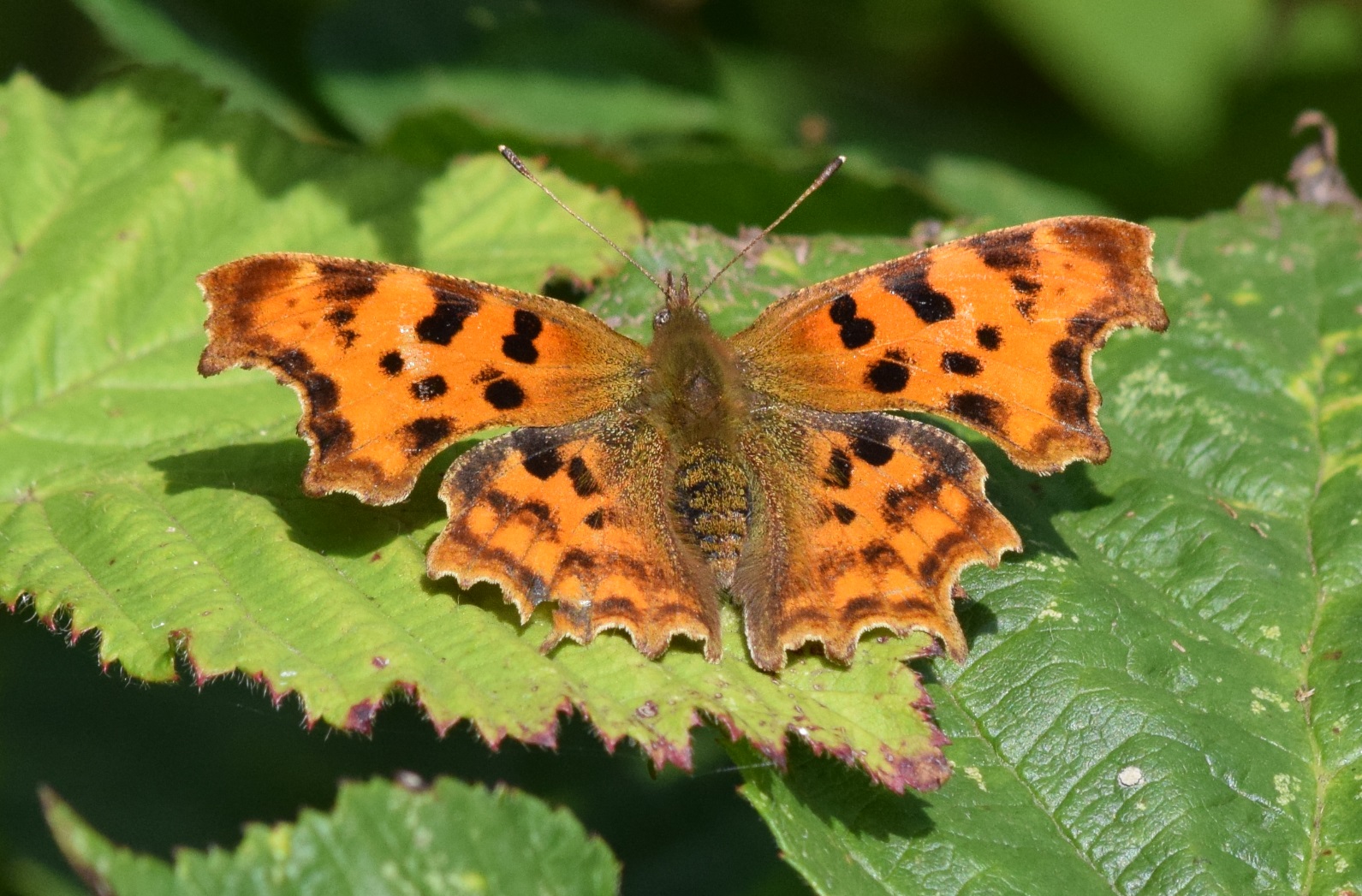
What a great way to end the weekend!
Where to next? In to the lion's den that is the town centre offices tomorrow, wonder if we'll see any wildlife around there.
In the meantime let us know who's


Sunday, 2 July 2017

#30DaysWild is over...or is it?

The Safari has been busy with all sorts of groups this week. We've played host to school classes, Rainbows, Brownies, Beavers, Guides and volunteers from the zoo doing their #30DaysWild challenge.


The schools pond dipping sessions have thrown up a couple of surprises. The first day the class watched a female Emperor dragonfly laying her eggs on vegetation in the pond right under the children's noses - none of them had ever seen a dragonfly before and didn't know insects could get that big, some even thought it was too brightly coloured to be an insect so must be a bird! Whether insect or bird it was an awesome spectacle for them to witness.
The following day's class the children watched a dragonfly nymph catch and devour a small 3-spined Stickleback - they found that awesome if a bit gruesome too. But generally apart from prodigious number s of Wandering Snails, darter sp dragonfly nymphs (probably Common Darter) and hundreds of 3-spined Sticklebacks there wasn't much for them to catch. Until one of them, and then others, pulled out a tadpole. Where had they come from surely the pond sides are too high for a Frog to jump up and over into the water. We surmise that someone nearby has a pond which was in danger of drying out during the hot spell last week and 'rescued' them in to our larger and deeper pond. One one of the last evening sessions a Brownie caught a Pond Skater, we've not seen one on there for a long time. But where are all the Bloodworms, Diving Beetles, Back Swimmers, Front Swimmers and Blue Tailed Damselfly nymphs? It's a funny old year in the pond!
The volunteers from the zoo had arranged to do a beach clean with us."We do like to be beside the seaside...but we don't like to see the beach covered in litter.
6 big bags of rubbish were eventually collected and taken off the sands - well done everyone
Perhaps the most disturbing piece of litter was this length of fishing tackle which had continued fishing after it had been snapped off and ended up killing a small Smooth Hound pup. We often find lost tackle with hooks and breakaway weights waiting to catch a fish, gull, dog's paw of child's foot. We think the anglers who lost their gear should come back as soon as the tide drops and try tto retrieve as much as they possibly can - that would be better than leaving in/on the beach - and while they were doing that they could pick up all the litter they leave behind where they stand too - Anglers are supposed to be protectors of the environment aren't they - well we don't think so!
The children's' best find was a tiny shell. So small we're quite surprised, but really pleased, that it was actually spotted and picked up. No not the pretty Sea Slug skeleton, the pink Acteon tornatitlis the other one. In all our years doing beach events with the children we've never seen anything as small as this so we went into detective mode and called on the expertise of our marine biologist friend DB who suggested it might be a Mediterranean/European Atlantic coast species that has been washed in  by the currents, Tritonalia aciculata. A quick search of the data-bases suggested that this could be a first for British waters - what an awesome find that would be for a Yr2 child!!!
Now not totally convinced with DB's ID we put the pic on the British Marine Life Study Society's Facebook page and they came back with a more likely ID of Netted Dog Whelk - albeit a very small one!
They also found several specimens of Dead Man's Fingers, which looks a bit like a Sponge but is actually a colonial polyp related to sea anemones and jellyfish.
At the end of the week we had a job to do at the zoo with Sustainability Officer LW, looking through some of the pics from their moth trapping event and a quick check of their data from the Native Species Bioblitz they did while we were away  in Cornwall.
Once we'd ID'd a few moth pics and asked for others to be sent on for more in-depth analysis (ie micro moths we can never remember the names of) LW said one of her keeper colleagues had found a rare orchid in the Dinosaur area and would we like to see it. Well we're never one to resist a rare orchid so of we went. We walked through the exhibit and back looking for what we supposed would be a Marsh Orchid and going bu the other Marsh Orchids locally were looking for a finished flower spike. We had no luck at all. LW then called her colleague who told us it was near one of the T. rex models. Again we looked and looked without success. Eventually JP was called out to show us exactly where it was. And no wonder we couldn't find it, it wasn't under the T. rex at all but a Pentasaurus!
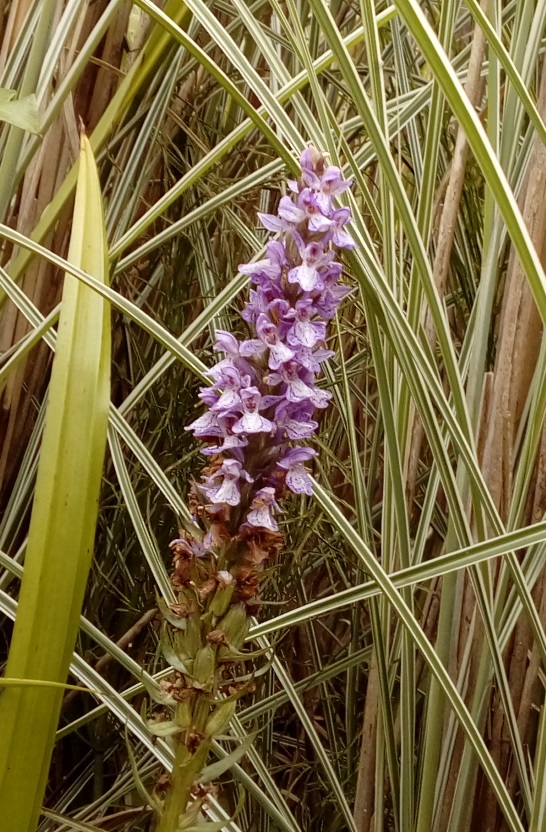
No, we've never heard of a Pentasaurus either! And no it wasn't a Marsh Orchid spike so we were looking for the totally wrong thing. It was actually a battered and bruised specimen of a helleborine species but which one?
We initially thought it was probably Broad Leaved Helleborine but info from Twitter suggested it was much more likely to be the much much rarer Dune Helleborine which is found locally a few miles away, on the dunes of all places. We've arranged to get back into the zoo to monitor its progress and get some pics - an awesome find! And then JP casually mentioned "we've got some other orchids - would you like to see those?" Of course we would,, ta v muchly! He took us to a currently out-of-bounds area undergoing a large scale construction site refurbishment and there on the edge of a pool was a colony of Southern Marsh Orchids growing among the waterside rushes and reeds.
He then said "we've got some more too, follow me to the Capybaras". A few minutes searching between the viewing rail and the safety fence had us looking at a gone over Bee Orchid and then a smaller one still in flower. Who needs to look at giant rodents when you've got these beauties right next to them!
With that it was time to leave for Base camp at the end of a very busty week and so ended #30DaysWild for us and the Zoo team - see their Facebook page Blackpool Zoo - Wildlife Learning for all they got up to. Looks like they had a blast being wild - just as e did. And just because the 'event' is over doesn't mean YOU have to stop being wild...please carry on doing random acts of wildness, finding bizarre, exotic, beautiful, ugly, rare and common species in your own outback and don't forget to share them!
Where to next? We've got a Year Bird Photo Challenge to catch up on this weekend, some of the other challengers are posting like mad and we don't want to get left behind!
In the meantime let us know how wild you're going to be in your outback this month.


Wednesday, 15 July 2015

Orchid time on the dunes

The Safari had built up a big surplus of extra hours and even after booking some flexi-time for a long weekend we still had a a few to play with. Yesterday mornig we got a txt from Young Un AB saying he'd just been on the dunes and counted a very accurate 841 Pyramidal Orchids and seen a Grayling butterfly - that was excuse enough for a very long lunch break. 
As soon as we arrived on site we saw there were lots of Burnet moths everywhere, almost every Creeping Thistle flowerhead had at least one supping away at the nectar within.
All the ones we looked at closely, without our specs we might add, were Narrow Bordered 5-spot Burnets.
Walking a few yards further into the dunes we disturbed a Meadow Pipit that wasn't at all happy with our presence
 It kept a rather watchful eye on us.
But where were all those orchids? Another couple of steps and we crested a small rise and there amid the Creeping Willow were several pink flower spikes, about 20of them, not the mother lode but a good start.
They were growing in an area from which much invasive Sea Buckthorn had been removed during the winter, the management certainly appeared to suit them.
AB was kind enough to tell us the whereabouts of other orchids nearby too which included Common Twayblade which we didn't know grew on the site, surely we'd been told at some stage over the last 25 years or so and forgotten if that was the case the information certainly wasn't for being retrieved from our memory banks!
Only a few yards away near a large hole that is being dug for an as yet unknown reason, probably to provide some form of dune slack (aka seasonally wet area), he said there were some Marsh Helleborines.
From there he directed us across the road to look into the garden of the rest-home which has been left uncut and is a wondrous array of colours from the multitude of wildflowers growing in the short sand turf, it is a sight to behold! The target here was probably the most dull and insignificant looking plant in the 'meadow' but one of the rarest in the country/world being an endemic to a handful of scattered sites around the coast and not overly numerous at any of them, the rather wishy-washy nondescript looking Dune Helleborine.
We didn't have permission to enter the garden but saw one of the five specimens not too far away from the wall.
 Exciting isn't it! Well it's not a looker but it is pretty special.
Walking back to the Land Rover (we keep threatening to replace it, but can we part with it?) a small orangy butterfly flew across the track in front of our knees, a Gatekeeper - one of the species we looked for unsuccessfully at the White Letter Hairstreak site at the weekend. They'll probably be out in force there this coming weekend if the warm(ish) sunny weather holds.
Not a bad way to spend a lunch hour and a bit.
Back in the office walking along the corridor we spotted a tiny bee that hadn't been able to find an open window and succumbed to the heat - yes we look at all manner of strange things! The thing that grabbed our attention was the red underside to its abdomen, not seen one like that before so in a pot it went, but what exactly was it? Why a pot for a dead bee - habit we suppose!
A plea on Twitter was made and the very knowledgeable and very modest @RyanClarkNature cme back with a name Megachile centuncularis, a quick look on the national database showed it to be, unsurprisingly, the first record for town and only the second for the whole of the Fylde (with the proviso that the NBN maps can be a little behind the times)/
Our last late finish of the season was helping an enthusiastic gang of Rainbows do some mini-beast hunting and pond dipping. Our best find for them was a Zebra Spider just before the action kicked off.
A quick little devil that didn't like being in the light in the middle of the lid of the pot
Better but stiller in the bright sunshine
Today we had a pretty intense time at work but were able to finish early and meet up with AB on the dunes and he showed us some of the other specialities he'd learned about from the old master MJ.
There's some nice moths on the dunes, we saw Latticed Heath but it was too quick for the lens unlike this Blackneck which did its best to hide from us.
It's larvae feed on Tufted Vetch of which there is plenty on the reserve. Nowhere near as common locally is Cotton Grass, a species more normally thought of as upland bog plant but was probably very common on the lowland mosses before they were extensively drained. A nearby field which had a sizeable colony was drained for a sports field not too many years ago.
Another orchid species here is Early Marsh Orchid, its earliness now meaning it's coming to the end of its season and most of them were going well over.
Harebells were everywhere, don't think we've ever seen so many here. the floral display this summer is really fine and well worth a visit.
 Like the Cotton Grass they were blowing around a bit
AB shifted up a gear after spotting another speciality moth, seconds later his bag was off his bag and a pot removed and de-lidded. in a jiffy a Silver Hook was inside. A new one for us and what a little beauty.
This one's a sedge feeder.
He released it but it wouldn't settle in the right place for a pic. While trying to get the pic we saw a shield bug. It's a still a nymph and we're not sure which species.
There are areas of the dunes that are losing their spectacular wildflowers to longer denser grassland. Some management has been begun to address this but really what's needed is more Rabbits to graze it down. There are some but not enough and they're widely scattered across the reserve and not able to 'control' large areas of dense vegetation. One thing is for sure they don't like Thyme!
On the final way back to the Land Rover we got the pic we wanted, OK very nearly the pic we wanted
We'd have preferred a more contrary Small Skipper but you can't have everything and it was a brilliant hour out all thanks to AB.
Where to next? Anything could happen tomorrow.
In the meantime let us know what unknowns who's keeled over in your outback.