Showing posts with label birch polypore. Show all posts

Tuesday, 1 October 2024

Back in more familiar territory

The Safari has only been able to get out n about a couple of times since getting back from our boaty ride. With t'mutt along with us most of our favourite reserves were out of bounds so to kick off we took CR to Lunt Meadows LWT reserve where we'd arranged to meet up with local lad IH. It was quite a pleasnat morning, some sunshine and, for a very refreshing change, little wind. We'd not long got our boots on and left the car when this lovely Red Admiral fluttered across the track in front of us and kindly stopped on a just above eye level Bramble leaf.

Rather than go onto the reserve the usual way IH took us through the woodland adjacent to the reserve boundary but unfortunately it was deadly quiet in there. We met a reserve work party at the gate so moved quickly on as they'd be disturbing anything close by in a few minutes time. In the field they were about to be start work in was the herd of Longhorn Cattle including the big bull, from where we were watching it seemed there was some trepidation amongst the workers about going any further particularly as one of them had a bright red LWT jacket on...possibly not the best choice when there's a bull nearby??? But we all know cattle are colour blind and the red thing is just a myth - don't we? The group were probably  just standing listening to some fascinating facts about the conservation benefits of having a variety of 'old fashioned' grazing animals on the reserve - at times they use Belted Galloway Cattle and sometimes Hebridean Sheep - but it didn't look like that too us...or was it just our imaginations running away with us.

Passing the fields a skein of Pink Footed Geese flew overhead but didn't drop in to land. Scanning the pool at the back of the fields gave us some Lapwings, Grey Lag Geese, Canada Geese and a few Teal. The ground in front of the corner screen was very dry, dare we say it  - we really could do with some rain...some rain, not 40 days and 40 nights worth!!! The large pool on the opposite side of the track held a similar mix of birds with larger numbers of Teal and some Mallards but not a lot else. Small birds were keeping very quite, totally silent in fact. 

The pool by the pumphouse which often has a Mediterranean Gull on it only had three gulls and one of those was dead, a Herring Gull by the look of it to go with  the live Herring Gull and the live Black Headed Gull. A group of about 100 Lapwings stood in the water and there were a small number of Teal scattered about about. Another birder put us onto three Snipe tucked up behind a clump of reeds with a couple of Teal. We thought we heard a Reed Warbler sing briefly from the distant far side of the pool but it only did it once and we couldn't be sure but we are certain there was a Cetti's Warbler singing short snatches of song much closer to our left. A couple of Herons put a smile on IH's face but where were the Little Egrets? CR had already spotted a Heron flying over the road on the way down so now they were 3-0 up and that doesn't happen often these days. 

There was little on the next pool as the work party were close by on the far bank cutting and burning young Willow trees that are threatening to cover large areas of that part of the reserve and then it was back to the cars. A quiet day but it had still taken the best part of two hours to wander round the shortest circuit of the reserve. You can tell how quiet it was as after the Red Admiral we didn't take a single pic to show you!

IH left us but suggested we go to the coast for the high tide to watch the waders there but instead we decided to head back towards Base Camp and have a mooch round Mere Sands Wood LWT reserve for a change and the chance of some interesting fungi.

At Mere Sands Wood we hit the trail anti-clockwise and soon came to the first hide - which wasn't there. It had been demolished and a low dead-hedge now took its place although the view of the lake was now totally obsured by tall vegetation. The second hide had become 'just' a screen with no roof or seats, probaly to dissuade the local scrotes from malingering during the hours of darkness, A coupleof other birders told us of a possible Scaup but when bettter views were had it was 'only' a female Tufted Duck with a fairly large blaze. In the poor light and at distance the head had looked rounded through their scope but when it came closer the tuft was easy to see.

Always worth a shout though. Next time they could well be right.

One of the main reasons for the visit was to find some nice autumn fungi but as we continued along the trail there were none to be seen, the woodland floor was devoid of anything mushroomy. It wasm't until we reached the next hide that we came across the first decent blob of fungi, is there a proper collective noun for fungi? A couple of blobs of this brown one were growing on a fallen bough just outside the hide.

From the hide it was a feral goose fest with shed loads of Grey Lags and Canada Geese and not a lot else.
Like Lunt Meadows small birds were hard to come by and apart from the very occasional tic from a Robin or scolding churr from a Wren there was nothing to be seen or heard in the woods, although to be fair it was the quietest time of day for birding. Pushing on in our quest for fungi we took the short route through the middle of the reserve at the path junction. At last we came across some decent 'colonies' of fungi. This hollow rotting tree stump had what we think are Fairies Bonnets growing outside and in.

 A bit further on next to the path was another cut stump, this one covered with the most colourful bracket fungi we've ever seen.

It was turning out to be a good afternoon but we still wanted to find a Fly Agaric, they're often seen here cos there's tons of Silver Birch trees, and some Earth Stars which have been photographed not too far away in recent days. In the meantime we'd have to 'make do' with whatever else we could find, which turned out to be some Sulphur Tufts growing in another hollow log, or half a hollow log, this tree had a healthy trunk too.

Our next find wasn't fungi but fish. At the little viewing platform overlooking the smallest of the lakes the usual flock of bread-greedy Mallards did a runner (or a paddler) out of the way not being too keen on the presence of t'mutt. Once the ripples from their wake had settled down we pered into the water to see if we could see the shoal of fish that hangs out beneath the Mallards hoping for missed bits of bread - they'll be lucky! We didn't see them immediately but then CR spotted them, they'd gone away with the Mallards but were now on the way back presumably less bothered by the presence of the dog. No big ones today and either Roach or Rudd and possibly a mixture of the two and some hybrids thrown in for good measure. The light and water clarity weren't the best for having a good close look at them. From there we went round to the former Cyril Gibbons hide which has been replaced after the local scrotes burnt it down and has now been renamed ???? but again has no seats. On the way we passed a rather stout Frog sat plumb in the middle of the path which being well camouflaged and hard to spot ran the risk of being trodden on.

After taking the obligatory pics we left him/her to hop off on their merry way passing another cluster of Sulphur Tufts on the way.


A group of birders on an outing were at the hide but we couldn't find them the Mandarin Ducks that are often on this large lake but they more than repaid our useless favour by spotting a Kingfisher dart along the tree-lined bank and settled on a handy snag miles away. CR managed to snap away at a Migrant Hawker dragonfly buzzing around the reeds just outside the window, too quick for us with only our long lens today. 

It was now time to head back to the car so we retraced our steps and were surprised to find the Frog hadn't budged an inch, time to 'rescue' it just in case of a size 9 welly coming this way. We gently picked it up and as is always the case with amphibians it weed all over our hand - well you'd wee if a giant 1000x your size picked you up even if it did have good intentions. The Frog was deposited out of harms way well into the undergrowth beside the path and we wiped our hands on a clump of nearby grass. 

We were under the impression that the path alongside the meadow area had been closed but before we found the suicide Frog we'd seen it was still open so went that way back to the car. At the strat of it there are a couple  of picnic benches that are perfect for Common Darters to sit out on and sure enough three or four were doing just that as we arrived. Getting a pic wasn't easy as they reacted to the slightest movement either from naturalist or sniffing dog, mostly the former it has to be said. They were extremely skittish and we had better success with the long lens than CR did with his macro.

CR collected a few wildflower seeds from the path side for his meadow back home then it was time to load a very tired mutt into the back of thecar and head back to Base Camp. Not a bad day out on safari at all in the end.

A few days later and t'mutt had it all to do again! this time we were with AH who we'd not seen for a while but who'd found a telescope while clearing out a relative's attic and wanted to try it out. For a change we started off at Hesketh Out Marsh and on arrival got said scope out of its large bag to find the tripod it came with was only a tiny table top one...that'd have to left in the car and AH would have to hold the scope on the top of fence posts for the time being. For starters we headed east from the car park and soon found a Little Egret striding around in the nearest pond/puddle left behind by last week's very high tides

Another one wasn't too far away but after that there was very little to be seen. AH's scope was tested out on a small flock of Wigeon with a few Teal thrown in but there wasn't much else to point it at. We found a Great Black Backed Gull sitting in the middle of a pool to point it at but then found something much more exciting behind them feeding along the water's edge on the far side, two Spoonbills. Sadly they were too far and the light far too poor to think about lifting the camera. To be honest there were far more birds in the fields on the inland side of the seawall than on the marsh, a flock of 100+ Lapwings in one field, a Red Legged Partridge in another and then about 50 Curlews spread across the next two fields. On the marsh we'd only had a handful of Redshanks and a fly-over Snipe. We turned round after about a mile but didn't find anything to point the camera at, in the distance a Kestrel hovering above the seawall and what looked like a Marsh Harrier out towards the river was getting grief from a Carrion Crow. It wasn't until we'd gone past the car and were now heading out west when another (or the same) Little Egret (there were a few scattered about) flew into the ditch at the bottom of the sea wall and started feeding.
Almost always obscured we waited for it to reach a more open patch of water but when it did it was mostly facing away from us.
And then turned round and went back to the narrow, densly vegetated part of the ditch...the swine!

There were more birds this side of the car park but not that many more. The first pool had a flock of Mallards rather than Wigeon, again joined by a small number of Teal. A flock of Lapwings went up possibly flushed by a Buzzard lazily wafting around in the middle distance.

There was nothing in with the Lapwings and we carried on walking. Yet again a Little Egret broke the monotony.
We had seen a couple of Herons today but egrets were convincingly in the lead, we also managed a distant Great White Egret just to rub the Herons' beaks in it. 

Walking back to the car and our butties took us past a small flock of Tree Sparrows most of them being on the wrong side of the hedge but it was while having our lunch that the day's best bird showed up. A Kingfisher appeared briefly on the little bridge into the car park close to the picnic bench  we were sat at. We'd left the camera in the car, we can't concentrate on food and cameras at the same time and food always wins. Still not bad - consecutive safaris south of the river with a Kingfisher isn't to be sniffed at.

After lunch we revisited Mere Sands Wood, a site at which we and AH had done a substantial amount of conservation work back in the day which included lots of fires with baked potatoes cooking in the embers....mmmmm. 

We went the opposite way round to the previous week's safari and at the start of the path by the meadow spotted some lovely Spindle berries we hadn't noticed last time.


We were still on the hunt for fungi though and like last time there weren't many to be found, we thought some might have sprung up in the intevening few days. This time we did the outer circuit of the reserve and came to the ex Cyril Gibbons hide where we did indeed find at least two Mandarin Ducks secreted under overhanging branches at the very furthest corner of the lake...they weren't there last week although the views we had were atrocious, even if AH had brought his scope out they wouldn't have been much better. A substantial Hoof Fungus a little further round the trail was much easier to spot.
The outer perimeter path here has some big old Beech and Oak trees and the woodland floor was littered with Beech mast and acorns which bodes well for attracting some nice winter finches like Bramblings if the rest of the county is the same. The path also overlooks the agricultural fields beyond the reserve boundary and we did spot a single Brown Hare but unfortunately it was hunkered well down and just lookmed like a lump of mud. We'd swapped cameras and now had the macro lens with us so no chance of a pic of the Brown Hare that looked like a lump of mud. Having seen few birds last time out and struggling to get pics of the fungi with the long lens was why we'd opted for the macro this time. However the perimeter path was like the rest of the reserve, more or less fungi free! It wasn't until we reached the next hide that we got an opportunity to use it...on the very same clump of brown fungus we'd photographed last week. Only four days later but was looking worse for wear now.
From the hide there wasn't a lot to be seen, the large flock of feral geese had moved on and we were only left with a couple of Coots and a handful of Mallards.

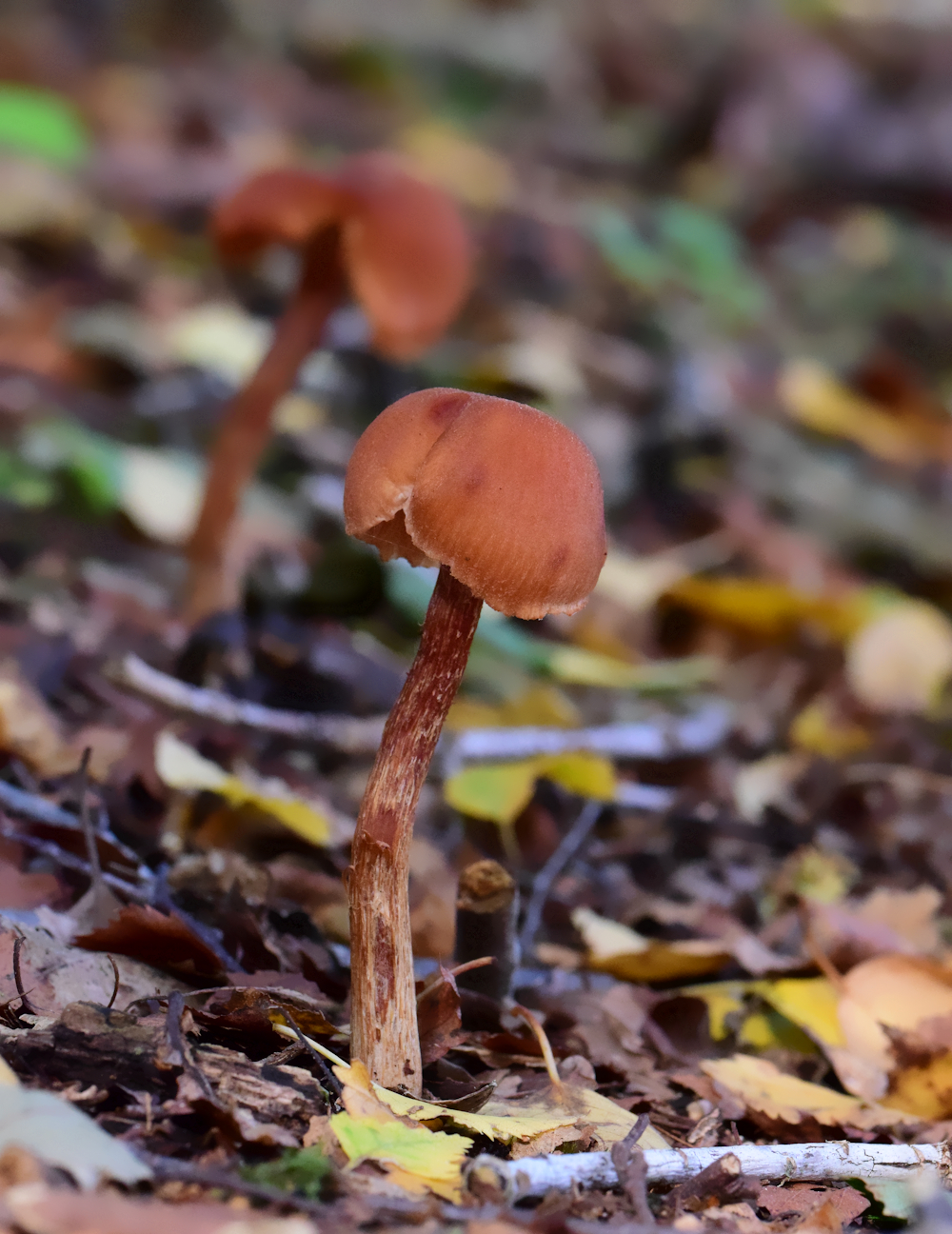
Nearby were some fresher fungi growing out of the leaf litter on the ground.
Knowing there wouldn't be much else to find we cracked on round the trail but we did remember there was a big Birch Polypore close to the next hide we didn't point the camera at last time. We're now glad we'd 'saved it for later'.
In the trees around this whopper was the most small bird activity we'd had over the two visits, a very lively, too lively for pics, flock of Long Tailed Tits was noisily working their way through the mid-storey of the woodland, we looked and listened but couldn't hear anything like Blue Tits, Goldcrests or Chiffchaffs among them.

And so it was back to the car dragging the knackered mutt behind us, at this rate he'll not be wanting to come out on safari again...all that walking we he could be sleeping...dohhhh.

Where to next? It's a bit weather and traffic dependent at the mo but we've got a safari lined up for later  in the week.

In the meantime let us know who's winning in the Herons v Egrets stakes in your outback.


Tuesday, 2 January 2018

One out one new one in

The Safari joined our long time birding chums south of the river for a wintry day ornithologising at Martin Mere WWT reserve the other day. We started off at their new fully glazed hide to get a bit of warmth in our bones before we ventured out in to the wild wet weather.
The problem with a fully glazed hide is that while it may be more comfortable it does make you a bit queasy when looking through the bins at an angle through the glass and isn't that good for pics either, although we could have been anti-social and gone and sat in the end wing with normal opening viewing slats but this was a holiday get-together with the gang not a full blown twitching expedition.
There was the usual fine selection of winter wildfowl in good numbers...except for Pochards which are hugely down on recent years...such a shame as they are a splendid looking bird.
Many species of diving birds from a variety of Families have that red iris so it must have some evolutionary advantage for seeing in murky water.
Also close by were a handful of Ruffs and as AB noted - phoaarr look at the chiseled scapulars on that!
One of our favourite hides here is the Feeding Station where the stars of the show are the 'Bare Tailed Ground Monkeys' of which there were three today, two females and a juvenile. The sit under the feeders while bits dropped/discarded by the birds rain down like manna from heaven - life couldn't be easier. Having said that one of the adults had a huge open wound on its back possibly from a lucky escape from the Buzzard that arrived in a nearby tree and was eyeing them up.
The arrival of the Buzzard sent all the small birds scattering for cover except this Great Spotted Woodpecker which froze in the 'you can't see me - I'm not here' pose, a bit hopeful really!
The Brown Rats shuffled on in the mud unperturbed by the raptor's presence. After it had left and before the small birds returned one of them climbed up the logs at the base of the feeders 
it then made a leap of faith towards the bird table but that turned into a leap of doom when the jump failed to reach the table and the poor animal nosedived onto the squidgy mud below. 
More excitement was seen there when a Moorhen inexplicably flew about 10 feet up into a tree, unfortunately it was badly obscured so we were unable to get photographic proof of this somewhat unusual event.
Moving on between rain showers we had a look from the next hide which was pretty quiet and then narrowly missed a soaking getting to the final hide. Here we had splendid elevated views of the wetland and watched a Marsh Harrier quartering over the fields in the distance. While watching that a small bird of prey shot through and landed on a fence post in the distance. A Merlin (YBC #168). It was just about in range in the grotty weather - why can't these birds do us a favour and sit on the nearest post when the light is awful?
By now it was lunchtime and while some of the gang enjoyed the delights of the cafe those who'd brought butties sat in the foyer overlooking the 'captives' lake. Again we were shooting through a window but it's good to see some species in close-up detail that we don't see often and when we do they are a mile away across a field in the scope.
White Fronted Goose
After lunch we back out on the trail heading the other way this time. The first hide after the new hide is a windowed and heated affair nice but not good for venturing in to the cold afterwards. From here we added a female Goldeneye to the day's list, it took us ages to spot it as it spent most of it's time under water. As it's name suggest it doesn't have a red eye like the Pochards but if you're a diving bird and not got a red eye then golden yellow is the next most popular colour.
The next small hide is another favourite offering exceptional views of everybody's favourite birds, Coots and Moorhens - and if they aren't your favourite they ought to be! Today they were sadly lacking in close up views but a Little Egret wasn't. It walked out of a ditch and sat on the bank in the wind for several minutes before having a big old yawn - it's not often you get a good view of a Little Egret's tongue!
Next up the elevated Kingfisher Hide, normally noted for its big open panoramic-windowed freezingness but today strangely rather mild in there. Stars of the show were up to 19 of the once common Tree Sparrows at the feeders but there was a no-show from the Brambling that had been reported in recent days.
By the time we reached the final hide the light was going. Try as we might we couldn't find the Green Winged Teal in with the flocks of 'normal' Teal.
Watching a Whooper Swan on its way to its maker was a little macabre but why was it it that strange position propping itself up at an angle on half open wings and half extended legs with its bill on the ground - almost as if it was trying to coll itself down to make it's demise come sooner.
With the light fading fast and no sign of the hoped for Kingfisher we had to go before the car park was locked and so ended another excellent bird filled trip out with the 'Boiders'
Our last snap of the day was of a large fungus growing out of a Silver Birch trunk, Birch Polypore.
Roll on 36 hours and it's 2018. Happy New Year to all our readers, we hope it's a good one for you and filled with exciting wildlife.
With the new year starts another birding Year List and another Photo Year List Challenge with Monika and her friends.
The morning of January 1st was sunny and mild but as soon as we got out of the car at Marton Mere the clouds rolled in and heavy hail ridden showers ensued. We had a wander anti-clockwise taking in the feeding station and the caravan site side to get our Photo Year List Challenge started.
Grey Lag Geese
Mallard
Treecreeper - a good one for the list on Day 1 as we struggled to find many in 2017
Blackbird
Pheasant
Bullfinch - arrghhhh! But still the best pic of this species taken at Marton Mere - must try harder - - or manual focus!
A couple of Carrion Crows watching over the wetland
Not the best start to the year, especially with that out of focus Bullfinch, but not bad given the awful weather and everything else we saw we'll be able to get pics of in better conditions before too long.
We finished the day on 23 species for the year without putting much time or effort in - we put more in to staying dry and failed miserably!
Today we were relieved to find the camera had dried out without issue and that was despite having a waterproof cover on it! The rain was again heavy so we nipped out to the local waste depot to see if the Iceland Gull was about - it was, happy days!A grotty pic for #8 on our PYLC but acceptable given the dreadful weather.
We gave Monty a quick run on the nearby sodden field and picked up Grey Wagtail, flushed by mutt from a large puddle and then Common Gull - amazing that we were able to get Iceland Gull on our year list before this obviously much more common species of gull!
Driving past Stanley Park on the way back to Base Camp and lunch we spotted a few Tufted Ducks in the near corner of the lake bring up 31 species for the year.
Where to next? A we and windy promenade perhaps.
In the meantime let us know who's all blurry in your outback.