Showing posts with label linnet. Show all posts

Monday, 18 May 2020

Week 8 but are the safaris locked down or not?

The Safari has taken advantage of the relaxed lockdown rules available in the second half of this week. 
To start the week we were still only able to do one proper walk a day and Monday saw us have a wander along the full length of the North Blackpool Pond Trail. Both Sedge Warblers were still in song but unseen at the reedbed at the strat of our walk as was a Reed Warbler, our first there this year. Once again a search of the mound revealed no Bee Orchid rosettes. Continuing through the wooded areas we heard but couldn't see a singing Chaffinch, one we frustratingly still need for our 1 Mile Bird Blitz, plenty of Blackcaps were in song too, is it just us or do they seem very numerous this year to you too? 
Getting to the lake we heard a Little Grebe calling from the 'secret' side and a pair of Great Crested Grebes displaying on the public side, no sign of any youngsters, have they nested and failed or not even started nesting yet?
 In its usual place aiting for bread of all things was the local Heron.
Our return journey gave us a couple of Speckled Wood butterflies in the glades bordering the wet woods and what looked at first like 3-Spined Stickleback fry by the bridge turned out to be stripey Perch fry on closer inspection.
The long Blackthorn thciket held a secretive singing Lesser Whitethroat that refused to show itself as did another by the Black Pond; we're now wondering if we'll get these on our vertebrate or 1 mile challenges at all this year or if we do will we have to ait until the autumn when they start eating berries and are a little less shy.
Almost at the end of pur walk at the bottom of the horse fields we heard an unmistakable sound 'prrt prrt'. Spinning round we connected with the white rumps of three House Martins disappearing over the , but still a mile or so further than we've been for a while.cratty hedge that divides the fields - our first of the year. Is it just us or do they seem very scarce this year to you too? 
Nothing was noted in the garden on Monday and nothing hit the notebooks from anywhere at all on Tuesday.
Wednesday was an interesting day! An early morning trip up the garden to the compost heap had us looking up when we heard an unfamiliar call above us. A flutey 'tiuu' sound. We heard it a couple of times more and saw a small short tailed bird circling around not too high up over the roof of the house behind ours before flying off more directly towards the water tower where it appeared to drop possibly in the compound where earthworks have been taking place and there's a few bushes to perch on too. We racked our brains but couldn't think what it might been. A flick through the field guide gave us a bit of a clue but a look in BWP wasn't so informative. Going off the clue in the field guide we had a listen on Xenocanto and found several recordings of flight calls that were bob on - Whinchat almost over the garden - get in!!! Wood Warbler last week, Whinchat this week = Wryneck next week doesn't it? 
Now that the lockdown has eased and we can go anywhere bearing in mind that everywhere is still closed and visitor attractions and beauty spots were imploring folk not to travel we decided to go further afield took the mutt in the car to Woodland Gardens and Heron's Reach. Not far just a dip the toe in the waters so to speak. Our main aim was to have a look for Great Crested Newts in the hot-spots. None there but we did have quite a few Toads under the refugia we peeked under. 
Woodland Gardens gave us a Mistle Thrush foraging on the soon to be destroyed golf course, another species we've had no luck connecting with for our 1 Mile challenge.
Blackcaps were everywhere on our route but the only one we actually saw was this female tackling a rather juicy caterpillar.
On our last visit here not too long before the lockdown we'd found some Bee Orchid rosettes and searching for them again we found they were now quite shaded and not in an optimal place for producing good flowers - we'll try to keep an eye on them over the next few weeks to see how they fare. 
The afternoon in the garden a bit of sunshine had us watching a pair of Red Mason Bees mating and not a lot of anything else. This week's change in the weather has certainly sent the invertebrates to ground.
Thursday dawned sunny but cool. We gave the mutt another change with a visit to Marton Mere nature reserve. e started at Staining Nook and walked in along the Heron's Reach path passing numerous Blackcaps, and Whitethroats, a couple of Chiffchaffs and a Willow Warbler along the way. One Whitethroat was sat up in the sunshine atop a tall tree. We stopped for a pic but it flitted down into the bushes below before we could focus on it. It appeared on the edge of the bushes a bit further down the track but look closely and you'll see this bird is a Lesser Whitethroat - bit of a fluke as it's one we needed for our Challenge becoming #143 on our tally. We didn't see the original treetop Whitethroat again.
On the reserve it was reedbed birds we were hoping to see (and hear). Hearing a Cetti's Warbler was no problem, one was singing loudly in our left ear as we chatted (at a safe distance) to FB and TS. Chatting face to face to other humans outside your home - what's the world coming to? Forgotten what that's like.
A singing Reed Bunting gave good views
Unlike most of the Sedge Warblers, of  which there seemed to be more of than in recent years, but persistence paid off and eventually we were able to get a pic of one that wasn't totally obscured by vegetation for #144.
None of the many Reed Warblers showed themselves for more than a millisceond so they weren't submitted to the SD card. We'll have to wait a while until they're feeding young and can be a bit more showy around the edges of the reedbed. We also had great vies of a Cetti's Warbler but like the Whitethroat disappeared into thick vegetation before we could lift the camera. Another Cetti's Warbler teased us with a game of 'hide and hide' singing here and there as it moved all around its territory without actually showing itself. 
Luckily this Linnet behaved. Nice to see a pair too, fingers crossed for a successful season for them on the reserve
The way back across the fields gave us a stonking male Chaffinch landing just above our head. Why won't they do that on the Pond Trail for our 1 Mile Blitz?
A Grasshopper Warbler sang from the field just beyond the Chaffinch. We had a good listen but weren't able to see it in the dense clump of Brambles it was singing from. Meanwhile a Kestrel hovered over the far end of the field and Swallows raked the long hedge for insects all in lovely sunshine and out of the cool wind - a cracking morning's birding.
Back where we'd parked the car there where several House Martins skimming low to the ground aroiund the horses in the paddock - a lovely summery scene.
After lunch the weather closed in a little but another trip to the compost heap had us come across this 14-Spot Ladybird taking advantage of a break in the clouds and sunning itself on a Nettle leaf. We'll have to check our records but we think this is the first record for the garden.
Friday saw some early sun so we hit the dunes to see if we could find any lizards. A search of the usual bank was disappointingly fruitless. As was an hours tromp through the sandhills. we did see some good insects though with some of them even settling for a few moments like this Common Blue
and this Small Copper, both butterflies looking very fresh and dapper.
Much more static was this large fly sitting motionless on the sand for ages. Had it got cooled and was warming back up? No - it's a Robber Fly which we could tell with our naked eye and was sucking the innards out of an unfortunate Crane Fly - - awesome find. We didn't realise it had prey until we downloaded the pics on the pc back at Base Camp.
Not much else in the dunes just a handful of Meadow Pipits, the odd Skylark and a pair of Linnets, but to be fair we were concentrating on finding scaly things rather than feathered friends.
On Saturday we made the fatal third time error of  not taking our phone out with us early morning. Two  Bottlenose Dolphins close in was the news from SD (he'd also had a distant one a couple of days earlier too) when we got back to Base Camp - dohhhhh what a numb-nut!!!!! Three times!!!! Note to self - JUST TAKE THE FREAKIN PHONE
The moth trap was out for the first time in the week but was empty yet again.
Saturday is also check the stealth-cam day. Not a lot to report apart from a plethora of cats using the garden like their private motorway.  Sadly no Hedgehogs nor Foxes using the garden but thankfully no nocturnal visitis to the pond by any Herons.Best of the rest were this pair of Dunnocks that we rarely see at the moment, they've gone very secretive, must be nesting not too far away though.
We have a Great Tit that comes to the feeders very regularly but prefers to expend his energy manipulating and opening a Black Sunflower seed when there's pre-opened hearts two feet away. Interesting  - and he almost always faces away, probably because that's the way the closest and densest cover is for a quick getaway if needed.
Never mind the Great Tit a real garden rarity turned up - Starling!!! We very very rarely get them actually in the garden although while we were emptying the moth empty moth trap there were two adults and a juvenile sitting on the top of our roof.
This was one of a family party that were taking advantage of our suet pellet feeder and a bathing in the ornamental waterfall. Let's hope they return - might be time to invest in some mealworms which we're sure Starlings can smell from some distance away as when we've fed them in the past Starlings have appeared out of the blue.
With Bottlenose Dolphins in the offing Sunday's early morning dog walk had to be down at the cliffs as the tide rose. Several scans of the sea revealed no seabirds at all never mind any fishing in association with blubber.
Eventually we had a few Gannets passing, a solitary Sandwich Tern dived once while a flock of nine Shelducks flew south west out to sea
We nearly missed a passing Little Egret
and did miss something fairly unusual, a second summer Common Gull, there's not many of those round these parts at this time of year.
Not a dolphin in sight - dohhhh.
It was the mildest night for a some time and next door's stadium quality floodlight wasn't on. That meant moths - at last! And it as a good catch, by far the best of the year so far. 
Here's the full list:-
4 Heart & Darts - yes FOUR!
2 Shuttle Shaped Darts - spot the shuttles below
2 Light Brown Apple Moths
1 Bright Line Brown Eye
and a Turnip Moth
Another real (back) garden rarity turned up in the form of a male House Sparrow. Regular visitors to the front garden they aren't even quite annual in the back. It didn't hang around for a pic unfortunately. We've got everything crossed that it develops a taste for suet pellets and brings the family next week. Less than an hour later a Coal Tit turned up, our first in the garden for ages and again we missed getting a pic - it's a species we haven't yet got for our 1 Mile Blitz..
As Sunday evening drew on this cheeky little blighter was helping him/herself to the bird food.

A mixed week with some superb wildlife - if only we'd got the blubber too.

Where to next? More more distant safaris, hopefully scales ill be involved if there's some sunshine

In the meantime let us know who's passing through your outback.

Stay safe, stay socially distant enjoy the wildlife around you it's good for your well being whether only on your doorstep or further afield if you can get out and about. The world is still turning it's only us humans who aren't.


Saturday, 2 March 2019

Cracking on a-pace

The Safari wants to know if anyone spotted the deliberate mistake in our last post? Treecreeper should have been number 87 not 86 again - somehow we missed we'd doubled up.
Since then we've been busy adding several more species to our Photo Year List Challenge. But we'll start with a couple of shots of our local Starling roost. The tide was just dropping when we arrived but the Starlings hadn't arrived yet, by the time the first few flew in the tide had dropped a fair way down the beach.
With the beach being exposed the birds chose to pre-roost on it. Being closer than normal we could just about see what they were doing down there - nothing much just standing around. Also being on the beach left them vulnerable to numpties getting too close mostly deliberately 'to make them fly'.
At least 50000 we totally guestimated, would love to know how many there actually are and if our guess is close or not.
News of a couple of Waxwings not too far up the road on the southern outskirts of Lancaster sent us twitching on a drizzly morning. We arrived on the street and saw two 'Starlings' sat in a low tree just past the row of shops, looking more closely as we drove slowly past gave us Waxwing (PYLC 88) as a top quality 'from the driving seat whilst moving' tick. We stopped a little further down the road and got our kit together and Monty out of the car but as we were doing that a bin wagon arrived and reversed into the driveway right under the tree flushing the birds. It took half an hour for them to be relocated, high in a tree on the opposite side of the small park there.
After a while they gained confidence and returned to their favourite berry tree. Shame the light was so grotty.
Job done we had a drive round the lanes back to Base Camp being thwarted by road closures at every twist and turn so we abandoned the lanes and went straight on to Knott End to have a look at the flock of Twite (PYLC 89).

A trip down to the SouthSide with CR saw us checking out a rather quiet Lunt but it did give us our first Toad of the year.
With nothing much happening we left earlier than anticipated and went down to the coast for an hour or so. It was mad busy being a sunny day and the tide was already too high for any waders to be on the beach. We headed through the dunes finding several Stonechats including a couple of singing males.
 With possibilities exhausted we upped sticks to Mere Sands Wood where it was quiet again but we did find several 7-Spot Ladybirds, a Tree Bee and a Buff Tailed Bumble Bee in the warm afternoon sunshine. The good weather had brought the farmers out on the land but never have we seen so few gulls following tractors, it used to be like a plume of snow behind a plough not just a few dozen.
The good weather continued in the week and we had our first butterflies of the year with this Small Tortoiseshell and later another at Marton Mere, but no decent birds to point the camera at.
The 'supermoon' coincided with high tides in the middle of th day so a safari down to the marshes was order of the day. We had a mooch finding this distant but shy male Kestrel (PYLC 90) which flew off when we tried to creep a little closer.
Retracing our steps back to the embankment we came a cross a pair of Wrens (PYLC 91) scolding a Dunnock that had strayed into their territory...They weren't happy!
The tide came right up to the defences, something you don't see too often but we failed to see the Hen Harrier(s) again. The other target birds were the Water Pipits which we did see but only as awful silhouettes in the atrocious glare. Best of the rest was this Water Rail flushed out of the marsh by the rising water and having to take refuge in a bankside Hawthorn bush in the absence of any other cover. Not a good day to be a vole either asa they were getiing picked off by the Black Headed Gulls as they desperately swam as fast as their tiny legs could take them for dry ground.
Another round Marton Mere this time on a gloomy day was unproductive until we left the reserve and walked round the bridlepath to give Monty an off-lead run and we came across a Goldcrest (PYLC 92). A tricky one to get to grips with as if flitted busily through the twigs and branches of a dense Willow bush.
An impromtu family wander along the prom at Fleetwood had us getting to grips with a Meadow Pipit (PYLC 93) while Wifey spotted three male Stonechats in a little group close to the tower on the way back to the car.
On a post so can't be included in the challenge
On the deck so good to go - sorted
Back at Base Camp in the week we'd watched a Buzzard soaring over CR's place and luckily a different, darker, bird came soaring high over Base Camp the following day. (PYLC 94)
Could do with a better one but it'll do as a placeholder
 Then it was all birding systems go when LCV came up for a few days non-stop birding. We met him at 'the place we don't mention by name' for a couple of hours getting lots of good birds, water fowl, waders and much better views or their Tawny Owls than last time we were here.
The sunshine brought out Brimstone and Red Admiral butterflies, always good to see the former as they are very scarce on our side of the river.
We counted 56 Avocets (PYLC 95) but learned that earlier in the day there'd been twice that many. Had to get a good pic of at range shooting into the harsh afternoon light.
The following day we set of up the motorway in the opposite direction to Leighton Moss in blistering sunshine again. Lots going on there with plenty to keep us occupied but a search for the over-wintering Great Grey Shrike was fruitless yet again.
Snipe
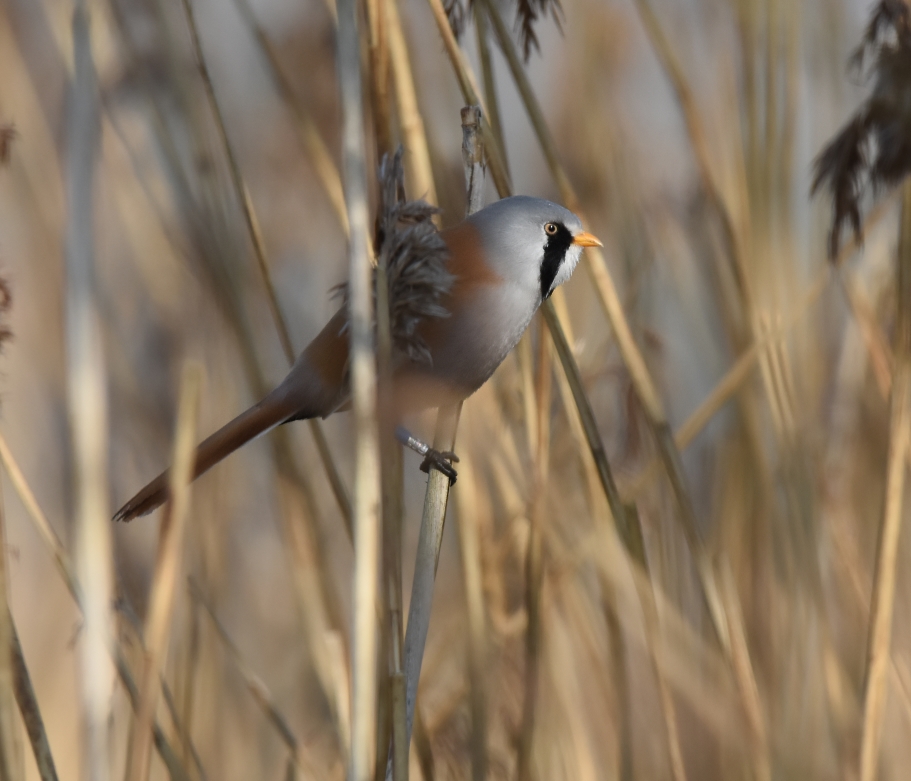
 We'd heard a few pings of Bearded Tits on the way down to Lower Hide but our luck was in when LCV heard more pinging on the way back and a male showed well but briefly, actually there were two when we noted the colour combinations of the rings on their legs.
OK for the challenge, number 96
A better, sharper pic but there's rings so it can't be posted for the challenge
Lots of other good stuff around
Shoveler
Robin
 For our next safari the weather had deteriorated horrendously and we had a wander locally round the lanes of Over Wyre. Bewick's Swans were on the hit list and fluky stop had a family of three being the closest birds to the car (PYLC 97).
The rain came down heavier as we visited more sites racking up LCV's year list with species he rarely sees back home in the Midlands.  At Fleetwood again we came across the Linnets (PYLC 98) that were too disturbed last time out here with Wifey the other day. The light was truly dreadful by now.
And was even worse when LCV picked up a flock of Ringed Plovers landing close by but a way down the beach. A year bird for both of us and number 99 for our challenge. Actually the 100th species we've photographed this year, Grey Wagtail on the edge of our pond being disqualified due to showing 'hand of man' for the challenge.
Our last day out was down to Moore nature reserve near Warrington to see if we could see their Lesser Spotted Woodpeckers. We'd not been there long when we heard one calling but could we see it??? We hung around the general area craning our necks at the slightest hint of a flit, we did get an incredibly brief glimpse of what was probably one after we'd seen a flit immediately after a bout of calling but not conclusive unfortunately.
We did get a Willow Tit (PYLC 100)
But is it? Latest info from the reserve's Facebook page suggests both Willow and Marsh Tits are now found on site and when visiting the feeders the Willows take their seeds high and the Marsh's go low...which this one did. They've learnt this from their calls, unfortunately this one didn't call and at the time we didn't realise both could now be seen here. So we're (probably) back to 99...or are we??? Which ever it is it was flippin tricky getting the shot in the dreadful conditions, as you can no doubt tell.
A great week with my boy.

Where to next? Oohh not sure where we'll be off to next week.

In the meantime let us know who's getting confused in your outback.

For more pics from our recent safari's have a look at our Flickr site - link on the right hand panel

Wednesday, 2 May 2018

Bird bingo

The Safari joined PT to lead the North Blackpool Pond Trail's Bird Bingo family event last Saturday morning. The birds were on fine form, showing well, it's just a shame the families didn't make such a good showing too. Maybe people are doing other stuff on Saturday mornings and Sunday might be a better day for more people to be able to come along.
The birding is quite easy at Kincraig Lake as the birds are more than willing to come close and grab a beakful of whatever is on offer so you can get some nice portrait shots of old favourites like this male Mute Swan.
The sun shone bringing out the finery of the drake Mallards.
Also present was a very tame Heron which has become accustomed to eating bread - Can't be good for it!
Note its iris, it seems to be deformed and not circular like its other one, an old injury perhaps or was it born like that?
There are three Herons' nests on the wooded island this year but now the spring buds are unfurling they are quite difficult to see unless you can watch the birds flying in to them.
Birds came and went and we saw Woodpigeons display flighting, Collared Doves passing by, Feral Pigeons doing circuits and a lone Stock Dove heading north - never really imagined seeing one of those at this sight, weird or what, it certainly wasn't on the Bird Bingo tick-off sheets!
Woodpigeon
One of the Woodpigeons alighted on the fence to our left so we crept closer for a better look
As we were edging closer a Common Sandpiper (154, YLPC #123) flew past us
And landed on the edge of the viewing area just behind the fence almost right beneath the Woodpigeon.
It was quite wary and flew round several times looking for the best feeding opportunities around the lake which has no muddy margins, eventually after waiting most of the morning it came reasonably close.
Where there's water and bread there's inevitably Coots, this one had a nest under construction close by but wasn't going to pass up a free lunch
And if there's Coots there's inevitably Moorhens
A young father and his very young son had tipped out what looked like some porridge oats, neither the Coot nor the Moorhen could pick up the small pieces left after the Mallards had had their fill of the choices and largest flakes in the conventional downward pecking manner we're used to seeing birds do but resorted to this unusual sideways forceps pincer peck to glean the pickings from the hard concrete.
Ever cautious at any hint of danger or anything untoward even if totally not dangerous the Moorhen would scurry to the water's edge where it waited a while before taking the plunge if necessary, which it rarely was.
From the scrub we heard Willow Warbler, Chiffchaff and Blackcaps and watched House Sparrows collecting feathers for their nest in the houses across the road.
Wandering around the lakeside path we came across our first Speckled Wood butterfly of the year and then spotted this collection of still sleepy Garden Snails.
Back at the viewing area chat had got round to news of a strange video of a deer sleeping on a dumped sofa - how comfy but how odd. Well knock us down wiff a feaver not twenty yards further on was a dumped sofa but this one had a one eyed cat sleeping on it. You couldn't rite it - well errr - we just did!
After giving us the evils for disturbing it it went back into comfy cat mode
Good to see someone has provided a ramp so it doesn't have to leap so high to get on the arm rest - fly tipping at its most considerate?
Further on out of the woods and back in the sunshine a big queen Red Tailed Bumble Bee was giving the pathside Dandelions a good going over.
Dandelions get such bad press so much so that they are the 'weed of choice' for the garden herbicide advertisers and yet they do so much good for the early pollinators enabling them to build up their populations - we should be celebrating them rather than demonising and obliterating them. Us humans really can't stand anything that thrives amongst us we didn't put there can we. Just think of all those expansive and expensive swathes of yellow Daffodils along the roadsides, we could have Dandelions, Lesser Celandine, Cowslips and Primroses for free - but no we'd probably mow and spray them off as soon as they appeared in the name of 'tidiness' -  what a ridiculous species we are.
Rounding the corner our group stopped to let this female Blackbird finish her ablutions.
Back at the viewing area the Common Sandpiper was still flying round and eventually settled on the remains of an old Willow bush. Not where you'd expect to see one but apparently they have been know to sing from the branches of riverside trees on their territories up on the hillside streams and smaller rivers.
A morning's birding in the sun wouldn't be complete without a raptor or two and we had three...a big female Sparrowhawk soared overhead before disappearing only to be found by the local Magpies in the wooded area when we walked through that way. A Buzzard gave a good display of 'skydancing' as it mooched sort or northeast wards and then this came over. At first when we first picked it up coming towards us being mobbed by a throng of gulls we hoped it might be an early Honey Buzzard, but the jizz wasn't right, then as it drew nearer it looked Osprey-ish for a moment but then was obviously far too long tailed. We tried to get some pics but it was quite high and the camera refused to pick it up against the sky until it was annoyingly well past us. we only got this one poor usable shot and now we're pretty sure it's a immature male Marsh Harrier - answers on the usual post card please.
Right at the death a family did turn up but only to feed the ducks...and the Heron!
Isn't urban wildlife great!
Yesterday we had a mooch round Marton Mere with CR calling in at the Woodland Gardens first to see if we could find the male Pied Flycatcher LR had told us he'd found there a couple of hours earlier. Needless to say it had moved on and with not a lot else on show in there we did too.
Our mission was to get some pics of the summer warblers for our challenge but they weren't playing ball, singing yes but showing no. Grasshoppper Warbler, Whitethroat and Sedge Warbler all noisy but invisible. The first bird to hit the SD card was a Linnet swaying away in the cold brisk wind on a thin stem poking out above the Bramble thicket.
At the Bird Club hide interest was provided by the first family of Coots we've come across this spring. Our first Swift (155) of the year dropped in with a few Swallows too.
The embankment was cold in the wind and again the Reed, Sedge and Cetti's Warblers were all keeping out of sight, fortunately a Reed Bunting bucked the trend and sang from an exposed perch.
The scrub taunted us with mostly invisible Blackcaps and Whitethroats. C managed a couple of snaps of a Blackcap and a Sedge Warbler deep in cover but try as we might we couldn't get the camera on to anything at all.
That said when all seems lost nature pulls a blinder for you. After seeing not a lot from the viewing platform we turned to leave and C spotted some bee activity around a patch of Nettles catching the sun. Patient watching revealed them as a species of Nomad Bee, we don't think we've ever seen any species of these here before. wit hour birding 600mm lenses getting pics was tricky to say the least. But we both were able to get a few and they look like Nomada flava (based on this one being a male [pale yellow eyes] having all dark antennae) but we could be wrong, they're not an easy group to ID
If the are N. flava they've not been recorded locally before according to the NBN map, Preston 15 miles away being the closest dot. Happy days!

Where to next? Family day on the Southside tomorrow but we might see something if we get a chance

In the meantime let us know who's buzzing around for the first time in your outback