Showing posts with label oyster. Show all posts

Friday, 13 February 2015

First look in the rockpools of the year

The Safari has a couple of updates from yesterday for you. Yesterday we had two visitors to the office both required us to leave the office and go outside. Lucky for us as we had a Grey Wagtail ((P2 #30) on the first visit and a Robin (P2 #31) poking around the shrubbery on our second jaunt outside.
This morning we resolved to count the gulls, it was too murky out to sea to see much anyway. We also counted the Oystercatchers as they are about the same size ass the gulls. The dropping tide gave us about 60 of each slightly more Oycs than gulls - gulls counted generically not to species - a Bar Tailed Godwit (P2 #32) was with the Oycs away to the south.
We did it again this at lunchtime and the result was the other way round with about 65 of each but slightly more gulls than Oycs. Still hardly a big count - where are the big flocks of gulls? We want some Yellow Legged Gulls and argentatus Herring Gulls to gawp at...a lost Laughing Gull having a 25 mile wander from it's 'pontoon' on the lake would be more than welcome to put in an appearance.
The Bar Tailed Godwit had done a bunk but there were just a measly four Sanderlings and eleven Redshanks out there.
Mid-afternoon we were able to get out on the beach with our marine biologist friend DB to look at the proposed works to the outfall pipe this coming summer. The one and only Limpet on our length of coast is right in the firing line of the demolition gang -  a rescue plan is needed and we were sussing out somewhere safe to relocate it to.
From ARKive
Common limpets begin their life as males, becoming sexually mature at around 9 months of age. Most individuals undergo a sex change, typically becoming female at 2 or 3 years of age, although some remain as males. Spawning takes place once a year, usually from October to December, although the timing varies around the British Isles. Fertilisation occurs externally; the larvae spend their first few days of life in the water column, after which time they settle on the shore. Life-span varies, but is between 10 and 20 years.
Also lurking in the rockpools were a good number of Beadlet Anemones waiting for the tide to return. Some tiny little baby ones clinging on there too and a Common Periwinkle.
One of the pools had a fairly fresh Native Oyster washed in to it.
Probably the most unusual sighting was a very small blob of Edible Whelks eggs stuck to the side of one of the pots. We see much larger egg masses all the time rolling around on the beach but we've never seen them stuck to the side of a pot before. DB said that there's been quite a few Whelks on the beach recently.
The shell below the eggs looks to have a very square end rather than a more randomly broken end which would make it Sand or Blunt Gaper and not Common Otter Shell.
Good to be out on the sands again and not too cold sheltered as we were by the wall from the south easterly wind.
Where to next? Back on the nature reserve at some time tomorrow - there's a Bullfinch to get a pic of you know.
 In the meantime let us know who's been stuck to the wall in your outback

Wednesday, 14 January 2015

Back on the beach at last

The Safari was able to get a few minutes down on the sands at lunchtime today. It was one of the highest low tides of the year and time was short before the incoming waters covered the beach again.
We had a target in mind but there wasn't much of anything about other than the larger than normal numbers of Common Otter Shells.
Other shells we found were a few Iceland Cyprines
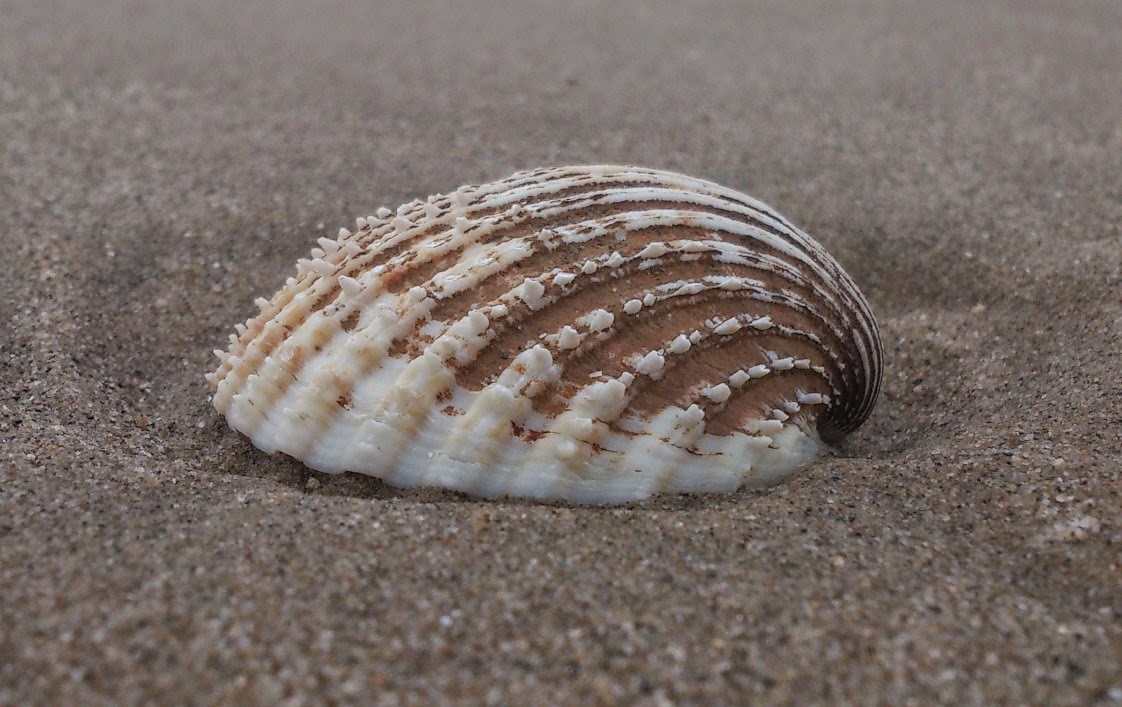
Lots of Prickly Cockles
and we found just singles of Tower Shell
and a gorgeous ?Queen Scallop
A large well worn Native Oyster was a nice surprise, been in the sea a long time. About 15cm long
Bits of seaweed lined the tideline, mostly Spiral Wrack with some strands of Egg Wrack mixed in.
Quite a few birds were on the beach including Patch 2's first Turnstones (P2 #17) and Ringed Plover (P2 #18) which might be somewhere behind the Black Headed Gulls in the pic amongst the Oystercatchers, there were about 30 unapproachable Redshanks too.
By eck it was cold out there! And we didn't find hardly any of our quarry - beach coal for the fire, we thought ther'd be loads after the storms but we only found a couple of bits other than this huge piece which wouldn't fit in Little Bertha. Its about 40cm long and 10 thick
Where to next? Might be back out there on the blustery chilly sands again looking to see what tonight's stormy tide has brought in
In the meantime let us know who's chilling out on the sands in your outback.


Tuesday, 29 January 2013

No excitement in, on or over the waves

The Safari was a little disappointed after yesterday’s gull-fest we could hardly wait to get to the wall this morning. A soon as it was light enough we grabbed the scope and made the 100 yard dash to the wall. No need to have rushed. The stiff breeze we’d driven to work in an hour earlier had dropped significantly and a mist had come down severely hampering visibility over the sea. Drat drat and double drat...no chance of any Fulmars today.
We had to content ourselves with checking the beach – well you never know if a Bar Tailed Godwit, Grey Plover or other exotica might just be have a rest on our hallowed sands.
Needless to say they weren’t! There were, however, a more than normal number of Sanderlings so in the absence of anything else to look at we set about counting them and reached a reasonable 158 before they were flushed by something unseen, certainly nothing hominid or canine was out there and we didn’t notice any birds of prey but they all scattered  pretty sharpish. Many of them flew up the beach into runnels out of our line of sight so we had to make do with the 158 we got to and put a ‘+’ for a totally unknown number of others.
Not too many Oystercatchers remained uncounted as they poked around the receding tide which was leaving plenty of goodies on the strand lines for them to rummage through – but where were the gulls? Hardly a one about and the huge numbers that sat on the sand banks to the north of our viewing point last winter have been seriously noticeable by their absence this winter. So we’re not getting any opportunities to have a butcher’s for any odd-balls likeargentatus’ Herring Gulls and Yellow Legged Gulls. Absence makes the heart grow paranoid!!!
Rain stopped play at lunchtime :-(
Yesterday our boss brought in an impressive shell his daughter had found on the beach just over our southern boundary at the weekend. A real whopper of a Native Oyster.


It was really thick and chunky, forcing the scales down to 175 grammes. Qustion is where did it come from? Is it truly native and died offshore fairly reccently? Was it harvested by a local trawler and eaten then dumped? Was it trawled from much further afield and dumped locally? Has it been washed down the river, or a different river from somewhere inland? How long has it been floating around in the sea - the fragile frilly bits are slightly worn but some are still quite sharp. was it dumped from a passing freighter coming in to Liverpool from who knows where on earth...Questions, questions, questions.
Here's another pic from our green-laning trip on Sunday
And the angel of the Ford came down and said unto us "tha'll nay be crossin the river ere t'day me boys"
There is supposed to be a gravel island in the middle of the river which marks a bend in the ford - it's somewhere under the rough water bottom centre. The guide books say don't attempt to cross if you can't see the island.
Where to next? Better seaward visibility please...
In the meantime let us know what's causing all the mystery in your outback

Monday, 23 July 2012

A lovely warm day on the beach

The Safari forgot to look for Old Ladies and Gothics (don't moths have great names!) in the garden at Base Camp last night; these two species are being seen in friends’ gardens not too far from Base Camp but so far we’ve never had either species grace our Buddleia with their presence.
So a minor set back last night but easily rectified by a crop of decent warm weather coming up hopefully one or both species will be found before to long.
This morning the strong overnight wind hadn’t abated and the sea was far too choppy to stand any chance of seeing any mammals; there’s been a flurry of Harbour Porpoise sightings away down the far end of the South-side recently and it would appear that the pod of six Bottle Nosed Dolphins we saw a few weeks ago are still kicking around offshore but over the horizon.
Far closer than the horizon from Patch 2 this morning were two Arctic Skuas. One of which harried a Herring Gull in to giving it a meal...not sure we’d relish the contents of a Herring Gulls crop/stomach but it’s obviously manna from heaven for the skuas.
Not a great lot of anything else out there other than a few distant terns.
After a quick cuppa we were back out leading a large group of young kiddies on their rockpooling session. The wind last night meant there was some interesting stuff washed up on the beach. The very first thing we picked up was a White Piddock shell which are not at all common or regular on our beach; unbroken too which is unusual for this very fragile species.
That seemed to be a good omen as before too long the nets were hoiking out huge numbers of small Brown Shrimps and a good many Common Prawns.  It wasn’t long before the first live crab appeared in one of the trays although we did need a microscope to see it properly, it was a tiny juvenile; bigger ones were eventually netted. 


Amongst the shrimps was another small wriggly thing that darted around the tray hiding under whatever was nearest – we eventually got to grips with it and identified it as a very recently hatched Blenny no more than 6 or 7mm long. What a find!


Most of the usual suspects were found, Pod and Common Razor Shells, Prickly and Common Cockles, Banded Wedge Shells, Rayed Trough Shells, and many more until one young girl showed us a larger than usual specimen of Iceland Cyprine and they are usually pretty big! But her success was short lived as another young lady brought us an enormous and very fresh Edible Oyster – great news and probably find of the year! What a beauty as a certain fisherman used to say...probably still does.
The sharp, undamaged frills show this specimen to be a fesh one and not one that has been rolling around in the tide for a good while...soooo there must be a small population out there somewhere...which is good.


A mystery item was brought to us to identify and it remains very much a mystery, possibly some a skull from some species of fish or other? Never seen anything quite like it in all our born days! Our marine biologist guru DB had a tentative guess at the skull of a Scorpion Fish.


Some of the pots hold anemones of various species and we wanted to show some of the older children ‘Nemo’s home’ but instead found a couple of live Sand Mason Worms, their cases are washed up by the million but we’ve never seen live ones at the top of the beach before even the ‘highest’ ones are only normally exposed by the very lowest low tides.


All most very excellent.
A lunchtime peer through the scope was nowhere near as productive with just a number of distant terns and one very distant Gannet to show for our efforts.
Where to next? Day off tomorrow to head back down the motorway to see m'laddo in hossy so there's a very good chance the moff trap will go on overnight.
In the meantime let us know what's all washed up in your outback.