The Safari peered over the wall this morning and was taken aback by the number of gulls on the beach, it was Larid heaven on a stick! There were thousands of them and a similar number of Oystercatchers too. All were walking down the dropping tide waiting for tasty morsels to appear. The strand-lines were large and strangely dark. It was one of those mornings when we really could have done with not being at work and having the real scope not the work's one. Still we made the best of it and stayed out as long as we dared. Somehow we failed to find a dodgy gull or any hint of a white-winger, just a few 'argentatus' type Herring Gulls. There may have been anything further down past our southern border as there were at least twice as many down that way - prodigious numbers!
Despite the 'lack' of quality gulls the waders didn't disappoint. Like we said thousands of Oystercatchers, and well over 100 Sanderlings too. A few Dunlins were mixed in with the Sanderlings but 'better' were the roughly 50 Knot (104, P2 #37).
Also lurking out there were a couple each of Bar Tailed Godwits and Curlews. So good was the beach that we didn't have time to look at the sea...how mad's that?!
At lunchtime we didn't take the scope but donned the wellies and camera and went down on the beach. The dark strand-line quickly gave up its mystery - masses of terrestrial leaves. By now the huge expanse of beach had spread out the gulls and they were not really accessible anymore. We spent our time looking in the pools left as the tide dropped. It's amazing how much sand has been washed off the beach, shingle layers that are never usually seen are everywhere, literally millions of tons of sand must be somewhere else.
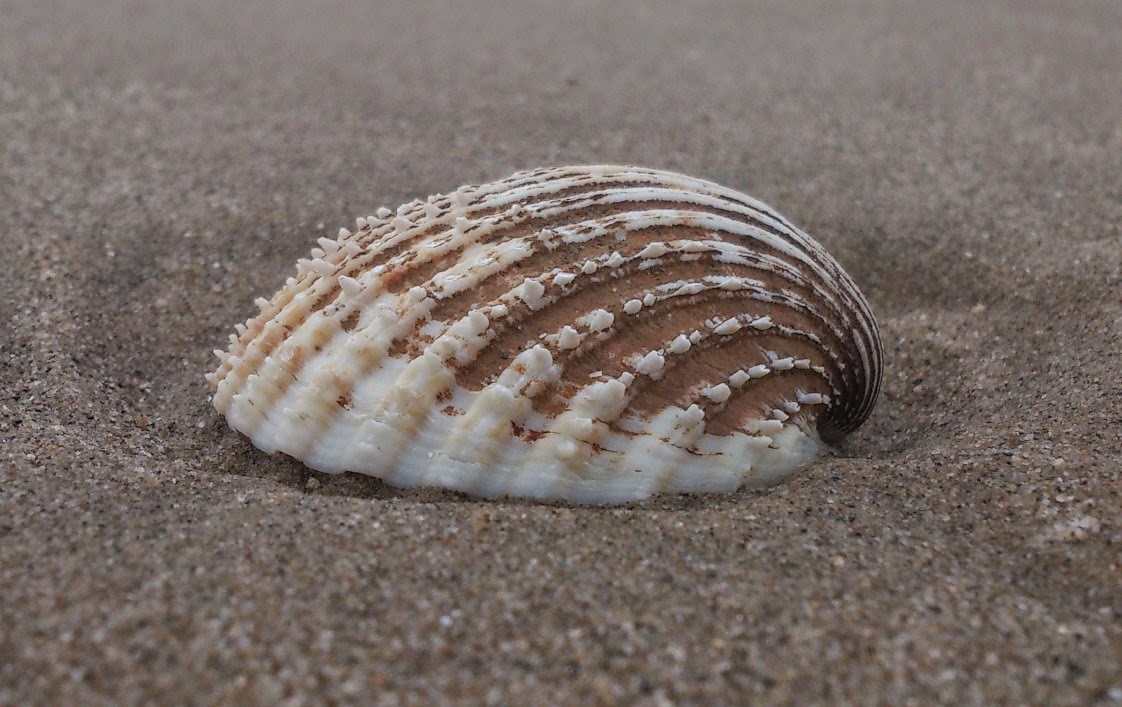
The pools were full of interest. We don't often find live shellfish and this Prickly Cockle is very lucky given the numbers of birds on the beach earlier. Sorry about the quality there was a bit of wind rippling the surface of the pool.
The end of the pool was a mass of shells, but a close look will show there's only a few species represented, wonder if they've been 'sorted' by the waves/currents, could well be as the only coal we found was here and there was a fair amount of it.
A closer inspection of said shells had us delving up to our elbow in to the cold water for this enormous Edible Whelk, it's undoubtedly the largest we've ever seen being almost half as big again as the 'normally' large one next to it. A real humdinger!
We had two target species, one of which is really scarce down here and we've not seen it for ages and 'need' a specimen for our box of tricks for the children to have a look at, the other is much more commonly found but we haven't seen one for a while for some reason.
We were lucky there was one, sadly deceased but it was there none-the-less, a Sea Mouse - crackin creatures and Britain's largest worm.
Just why do they need those super iridescent hairs for if they normally live deep in the mud out of the light...oh we do love a mystery and there's plenty in the natural world even right on our own doorstep...and someone out there is going to be the brain-box who works them out. No matter what the answer to the mystery is they're still great animals.
Where to next? Winter thrushes weather permitting in the morning.
In the meantime let us know who's bigger than they're supposed to be in your outback.