Sunday, 14 August 2011

Drawn - like moths to a flame

The Safari had already emptied the moth trap before we got stuck into a bacon butty with lashings of mushrooms, brown sauce and fluufy thick piping hot tatty-scones. Breakfast was chomped upstairs watching just one Peregrine do very little at all.

Earlier we had spent nearly an hour removing 20 Large Yellow Underwings and 6 horribly worn Dotted Clays from the various nooks and crannies of the trap. An intersting pale and speckly pug escaped before it could be captured in pot or lens. Easier was this Bird Cherry Ermine (? confirmation anyone) which was posing nicely on the edge of the trap. You can even see its yellow tiongue rolled up under its head


Along with the numerous Large Yellow Underwings we had just one Lesser Yellow Underwing and a few (Lesser?) Common Rustics.


As you can see the two are horribly similar ansd i n fact can only realy be identified by examination of their nether regions. Well you would be able to see if we hadn't cropped the pic to high and chopped of the script for Lesser Common Rustic - whata mistaka to maka...duhhh

'Common' wasa common theme for the moths this morning with a Common Carpet - the carpet refers to the patterns not that they eat carpets like the urban myths tell you.


Common Wainscot was, we think, a new moth for Base Camp, not checked all the records but it certainly hasn't been found in the last two or three years and there is not annotation in the field guide to suggest we'd had it earlier - a nice rich straw coloured specimen too.


Also common but not in name are these Crambids - but are they all the same species, two species or three species? We have to admit we are pretty useless at IDing them.

Crambid 1

Crambid 2

and Crambid 3


Other micros included these two little beauties
Micro 1

and micro 2

Another beauty this time easy to identify is the much larger Willow Beauty.

As for the footy - the gane could have ended 7-6 for either team. As it was 'Pool put away a cracking goal just before half time then added a second - again by new boy Kevin Phillips shortly in to the second half. After that Peterborough faded a bit and began to look a bit dejected, three were on the cards as 'Pool picked up the pace and put together some nice passing moves. Then with 15 minutes r so to play the defence did a silly faffing around rather than clearance
thing and gifted the ball to a 'Boro stiker in acres of space - the result was inevitable - Gilks was beaten unable to make a fourth or fifth fine save as he had done in the first half. 2 -1
The remainder of the game wasa tense affair with 'Boro desparately trying to find an equaliser - if the four minutes of added time had been longer they'd have probably got it.

Three points is three points though so bring on Derby County midweek and lets make it nine out of nine.

Where to next? A couple of days off but plenty of chores to do round Base Camp so we might not get far.

In the meantime let us know if the defenders in your outback are drawn into making horrendous mistakes like moths to a flame


Saturday, 13 August 2011

Record Peregrines - updated

The Safari will be back later this arvo. Meanwhile have a butchers at this rather shakey vid of our record count of Peregrines on the tower. And if anyone knows the ID of the little micro...


Many thanks to DS for the ID on the moth earlier in the day...see comments below.


Immediately after lunch we set off for the North Blackpool Pond Trail Fun Day. After saying hello to all present we had a mooch around the pond there which is in the later stages of succession - some might say 'overgrown' but we don't believe that is a valid expression for an ecosystem. Frank went in the stinking mud...he always does.


A fallen log had a good population of Jew's Ear Fungus - is it still PC to call it that these days?


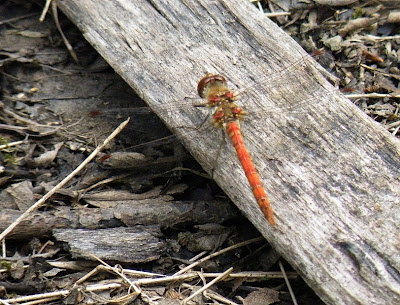
Several Speckled Woods were flitting about round the trees and we disturbed a Brown Hawker dragonfly. We followed it into a sunny glade where we hoped it might land and saw this Common Darter resting up instead. Very cautiously we crept as close as we dared...got this pic then tried for another few inches...'drat' as Dick Dastardly used to say!


As the event finished and we started packing up the local Swallows swooped low over the field after the insects that were being disturbed from the grass. They were joined briefly by a few House Martins and a single Swift, won't see many more of those this year.


At the very end this moth fluttered out of the grass by the track and landed on the van window. Which Crambid is it Dean? anyone else can have a stab if they so desire...


Chatting to fellow FARG member Alan he told us of a true bug we'd never heard of which is present in another pond not too far away from where we were and is listed as 'Local' on the British Bugs website - Aphelocheirus aestivalis aka the Saucer Bug - we'll have to investigate further...apparently it can give quite a sting from its predatory mouthparts.

A quick sin round Patch 1 with Frank and his football gave us just two Peregrines on the tower, a squealing Sparrowhawk somewhere near the nest site in the Park and another Swift overhead on the way back to Base Camp...won't see many more of those this year...famous last words!

Where to next?
Mothy will be on tonight...weather permitting of course.

In the meantime let us know what's got the predatory mouthparts in your outback

Friday, 12 August 2011

Inglorious

The Safari got a little further round Patch 1 this morning in some cool and very wet drizzle. No sign of the Peregrine on the tower but getting into the park there were a couple of Wrens and Robin singing. Overhead a small Sparrowhawk flew round the tree tops for several minutes squealing loudly.
Out in the open we noticed several small groups of Starlings coming from the direction of the coast, once we’d started counting we got to around 275 before getting back to Base Camp, no idea how many we ignored.
Very heavy rain prevented a Patch2 safari before work which was a great disappointment. As we drove down the prom we could see the light was superb for observing marine life and the sea was mirror calm in the light easterly...we were so looking forward to our safari over the road to the wall.
Crikey it was as black as the obb’s of hell behind us when we went out at lunchtime and we expected to get a soaking as we darted back across the road when the first drops fell but fall they didn’t and the monstrous cloud drifted away northwards.
It warmed up considerable but was very ‘close’ and the light was good; we were able to pick out tons of driftwood wafting along on the gentle swell. Earlier in the morning the conditions to the north must have been equally good as SD had made a count of ‘about’ 10,000 Common Scoters, to which we were now able to add another 100 or so. Two Grey Seals were distant and our whale watching partner, fresh in from a rather choppy ferry survey yesterday, found a third way off to the south.
Also out that way was an Eider and a little further out a Great Crested Grebe.
Towards the end of our watch a small flock of chunky waders flew past in the middle distance but we were unable to tell if the were Golden or Grey Plovers.
Forgot to mention yesterday that our family group found three Sea Slaters lurking on the sea wall when they joined us for the Whale and Dolphin Watch and then later on the beach up north found a freshly dead Sea Mouse.
This bizarre blobby thing (in 080811 folder) has been identified by those clever folk on iSpot as a piece of ‘probably’ Leathesia difformis Punctured Ball Weed...no; we’ve never heard of it either!!!

Where to next? It’s the weekend and ‘Pool’s first home game and we’ve got a ticket – hope they do better than they did in the cup match last night. Mothy should go on one night...weather permitting as ever.
In the meantime let us know how black the clouds were in your outback.


Thursday, 11 August 2011

Down on the beach again

The Safari didn’t get too far on Patch 1 due to bad weather but far enough to see no Peregrines on the tower but could have been round far side due to the wind direction.
and there was nowt of note at the Great Crested Newt mitigation site, unless your a glutton for slugs.
Patch 2 before work gave us a rough sea on a rising tide but the wind was still from not quite the right direction. We soon connected with a Sandwich Tern and shortly after that came a Common Tern. In the middle distance an adult and juvenile Gannet travelled south together.
Whilst keeping an eye on those a gull swept through the field of view looking just a bit too interesting to ignore. A Fulmar! It was close and going south giving one of best views, if not the best, from the prom we’ve ever had – just beyond the surf, magic.
At lunchtime we got less just two Sandwich Terns, six Dunlins and about 75 Common Scoters bobbing about not too far away.
Then it was time to head up the road to the top ensd of town for a Marine Week event scouring the beach for goodies.
Whilst waiting for the folk to turn up three Ring Plovers and a Dunlin showed up just below our vantage point. Note the totally grotty light.

Some unusual stuff was found today which we didn't recognise including this shell of an unknown species full of holes made by something unknown, so if there are any marine biologists looking in...

This is another shell we haven't got a clue about. Quite a thick and chunky beast.


A nice mix of shells were found including a lot of old Oyster shells some could be about 100 years old especially the smaller ones that have almost worn away like the 'lip' shaped one in the middle.

Several Compass and one small Lion's Mane Jellyfish were found along with this strage blobby thing which we think is a species of Sponge.


A Hermit Crab crawled out of the Necklace Shell just before we tipped everything back in the drink.


Then we took some short vids of him


Where to next? No beach and no mitigation work tomorrow so just the patches.


In the meantime let us know what's hiding where in your outback.


Wednesday, 10 August 2011

There's no newt like a (no) show newt

The Safari dodged the rain for a while on patch 1 this morning and saw that one of the Peregrines was on the tower doing the same. Then we got soaked and envied the bird tucked up nice and dry on the leeward side.
A slightly earlier departure than normal from Base Camp had us heading in the opposite direction to help with some Great Crested Newt mitigation works. One of the local schools is having an all-weather playing area built during the hols and there is a population of said rarities nearby so every morning a suitably licensed volunteer has to walk the site before the machinery can start up.
This was our first visit and we found no amphibians of any species to translocate to a place of safety. The work area is surrounded by a ‘weedy’ mound and it was here we got a big surprise. Amongst the bits of plastic and empty crisp packets that had blown through the fence a small pale thing caught our eye, bending down we discovered it was a Common Blue butterfly – a very hopeful individual as it was angled to catch the morning sun or more likely the driving cold rain!

The over night rain had also brought out a few Garden Snails and this little cluster of Brown Lipped Banded Snails, there was a fourth but it was a little far away to get in the pic with the others.


Slugs too were enjoying the recent rain. These two were pretty chunky beasts, while this one posed quite nicely for a portrait.
The guys had stripped away the topsoil ad revealed the glacial till beneath. We had a quick scout round and picked up a handful of different rocks. You can tell they’re glacial by the broken faces which are worn from them moving against the grit and other stones in the glacier.


They are 1. Limestone 2. Mudstone 3. Sandstone 4. Limestone 5. & 6. Mudstone 7. A Granite 8. A different type of granite 9. Quartz and have been transported here from elsewhere; the Limestone and Quartz from the south Lakes or Yorkshire, the Mudstone from the Pennines, the sandstone – not sure, and the Granite could have come from the Lake District, Northern Ireland or Southern Scotland.

Lunchtime gave us a blasting in the very strong wind but only a Kittiwake and about 30 Common Scoters to show for our efforts. There could have been many more scoters but they were being tossed around in the maelstrom and very difficult to get more than a glimpse of at a time. No sign of any pelagic ‘House Martins’...maybe if the wind stays as it is although the direction isn’t the best.


Not unsurprisingly no one turned up for our beach event mid afternoon.

Where to next? More mitigation tomorrow.
In the meantime let us know who made the weather forecast booboo in your outback

Tuesday, 9 August 2011

Not windy enough or too windy

The Safari copped for a Willow Warbler singing quietly on Patch 1 this morning and another, or a Chiffchaff, softly weeting away in the dense vegetation. No sign of any Peregrines at all.

we didn't last long at Patch 2, the tide was in and a very cold wnd was blowing. It was far too strong for any cetacean spotting but had died down considerably from last night's gale so no decent seabirds were evident.

The lunchtime National Whale and Dolphin Watch was equally useless, we dipped a Gannet which was easily the highlight of the hour...nuthin doin then!!! Then our beach group phoned to cancel so no away day to beaches away to the north :(

Still no Peregrines on the tower at tea-time when we were out that way for a kick about with a much improved and almost back to old self Frank.

Where to next? Hope we get something worthwhile tomorrow, we have another beach event ooop north in the afternoon.

In the meantime let us know if your outback let you down today.


Monday, 8 August 2011

What a way to start the day

The Safari was out on a slightly longer than of late patch 1 walk this morning. We noted one Peregrine on the tower. A second came in and landed a little round the corner, the first set off calling like billy-o and sent it packing. Later, on the return leg we say one feeding away on the large rim. The second came in from the east right over Base Camp carring a very heavy load; a trail of gulls followed it all the way to the ledge. A great set of sightings before breakfast. On the way out to work we could still hear them shrieking at each other.
Our short lunchtime National Whale and Dolphin Watch had us narrowly missing a skua, probably an Arctic Skua, which the youngsters found while we were finishing off the last of our butties in the office. We also missed a couple of dozen Manx Shearwaters, although we spotted one for ourselves. with all these good seabirds about you can probably guess the weather was u/s for cetaccean watching.
A white ''plastic bag' lying on the beach looked wrong so we sent the lads to investigate - a dead juvenile Kittiwake was the end result.


After the watch we had a group of children to keep entertained with pots and nets down there. Again the usual suspects came to the trays. One we've not seen for a while is Iceland Cyprine probably washed in on the recent stormy weather. each ring represents a year's growth, this one is well older than we are.
Somewhat strangely several unknown species were discovered. Enough to keep our marine biologist friend LB busy for a few minutes.
Worm 1...is? Looks like it's got eyes - if that's the front???
Worm 2 anyone...perhaps Green Leaf Worm?
And this one is...a Sponge or someone's eggs?
We spotted a Tower Shell, the only one we saw all day and when we reached down to pick it up it tried to scuttle away...a tiny little Hermit Crab...watch him scurry.


Where to next? Yet more watching a cetacean free raging sea (actually it's not cetacean free - we just can't spot them) and then we'll be back on the beach with pots and nets.
In the meantime let us know how easy it is to find the cetaceans in your outback.