Saturday, 19 March 2016

Dawn duet

The Safari is getting rather concerned about the dawn chorus round here, it's sadly become just a slanging match between two Blackbirds. We lay in bed in the pre-dawn darkness straining our ears to hear any other birds but couldn't.
Unable to sleep we got up early and went to the nature reserve, getting there for about 06.15. Thankfully there was, a little more bird song to be heard. We didn't see the Barn Owl over the wetland this morning and sort of started our watching down at the far end where we saw that there are now six completed ponds. On the wet area of the field beyond the dyke four male Pied Wagtails ran about but there was no sign of any Wheatears or waders. A thin 'seeeep' over our head made us look up to see two Redwings (115, MMLNR #81) heading south east, beyond them in the tall trees we counted 21 Fieldfares. Cetti's Warblers, Reed Buntings and the Skylark were all singing as we wandered over the bridge and round to the hide passing the pair of Kestrels and three Long Tailed Tits on the way. 
From the hide we looked into the scrape to see if there were any waders present, other than the now regular pair of Oystercatchers there wasn't, there wasn't much at all. About 30 Teal, four Gadwall, eight Shoveler, a couple of Mallards and eight Cormorants sat on the remains of the old bund were all we could see.
The digger that dug the ponds was parked up on the opposite bank all boarded up when we spotted a Blue Tit land on it and start inspecting all its nooks and crannies. It soon moved on finding either no spiders or no potential nesting crevices.
We made our way back the way we'd come and bumped into LR on his early morning dog walk. In the distance we saw that another digger was being unloaded at the main gate - working on a Saturday, could be interesting!
The two diggers were to work  in tandem clearing the area of dense reeds in front of the new hide.
Tracking out and testing the depth
The first mouthful
A few minutes later
It wasn't long after the pic above was taken that the Bittern fluttered up out of the reeds no more than 20 yards from the bucket and flew behind the digger to land not far away in the reeds to the left.
The machine got quite a way out
The dug reed was pushed shorewards where the second digger scraped it up onto the bank
From the viewing platform we watched a pair of Sparrowhawks sky-diving with AH and AL but otherwise it was quiet. Breakfast now beckoned so it was time to nick off and think about coming back later.
An errand had us nipping out to the shops which gave us the opportunity to have a look at Chat Alley. The tide was just about to drop off the wall giving us the chance to count 52 Redshanks before they left their roost on the wall. There were only eight Turnstones and no sign of any Purple Sandpipers. Walking along the clifftop path we looked down at the rocks but didn't see any Wheatears. Out to see was a raft of Eiders but nothing else within range of our bins.
At one of the massive sets of steps a Pied Wagtail dropped in had a quick sing-song and then carried on northwards.


There were no other migrants other than a single flock of about 10 Meadow Pipits.
By mid-afternoon we were able to have another visit to the nature reserve. Mid-afternoon isn't the best time for bird activity but there were a few unidentified Bumble Bees on the wing despite it still being quite cool. The gate was closed and the digger drivers' van had gone so we made bee-line for the hide to see how far they'd got with the clearing...quite a lot as it happens.
A party of Grey Lag  Geese, a pair of Mallards and a Coot were chewing on the broken Phragmites roots....if a bird can chew!
But what did it look like from the other side? Only one way to find out...keep walking! Passing the field we now counted an improved 36 Fieldfares and the two Oystercatchers had move to there from the scrape. Still no Wheatears or waders in the wet bits though. 
A look across to the scrape revealed no waders there either, a Little Ringed Plover would have been nice, but the hide does look good now.
A Willow tree has gone missing at the right hand end of the mud but the Cetti's Warblers will still be able to nest in it ass the brash has been piled up, it'll probably resprout in all that fertiliser too.
And will this feat of real estate engineering be colonised this season? Hope so!
After a chat with MMcG we had a shuffy at the Snake's Head Fritillaries, a few flower buds but still a good way off opening, need a bit of sun on them really. By now time was pushing on so we made tracks to the car stopping briefly at the Feeding Station where we watched a Reed Bunting just about bury itself in seeds. There's a rot hole in the top of the post that gets filled with seeds and it seems to have dug itself down into it.
So that was a few mmore miles walked and a few more birds and other interesting stuff seen.
Where to next? More of the same perhaps or maybe a bit further afield.
In the meantime let us know who's playing in the mud in your outback


Friday, 18 March 2016

Some news from our Extreme Photographer

The Safari went to work full of optimism this morning, the sun was shining the sea was like a carpet all was well with the world. We got to work grabbed the scope and went over the road for a shuffy. Our optimism was short lived, a thick sea mist had rolled in and bizarrely there was a heat haze over the water too. Visibility was down to less and about a kilometre and what we could see was wobbly. All we could see was a couple of Great Crested Grebes and a pair of Eiders becalmed on the water.
In the absence of any other news here's a few pics from our Extreme Photographer down in south west Wales. The reservoir at the bottom of his garden has had a Great Northern Diver, occasionally two, a decent gull roost with a regular Ring Billed Gull and good numbers of commoner waterfowl, even a solitary Moorhen which one of his birding pals down there has never seen at the res in many years watching there.
Drake Goldeneye
After the excitement of his Palmate Newts being still active on News Years Eve they went down just after that and haven't been seen since. However his Toads have now woken up and are doing what Toads do when the come out of hibernation.
Far more interesting was a snatch of drumming coming from the wood at the bottom of the garden that he sent to us. We had a listen and independently came up with the same answer as his local birding mate. Lesser Spotted Woodpecker!!!! He's heard it a few times since and managed to triangulate where the sound was coming from and discovered this recently dug hole.
We're looking forward to seeing pics of the bird itself.
Not only that he saw one in a park well away from his garden a while back and now someone else has seen one/it in the same place to confirm his sighting. All fascinating stuff - we're really looking forward to going down there before too long.
Back at Base Camp the House Sparrows were chirruping noisily in the garden opposite again this morning. On the way back after work we stopped at the shops to buy a feeder and a load of suitable small seeds and put it up on the pergola over the front gate - hope they find it tomoz.
Where to next? It's the weekend again  so snotty nose and pounding man-flu infested head permitting we'll be out on safari somewhere.
In the meantime let us know who's having all the luck in your outback

Thursday, 17 March 2016

Oh we do like a flat calm sea

The Safari has been left to our own devices this week with Wifey working away seeing yet more Red Kites on her travels and adding the likes of Pheasant (Wifey #53), Kestrel (Wifey #54) only two in over 500 miles of driving in reasonable weather conditions isn't good, and Pied Wagtails (Wifey #55) typically poking around on a car park. At this rate she'll be catching us up!!!
We've been able to get quick looks at the sea in the mornings and the visibility has been exceptional, so clear you could almost see climbers on the Lake District fells about 50 miles away! By lunchtime it's got as hazy as hell making it almost impossible to focus the scope and the bright sunshine made looking south out of the question.
We haven't seen much of note on the sea apart from a pair of Shovelers (P2 #44) which were only the second record for us here in 10 years, last year being the other, will they make it a three in a row hat-trick next year?
A Harbour Porpoise, or maybe two, put in an appearance for SD the day before yesterday, possibly as we passed him scoping from the cliff-top bench on our way to work. Not to be out done we had a definite two yesterday, one looking smaller than the other so perhaps a female with a well grown calf although we have to say our several sightings of them were very brief as the surfaced and rolled back down very quickly. Good to see all the same and only our fourth mammal species of the year, we seem to be struggling for mammals this year, not even seen the Long Tailed Field Mice in the garden yet.
The Friends of North Blackpool Pond Trail had their meeting the other night and before we went in we had a look in the pond near the community centre and found a fairly impressive dollop of Frog spawn.
The House Sparrows have been heard again from the door step when setting off for work which is more good news.
Today we've been feeling pretty grotty coming down with man-flu of the worst order and so with a pounding head, drowsiness and increasingly snotty snozzwanger we made our excuses and left work an hour early. We headed to the nature reserve to get some much needed fresh air and open space and found the main gate wide open, a van parked up and caterpillar tracks leading off down the main drag.
From the Viewing Platform we could see the bright orange arm of a digger working in the distance. We had a quick scan and picked up the Iceland Gull straight away. We weren't in a counting frame of mind but there must have been at least 30 of each of Wigeon and Shoveler, both looking splendid in the bright sunshine. We saw several big bumble bees but were only able to positively identify one, our first Red Tailed Bumble Bee of the year. 
Down at the far end we came upon AH and IB inspecting the works - they look impressive, the works that is! The digger had excavated several ponds already, the largest will be an educational dipping pond for visiting groups. The others will be linked to it by a path and the last one will be left undisturbed to its own devices...provided the flippin dog walkers don't find it.
One of them is in the shape of a flying bat...not to attract batman but to provide extra length of margin apparently. Can't wait to see how they develop over the summer. Interesting times ahead.
IH told us he'd found more Bee Orchid rosettes near the others we found a while back after he had mown the area so we stopped to have a look on the way back to the car. It took a bit of methodical searching but we found the three new ones eventually. Further on we searched quite diligently in other areas where they've popped up in the past but had no luck.
At the gate a cacophony of gulls alerted us to raptor, Osprey??? No, a much more likely Buzzard and just about right over our head.
By now we were hot and in desperate need of a brew so it was back to Base Camp as quick as maybe. Not at all bad for an impromptu hour though.
We also came across this simple survey for you to get involved with, looks like fun too so get yourselves registered and start counting those garden butterflies.
Where to next? More Patch 2 tomorrow but will it be bright and clear or as wobbly as jelly out there? 
In the meantime let us know who's been digging all the holes in your outback.

Monday, 14 March 2016

Hen harrier at high tide and a barn owl before breakfast

The Safari picked up BD yesterday and we headed for the marshes. There was a high high tide and we had a few target species. On the way we passed a Peregrine, possibly two, on the roadside church. Once ensconced at our vantage point we watched the tide rise. It didn't take long to find eight Avocets well down by the river but it was hellish misty out there and distance viewing wasn't that good. All the common stuff was about on good numbers, 66 Whooper Swans, immeasurable Shelducks, Curlews, Redshanks, displaying Lapwings and singing Skylarks. The sound-scape was phenomenal out there. Behind us on the fields a Song Thrush belted out its repetitive, but happy sounding, musical ditty.
Out on a washed up tree log two Peregrines laid up watching and waiting. A Merlin gave fantastic chase to a Skylark or Meadow Pipit, the victim spiraled upwards trying to shake the attacker off. The chase lasted over a minute with the small bird eventually winning its freedom by twisting this way and that until the Merlin gave up the chase. Later we witnessed a faster low-level chase with the small bird nipping either side of a barbed wire fence through the wires and again survived after a few long seconds. 
The tide inexorably rose higher and higher pushing the birds closer together, a count of the Little Egret maxed out at 62, very likely the most we've seen here by a good way. With no wind and high pressure the tide didn't quite reach the sea defences but at the top of it we watched a raptor cruise in close and low, a ringtail Hen Harrier, epic!!! Our target species didn't put in appearance though, but it didn't matter as a Hen Harrier trumps just about everything else these days. We hope it stays safe over the summer months. Not long after we had a Kestrel and a Buzzard, so a five raptor day with no Sparrowhawk!
We dropped BD off, after passing the two Peregrines again and probably a third on a different building. And then got ran in to the back of by a plonker in a van. No injuries thankfully but some damage to the motor that couldn't be attended to late on a Saturday afternoon. The we discovered there'd been a Black Necked Grebe at the nature reserve, a few muxed ip txts later and a look at the website showed it to be still present late on...
This morning we were up and at em at dawn. Only a few minutes after getting out of the car we were watching a Barn Owl hunting over the wetlands, we filled our boots watching it. Had we been still in the car on the roadside we'd have seen it through the hedge from the driver's seat. It's all good stuff when you consider we were only a mile and a half from the some of most urbanised areas in the country outside of inner London. If there is sufficient habitat wildlife can and will thrive.
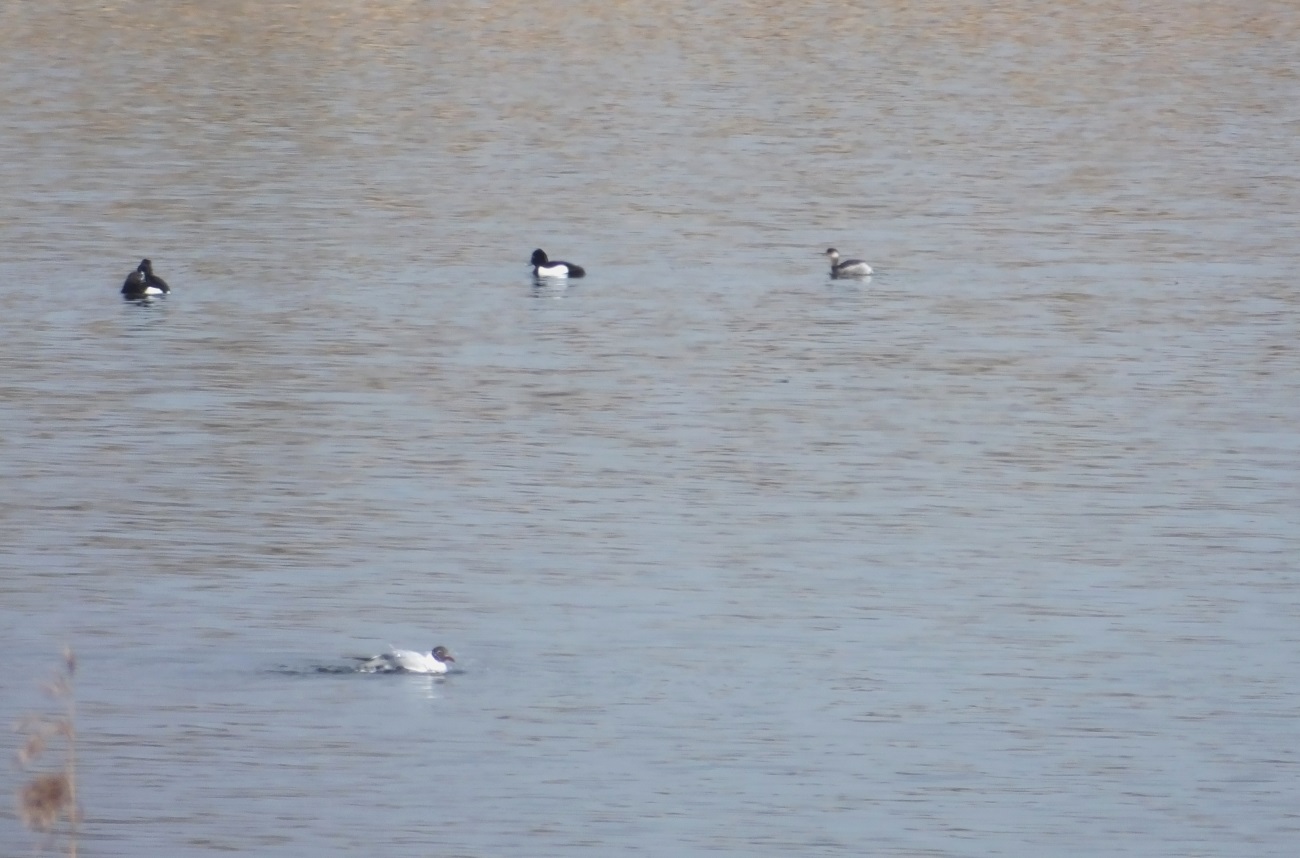
Not many minutes after that we were watching the Black Necked Grebe (113, MMLNR #78) showing not too well in the gloom well down the mere. Again if there's suitable habitat passing wildlife can and will find it. Wandering down that way with LR we saw the first of several skeins totaling at least 2000 Pink Footed Geese making the first stages in their journey to Iceland. Beautiful to listen to. Down at the hide we had poor views of the grebe but found a Curlew (MMLNR #79) on the new scrape. Still rubbishy dull light this soon after sunrise.
Continuing beyond the bridge we soon heard a Skylark (MMLNR #80) another beautiful sound and one seldom heard from here these days so lets hope they stick around and have a successful breeding season. They have been heard singing over the nature reserve's island in recent days, that would be something extra special if they managed to nest and raise chicks on there - it's been many years since they nested withing the borough boundary.
From there we left the reserve to have a quick check on the Long Eared Owls, woulda been rude not to. All three were present and correctly sitting on their favoured branches, so much so we're not sure they aren't actually stuffed toys or even cardboard cut-outs! The walk to the owls along the embankment gave us more Cetti's Warblers singing at each other, when we totted up how many we'd had we were a little surprised to find that we'd had 10 of them, that's a  pretty good poopulation of this still fairly scarce little bird, we saw just one briefly as it flitted across a gap in the reeds.
The day was beginning to warm up nicely even though it was still pre-breakfast time. A large bumble bee whizzed past us at head height, probably a queen Buff Tailed Bumble Bee, just to prove how warm it was.
LR met some of his dog walking mates and left us to wander back to the car alone. We had a quick and unsuccessfull look for the Stonechat at the wetland on the way.
Back at Base Camp we made Wifey her breakfast after which she got ready to go out and do her ususal Sunday duties. We left for the nature reserve but came staright back in to tell her that the House Sparrows were back on the opposite side of the road so she stopped what she was doing and came out to get them on her year list, we both saw one flit from garden to garden but when we got our bins on it it was a Dunnock (Wifey #51), the House Sparrows (Wifey #52) called incessantly but remained hidden in the hedge.
On our short walk from the car to the nature reserve we have a choice of two paths, the inner and the outer path. We thought about taking the outer one but realising the large puddle by the pond at the far end along the inner path would be dry by now as it's not really rained much (thankfully) for a while so we took the inner path. what a good choice that was, about two thirds of the way to the pond a small brown bird called as it flew from the bushes on one side to the trees on the other. Treecreeper (114, MMLNR #81) - what a stroke of luck!
The Black Necked Grebe took no time at all to locate at the west end living it up with a small group of Tufted Ducks. It was distant though and diving constantly.
We could see BD and others over on the viewing platform and a quick txt told us it was showing well and much nearer from there so off we went but not before a Small Tortoiseshell butterfly had flown past us, our first butterfly of the year. We didn't stop at the Feeding Station but watched a Coal Tit singing high in the Alder trees as we passed beneath.
At the platform we spoke to EP who'd a couple of hours earlier had a bat flying round over near where we'd just come from, almost definitely a Noctule. We took lots of pics of the Black Necked Grebe as it was indeed considerably nearer but being a bad workman and blaming our tools none of them came out any better than the rubbish pic above. Better than the grebe was the Iceland Gull which dropped through our field of view as we were scoping the gulls down at the far end of the mere. In front of us a Peacock butterfly flitted quickly by.
While scoping the Iceland Gull even more distant in the fields beyond the reserve boundary a flock of Lapwings over 100 strong had been flushed from a depression in the fields where there is a bit of flood. With them appeared ever so briefly a flock of something else wadery, our first thought was Golden Plover but then something made us change our mind to perhaps Black Tailed Godwits. OK so they're not really similar but in our defence they were only up a short while and we were looking at something else a lot nearer. Only one thing for it get down that far end and hope they have another fly round so off we went with BD to see if we could solve the mystery.
At the Bee Orchid site we'd heard rumours of two more rosettes now on show. We had a good look round but could only find the usual two although BD did come across the first 7-Spot Ladybird for the year.
Putting the scope up on the embankment we started to look across the fields, Lapwngs, Woodpigeons a couple of Stock Doves and a few Fieldfares were out there but nothing more exciting than than. Where's the Buzzards when you need a  to come cruising by and shuffle everything around. The scope wasn't necessary for the Reed Buntings that were playing chase me chase me in and out of the nearby bush and the small ones in the rough wetland below us.
There's always a flippin twig!
Also down on the wetland and altogether more unexpected were two Skylarks, are these the same as the one we had singing earlier in the day? The plot thickens!
By now it was coat off warm and there were plenty of insects on the wing. A stop at the hide saw us looking through the gulls but nothing out of the ordinary materialised. A young family came in and the young girl looked at the picture board pointing out the Pochard which we were able to show her through the scope and how fine they looked in the bright afternoon sunshine.
Outside a fence post had several basking Drone Flies.
And a wind damaged tree trunk had a basking Tree Bee - it looks worn on its thorax, do they overwinter??? Approaching it for the pic we saw some others come up from the ground, underground? We didn't see a hole they may have been emerging from.
Before heading off back to Base Camp we stopped off for the very last of the afternoon light at the Feeding Station. Quite lively in there today.
Two Grey Squirrels were up to their usual smash n grab antics
Less expected but perhaps not so when near to a wetland a Moorhen skulked gracefully at the edge of the scrub never brave enough to venture too far from dense cover.
And someone has donated us, or its flown/walked in from who knows where, this rather lovely female Pheasant. Really need to catch her in better light to show you the lovely purple and rich red-brown hues in her feathers.
Last but not least was the enigma of the many thousands of empty Garden Snail shells lining the side of the path, what had caused that? Why were there so few in the rough grass away from the path edge, was it something to do with the fence? One seemingly simple observation in nature can bring on a multitude of questions and hypotheses. Had they been victims of spraying, had they been hibernating on the fence died and dropped off, had something piled them up there like a Song Thrush although most of the shells were unbroken, was an invertebrate predator/parasite responsible in some way? Questions questions questions.
This lot is a tiny proportion of the whole - they went on like this for tens of yards being most dense near the fence posts - weird or what ? Any suggestions folks
Once back at BAse Camp we learnt that if we'd stayed longer we might have been in the right place at the right time to see both Bittern and Bearded Tits! That's a cracking day's selection for a 40 something acre reserve.
Today the beach and sea were pretty quite although we did have a Chaffinch (P2 #42) going over, they're not quite annual here
Where to next? It's getting to that time of year when just about anyting can happen so our eyes will be to the skies and our ears open.
In the meantime let us know who's doing the cruising in your outback


Friday, 11 March 2016

A few more added to the various birding lists

The Safari hasn't seen too much of late and we've not had chance to get the camera out of its bag but that's not to say we've not seen nothing.
Actually it was Wifey who added to her list first with several Rooks (Wifey #50) seen along the side of the motorway on her business trip to London recently. She's also probably seen more Red Kites than we've had hot dinners this year too.
We've been out on Patch 2 for a few minutes most mornings and lunchtimes seeing nothing out of the ordinary apart from three Curlews (P2 #41) a couple of mornings ago. other than those excitement out to sea has been confined to a reasonable count of 159 Sanderlings today and a loose flock of 11 Kittiwakes heading north yesterday, followed by the impressive sight of over 1000 Common Scoters in flight as a flock of them was disturbed by a small boat.
Mornings have been frosty but it's been well worth getting out for the blue skies alone. The snow on the Lake District fells was still there this morning.
Best and deffo the most unexpected sighting of the week was left until this morning. Leaving the front door as usual there didn't seem to be anything amiss, all was as quiet as it gets - too quiet even it's getting far too close to Rachel Carson's Silent Spring round here. But then we heard a cheeky chirruping we rarely hear close to Base Camp, in the small trees. Wow at least three dark shapes, House Sparrows! Great to have them so close to Base Camp...and then one, a handsome male, flew and perched on the gutter on the corner of the house right above us. And we'd just put the camera on the back seat of the car and closed the door dohhhhhhhh. But still House Sparrow (Garden #22) on the garden list is a great addition, we normal only get one or two visits a year and they're in June so we're well chuffed. The one on the gutter disappeared round the back of the house possibly towards the feeders - did it see the House Sparrow nesting terrace on the way??? We didn't see if the others followed it or not. We really hope they come back tomorrow morning!
At work we've set up a small tank with some Frog spawn from the pond at Base Camp for the children to study.
It's only been there 36 hours and already the eggs have grown some shape into miniature tadpoles, it's a lot warmer inside the heated building than in the pond so they're going to develop much faster than their cousins. Once they've metamorphosed almost into Froglets we'll return them. There's plenty more spawn in our pond but the fish will more than likely end up eating it so these will be the survivors.
Where to next? It's the weekend, there's big high tides and we have a cunning plan that involves the estuary.
In the meantime let us know who made a most unexpected and very welcome visit to your outback.


Monday, 7 March 2016

A quick sprint round the big park

The Safari stopped off at the big park on the way back to Base Camp after work.It was another mission to find a Treecreeper but first we called in at the lake to see what was going on there. There were young families on their way home from school armed with bread and seeds for the ducks. All this free food on offer had attracted plenty of Black Headed Gulls too
 And of  course the local Coots aren't going to pass up a free meal either.
Further out the Great Crested Grebe showed no interest in the bread and was shy of the activity.
 Of course what all the kiddies wanted to see were the resplendent drake Mallards which looked might fine and dandy in the late afternoon  sunshine.

We lurked furtively around the wooded areas but again to no Treecreeper avail. Lots of Blue Tits, Great Tits, Robins and Blackbirds as usual but today we saw a pair of Long Tailed Tits which we managed to avoid yesterday. 
The feeders we watched yesterday were mobbed by three Grey Squirrels which kept almost all the birds, apart from Feral Pigeons which waited for any spillage, away.
We've also had some exciting news from our Extreme Photographer down in sunny South West Wales. More about this revelation as it happens, he's got no pics yet but you'll like em when he does.
In the meantime he sent this sequence of a Starling fight on his feeder recently. The lower one was taking a battering but wasn't for letting go.
He apologises for the poor quality, the pics were taken through a double glazed window in not the best of light.
Where to next? Not a lot was happening on Patch 2 today, better luck tomorrow hopefully.
In the meantime let us know who's looking fine and dapper dandy in your outback.

Sunday, 6 March 2016

A change of scenery

The Safari got out of bed way to early today and we perhaps should have gone out for an early morning look-see but we didn't we waited in to make Wifey her breakfast when she woke up.
We did get out just before lunchtime and made a detour to the large park rather than  head straight to the nature reserve. There were plenty of gulls on the lake but nothing out of the ordinary. A Great Crested Grebe was top of the bill on the more open part of the lake. The other part of the lake had a few Shovelers and a few more Tufted Ducks. It wasn't waterfowl we were here to look for though, we were more interested in what might be in the trees. Last week CR had had good views of Treecreepers which we've missed at the nature reserve this winter and now they'll be back on the much bigger trees here. A Great Tit sang non-stop for several minutes while we checked the tree trucks for mouse-like birds.
A movement high above us caught our eye, not a Grey Squirrel this time but something more interesting and bluer...a Nuthatch, then we lost it as it flew to another tree. This was good as they have been reported only very infrequently this winter. Fortunately it reappeared after not many minutes.
Look at that, it's got a sunny seed. It was stashing them in the cracks in the bark for a rainy day. Following it back as well we could through the twigs and branches we soon found where they were finding them. Many kind souls bring seed and fill a variety of homemade feeders and this was where the two, yes two, Nuthatches were finding the seeds.
Not the best of pics the light was dodgy (poor excuse we know) and they are quick little devils!
The seed ran out and they soon disappeared but PL came by with some in his pockets and scattered it around for the other small birds and the ever greedy Feral Pigeons. The Nuthatches didn't come back. They were, however, a tick on our Patchwork Challenge Marton Mere list but it won't go on our 'official' Mere list, the site boundaries aren't the same.
There's always a Robin or two on the prowl
And they aren't shy of accepting free offerings


We wandered through the park with PL coming across some Gadwall at the far end near the heronry, not many Herons were in residence today. this one was at the water's edge sunning itself.
A Great Spotted Woodpecker was heard drumming but we didn't locate it in the tree tops. We left the park crossing the road to the ornamental woodland. Here we heard a Goldcrest but again couldn't find any Treecreepers. At the old log PL put down more seed from his pocket and down they came in their droves as if they'd been expecting him including this female Blackbird.
Out of the wood we had a look under the wooden sheets to see if there were any early waking Great Crested Newts, there weren't but there were two sleepy Toads.
Wandering on we checked out the nearby Bee Orchid patch at the side of the path, we found four rosettes which was nice. 
Now the nature reserve was beckoning, we looked unsuccessfully for the Stonechat at the wetland on the way. Instead of going in we went round to look for the Tawny Owl, no joy but it's probably long gone. There was a family looking for the Long Eared Owls, they'd been told were to look from by another birder but couldn't find the owls in the bushes. We were able to put them on to one of them straight away, the other two were tricky.
The easy one, facing away as usual
We met up with PL again. this time with TS and spent some time watching several Buzzards soaring in a 'kettle' on a thermal reaching an prodigious height. Away beyond the distant woods a white flash from a flock of birds was seen over the trees. A look gave us a flock of Lapwings and then the white flock again - Golden Plovers, about 200 of them. Another Patchwork Challenge tick - you can count birds seen from your patch boundary, but again not an 'official' patch tick,, far too far from that patch boundary. Another 100 or more Lapwings were on the flood the other side of the dyke and two Shelducks on the nearer flood in the corner of the field. The Lapwings weren't calling and displaying today despite the sunshine and we heard no Skylarks. There were a couple of dozen Fieldfares in the nearer field but we still can't find a Redwing.
A look at the Bee Orchid area which has been mown, fortunately sparing the two Bee Orchid rosettes we found a few weeks ago. Coltsfoot was in flower at the edge of the meadow, the first we've seen this year.
A quick sprint back to the car in the park took us past the wooded area to look for Treecreepers again - again no joy but we did nearly step on some Dog(?) Violets we hadn't noticed earlier in the day.
What a cracking day out on safari.
Where to next? Back to see what's happening on Patch 2 tomorrow.
In the meantime let us know who's been playing hide and seek in your outback.