Showing posts with label drone fly. Show all posts

Monday, 13 April 2020

The third week of lockdown local wildlife safaris

The Safari has had a rather productive week despite being on Lockdown. Last week ended on a high too with our first ever spring record of a Rook flying over Base Camp, they are very infrequent in the autumn, usually tagging along with flocks of Jackdaws on passage.
An early morning visit to the prom last Monday gave us a distant flock of Eiders heading south and the day got better still when a Chiffchaff dropped into the Base Camp garden staying a while to have a  little bathe in our ornamental waterfall. That gave us just enough time to grab the camera and fire off a few shots through the increasingly dirty kitchen window - time for the mop, bucket and Windowlene. Number 32 on our 1 mile from home challenge which was a two week challenge but has now been extended to six weeks - we get the impression it might be expanded even further yet too.
It wasn't the only bird having a spruce up that day, a Blackbird was in there too.
The following day we were back in the park this time we'd taken the camera to see if we could get a pic of the local House Sparrows that hang around the perimeter of the field where it backs on to the neighbouring gardens. Crikey it took some doing they were either very flighty not allowing any sort of close approach or keeping hidden in the dense Ivy or thick twiggery of the bushes. It took several circuits to finalyy get one submitted to the SD card for #33.
On a further lap of  the fields we heard a commotion of Sparrowhawk yikkering coming from the Butterfly Zone. We headed over that way to see what all the racket was about only to find the pair mating in one of the Sycamores at the edge of the scrub but requiring a very tricky shot through plenty of intervening branches and twigs.
Flamin out of focus twigs!
Job done and off...
The female
Never seen that before and very lucky to witness we guess. 
Nearby Green Alkanet was flowering in a sunny glade
Bright sunshine, warm too, brought a Peacock to nectar on the Aubretias in the garden tubs. Our first and so far only butterfly pic this year.
The fine weather got us to thinking about doing a bit of gardening so out came the stout gloves and secateurs and we ventured into the Bramble-infested no-man's land behind the garage. Now Brambles aren't that bad and provide habitat and food for a humungous number of invertebrate species but in a very small garden it's easy to have too much of a good thing. While doing a bit of snipping we heard the gulls go up in alarm and looking up we saw about a dozen of them chasing an Osprey almost directly over our head, tantalisingly close to being a Garden Tick but at least we'd joined the Osprey-from-the-garden-during-Lockdown club. We dropped the secateurs and tried to remove our gloves as we sprinted back down to the kitchen where the camera lay waiting. Too late - by the time we'd grabbed it the Osprey as nowhere to be seen, obscured by all the neighbouring houses. We called CR but sadly he missed ti too. There's a moral here - if you go up to the furthest reaches of the garden take the flippin camera with you!!! A Blackcap was singing very close to Base Camp much of the day too but never ventured in to the garden.
That takes us to Thursday. Leaving Base Camp for the early morning quick dog walk we had a skein of about 90 Pink Footed Geese fly over us. Later, on the proper exercise/dog walk we heard or first  Coal Tit for a long time, singing away in the line of tall conifers by the water tower and further on in the park the Chiffchaff and Blackcap now seemed to be settled in the Butterfly Zone which incidentally is so far devoid of butterflies.
Base Camp's moth trap has been dire, a combination of the Super Moon, neighbouring high intensity security lights and severe local habitat destruction aka garden tidying has butchered the local moth populations. A tatty Hebrew Character was a welcome find but we're getting to the stage of How many kilowatt hours per moth!
The Super Moon - we were out too late to find it in all its pinky glowing glory
Good Friday was a good day on the prom early morning, out on the beach we came across a Green Leaf worm in a little puddle, not something you see ervyday and it soon buried itself in the soft sand. A few yards further on a recently deceased Lesser Spotted Catshark lay on the beach. Probably a victim of the anglers that are still out angling abeit in much smaller numbers than usual.
When we got up to the top of the cliffs at the furtheest point of our walk there was a bit of passage going on. We counted at least 35 Meadow Pipits and 21 Linnets going northwards, five Pink Footed Geese heading NW out to sea, got our first Swallow of the year, quite late we've ususally come across one in the earliest days of April rather than into the second week and a Blackbird was singing from a promenade rooftop - most unusual, the first we've heard along here in several years of 'treading the beat'.
Back at Base Camp several Nomad Bees were flying around and a Sparrowhawk soaring away to the north got the gulls going and our pulse racing again.
Easter Saturday started well with 50 Pink Footed Geese going north and a few minutes later we heard our first Willow Warbler of the year, which, like the Swallow, was quite late for us. We heard the conifer Coal Tit singing again and followed it up with a second this time in the big conifers in the park.
Most unexpected, although at migration time birders should always expect the unexpected, a pair of Shelducks flew towards the sea just east of the park - a Patch Tick!
In the garden a female Light Brown Apple Moth graced the trap and up to four Greenfinches graced the feeders.
Best sighting of the day was a female Orange Tip butterfly, really scarce here, flying through the gardens just round the corner on our very quick lunchtime dog-pee walk. In the afternoon another good sighting was had, a Red Mason Bee, a new species for the garden, was discovered when we ventured behind the garage to bash some Bramble again.
A Common Quaker and a large Crane Fly were in the moth trap on Easter Sunday.
And a review of the stealth-cam revealed the Hedgehog is still about if only an occasional visitor this week. we've repositioned the camera to see if we can get a better view of him for next time.

In other news the sunny week has given us lots of invertebrate photo opportunities at Base Camp - here's a selection of what we've seen.
Buffish Mining Bees - from the 'colony' at the corner of our street
Several Eristalis Drone Flies take up positions around the garden. We've not had a proper look at them but guess they'll be E. pertinax.
Some of our plant pots have more moss than plant!
In the latter half of the week Gooden's Nomad Bees became regular visitors but they're a nightmare to photograph as they just won't settle for more than the briefest moment - here's a few of the hundreds of pics we've tried to take of them.
Another good find in the 'Bee-line' was this Tawny Mining Bee sunning itself on the fence, a rare find in the garden.
While watching our first Zebra Spider of the year clamber about on the the trellis 
we spotted this tiny Hoverfly flitting around the flowers by our knee - no idea which species, one of the Sphaerophorias perhaps.

Where to next? More of the same - here's hoping the weather stays fine for daily Base Camp safaris and there's still the opportunity to take the dog for his walks round the park and occasional visits to the beach which he loves.

In the meantime let us know what's in your very much restricted outback. Stay Safe - Keep your distance!!!

Thursday, 3 November 2016

Some more ticks on the bird lists

The Safari is still struggling to get out much although we have added a few more birds to our various lists.
First up was a Great Spotted Woodpecker (Garden #30) flying up the street while putting Monty in the car for a trip somewhere or other. We haven't seen one round these parts for a couple of years, the numpty that cut down the big Sycamore because he didn't like sweeping up the autumn leaves didn't help matters! Next up was a Cormorant (Garden #31) flying inland quite high up, another species that isn't quite annual at Base Camp and again Monty was involved, we were out in the back garden giving him a work out with a flattened water bottle - yes we've spent a fortune on toys but his favourite is a squashed old plazzy bottle. Our final addition also involved Monty, this time a late night out before bed-time. A flight of 13 Whooper Swans (Garden #32) were heard long before they were seen passing right over heard eerily illuminated from beneath with an orangy glow from the street lamps. Bizarrely we had another two before dawn the following morning. Whooper Swans have been annual over the last few years after no records between 2010 and 2013.
This morning the recently rubbish Patch 2 came up with a new species for the year when a flock of 27 Wigeon (P2 #77) flew by just behind the  light surf, best of the rest was a single Dunlin which flew in to join a small number of Sanderlings scampering around dodging the incoming waves.
Yesterday there was a bit of a sunrise going on so we took the camera out to try to do a bit of art but were just a tad miffed by the number of plane con-trails.
Pick a favourite
Later we had another short session while the last of the day's warm sunshine was shining brightly on the Caster Oil plant's flowers. 
Lots of these Drone Flies were slurping up nectar.
There were a couple of other species flying around too but we only managed a snap of one of them.
Any one any ideas? CR may well know, he's pretty clued up on hoverflies.
Where to next? Still in the throes of some pretty stressful family stuff so the weekend might not provide as many opportunities for safari-ing as we might like.
In the meantime let us know who's slurping up the last of the nectar in your outback.


Monday, 14 March 2016

Hen harrier at high tide and a barn owl before breakfast

The Safari picked up BD yesterday and we headed for the marshes. There was a high high tide and we had a few target species. On the way we passed a Peregrine, possibly two, on the roadside church. Once ensconced at our vantage point we watched the tide rise. It didn't take long to find eight Avocets well down by the river but it was hellish misty out there and distance viewing wasn't that good. All the common stuff was about on good numbers, 66 Whooper Swans, immeasurable Shelducks, Curlews, Redshanks, displaying Lapwings and singing Skylarks. The sound-scape was phenomenal out there. Behind us on the fields a Song Thrush belted out its repetitive, but happy sounding, musical ditty.
Out on a washed up tree log two Peregrines laid up watching and waiting. A Merlin gave fantastic chase to a Skylark or Meadow Pipit, the victim spiraled upwards trying to shake the attacker off. The chase lasted over a minute with the small bird eventually winning its freedom by twisting this way and that until the Merlin gave up the chase. Later we witnessed a faster low-level chase with the small bird nipping either side of a barbed wire fence through the wires and again survived after a few long seconds. 
The tide inexorably rose higher and higher pushing the birds closer together, a count of the Little Egret maxed out at 62, very likely the most we've seen here by a good way. With no wind and high pressure the tide didn't quite reach the sea defences but at the top of it we watched a raptor cruise in close and low, a ringtail Hen Harrier, epic!!! Our target species didn't put in appearance though, but it didn't matter as a Hen Harrier trumps just about everything else these days. We hope it stays safe over the summer months. Not long after we had a Kestrel and a Buzzard, so a five raptor day with no Sparrowhawk!
We dropped BD off, after passing the two Peregrines again and probably a third on a different building. And then got ran in to the back of by a plonker in a van. No injuries thankfully but some damage to the motor that couldn't be attended to late on a Saturday afternoon. The we discovered there'd been a Black Necked Grebe at the nature reserve, a few muxed ip txts later and a look at the website showed it to be still present late on...
This morning we were up and at em at dawn. Only a few minutes after getting out of the car we were watching a Barn Owl hunting over the wetlands, we filled our boots watching it. Had we been still in the car on the roadside we'd have seen it through the hedge from the driver's seat. It's all good stuff when you consider we were only a mile and a half from the some of most urbanised areas in the country outside of inner London. If there is sufficient habitat wildlife can and will thrive.
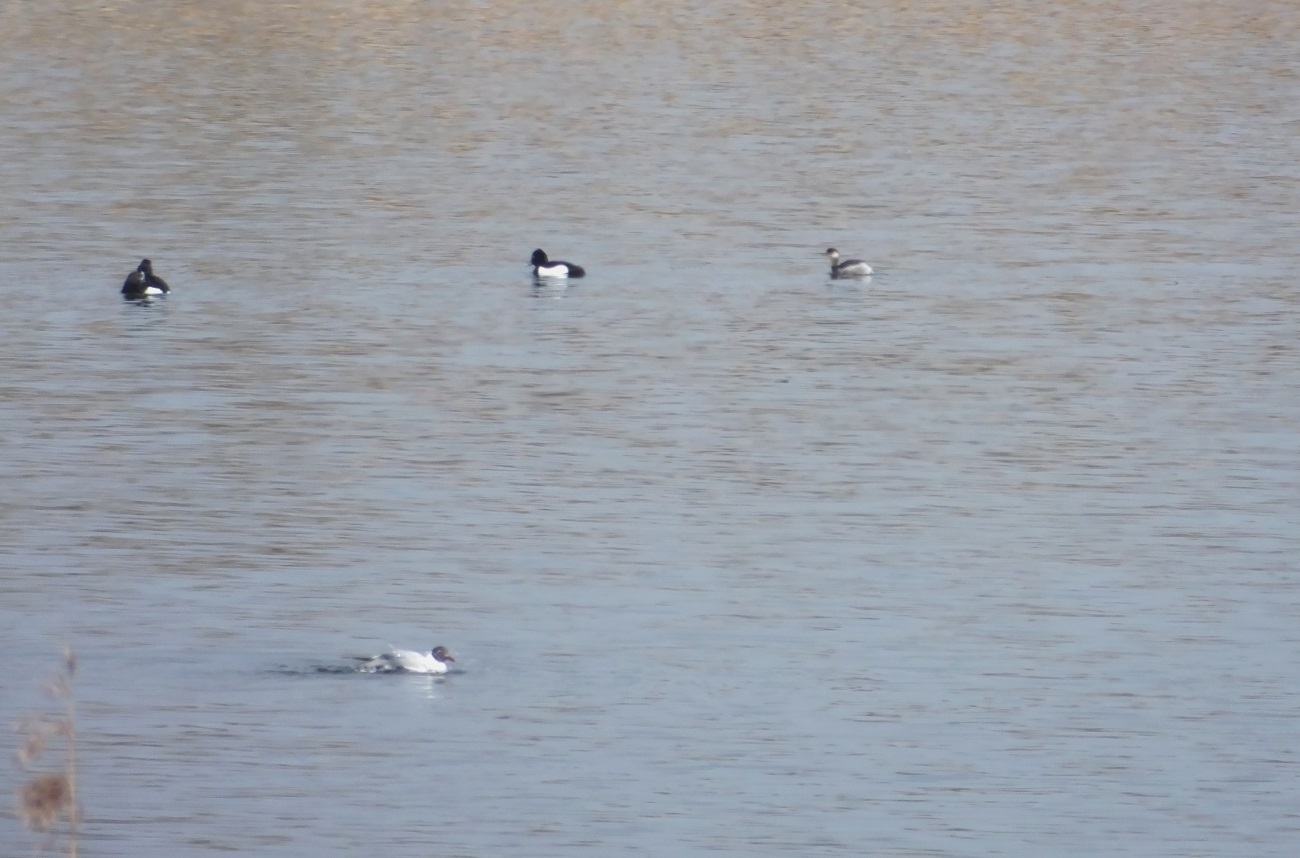
Not many minutes after that we were watching the Black Necked Grebe (113, MMLNR #78) showing not too well in the gloom well down the mere. Again if there's suitable habitat passing wildlife can and will find it. Wandering down that way with LR we saw the first of several skeins totaling at least 2000 Pink Footed Geese making the first stages in their journey to Iceland. Beautiful to listen to. Down at the hide we had poor views of the grebe but found a Curlew (MMLNR #79) on the new scrape. Still rubbishy dull light this soon after sunrise.
Continuing beyond the bridge we soon heard a Skylark (MMLNR #80) another beautiful sound and one seldom heard from here these days so lets hope they stick around and have a successful breeding season. They have been heard singing over the nature reserve's island in recent days, that would be something extra special if they managed to nest and raise chicks on there - it's been many years since they nested withing the borough boundary.
From there we left the reserve to have a quick check on the Long Eared Owls, woulda been rude not to. All three were present and correctly sitting on their favoured branches, so much so we're not sure they aren't actually stuffed toys or even cardboard cut-outs! The walk to the owls along the embankment gave us more Cetti's Warblers singing at each other, when we totted up how many we'd had we were a little surprised to find that we'd had 10 of them, that's a  pretty good poopulation of this still fairly scarce little bird, we saw just one briefly as it flitted across a gap in the reeds.
The day was beginning to warm up nicely even though it was still pre-breakfast time. A large bumble bee whizzed past us at head height, probably a queen Buff Tailed Bumble Bee, just to prove how warm it was.
LR met some of his dog walking mates and left us to wander back to the car alone. We had a quick and unsuccessfull look for the Stonechat at the wetland on the way.
Back at Base Camp we made Wifey her breakfast after which she got ready to go out and do her ususal Sunday duties. We left for the nature reserve but came staright back in to tell her that the House Sparrows were back on the opposite side of the road so she stopped what she was doing and came out to get them on her year list, we both saw one flit from garden to garden but when we got our bins on it it was a Dunnock (Wifey #51), the House Sparrows (Wifey #52) called incessantly but remained hidden in the hedge.
On our short walk from the car to the nature reserve we have a choice of two paths, the inner and the outer path. We thought about taking the outer one but realising the large puddle by the pond at the far end along the inner path would be dry by now as it's not really rained much (thankfully) for a while so we took the inner path. what a good choice that was, about two thirds of the way to the pond a small brown bird called as it flew from the bushes on one side to the trees on the other. Treecreeper (114, MMLNR #81) - what a stroke of luck!
The Black Necked Grebe took no time at all to locate at the west end living it up with a small group of Tufted Ducks. It was distant though and diving constantly.
We could see BD and others over on the viewing platform and a quick txt told us it was showing well and much nearer from there so off we went but not before a Small Tortoiseshell butterfly had flown past us, our first butterfly of the year. We didn't stop at the Feeding Station but watched a Coal Tit singing high in the Alder trees as we passed beneath.
At the platform we spoke to EP who'd a couple of hours earlier had a bat flying round over near where we'd just come from, almost definitely a Noctule. We took lots of pics of the Black Necked Grebe as it was indeed considerably nearer but being a bad workman and blaming our tools none of them came out any better than the rubbish pic above. Better than the grebe was the Iceland Gull which dropped through our field of view as we were scoping the gulls down at the far end of the mere. In front of us a Peacock butterfly flitted quickly by.
While scoping the Iceland Gull even more distant in the fields beyond the reserve boundary a flock of Lapwings over 100 strong had been flushed from a depression in the fields where there is a bit of flood. With them appeared ever so briefly a flock of something else wadery, our first thought was Golden Plover but then something made us change our mind to perhaps Black Tailed Godwits. OK so they're not really similar but in our defence they were only up a short while and we were looking at something else a lot nearer. Only one thing for it get down that far end and hope they have another fly round so off we went with BD to see if we could solve the mystery.
At the Bee Orchid site we'd heard rumours of two more rosettes now on show. We had a good look round but could only find the usual two although BD did come across the first 7-Spot Ladybird for the year.
Putting the scope up on the embankment we started to look across the fields, Lapwngs, Woodpigeons a couple of Stock Doves and a few Fieldfares were out there but nothing more exciting than than. Where's the Buzzards when you need a  to come cruising by and shuffle everything around. The scope wasn't necessary for the Reed Buntings that were playing chase me chase me in and out of the nearby bush and the small ones in the rough wetland below us.
There's always a flippin twig!
Also down on the wetland and altogether more unexpected were two Skylarks, are these the same as the one we had singing earlier in the day? The plot thickens!
By now it was coat off warm and there were plenty of insects on the wing. A stop at the hide saw us looking through the gulls but nothing out of the ordinary materialised. A young family came in and the young girl looked at the picture board pointing out the Pochard which we were able to show her through the scope and how fine they looked in the bright afternoon sunshine.
Outside a fence post had several basking Drone Flies.
And a wind damaged tree trunk had a basking Tree Bee - it looks worn on its thorax, do they overwinter??? Approaching it for the pic we saw some others come up from the ground, underground? We didn't see a hole they may have been emerging from.
Before heading off back to Base Camp we stopped off for the very last of the afternoon light at the Feeding Station. Quite lively in there today.
Two Grey Squirrels were up to their usual smash n grab antics
Less expected but perhaps not so when near to a wetland a Moorhen skulked gracefully at the edge of the scrub never brave enough to venture too far from dense cover.
And someone has donated us, or its flown/walked in from who knows where, this rather lovely female Pheasant. Really need to catch her in better light to show you the lovely purple and rich red-brown hues in her feathers.
Last but not least was the enigma of the many thousands of empty Garden Snail shells lining the side of the path, what had caused that? Why were there so few in the rough grass away from the path edge, was it something to do with the fence? One seemingly simple observation in nature can bring on a multitude of questions and hypotheses. Had they been victims of spraying, had they been hibernating on the fence died and dropped off, had something piled them up there like a Song Thrush although most of the shells were unbroken, was an invertebrate predator/parasite responsible in some way? Questions questions questions.
This lot is a tiny proportion of the whole - they went on like this for tens of yards being most dense near the fence posts - weird or what ? Any suggestions folks
Once back at BAse Camp we learnt that if we'd stayed longer we might have been in the right place at the right time to see both Bittern and Bearded Tits! That's a cracking day's selection for a 40 something acre reserve.
Today the beach and sea were pretty quite although we did have a Chaffinch (P2 #42) going over, they're not quite annual here
Where to next? It's getting to that time of year when just about anyting can happen so our eyes will be to the skies and our ears open.
In the meantime let us know who's doing the cruising in your outback