Showing posts with label tree bee. Show all posts

Tuesday, 4 February 2025

Has the time arrived for landscape scale re-wilding finally arrived?

The Safari saw a headline a couple of days ago.

English farmland could be cut by 9% to hit green targets

The article beneath the headline made for interesting reading and although it might seem like 'another' threat to farming from an already precieved as farming-unfriendly government there are fantastic opportunities to be had for our beleaguered wildlife, not forgetting the the UK is one of the most wildlife depleted countries on the planet. By coincidence for Christmas we had received this book and read it during the bad weather that prevented going out on safari in January.

We're a big fan of re-wildling and that doesn't mean land abandonment which many folk out there seem to think it does. To maximise the diversity of wildlife an area can hold there does need to be some management otherwise one vegetation type will tend to dominate (dependent  on local variations in soil composition/moisture etc). However, and this is the biggy, the management doesn't have to be done by man, although some works like stopping us peatland drains and removing invasive non-native species eg Rhododenron ponticum need to be done by us humans. What happened before us humans brought fire, axe and sheep? The answer is wild animals would have shaped the vegetation across landscape scale areas. 

Does anyone watch Wildearth TV? The reserves to highlight southern Africa's majestic animals they use all used to be farmland but now have fabulous ecosystems thanks to letting the land recover from cattle overgrazing and introducing larger native animals. We don't have Elephants and drove our nearest equivalent, Aurochs, to extinction many many years ago but we do still have plenty of proxy animals that would do the job of long lost wild cattle, horses and Wild Boars. We have deer two, although only two are native, two are naturalised and are 'probably?' OK the other two are definitely not OK - more about those later. 

Several of the reserves we visit use proxy animals to manage the habitats mainly for specific species/associations of birds although in a couple of cases it is shorter vegetation to enhance the overall diversity of wild flowers that is the target.  Here are some examples of our favourite management tools going about their work.
Longhorn Cattle


Redpoll Cattle

Mixed cattle including a Belted Galloway
Exmoor Pony
Redpoll Cattle
Redpoll Cattle
Redpoll bull
Highland Cattle
Highland Cattle

Carneddau Pony


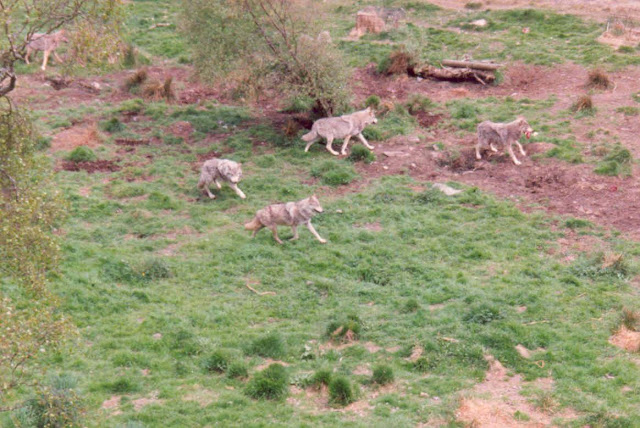
We should have drawn the southern boundary line to include the steep Patterdale Common and the northern boundary line to include Matterdale Common too, basically taking in all the western watershed  into Ullswater from Grisedale Beck (= Wild Boar stream) to Aira Beck at Dockray. Arnison Crag (bottom right probably alludes to White Tailed Eagles, Whelp Side (bottom left) - Wolves, Hart Side (top centre) - deer possibly Fallow Deer as Red Deer males are known as stags not harts, Swineside Knott - Wild Boar. Now what do all these creatures have in common? They're all woodland species (the White Tailed Eagle is a wetland/coastal species but often requires big trees close by for nesting), yet if you were to climb to the top of Birks above Black Crag and looked slightly west of north you'd barely see a single bush never mind a whole tree. There's got to be an opportunity to relieve that area, 26 sq kms and at least probably that much again going up to Dockray, of its sheep, do some tree planting, allow some tree regeneration, prevent any non-natives establishing (need humans to do that), bring in suitable hardy cattle and pony species (there's an income stream for the farmers - who might no longer be called farmers but Landscape and Biodiversity Stewards (and hopefully be handsomely subsidised for becoming such) - - would 'Conservation Grade Meat' bring a premium price to their pockets?) The question of free-roaming pigs is a little more tricky but there could be the potential to use inobtusive electric fencing enclosures which can easily be moved around to prevent the pigs over-grazing, or better still what about good old fashioned proper job wild Wild Boar? Wild Boar could be controlled (in sustainable numbers) by those  members of society who like killing things, instead of shooting millions of tame non-native Pheasants how about learning how to stalk Wild Boar and use the meat...hmmm WB sausages - very nice indeedy. And therein lies another issue - how do you  prevent the cattle and ponies over grazing? In the old days those whelping Wolves would have kept our beasts on the move not lettin g them settle in any one area too long. Now there's no chance of bringing Wolves into this area and that could potentially be a problem, we're not sure what the answer is - someone walking behind them with a sharp stick??? Oh you mean a shepherd! 

Now all this might sound like pie in the sky but it is beginning to happen, even in the lake District NP with the new Skiddaw Forest Cumbria Wildlife Trust project, the more established Wild Ennerdale and the Restoring Hardknott Forest Project which aims to create and restore 630 ha native woodland and other wildlife rich habitats on what was recently one of the Lake District's largest commercial coniferous forests - there's another discussion as to whether or not foerestry plantations should have ever been allowed in a National Park in the first place but it is possible that the trees were planted before the NP status was confered - we don't know. Neither do we know if Skiddaw Forest or Hardknott intend to have proxy grazers, Wild Ennerdale and Wild Haweswater definitely do.

Not far to the south and west of the map above another exciting re-wildling project is afoot. This time it's not an area or a habitat but an iconic species that was extirpated from this area many years ago, namely White Tailed Sea Eagles aka Ernes (Heron Crag, on the main Ambleside to Keswick road, and Arnside Knott across the bay etc are place names that allude to their former presence). We can't wait to see this project get off the ground - if only to get WTE on our garden fly-over list. It would be great to watch them catching Mullet off the mouth of the River Wyre or plucking feral Canada Geese from the shores of Windermere in front of gobsmacked tourists. Let's hope it gets the go-ahead before too long but we do have some reservations about any potential impact on nearby seabird colonies at St Bee's Head and RSPB's Hodbarrow reserve and also on potential distubance to the eagles themselves just from the sheer numbers of people on the fells these days. Anyway fingers crossed it happens soon...and they don't 'disappear' like almost all of the re-introduced Red Kites have.

Moving on...our National Parks are probably where most of the effort should be concentrated and not only the upland  ones as there are other areas that would benefit such as some of the former Areas of Outstanding Natural Beauty, our nearest one, the Forest of Bowland, is about as an unnatural area of little beauty as you can imagine, it could be so much better. There are three main land owners, the water authority who to give them their due are doing their but but the other two need a bit of persuading, one of whom is the King, Charles III, who allegedly has conservation running through his blue blooded veins - it certainly doesn't show up there on his hunting estate nor at Balmoral (in Scotland) where if he were to re-wild his estates rather than haveing them as killing grounds maybe some of his neighbours might follow his lead. Come on Charlie Boy grasp the Nettle what's stopping you?

9% of farmland given over to nature might sound like a very frightening amount to some folk but when you consider that much of that 'farmland' is barely productive at the moment and sheep aren't a necessary staple in our diets and that we pay heavily to subsidise them along with often paying through taxed to drain land for them, then pay again for flood defences to cope with the increased water flow off the mountain - there's nothing wetter that wet long grass but there isn't much long grass up there its all been nibbled away, and then we pay again in increased insurance premiums to cover the losses when floods do happen. When you look at it that way and the very few jobs provided by that amount of land it makes sense to us to restore its biodiverisity and enrich its landscape. There's probably quite a few more jobs available in the latter scenario as well.

Going back to those members of our society who like killing things, they could become conservationists too by doing some essential culling of some of our non-native nightmares - we're looking at you Muntac Deer (the carnage we saw on the roads between Oxford and Southampton last year was horrendous, the carnage they cause to our woods and associated wildlife is even worse), Sika Deer, Grey Squirrel, Canada Geese to name but a few. They could fulfil their bloodlust while providing our beleagured wildlife a very helpful service rather than being  part of the problem. Not sure about the freal geese and the squirrels but venison should be almost free in this country there's so many deer causing so many problems. The squirrels and geese - well there's lots (far too many!) dogs n cats that need feeding, would the pet food industry be interested in free range produce; shot with non-toxic ammo though. How about "Eat the Aliens" as a slogan?

Not just woodland/forest either, parts of Somerset flooded again last week not as devastatring as a few years ago but enough to show there's anm on-going issue -  the book describes opportunities for large scale wetland restoration in various areas of the country especially Somerset...Pelicans? Yes please!

all well and good this know-it all townie  - Community buy-in essential - aging multi-generational sheep farmer how to engage and encourage them to change/retrain - economics, government initiatives and incentives, the policy is just about there

Fewer sheep, fewer problem deer, more Wild Boar, Beavers, Moose and Wisents please and Nightingales which used to nest in Lancashire just about living memory. The Safari is going to admit to watching a TV show called  A Place in the Sun, when they visit France the sound of the local area being viwwed by the punters is always Nightingales. And can we have more Corncrakes which an elderly relative now passed away could remember calling on our family farm when she was a young girl - oh did we not mention we're not just a another suburban townie keyboard warrior know it all.

All we want is a future abounding with wildlife rather than the currrent position of letting it dwindle away with the shifting baseline getting lower and lower despite the odd success story like the Bittern comeback

and Cetti's Warbler colonisation,
these are just feel better blips on the otherwise inexorable downward spiral to mass extinction on these isles. Being closer to 70 than 60 now were unlikely to see the benefits of all this good work even if it starts at first light tomorrow morning. But given the opportunity wildlife can spring back very quickly as the Knepp project down south has shown - somewhere we'd like to visit for a good shuffy round one day. All it needs is the will and some sensitive management and our future generations will be looking back asking why didn't they do it sooner. 

There has to be community buy-in to these projects. After all you can't just turf folk off their land, well ntot in a civilised society you can't. But how do you convince an aging sheep farmer whose family have been sheep farmers for generations to give his land over to nature, even with compensation what is he going to do next? What's in it for hime? Can he quickly learn a new set of livestock skills to look after cattle rather than sheep, can he become a woodsman - does he have the time to wait for trees to grow so he can harvest them - does he really feel comfortable running wildlife watching safaris - questions that those affected will need answering. Maybe the government coud waive the recently introduced inheritance tax for those farmers that would be affected by the tax that join the schemes. We'd much rather se a lot of carrot and not a lot of stick in this transition to a better state otherwise there's going to be a lot of resentment. It's going to be hard enough to get the status quo vested interests on board as it is. Look how difficult it continues to be to get raptor persecution to stop or even a prosecution on the few occassions there's enough evidence.

Here's some pics of recent 'winners'

Little Egret

Spoonbill

Roe Deer

Tree Bee

and some recent 'losers'

Corn Bunting

Skylark

Willow Tit

Tree Sparrow
And don't forget it's not just about birds, it's as much if not more about soil improvement (structure, microbiome and losing toxins), mosses, lichens, liverworts, fungi, the herb layer, invertebrates (see above), fish, amphibians and reptiles as well as the birds and mammals - it's restoration of a whole (at least as whole as can be) functioning ecosystem including these chaps - one day? Maybe the wilder parts of NW Scotland first, can't really see England going for Wolves anytime soon...but you never know, if you don't ask  you certainly won't get!
Lynx should be out there soon. However, numpties recently illegally releasing them inappropriately might have added a few years on to that wait though.

Anyways it's all food for thought so what do you think? 

Where to next? We expect to be out  on safari again later this week - when the weather imroves, honking it down today!

In the meantime let us know how much wilder your outback could be given a few sympathetic changes.

Wednesday, 15 June 2016

There's always summat to moan about

The Safari has been mostly stuck indoors watching the feeders through the kitchen window. Nothing overly exciting but the unringed male Greenfinch put in an appearance after several days AWOL and where have the Jackdaws gone? Not even heard them for a good few days now.
Nice to see a young Blackbird learning the ropes
This is the only time we've seen a Starling on the seed feeder
The Starling above is doubly unique, not only was it on that feeder it was also ringed. A look at SE's blog showed that the Fylde Ringing Group had only ringed two Starlings this year to the end of May, so not a species they come across very often and don't target specifically at this time of year so where had it come from. Further inquiries suggested it may have been ringed well to the south of us in a trainee ringer's garden but that location does seem too  far away from Base Camp we'd expect that it was a much more local bird, but who knows? There's one way to find out, hope it comes back and hope we've got the big lens ready when it does.
We had the big lens on whilst sat outside once the rain had stopped when a big dobber of a Tree Bee flew past us and landed on the Northern Marsh Orchid and stated to crawl about. We fired off a few shots at 600mm; it was about 18ft (6m) away from us.
OK so they show a bee crawling up a flower, nowt special about that. But look closer at the two side shots, in the top one you can see the proboscis going into the flower but what's that yellow stuff. One shot we weren't fast enough on the shutter button to get but saw through the viewfinder was the bee leaning right back as though it was pulling something from the flower - was it the yellow 'stuff' are they stamens? We didn't notice the yellow stuff til we downloaded the pics.
We put the pics on Twitter asking for opinions and got a 'like' but not an answer from a Steven Falk - we wonder if it was this Steven Falk???
A little later another bee was seen visiting flowers in the same tub, this time an Early Bumble Bee with some hitch hikers.
Not the best of pics but you can clearly see the mites on the bee's back
The Foxgloves are ever popular too.
Other than these goings-on not a great lot was happening out there although a bit of warm sunshine brought some Blue Tailed Damselflies out of hiding.
Later on in the afternoon we spotted this story in the local newspaper, the 'Tidy Brigade' strike again in big contrast to this much more positive offering from the other side of the border.
Pic belongs to Cugel Phandaal Law originally posted here and stolen from him by all and sundry - hope he doesn't mind us adding to that list
The comments section in the newspaper article show the fear of the natural world, people have become so used to dominating and controlling vegetation they're now frightened of it and will use any excuse to regain control. Those children shouldn't be pulling faces they should be getting down amongst the grass and looking for beetles, snails and the like, chasing the butterflies that will now abound (at lest the skippers will abound), getting mud on their knees, getting stung by Nettles, scratched by Brambles, accidentally putting their hand on an ant's nest- it won't kill them!!! Don't panic about it it's not the end of the world there's far more things to worry about like why there isn't the money to continue cutting the grass aka destroying the biodiversity. And hey (hay?) exposure to all that grass of a multitude of species might actually help them not contract hay-fever in the first place as some studies are suggesting that it is our under-exposure to a variety of chemicals and compounds that are the cause of so many people having immune deficiency/over-reaction disorders.
Blaming litter is out of order - long grass does not produce litter, lazy litter louts make litter whether there's long grass or not. We reckon it looks good and because the path edges are mown it looks managed and supposed to 'be like that'. The doggy do-do they're whinging about should be less of a problem too, the slugs and snails will eat it overnight provided some charming person hasn't bagged it and chucked the bag; although it does add unwanted nutrients to the eco-system. And anyway you should be keeping your mutt on a lead until it's done its business and  you can see it to tidy away into a bin not letting it run rampant and squat 'unseen'...we can only dream......Don't know about London but the street on our walk to the shops certainly isn't paved with gold, brown yes, gold no!
Trouble is the areas that really do need to get cut and raked/collected like both the rough and smooth fields at Patch 1 and the grassy area in the scrub that is so good for invertebrates unfortunately will never be cut as they aren't seen as a 'tidy' priority when in fact they should be the top priority.
Hopefully these numpties will get used to the long grass in a couple of years and by then there might even be some orchids and other spectacular (and not so spectacular) wildflowers growing in the verges, parks and open spaces too. It all goes to show yet again that we desperately need some serious environmental/ecological education right through the school curriculum system so these elementary mistakes and fears can be done away with once and for all.
Where to next? We put the moth trap out last night so there should be some mothy news for you next time.
In the mean time let us know who's hiding in the long grass in your outback.


Monday, 14 March 2016

Hen harrier at high tide and a barn owl before breakfast

The Safari picked up BD yesterday and we headed for the marshes. There was a high high tide and we had a few target species. On the way we passed a Peregrine, possibly two, on the roadside church. Once ensconced at our vantage point we watched the tide rise. It didn't take long to find eight Avocets well down by the river but it was hellish misty out there and distance viewing wasn't that good. All the common stuff was about on good numbers, 66 Whooper Swans, immeasurable Shelducks, Curlews, Redshanks, displaying Lapwings and singing Skylarks. The sound-scape was phenomenal out there. Behind us on the fields a Song Thrush belted out its repetitive, but happy sounding, musical ditty.
Out on a washed up tree log two Peregrines laid up watching and waiting. A Merlin gave fantastic chase to a Skylark or Meadow Pipit, the victim spiraled upwards trying to shake the attacker off. The chase lasted over a minute with the small bird eventually winning its freedom by twisting this way and that until the Merlin gave up the chase. Later we witnessed a faster low-level chase with the small bird nipping either side of a barbed wire fence through the wires and again survived after a few long seconds. 
The tide inexorably rose higher and higher pushing the birds closer together, a count of the Little Egret maxed out at 62, very likely the most we've seen here by a good way. With no wind and high pressure the tide didn't quite reach the sea defences but at the top of it we watched a raptor cruise in close and low, a ringtail Hen Harrier, epic!!! Our target species didn't put in appearance though, but it didn't matter as a Hen Harrier trumps just about everything else these days. We hope it stays safe over the summer months. Not long after we had a Kestrel and a Buzzard, so a five raptor day with no Sparrowhawk!
We dropped BD off, after passing the two Peregrines again and probably a third on a different building. And then got ran in to the back of by a plonker in a van. No injuries thankfully but some damage to the motor that couldn't be attended to late on a Saturday afternoon. The we discovered there'd been a Black Necked Grebe at the nature reserve, a few muxed ip txts later and a look at the website showed it to be still present late on...
This morning we were up and at em at dawn. Only a few minutes after getting out of the car we were watching a Barn Owl hunting over the wetlands, we filled our boots watching it. Had we been still in the car on the roadside we'd have seen it through the hedge from the driver's seat. It's all good stuff when you consider we were only a mile and a half from the some of most urbanised areas in the country outside of inner London. If there is sufficient habitat wildlife can and will thrive.
Not many minutes after that we were watching the Black Necked Grebe (113, MMLNR #78) showing not too well in the gloom well down the mere. Again if there's suitable habitat passing wildlife can and will find it. Wandering down that way with LR we saw the first of several skeins totaling at least 2000 Pink Footed Geese making the first stages in their journey to Iceland. Beautiful to listen to. Down at the hide we had poor views of the grebe but found a Curlew (MMLNR #79) on the new scrape. Still rubbishy dull light this soon after sunrise.
Continuing beyond the bridge we soon heard a Skylark (MMLNR #80) another beautiful sound and one seldom heard from here these days so lets hope they stick around and have a successful breeding season. They have been heard singing over the nature reserve's island in recent days, that would be something extra special if they managed to nest and raise chicks on there - it's been many years since they nested withing the borough boundary.
From there we left the reserve to have a quick check on the Long Eared Owls, woulda been rude not to. All three were present and correctly sitting on their favoured branches, so much so we're not sure they aren't actually stuffed toys or even cardboard cut-outs! The walk to the owls along the embankment gave us more Cetti's Warblers singing at each other, when we totted up how many we'd had we were a little surprised to find that we'd had 10 of them, that's a  pretty good poopulation of this still fairly scarce little bird, we saw just one briefly as it flitted across a gap in the reeds.
The day was beginning to warm up nicely even though it was still pre-breakfast time. A large bumble bee whizzed past us at head height, probably a queen Buff Tailed Bumble Bee, just to prove how warm it was.
LR met some of his dog walking mates and left us to wander back to the car alone. We had a quick and unsuccessfull look for the Stonechat at the wetland on the way.
Back at Base Camp we made Wifey her breakfast after which she got ready to go out and do her ususal Sunday duties. We left for the nature reserve but came staright back in to tell her that the House Sparrows were back on the opposite side of the road so she stopped what she was doing and came out to get them on her year list, we both saw one flit from garden to garden but when we got our bins on it it was a Dunnock (Wifey #51), the House Sparrows (Wifey #52) called incessantly but remained hidden in the hedge.
On our short walk from the car to the nature reserve we have a choice of two paths, the inner and the outer path. We thought about taking the outer one but realising the large puddle by the pond at the far end along the inner path would be dry by now as it's not really rained much (thankfully) for a while so we took the inner path. what a good choice that was, about two thirds of the way to the pond a small brown bird called as it flew from the bushes on one side to the trees on the other. Treecreeper (114, MMLNR #81) - what a stroke of luck!
The Black Necked Grebe took no time at all to locate at the west end living it up with a small group of Tufted Ducks. It was distant though and diving constantly.
We could see BD and others over on the viewing platform and a quick txt told us it was showing well and much nearer from there so off we went but not before a Small Tortoiseshell butterfly had flown past us, our first butterfly of the year. We didn't stop at the Feeding Station but watched a Coal Tit singing high in the Alder trees as we passed beneath.
At the platform we spoke to EP who'd a couple of hours earlier had a bat flying round over near where we'd just come from, almost definitely a Noctule. We took lots of pics of the Black Necked Grebe as it was indeed considerably nearer but being a bad workman and blaming our tools none of them came out any better than the rubbish pic above. Better than the grebe was the Iceland Gull which dropped through our field of view as we were scoping the gulls down at the far end of the mere. In front of us a Peacock butterfly flitted quickly by.
While scoping the Iceland Gull even more distant in the fields beyond the reserve boundary a flock of Lapwings over 100 strong had been flushed from a depression in the fields where there is a bit of flood. With them appeared ever so briefly a flock of something else wadery, our first thought was Golden Plover but then something made us change our mind to perhaps Black Tailed Godwits. OK so they're not really similar but in our defence they were only up a short while and we were looking at something else a lot nearer. Only one thing for it get down that far end and hope they have another fly round so off we went with BD to see if we could solve the mystery.
At the Bee Orchid site we'd heard rumours of two more rosettes now on show. We had a good look round but could only find the usual two although BD did come across the first 7-Spot Ladybird for the year.
Putting the scope up on the embankment we started to look across the fields, Lapwngs, Woodpigeons a couple of Stock Doves and a few Fieldfares were out there but nothing more exciting than than. Where's the Buzzards when you need a  to come cruising by and shuffle everything around. The scope wasn't necessary for the Reed Buntings that were playing chase me chase me in and out of the nearby bush and the small ones in the rough wetland below us.
There's always a flippin twig!
Also down on the wetland and altogether more unexpected were two Skylarks, are these the same as the one we had singing earlier in the day? The plot thickens!
By now it was coat off warm and there were plenty of insects on the wing. A stop at the hide saw us looking through the gulls but nothing out of the ordinary materialised. A young family came in and the young girl looked at the picture board pointing out the Pochard which we were able to show her through the scope and how fine they looked in the bright afternoon sunshine.
Outside a fence post had several basking Drone Flies.
And a wind damaged tree trunk had a basking Tree Bee - it looks worn on its thorax, do they overwinter??? Approaching it for the pic we saw some others come up from the ground, underground? We didn't see a hole they may have been emerging from.
Before heading off back to Base Camp we stopped off for the very last of the afternoon light at the Feeding Station. Quite lively in there today.
Two Grey Squirrels were up to their usual smash n grab antics
Less expected but perhaps not so when near to a wetland a Moorhen skulked gracefully at the edge of the scrub never brave enough to venture too far from dense cover.
And someone has donated us, or its flown/walked in from who knows where, this rather lovely female Pheasant. Really need to catch her in better light to show you the lovely purple and rich red-brown hues in her feathers.
Last but not least was the enigma of the many thousands of empty Garden Snail shells lining the side of the path, what had caused that? Why were there so few in the rough grass away from the path edge, was it something to do with the fence? One seemingly simple observation in nature can bring on a multitude of questions and hypotheses. Had they been victims of spraying, had they been hibernating on the fence died and dropped off, had something piled them up there like a Song Thrush although most of the shells were unbroken, was an invertebrate predator/parasite responsible in some way? Questions questions questions.
This lot is a tiny proportion of the whole - they went on like this for tens of yards being most dense near the fence posts - weird or what ? Any suggestions folks
Once back at BAse Camp we learnt that if we'd stayed longer we might have been in the right place at the right time to see both Bittern and Bearded Tits! That's a cracking day's selection for a 40 something acre reserve.
Today the beach and sea were pretty quite although we did have a Chaffinch (P2 #42) going over, they're not quite annual here
Where to next? It's getting to that time of year when just about anyting can happen so our eyes will be to the skies and our ears open.
In the meantime let us know who's doing the cruising in your outback


Friday, 13 June 2014

Greens, grass n sand

The Safari has been otherwise engaged of late and hasn't had a lot of time to put fingers to keyboard for you. Last night we had another gaggle of brownies on the beach and they had a good session rummaging in the pools and scouring the beach for shells. 

As with the previous evening's group they couldn't catch any of the extremely quick Sand Gobies but we managed to catch them a baby Dab, more by luck than skill and between us we caught what we think might have a been a Sand Smelt, not sure how variable they are but the general consensus is that that they are pale olive green on the back and ours was decidedly darker than that. No photo as the Brownie who found t was ever so possessive of it and wouldn't let us anywhere near it with the camera, wouldn't even allow us to transfer it from here castle shaped blue bucket into one of our larger white ones for a better look at it.
A crab they picked up caught our eye too having great big flat paddles on its rearmost legs, obviously a swimming crab of some sort but with a broad carapace not the 'usual' Pennant's Swimming Crab we find occasionally.
Not the best pics and we're not sure if the blue is true or an artifact of the camera or reflection from the net handle. A species in the genus Liocarcinus seems favourite at the moment.
Now identified as Liocarcinus holsatus
Whatever it is it's the first of its kind we've seen here! Well done the Brownies!
Today we were able to have a little much round the gardens seeing as Patch 2 was pretty quiet. just a Grey Seal and some very hazy Gannets and gulls at a distant bait ball.
The sun wasn't strong but with hazy cloud the light was good so we concentrated on the front lawn where the scent from the White Clover is heady.
We wandered round the back to the patch of Meadow Cranesbill were the bees were busy, busy, busy.
Bombus terrestris
Male Early Bee - note the yellowy facial hairs
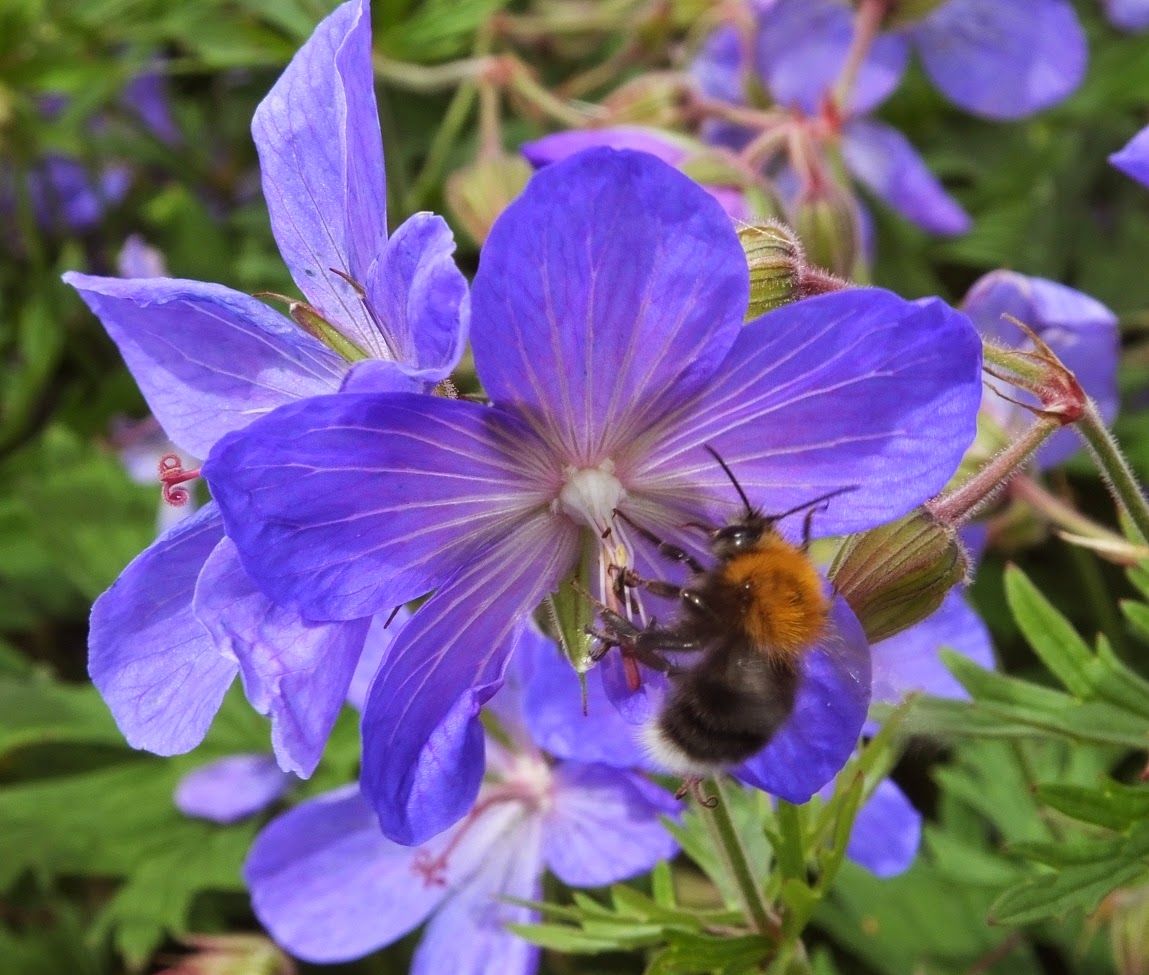
Tree Bee
In our wild garden we spotted a hoverfly doing a good job at  mimicing the Tree Bees
Mooching back round to the front there was what seemed to be a fairly freshly emerged female Common Blue butterfly.
After work we went back onto the beach to watch the tide drop and see if we could find the swimming crab and the dark backed fish again. Neither were findable but there were several whole Sea Potatoes, the smaller ones remarkably still had their hairs, yes for Sea Urchins they are a bit unusual in that they are hairy and not spiky, and our first jelly fish of the summer, a Moon Jelly
A walk along the runnel gave us several sightings of the goboes but not of the (?)smelt. We did manage to catch one of the smaller Sand Gobies, took some doing and again was more by luck than judgement.
Lots of Brown Shrimps were netted but numbers were paltry compared to the hordes lifted by the Brownies yesterday.
Not a bad day in the 'field' at all, really enjoyable!
Where to next? The weekend is upon us and the moth trap is out!
In the meantime let us know what was captured at the eleventh hour in your outback.