Thursday, 15 December 2011

What’s gone wrong with the weather? There wasn’t not a breath of wind first thing


The Safari stepped out of the front door to a bit of a welcome surprise this morning. We didn’t hear the whooshing of wind across the rooftops or through the branches of the trees and the telephone wires; instead we were very pleased to hear the delightful twitterings of a couple of Robins. Walking round the corner we  bumped into another Robin pecking around on the footpath where we had wrangled a soggy crust from the vice-like jaws of Frank late last night – he is basically a canine hoover when it comes to littered food and has been known to swallow half a pizza without even breaking stride.
A Blackbird was on the grass verge listening for worms in the sopping wet grass. On the far side of the road yet another Robin was singing its little syrinx out – seems like all life was glad to back to normal. A far longer than of recent but still shortened wander round Patch 1 gave us more Robins and Blackbirds and we’re pretty sure we could see not one, not two, but three Peregrines tucked up on the tower! And at long last we’ve managed a count of the Magpies roosting in Magpie Wood. Very cautiously we walked slowly passed trying to pretend not to look up and disturb them – 45 but we could easily have missed a few as it was quite dark in there; still, not a bad count!
At work we put our wellies on and hit the beach to see what the last few days’ storms had brought up. The answer was loads but on the way we found a dollop of Fox doo-doo on the promenade which might go a little way to explain the reason why some of our punters at work have been coming in asking where all the Rabbits have gone.
On the beach the strandlines held vast numbers of starfish and shells. Most of the starfish were Common Sand Stars, but there were also a good number of Cushion Stars and a few broken Brittle Stars. Some of the Common Sand Stars were big, up to ten inches (25cm) across.


Huge numbers of Prickly Cockles were also a feature of the strandline.

Of note was the number of complete Common Otter Shells

despite them being common and easy to find we very seldom find them whole, this is a bit weird considering the weather we’ve just had; you’d think the severe storms would have broken them all up.
One species we came across was one we’ve not recorded on the beach before, Queen Scallops. We found three and each was encrusted with what proved to be a species of soft coral - Dead Man's Fingers - Thanks to our marine biologist friend DB for the ID. 

The same, or a similar, coral/sponge was also seen unattached but in much smaller pieces perhaps broken off but they didn’t look it – thing to the right under the Pod Razor. Stalked Anemones also featured, some were still alive like the one on the left in the pic.

We came across several well pecked fish remains before stumbling over this very fresh Dab

Masked Crabs were quite numerous but undamaged ones were few and far between, this one is a female, easily told by the short chelipeds – the ‘legs’ the claws are on, the males having much longer ones for use in display. The antennae form a respiratory tube when locked together as they are in the pic helping them ‘breath’ when buried in the sand. 

Sea Hearts (aka Sea Potatoes) were numerous but being fragile few were in good condition. They are a species of Sea Urchin but a hairy rather than spiny one; it’s very seldom we find them with some of the hairs still attached.

Apologies for the grotty pics – we never did get round to cleaning the salt spray off the lens. (Have done now).
We also picked up a bulging pocket of sea coal in a matter of minutes; not carbon friendly but it’ll supplement the wood burner over the weekend. There was buckets of the stuff enough to keep the home fires burning for a coupla-three weeks if we’d have had the time and a big enough bag.
Fast approaching heavy rain had us heading back to the office before we could have a proper look out to sea so not a lot of birds were noted. Four Knot with a Dunlin and only two Sanderlings was an unusual ratio of waders. Lots of Oystercatchers, well over 100 and, best of all, our firstargentatus Herring Gull – ye olde gulling season has starteth! Could do with finding one like the one in the first pic here from just down the coast aways.
Lunchtime and the wind had picked up again, nothing too serious but it had made the sea very lumpy on the rising tide. It was pleasantly warm stood in the sun provided we didn’t look to the south and burn out our retinas with the glare off the water. Looking north however the light was very good and we had a decent variety of seabirds to keep us entertained – seven or more Great Crested Grebes, three definite auk sp, of which one was a probable Guillemot, one a definite Razorbill, several Kittiwakes including a 1st winter, at least five Red Throated Divers. 300+ Common Scoters, all very mobile and we'd probably reckon all our counts are under-estimates. Much more like it! Would have been better if we’d been able to stay out another hour or so over the high tide and watch it start to drop.
Where to next? More of the same please!
In the meantime let us know how lumpy your outback is.

Wednesday, 14 December 2011

A scary night passed by without incident


 The Safari took Frank out before bedtime last night and rounding the corner onto the main road we were caught by a gust that had us both teetering on the verge of collapse. Back indoors it was off to bed where we could hear the wind wreaking destruction in the gardens all around, by eck it was howling – unknown things were crashing around all over the place outside...we prayed the chimney stack wouldn’t come crashing through the ceiling, or worse come down on the Land Rover parked in the drive. Earlier during our teatime game of footy we saw only one Peregrine sitting tight up against the cables trying to squeeze itself out of the wind.
Yesterday we reckoned that at the high tide with the storm surge the water on the other side of the sea wall was actually higher than the carpet under our feet. It wasn’t the biggest of tides either, the big spring tides can add another metre to the water level...now that would be scary – oh by the way Canada, thanks a bunch for pulling out of Kyoto - we’ll send you the bill for a new carpet and a pair of wellies to wear at our desk...30% increase in CO2 emissions in 20 years...how’d a ‘developed’ country manage that? Who do they think they are China?
Overnight the wind dropped but by dawn it was still running at 30mph (50kph) with higher gusty spells. Heavy hail showers rattled against the kitchen window and against the darkness we could see the stones piling up on the sill outside as they dribbled slowly down the glass. Brrrrrrr...we didn’t really fancy going out in that.
But out in that is exactly what we did once it was light enough to use the scope. Looking over the wall at Patch 2 the sea was still heaped up and as white as the Rocky Mountains in winter. Here and there small parties of Common Scoters lifted off the water before yet another huge breaker swamped them. Impossible to count them and we did see a few small flocks closer inshore riding the waves. Still no sign of any Velvet Scoters, Long Tailed Ducks or Little Auks :-( but a novelty in the form of a Red Throated Diver was seen at mid range heading southwards through the deep troughs. Monotony of the scoters slightly relieved!
Two Great Black Backed Gulls patrolled the waves with menace on the look out for anything that might look a little slow, weak or feeble. There was a passage of about two dozen Kittiwakes, all adults, and one of those would have made a tasty light snack for the GBBGs.
Although the tide was out and a good stretch of beach was uncovered we only had a cursory scan along the water’s edge. Not many Oystercatchers and only a handful of Sanderlings but beyond the southern boundary of Patch 2 we could see many hundreds of Oystercatchers and gulls feeding along the various strandlines and in the shallow pools left by the receding tide.
The high tide and high winds at lunchtime once again meant no birding but we did dash out to get the following pics. Might have been OK for the scope if we had a tripod in the shelter of the not-so-sheltery shelter (last pic) – they’d be miles better as shelters if they didn’t have a gaping big hole in them!
No chance of standing in our normal spot again today...
 Plenty of blobs of flying foam again
 The gulls had to dodge so of the blobs of foam
 There were quite a few gulls playing on the wind
 Nearly every wave gave a big over-the-wall splash


 lens was salt encrusted by the time we took this last pic
Where to next? Hopefully the wind will have died down enough to let us have two full sessions but not so much as everything can re-orientate itself out to sea.
In the meantime let us know what's getting splashed all over in your outback.

Tuesday, 13 December 2011

Another rank day in paradise


The Safari dodged the torrential hail showers to get a ten minute watch over the se wall. Even four hours before high tide the water was well up the beach driven by a force 8 sou’wester.  The tumbling waves were already huge, so much so that it was several minutes before we found the first of not so many Common Scoters. A dozen or more Kittiwakes, all adults, battled southwards over the spray, hard to get a proper count as it was one flap forwards two flaps back.
Having had a major study of a plethora of leucistic Herring Gulls and  ‘proper’ white wingers we are now reasonably sure that the one we had on Sunday morning wasn’t a Herring Gull  based on the brief views we had on our 40mph drive-by - the primaries and secondaries were uniformly pale and translucent with the underwing coverts a pale tea colour. A leucistic Herring ought to show darker outer primaries contrasting with the paler inners. Our money is now on a 1st winter Iceland Gull but we’ll have to wait until someone else comes across it for verification. We doubt if it was a Glaucous Gull as it didn’t seem big and bulky enough and even at the range we saw it at the distinctive two-tone large bill of a 1st winter Glaucous Gull should have been easy to see.
The following pics may give you some clue as to why we didn’t get a lunchtime safari in...fortunately we successfully avoided a soaking by the narrowest of margins. These were taken about an hour before high water – don’t think we’d have stood a chance of staying dry if we’d have gone across at the top of the tide. The wall we lean the scope on is about 4 feet (1.25m) high.
Apparently after last week’s storm hundreds of Common Sand Stars and a Dab (a species of flat-fish) had been thrown out of the sea and onto the road at the point where we photographed these Bottle Nosed Dolphins at the end of the summer


Where to next? Even more wind forecast tonight - 80mph is possible!!! So once again it'll be patch 2 tomorrow might even try to get on the beach for a look at the carnage that is the strandlines...now where'd we put those wellies?
In the meantime let us know what's battling against the wind in your outback.

Monday, 12 December 2011

Short and sweet at the seaside

The Safari was able to get across the road as all that nasty fencing had been taken down over the weekend. We didn't have long but it was a fairly productive few minutes. The tide was rising quickly and most of the beach was already covered but where there was a strand-line of shellfish we noted a large number of Common Gulls and counted 207 Oystercatchers with many more further to the south. A few Sanderlings dodged in and out of the thousands, nay millions?, of wrecked shellfish. We haven't had a chance for a go see but through the scope we could pick out zillions of Pod Razors and Rayed Trough Shells in several lines stretching as far as the eye could see (with the scope) in both directions. There were so many Common Sand Stars that even the gulls appeared to be bored with them! A friend told us that she had been on the beach and seen loads of Brittle Stars and Sea Potatoes; at the weekend her hubby told her one of the anglers had caught (and released) a 2lb+ (1kg) Squid - a real rarity along this coast!
As the tide rose the Sanderlings got restless and a flock of over 30 'picked up' our few and sped off northwards to their favourite roost.
A Cormorant flew by, nothing unusual in that, but this one had the full white head and thigh patches already.
At sea we could only pick up a few dozen Common Scoters but above them we had five Kittiwakes
An even shorter lunchtime session was a little more productive. The wind had picked up a bit and roughened the sea even more and the light was worse but the numbers of scoters was now perhaps 3-400 with them moving about all over the place and a good few small flocks quite close inshore. Two Great Crested  Grebes kept appearing through the heavy swell looking for all the world like two periscopes, but we couldn't find anything else with the scoters...where is that Long Tailed Duck? All the while we were there there was a trickle of Kittiwakes going past, we didn't count them but we'd guess at somewhere between 20 and 30 as there was some doubling back going on, all bar two were adults.
Sticking with the gull theme we noted a couple of Great Black Back Gulls and made an effort to stick with them through the troughs as they can be good 'value'; at the end of last week one was seen to find, and promptly swallow, a Little Auk that had wandered too close to shore only a few miles up the coast...damn things eating a Lifer!...shouldn't be allowed!!!
Where to next? More ferocious wind is forecast for the next couple of days so Patch 2 will be our best bet for some decent birding.
In the meantime let us know what's swallowing the Lifers  in your outback.

Sunday, 11 December 2011

Missed again!!!

The Safari was chatting to next door who have recently got the tiniest little Jack Russell puppy they've called Albert - no doubt that in the not too distant future he'll be running rings round Frank. As we were out a Cormorant and a Sparrowhawk went over. Then it was out to see if we could find any of the several Bean Geese that are in the area, not seen one for the best part of 20 years. We headed out to the moss and on the main road saw two birders scoping what could only have been a flock of grounded geese from a most unusual place. We passed them but as we did we saw a white winged gull come half way across the road then turn back and head off over the houses...we were in  a busy stream of traffic approaching a motorway junction at 40mph so couldn't do anything about it...nothing for it but to abort the planned excursion and spin back round the roundabout...couldn't find it but did have a quick chat to the birders who hadn't seen a Bean Goose in the flock but had seen a Greenland Whitefront on the moss. Abandoning the leucistic Herring/Iceland/Glaucous Gull to was back to the original plan. We found the location easy enough only to see the flock flushed by a block with two dogs walking them where he shouldn't have been - marvelous!!! NOT. A drive down the very bumpy and very wet track got us no nearer the flock but we did see a field of at least 30 Curlews.
So it was back to the nature reserve where the white headed Blackbird was once again in its usual place half way down the main drag. A Cetti's Warbler was heard almost straight away but we went to see if there were any geese in the fields to the east. On the way we heard a second Cetti's Warbler fire up. 27 geese came in but landed a long way off in dense tall stubble and it was impossible to grill them. While we struggled with the geese 16 Whooper Swans came from the north west but ignored the three Mutes Swans on a large puddle in the goose field. 30 or so Linnets were on the wires and joined by about two dozen more. 
Another 15 geese landed but this time we could tell they were all Pink Footed Geese as they whiffled in to land. At the far end of the embankment we could hear a Song Thrush singing and spotted a second. Four Snipe flew over, today was going to be a Snipe day with many more seen, the best number we've come across here for a long time. A Water Rail squealed from the very flooded 'dry' reedbed, on a pile of windfall apples a few yards further on were a good many Blackbirds and two Fieldfares. A Kestrel came in and landed atop a tall tree flushing them all, not enough wind for hovering today! Before long it was joined by the other half of the pair.
Rounding the corner we noted a flower in flower - Hogweed.

Apologies for today's pics the light was awful but worse was the fact that we hadn't noticed all the condensation between the filter and  the lens - - dooohhhh, no wonder the pic were so rubbishy. Then we saw a hint of movement in the corner of our eye and turned round to see a Grey Squirrel in an isolated tree.

Nothing over exciting was seen from the hide so after a few minutes we headed back to the Long Eared Owls, one of which was just about visible deep in the usual (for this season) bush.


By now it was time to go and look at the geese again as we'd seen more come in, well over 100 now. On the walk past the reedbeds a dozen or so Long Tailed Tits were flitting about in a Willow tree at the side of the path but we didn't bother with the camera - gone off em!
The geese were still out of sight/range even through friends' telescopes. Two Buzzards buzzed the flock to no avail although one managed to catch a mouse or vole. Nothing for it but to head off to the other end and wait for the Bittern/Otter combo. At the hide a Water Rail scuttled a cross the small gap at about 100ph shrieking as it went. We started to get a bit cold so decided to walk up to the bench to get the circulation going. from there we got a better view along the length of the mere and counted 15  Wigeon along with loads of other waterfowl but only one Goldeneye today.
We were joined by quite a throng but all we could muster between us was a third Cetti's Warbler and a Sparrowhawk - they told us we'd missed bird of the day...they'd had an adult Mediterranean Gull down the other end not long after we left them. No Bittern/Otter combo this evening...
Where to next? Patch 2 might throw up a goody or two.
In the meantime let us know what should have shown themselves in your outback.

Missed it!

The safari learned this morning that yesterday was International Mountain Day - we didn't have a clue even though we included a pic of a 'mountain' in yesterday's missive...something subliminal going on???
Can't really call Parlick a mountain as it's only a small outlier of the larger, but still small, Bowland Fells and stands a huge oxygen deficient 1417ft (432m). In yesterday's pics the green tree covered hill to the right is Beacon Fell which is much smaller still at only 873 ft (262m) but as it stands alone it affords great views in all directions...well it did until the forestry trees grew. However there is a long term management plan to replace the conifers with native woodland and increase the area of heath at the the summit. 
Where to next? Back later with tales of woe from dipping today's intended quarry due to torrential rain.
In the meantime let us know if your outback has a long term management plan.

Saturday, 10 December 2011

Death in paradise

The Safari wasn't expecting such a grim day, it started out without much of a to-do.

Two Peregrines were huddled on their respective ledges last night during our game of footy, the wind had dropped to next to nothing but with that came clearing skies and dropping temperatures - it was going to be the coldest night for some time.
This morning on our return back down the hill from behind us we heard a whooshing sound steadily increasing increasing in volume, looking up we saw a narrow crescent of well over 1000 Starlings scythe their way towards the lightening dawn.
Back at Base Camp a lump of bread on the garage roof attracted the attention of a Herring Gull, we hadn't thrown any bread up there for a while so we wondered where it had come from. The shape of the bread was quite fish like...very fish like as it happened. We went for a closer look and discovered that it was, sadly, one of the large Goldfish from our pond...now we really began to wonder how it could have got there...cat, Fox, Heron? Was it dead and hoiked out or did something catch it then abandon it? And if the latter will what ever it was come back for the others? The pond is netted against Herons and we don't think they'd leave a fish that small just swallow it straight down and was it not a bit too windy for one to be able to land in the limited space? Mysterious???

 Once we'd gone back inside the Herring Gull soon came back. Looking at the fish's eye it would seem that it hasn't been dead too long.


 We set off very glumly to the shops but stepping out of the front door we were confronted by more death...small bits of a Woodpigeon were scattered around the front garden. Did the culprit have mustard on it's Woody with the discarded Coleman's wrapper there?
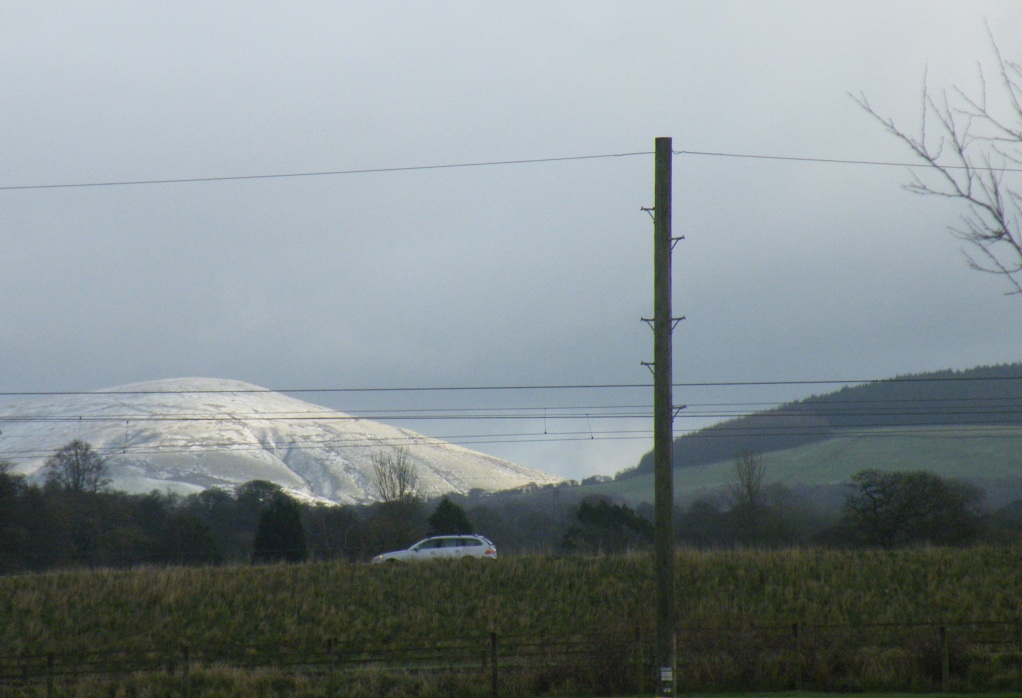
On the way to the our garden centre destination a little inland we soon spotted the snow on the Bowland hills. Thought it was a bit chilly last night.

We've often felt that the deep clough on the lower flank of Parlick should be fenced off and planted with trees.

Back at Base Camp we tucked into a sumptuous pie each...whoever Shirley is she makes flippin good pies, we had a Christmas Pie with half a turkey in it along with a chipolata, a slab of bacon, cranberries and rich stuffing; Wifey 'made-do' with a lusciously rich Butter Pie filled with chunky slices of potatoes and gently softened onions all washed down with lashings of homemade gravy...yummmmm...can deffo recommend.
A chat about the Otters at the nature reserve with our Extreme Photographer who now has some natty kit and a cunning plan...need to test it first but the results could be good...providing the Otter(s) play ball. While he was on the phone a big female Sparrowhawk dived between Base Camp and next door at an astonishing speed...after another Woodpigeon?
Where to next? Out and about tomorrow with perhaps another year bird to have a look at, won't be many more now, so we hope it's still there and then we'll end up on the nature reserve at Otter/Bittern time, providing the 100mph gales haven't come back.
In the meantime let us know what's thieving what in your outback.