Showing posts with label bee orchid. Show all posts

Tuesday, 18 June 2024

A safari back to former haunts

The Safari met up with IH down at Ainsdale Dunes LNR, where many many many years ago we were a Ranger, for a safari looking at plants and inverts and trying to avoid the birds for a change. There's also goodies like Sand Lizards and Natterjack Toads to be on the look out for too. We had a good look for the former of those two along the frontal dunes but the weather wasn't doing us any favours; it was only 9°C when we arrived mid morning and a strong blustery cold north westerly wind was blowing, in the sun and out of the wind it was warm but in the wind and out of the sun it was still winter! The back of the hand temperature test on sheltered patches of sand showed the ground to be reasonably warm maybe just warm enough for lizards to bask in a sunny spot.

The hunt for lizards was proving unsuccessful not even finding a Common Lizard, which was rather unexpected, after an hour's searching we thought we'd have come across one by now. We moved into the fixed dunes and soon discovered more Pyramidal Orchids than we've ever seen before, they were everywhere.

And it wasn't long before IH picked out a nearby cluster of Bee Orchids hiding in plain sight.

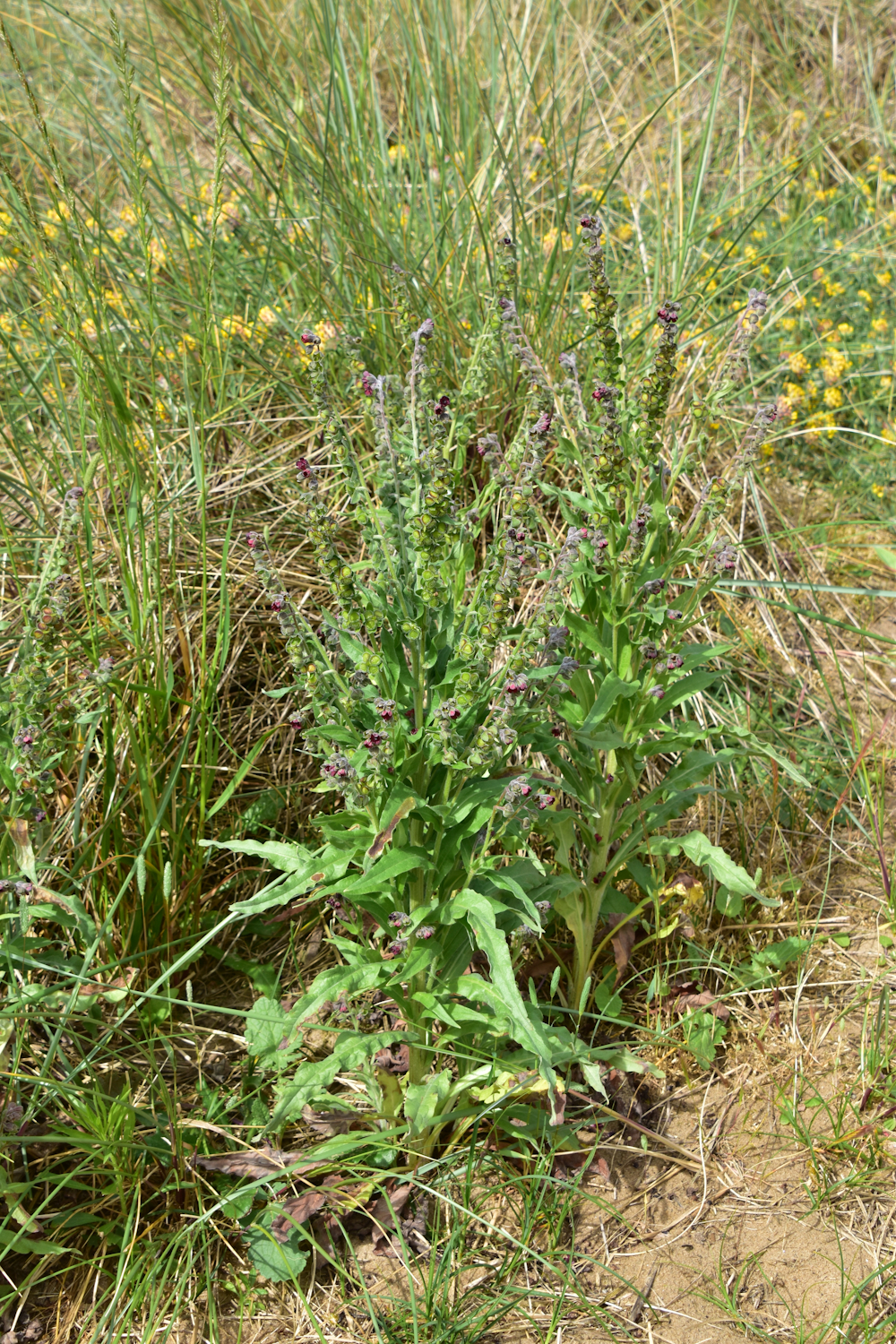
Along the edges of the tracks we came across a few Hound's-tongue plants, a plant we rarely see on our travels as it is a very scarce species north of the Ribble, confined to the Morecambe Bay limestones.
Our wanderings took us through acres of Kidney Vetch dotted hither and thither with the pink flowers of multitudes of Pyramidal Orchids, a real treat for the eyes especially as the tiny dune system close to Base Camp has just one small specimen of Kidney Vetch and that didn't appear last year although this year it is quite a bit larger than it was in 2022.
We mentioned earlier that we weren't too interested in the birds today but the number of singing Skylarks was a joy to listen to so when one sang not too high above our head we couldn't resist firing off a few shots even though the lens we had today was too short really.
Another pathside plant we rarely see was the pink but misnamed Blue Fleabane.
This one does occur north of the Ribble in a few places but we probably overlook it as we don't often concentrate on the plants on most of our safaris - maybe we should take more notice of them. 
The cold wind meant that not many insects were on the wind, we passed several scrapes dug for the Natterjack Toads and some huge almost impassable dune slacks but saw nothing moving in the gin-clear, aquatic plant filled, water nor anything other than a few hardy gnats flying above them, even furry bumblebees. Eventually we found a hoverfly. CR kindly identified it for us upon his return from sunny France, Chrysotoxum festivum and he tells us it now has an English name too - Hook-barred Spearhorn...nice!
Hundreds of years ago we bought a book for our degree course, apparently it cost me 82p a small fortune back in those days when a pint in the student union bar was just 12p - those were the days ehh. We struggled with it then when we used it a little bit and have barely opened it in the intervening 40 odd years.
So when we found this rather natty looking grass we pulled it off the shelf when we got back to Base Camp - could't make head nor tale of it but we think this is Dune Fescue  we could well be wrong!
All along our walk we'd been seeing Dune Robber Flies but getting a pic wasn't easy, they were very active and soon spotted us trying to creep up on them...until this one stayed put long enough to get a few snaps.
Job done with the skittish robber flies it was back to plant hunting. Wild Pansies are always a nice find. They were patchily distributed, in places few and far between, but where they did occur there were nice patches of them.
By now the sun was higher and warmer but the stiff cold breeze was still blowing. We'd seen several more Common Blue butterflies mostly keeping well down where it was warmer. We found several that had become chilled and needed to bask to warm back up.
Most of them were tatty like this one, probably from being battered about by the wind. 
A tiny purple flower caught IH's eye, a one of the colour forms of the Common Milkwort.
Far more numerous was the more typical blue form.
While wandering around edge of one of the many flooded paths, a legacy from the very wet winter and spring, and the person who laid out many of those white topped posts all those years ago, IH spotted a big hairy caterpillar inches away from our size 9 boot print - it could all have gone horribly wrong! At first we thought it was a Garden Tiger moth but again closer insection after downloading the pics revealed it to be a Ruby Tiger, a much more common species sadly the Garden Tiger has declined dramatically in recent years, so much so that we've not seen one for a long time now.
It was at this flood we managed to get a pic of our first dragonfly, a Common Darter. we'd seen a very small would have been either number of dragonflies so far most of them being this secies but a couple would have been either 4-Spotted Chasers or Broad Bodied Chasers.
 Up the dune a few yards further on we came across a low sand bank being buzzed by non-bumble hairy bees. We decided that they were the fairly rare Vernal Mining Bees but again once back at Base Camp and asking people far more knowledgeable it turns out that they are Coastal Leaf-cutter Bees - now we've been told the shape of them is obviously that of a leaf cutter bee. The Vernal Mining Bees should really have gone over by now even allowing for the cold, wet, late spring.
Some more orchids for you to enjoy.

All the while we were checking the scrapes for signs of life unsuccessfully until we walked past this wee beasty that IH called us back to see. How on earth we missed it we've no idea as it was only inches from the water's edge.It's a chaser dragonfly nymph. A hungry one at that, unless it had already eaten every living thing in the pool...except a large Horse Leech which IH found on the far bank and again we missed.

This pool had a wide sandy draw-down margin with little humps which would have been tiny islands a couple of weeks earlier. One of these had a number of miniscule Eyebright flowers on it. Apparently there are over 25 species, subspecies and hybrids of them in Britain, you've guessed it - we've no idea which one this is. Lovely little things no matter which they are.
In the distance to the east of this slack there must be an even larger one as it held a colony on nesting Black Headed Gulls but getting there was proving difficult and time consuming going up and over dune ridges. Which is precisely why the birds are nesting there, too far away from civilisation for even the dog walkers to reach and fenced off to keep the cattle used for conservation grazing confined.
Whilst climing one of the ridges via a huge blow out we spied a tiny spider zooming around with lots of vim and gusto. Submitting it to the SD card wasn't easy as, like thr robber fly earlier it had good eyesightand saw us coming a mile away. We perservered and eventually struck lucky with just one of about 50 shots of it (nearly) in focus. We say 'it' but we now know he's a male Xerolycosa miniata the Dune Wolf Spider and is listed as NATIONALLY SCARCE.
Here's another teneral Common Darter for you, as the strong afternoon sun put a bit more warmth into the air more inverts began to appear. IH even got a brief view of a couple of damselflies including a mature Blue Tailed Damselfly at one of the pools.
IH has a pet hate about invasive non-native plants, Himalayan Balsam is his 'favourite but the dunes here hold a close second - Perennial Sweet Pea. it is beginning to clamber over large swathes of dune vegetation here but he tells us that it's not as bad as it is on the dunes further south where it is totally dominant to the detriment of just about everything else. A perfect reason not to dump your garden waste in the countryside or even over your back fence, which far too many people do.
Eventually we got back to our initial path passing the first scrape we came across. Having a more thorough look this time we found a good patch of Lesser Spearwort growing just outside the safety of the fence and beneath a post so we can't imagine how many dogs must have peed on it - all good nutrients we suppose.
The pool also gave us our first toadlets of the day, 'unfortunately' for us not the yellow striped Natterjack Toadlets 'just' Common Toads but still good to see. There were hundreds off them swarming through the low vegetation - it was seething with them.
The warmer sunshine had also brought out some parasitic wasps and like the other inverts were flighty so getting a decent pic was tricky. The Red Banded Sand Wasp hunts for moth caterpillars with which to provision its larvae.
Back at the car with an hour to spare we decided to have a look at the section of dunes over the road, Birkdale Hills LNR. But before setting off we jetisoned some outer layers and then had a chat to current Ranger and top birder JD.
We gave it half an hour out and half an hour back passing first Sands Lake and its huge Brown Rat, you must know by now we can't resist a good mammal! Out of the fringe of trees around the lake and onto the dunes proper brought us to a very pale obviously hybrid marsh orchid.
Perhaps Common Sotted Orchid x anyone's guess orchid.
There were quite a few dingy grey day flying moths about deeper into the dunes and after a bit of chasing around we copped for one, they were Anania fuscalis - no we'd never heard of them either.
We reached the nearest dune slack but the margins were so well vegetated we couldn't get anywhere close enough for a proper look. 
By now time was short and so back to the cars we headed with one last stop that would require a close look at Hubbard back at Base Camp. A very short patch forming attractive grass mostly found on bare or nearly bare ground away from any taller vegetation turned out to be Sand Catstail...good old Hubbard. At the rate we've been using him we'll be well over 100 years old next time we reach for him on the shelf!
What a fabulous day out on safari in great company...and barely a bird in sight for a change.

Where to next? We've got a bit of a long blog from a bit of a long safari coming up next but it might be a while as this is single finger typing after (yet) another hand operation...Be patient it will arrive on a device near you in due course.

In the meantime let us know who's making the ground seeth in your outback.


Tuesday, 7 July 2020

June didn't really improve

The Safari received an email from the water board imploring their customers to save water. Well that did the trick it has hardly stopped raining since! And as a consequence our forays with the camera have been somewhat curtailed.
Needless to say though we have been out on safari looking for all manner of interesting wildlife.
Our first trip was down to the docks at Preston to have a look at the tern colony which apparently hasn't been doing so well this year. A Combination of ferocious predatory Coots and ever-present Lesser Black Backed Gulls have meant far fewer Common Tern nests this year. We met up with SB to give her a skull a dog-walking friend's son had found at the bottom of their garden. We thought it was a Fox as it had extremely worn teeth but as soon as S saw it she said Cat. taking up our usual position on the south side of the dock where the light is supposed to be better it was immediately obvious that there were no  tern nests at all on the pontoons on this side. Rather than take the car round the far side and look into what little light there was we walked across to the bullnose within the dock and tried to get some shots of the Common Terns coming and going along the short channel to the lock gates. Had we gone round to the other side and viewed the northern set of pontoons there's a chance we might have seen the pair of Arctic Terns.
Common Tern - PYLC #154. the spikes are to keep the Lesser Black Backed Gulls from swooping down to steal the chicks

Nearby in a gap between the blocks of flats is a small patch of 'amenity grassland' which has  a superb range of wildflowers on it including a sizeable population of Bee Orchids. Unfortunately it had been mown the day before because long grass is 'untidy' not that it was very long anyway. This was the only Bee Orchid to survive the mower out of at least a dozen others apparently in flower a couple of days earlier - what a shame! This out-dated out-moded Victorian 'control nature at all costs' attitude has to stop or be stopped and soon.
Meanwhile the millet CR donated to us is going down a treat with our regular male House Sparrow
so much so that we went and ordered a ginormous bag of the stuff so we're praying he sticks around and brings the wife and kids to the feast in due course too.
A visit to the rock pools at South Shore which we ransacked regularly when we worked down that way was a little disappointing. The loss of the old over-spill pipe along the beach seems to have allowed much more wave action on the wall and there is now far less seaweed for the creepy-crawlies to hide in. 
We struggled to find more than a handful of Common Prawns although this one in berry was a welcome sight.
Green Shore Crabs were similarly hard to find unlike the Periwinkles of which there appeared to be more than we've previously noticed.
One of our main aims of this safari was to find some fish for our Vertebrate Photo Year List Challenge. In the pots we saw a few small Blennies but couldn't catch any, they're just far too quick for us with no seaweed to hide in they see you coming long before you can lift a net. The runnels below the seawall held a a small number of Sand Gobies but agaqin they were too quick for us. Normally another net is required and some team-work to out-wit them; fancy being out-witted by a fish with a brain the size of a pin-head - sad but true!
Further down the beach in the next runnel over the sand-bank we did catch this juvenile Sole (PYLC #155) and some rather large Brown Shrimps that were bigger than it.
Also on the beach were masses of Sea Gooseberries. There were several different strand-lines of them as you went down the beach.
A quick back of the fag packet calculation gave us a figure of somewhere between 10 and 15 million between St Anne's and Fleetwood, based on the density we noted above and there may have been more as photos on the local media sites showed them much more tightly packed than we saw them in various places along the coast.
The following week we had a surprise visitor to Base Camp. A Coal Tit turned up - not seen one here since the end of the winter.
A wander round Heron's Reach starting out in the Woodland Gardens gave us this massive Parasol Mushroom, a real corker!
Once out on the more open track we came across a few butterflies including our first Painted Lady of the year.
Another good find was this hybrid Marsh Orchid spotted in a place we regularly check but have never seen one there before.
An interlude of bright weather had us nipping out to the Rock Gardens to see if the earlier hot spell had brought the White Letter Hairstreaks out. It was a bit blustery and their favourite tree was being tossed around so we didn't hold out much hope after half an hour we gave up and went around the rough fields to see what else we could find - not a lot was the answer. but we did get great views of this hoverfly holding territory in the lee of the big trees at the edge of the park.
Volucella pellucens - a bumble bee mimic
Back at Base Camp the first juvenile Blackbird of the season turned up. Rather late, either a second brood and we'd missed the first or the first broods failed when it was so dry that the adults couldn't get food.
In poor weather the driest, cleanest place to walk the mutt is along the cliffs where there is far less opportunity for him to become a mud-mop. So far this year we've not had much success with Grey Seals so it was a nice bonus to have one bottling not too far offshore although another 50 yards closer to the lens might have been better - can't have everything that'd make us spoilt and no-one like s a spoilt brat!
With Lockdown restrictions easing still further we arranged to meet CR for a mooch round Marton Mere. Gee it's different (good/better) in the summer when the dreadful caravan site adjacent is closed, no numpties, far fewer dogs around and no booming music from the clubhouse.
A good selection of wildlife was enjoyed
Freshly emerged Narrow-bordered Five Spot Burnet  moth
Small Skipper - who's going to first to find an Essex Skipper on the Fylde?
A species we had hoped to see well and until now had had only fleeting glimpses, nothing to point the camera at was the Reed Warblers. But from the Fylde Bird Club Hide we were entertained by a family flitting around the reedbed for about half an hour, just great to watch.
Reed Warbler - PYLC #156
We left the Reed Warblers to their business and carried on the circuit. After a few yards C says look at this...there was a small mammal we assumed (never assume nothing!!!) was a Short Tailed Field Vole. We fired a few shots off but even the best one's not that brilliant but does show a pointy nose rather than a blunt one so it's a shrew not a vole and from the tail length it's a Common Shrew (PYLC #157). Not a species we expected to see out in the open and certainly not one we'd have expected to add to our challenge tally.
 Further on still we could hear nearby Cetti's Warblers but as usual they were all doing remarkably well at staying hidden and out of camera sight. While waiting for a particularly loud and therefore close one to show - it didn't - we spotted this awesome nest of Peacock butterfly caterpillars.
For the final week of June the weather was more like March although we did get a couple of hot days (see previous post about our safari to Lunt Meadows).
First up we headed back out to Marton Mere inspired by our previous visit. This time it as much duller and much quieter. we'd got half way round before we'd come across anything to point the camera at and when that happened it was at this very distant but still lovely and brightly coloured male Linnet.
Nothing else made it on to the SD card, which has got to be a record, there's always something worth pointing the camera at there.
The following day we were back, this time with CR. We'd hardly left the car behind when we came across this very confiding Sedge Warbler. he was totally oblivious to our presence flitting from song post to song post and giving a us a chorus of his extensive and loud repertoire.
A few Swifts were about too.
But again the weather wasn't conducive for a lot of the wildlife to be on show, particularly the invertebrates.
Back at Base Camp we tried a different tack with the mealworms trying to entice the local Starlings to come into the garden. no Starlings just this brute polishing the mealworms off in a matter of seconds again. We're sure he can smell them, there's no sign of him when we put them out but within a matter of minutes he's turned up.
An early morning dog-walk round the rough fields at the Rock Gardens had us see some ginger movement close to one of the big Bramble thickets. We only had our phone with us at that time of the morning and were very surprised that the Fox sat and watched us fumble in our pocket for it, turn it on and point it in her direction AND the dog was sniffing around very excitedly where she had been only moments earlier. We had to use full zoom and couldn't see the screen for the low early morning sun  hence the rather grotty pic. But hey it's identifiable (just) so goes on our Challenge tally as #158 - Result
And so ended June.

Where to next? Well the rain continues into July but we've already got a few wildlife moments to share with you next time.

In the meantime let us know who's sitting still watching in your outback

And don't forget to stay safe and socially distanced.