Showing posts with label pyramidal orchid. Show all posts

Tuesday, 18 June 2024

A safari back to former haunts

The Safari met up with IH down at Ainsdale Dunes LNR, where many many many years ago we were a Ranger, for a safari looking at plants and inverts and trying to avoid the birds for a change. There's also goodies like Sand Lizards and Natterjack Toads to be on the look out for too. We had a good look for the former of those two along the frontal dunes but the weather wasn't doing us any favours; it was only 9°C when we arrived mid morning and a strong blustery cold north westerly wind was blowing, in the sun and out of the wind it was warm but in the wind and out of the sun it was still winter! The back of the hand temperature test on sheltered patches of sand showed the ground to be reasonably warm maybe just warm enough for lizards to bask in a sunny spot.

The hunt for lizards was proving unsuccessful not even finding a Common Lizard, which was rather unexpected, after an hour's searching we thought we'd have come across one by now. We moved into the fixed dunes and soon discovered more Pyramidal Orchids than we've ever seen before, they were everywhere.

And it wasn't long before IH picked out a nearby cluster of Bee Orchids hiding in plain sight.

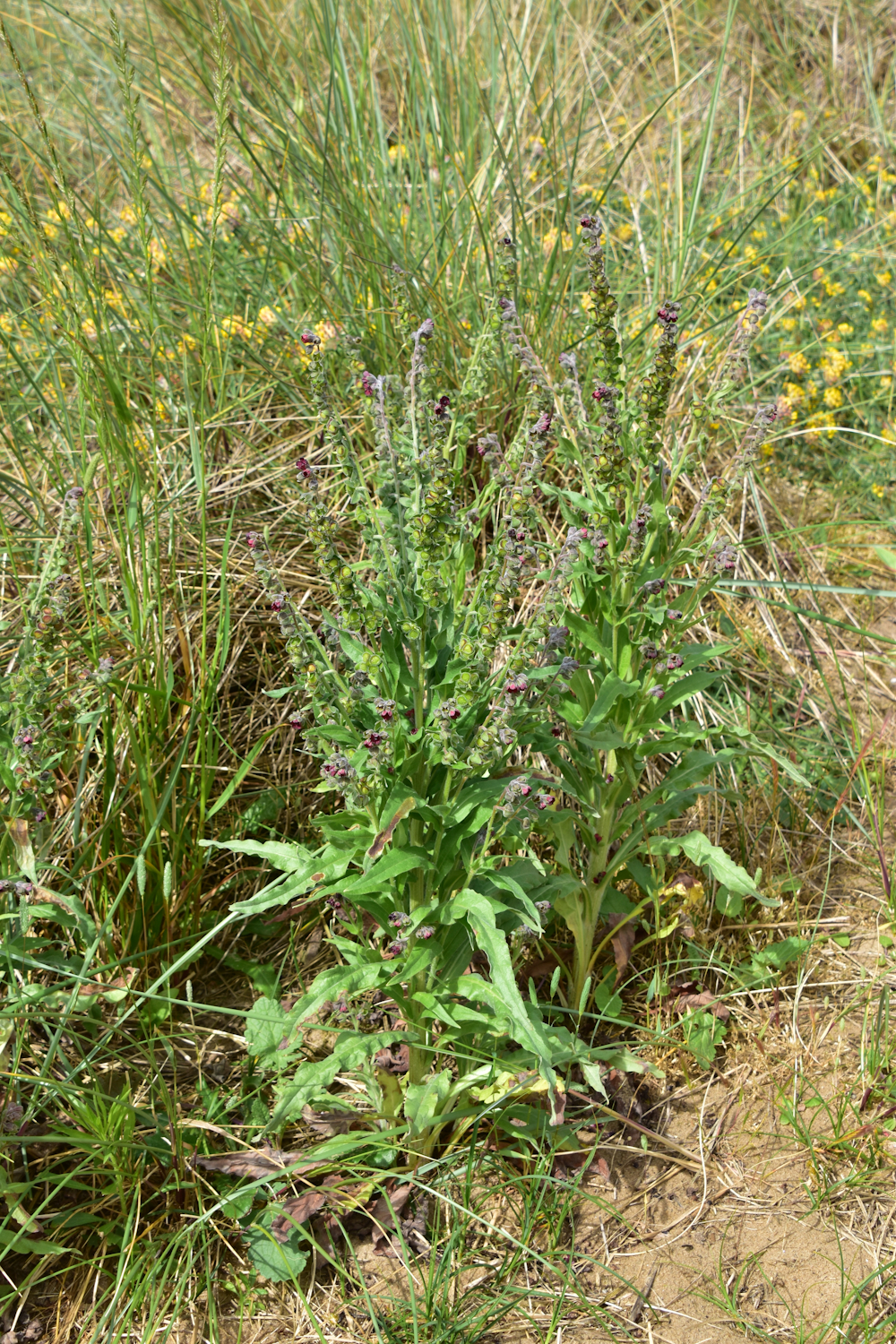
Along the edges of the tracks we came across a few Hound's-tongue plants, a plant we rarely see on our travels as it is a very scarce species north of the Ribble, confined to the Morecambe Bay limestones.
Our wanderings took us through acres of Kidney Vetch dotted hither and thither with the pink flowers of multitudes of Pyramidal Orchids, a real treat for the eyes especially as the tiny dune system close to Base Camp has just one small specimen of Kidney Vetch and that didn't appear last year although this year it is quite a bit larger than it was in 2022.
We mentioned earlier that we weren't too interested in the birds today but the number of singing Skylarks was a joy to listen to so when one sang not too high above our head we couldn't resist firing off a few shots even though the lens we had today was too short really.
Another pathside plant we rarely see was the pink but misnamed Blue Fleabane.
This one does occur north of the Ribble in a few places but we probably overlook it as we don't often concentrate on the plants on most of our safaris - maybe we should take more notice of them. 
The cold wind meant that not many insects were on the wind, we passed several scrapes dug for the Natterjack Toads and some huge almost impassable dune slacks but saw nothing moving in the gin-clear, aquatic plant filled, water nor anything other than a few hardy gnats flying above them, even furry bumblebees. Eventually we found a hoverfly. CR kindly identified it for us upon his return from sunny France, Chrysotoxum festivum and he tells us it now has an English name too - Hook-barred Spearhorn...nice!
Hundreds of years ago we bought a book for our degree course, apparently it cost me 82p a small fortune back in those days when a pint in the student union bar was just 12p - those were the days ehh. We struggled with it then when we used it a little bit and have barely opened it in the intervening 40 odd years.
So when we found this rather natty looking grass we pulled it off the shelf when we got back to Base Camp - could't make head nor tale of it but we think this is Dune Fescue  we could well be wrong!
All along our walk we'd been seeing Dune Robber Flies but getting a pic wasn't easy, they were very active and soon spotted us trying to creep up on them...until this one stayed put long enough to get a few snaps.
Job done with the skittish robber flies it was back to plant hunting. Wild Pansies are always a nice find. They were patchily distributed, in places few and far between, but where they did occur there were nice patches of them.
By now the sun was higher and warmer but the stiff cold breeze was still blowing. We'd seen several more Common Blue butterflies mostly keeping well down where it was warmer. We found several that had become chilled and needed to bask to warm back up.
Most of them were tatty like this one, probably from being battered about by the wind. 
A tiny purple flower caught IH's eye, a one of the colour forms of the Common Milkwort.
Far more numerous was the more typical blue form.
While wandering around edge of one of the many flooded paths, a legacy from the very wet winter and spring, and the person who laid out many of those white topped posts all those years ago, IH spotted a big hairy caterpillar inches away from our size 9 boot print - it could all have gone horribly wrong! At first we thought it was a Garden Tiger moth but again closer insection after downloading the pics revealed it to be a Ruby Tiger, a much more common species sadly the Garden Tiger has declined dramatically in recent years, so much so that we've not seen one for a long time now.
It was at this flood we managed to get a pic of our first dragonfly, a Common Darter. we'd seen a very small would have been either number of dragonflies so far most of them being this secies but a couple would have been either 4-Spotted Chasers or Broad Bodied Chasers.
 Up the dune a few yards further on we came across a low sand bank being buzzed by non-bumble hairy bees. We decided that they were the fairly rare Vernal Mining Bees but again once back at Base Camp and asking people far more knowledgeable it turns out that they are Coastal Leaf-cutter Bees - now we've been told the shape of them is obviously that of a leaf cutter bee. The Vernal Mining Bees should really have gone over by now even allowing for the cold, wet, late spring.
Some more orchids for you to enjoy.

All the while we were checking the scrapes for signs of life unsuccessfully until we walked past this wee beasty that IH called us back to see. How on earth we missed it we've no idea as it was only inches from the water's edge.It's a chaser dragonfly nymph. A hungry one at that, unless it had already eaten every living thing in the pool...except a large Horse Leech which IH found on the far bank and again we missed.

This pool had a wide sandy draw-down margin with little humps which would have been tiny islands a couple of weeks earlier. One of these had a number of miniscule Eyebright flowers on it. Apparently there are over 25 species, subspecies and hybrids of them in Britain, you've guessed it - we've no idea which one this is. Lovely little things no matter which they are.
In the distance to the east of this slack there must be an even larger one as it held a colony on nesting Black Headed Gulls but getting there was proving difficult and time consuming going up and over dune ridges. Which is precisely why the birds are nesting there, too far away from civilisation for even the dog walkers to reach and fenced off to keep the cattle used for conservation grazing confined.
Whilst climing one of the ridges via a huge blow out we spied a tiny spider zooming around with lots of vim and gusto. Submitting it to the SD card wasn't easy as, like thr robber fly earlier it had good eyesightand saw us coming a mile away. We perservered and eventually struck lucky with just one of about 50 shots of it (nearly) in focus. We say 'it' but we now know he's a male Xerolycosa miniata the Dune Wolf Spider and is listed as NATIONALLY SCARCE.
Here's another teneral Common Darter for you, as the strong afternoon sun put a bit more warmth into the air more inverts began to appear. IH even got a brief view of a couple of damselflies including a mature Blue Tailed Damselfly at one of the pools.
IH has a pet hate about invasive non-native plants, Himalayan Balsam is his 'favourite but the dunes here hold a close second - Perennial Sweet Pea. it is beginning to clamber over large swathes of dune vegetation here but he tells us that it's not as bad as it is on the dunes further south where it is totally dominant to the detriment of just about everything else. A perfect reason not to dump your garden waste in the countryside or even over your back fence, which far too many people do.
Eventually we got back to our initial path passing the first scrape we came across. Having a more thorough look this time we found a good patch of Lesser Spearwort growing just outside the safety of the fence and beneath a post so we can't imagine how many dogs must have peed on it - all good nutrients we suppose.
The pool also gave us our first toadlets of the day, 'unfortunately' for us not the yellow striped Natterjack Toadlets 'just' Common Toads but still good to see. There were hundreds off them swarming through the low vegetation - it was seething with them.
The warmer sunshine had also brought out some parasitic wasps and like the other inverts were flighty so getting a decent pic was tricky. The Red Banded Sand Wasp hunts for moth caterpillars with which to provision its larvae.
Back at the car with an hour to spare we decided to have a look at the section of dunes over the road, Birkdale Hills LNR. But before setting off we jetisoned some outer layers and then had a chat to current Ranger and top birder JD.
We gave it half an hour out and half an hour back passing first Sands Lake and its huge Brown Rat, you must know by now we can't resist a good mammal! Out of the fringe of trees around the lake and onto the dunes proper brought us to a very pale obviously hybrid marsh orchid.
Perhaps Common Sotted Orchid x anyone's guess orchid.
There were quite a few dingy grey day flying moths about deeper into the dunes and after a bit of chasing around we copped for one, they were Anania fuscalis - no we'd never heard of them either.
We reached the nearest dune slack but the margins were so well vegetated we couldn't get anywhere close enough for a proper look. 
By now time was short and so back to the cars we headed with one last stop that would require a close look at Hubbard back at Base Camp. A very short patch forming attractive grass mostly found on bare or nearly bare ground away from any taller vegetation turned out to be Sand Catstail...good old Hubbard. At the rate we've been using him we'll be well over 100 years old next time we reach for him on the shelf!
What a fabulous day out on safari in great company...and barely a bird in sight for a change.

Where to next? We've got a bit of a long blog from a bit of a long safari coming up next but it might be a while as this is single finger typing after (yet) another hand operation...Be patient it will arrive on a device near you in due course.

In the meantime let us know who's making the ground seeth in your outback.


Wednesday, 15 July 2015

Orchid time on the dunes

The Safari had built up a big surplus of extra hours and even after booking some flexi-time for a long weekend we still had a a few to play with. Yesterday mornig we got a txt from Young Un AB saying he'd just been on the dunes and counted a very accurate 841 Pyramidal Orchids and seen a Grayling butterfly - that was excuse enough for a very long lunch break. 
As soon as we arrived on site we saw there were lots of Burnet moths everywhere, almost every Creeping Thistle flowerhead had at least one supping away at the nectar within.
All the ones we looked at closely, without our specs we might add, were Narrow Bordered 5-spot Burnets.
Walking a few yards further into the dunes we disturbed a Meadow Pipit that wasn't at all happy with our presence
 It kept a rather watchful eye on us.
But where were all those orchids? Another couple of steps and we crested a small rise and there amid the Creeping Willow were several pink flower spikes, about 20of them, not the mother lode but a good start.
They were growing in an area from which much invasive Sea Buckthorn had been removed during the winter, the management certainly appeared to suit them.
AB was kind enough to tell us the whereabouts of other orchids nearby too which included Common Twayblade which we didn't know grew on the site, surely we'd been told at some stage over the last 25 years or so and forgotten if that was the case the information certainly wasn't for being retrieved from our memory banks!
Only a few yards away near a large hole that is being dug for an as yet unknown reason, probably to provide some form of dune slack (aka seasonally wet area), he said there were some Marsh Helleborines.
From there he directed us across the road to look into the garden of the rest-home which has been left uncut and is a wondrous array of colours from the multitude of wildflowers growing in the short sand turf, it is a sight to behold! The target here was probably the most dull and insignificant looking plant in the 'meadow' but one of the rarest in the country/world being an endemic to a handful of scattered sites around the coast and not overly numerous at any of them, the rather wishy-washy nondescript looking Dune Helleborine.
We didn't have permission to enter the garden but saw one of the five specimens not too far away from the wall.
 Exciting isn't it! Well it's not a looker but it is pretty special.
Walking back to the Land Rover (we keep threatening to replace it, but can we part with it?) a small orangy butterfly flew across the track in front of our knees, a Gatekeeper - one of the species we looked for unsuccessfully at the White Letter Hairstreak site at the weekend. They'll probably be out in force there this coming weekend if the warm(ish) sunny weather holds.
Not a bad way to spend a lunch hour and a bit.
Back in the office walking along the corridor we spotted a tiny bee that hadn't been able to find an open window and succumbed to the heat - yes we look at all manner of strange things! The thing that grabbed our attention was the red underside to its abdomen, not seen one like that before so in a pot it went, but what exactly was it? Why a pot for a dead bee - habit we suppose!
A plea on Twitter was made and the very knowledgeable and very modest @RyanClarkNature cme back with a name Megachile centuncularis, a quick look on the national database showed it to be, unsurprisingly, the first record for town and only the second for the whole of the Fylde (with the proviso that the NBN maps can be a little behind the times)/
Our last late finish of the season was helping an enthusiastic gang of Rainbows do some mini-beast hunting and pond dipping. Our best find for them was a Zebra Spider just before the action kicked off.
A quick little devil that didn't like being in the light in the middle of the lid of the pot
Better but stiller in the bright sunshine
Today we had a pretty intense time at work but were able to finish early and meet up with AB on the dunes and he showed us some of the other specialities he'd learned about from the old master MJ.
There's some nice moths on the dunes, we saw Latticed Heath but it was too quick for the lens unlike this Blackneck which did its best to hide from us.
It's larvae feed on Tufted Vetch of which there is plenty on the reserve. Nowhere near as common locally is Cotton Grass, a species more normally thought of as upland bog plant but was probably very common on the lowland mosses before they were extensively drained. A nearby field which had a sizeable colony was drained for a sports field not too many years ago.
Another orchid species here is Early Marsh Orchid, its earliness now meaning it's coming to the end of its season and most of them were going well over.
Harebells were everywhere, don't think we've ever seen so many here. the floral display this summer is really fine and well worth a visit.
 Like the Cotton Grass they were blowing around a bit
AB shifted up a gear after spotting another speciality moth, seconds later his bag was off his bag and a pot removed and de-lidded. in a jiffy a Silver Hook was inside. A new one for us and what a little beauty.
This one's a sedge feeder.
He released it but it wouldn't settle in the right place for a pic. While trying to get the pic we saw a shield bug. It's a still a nymph and we're not sure which species.
There are areas of the dunes that are losing their spectacular wildflowers to longer denser grassland. Some management has been begun to address this but really what's needed is more Rabbits to graze it down. There are some but not enough and they're widely scattered across the reserve and not able to 'control' large areas of dense vegetation. One thing is for sure they don't like Thyme!
On the final way back to the Land Rover we got the pic we wanted, OK very nearly the pic we wanted
We'd have preferred a more contrary Small Skipper but you can't have everything and it was a brilliant hour out all thanks to AB.
Where to next? Anything could happen tomorrow.
In the meantime let us know what unknowns who's keeled over in your outback.