Showing posts with label brimstone. Show all posts

Saturday, 4 June 2016

At long last a moth or two

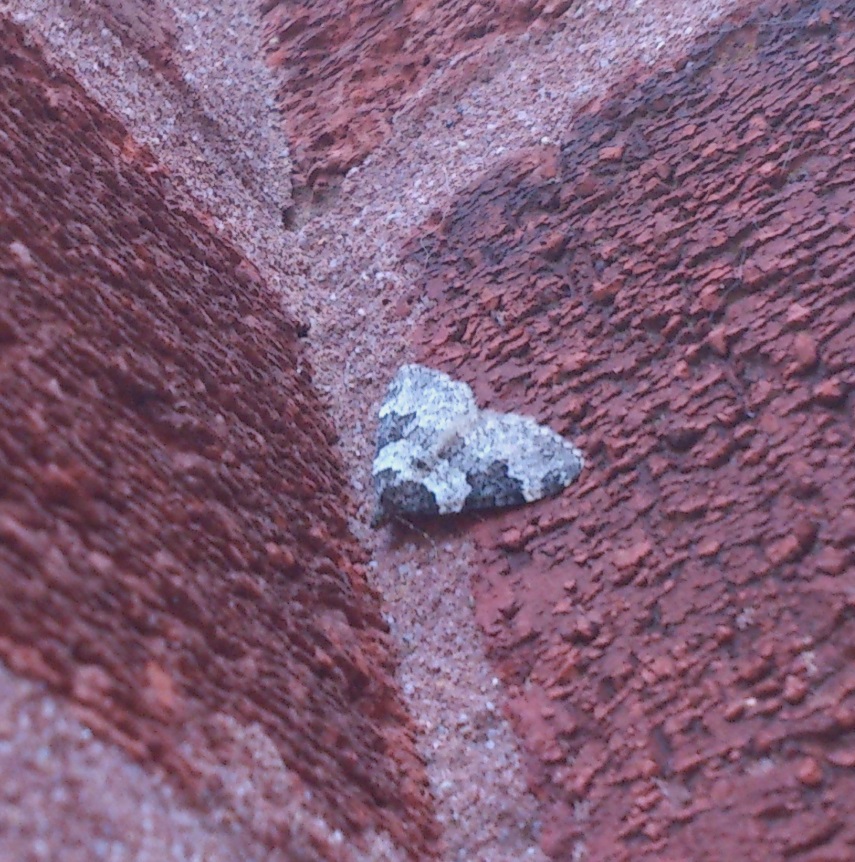
The Safari put the moth trap out on a muggy evening and was very hopeful of a decent catch. Approaching it this morning there were encouraging signs with a bright yellow Brimstone clinging to the underside of the lid.
It was even brighter when we turned it the right way up not shooting through the aging perspex.
Carefully examining the egg cartons in turn as we lifted them we came across this stunner, Anania coronata, it's a micro-moth that's as big as many of the smaller macro-moths and is very common so really does deserve a decent English name. Any suggestions anyone?
As expected there were some of the immigrant Diamondbacks, hard to believe these tiny delicate insects have flown from the continent some 500 miles away and over the North Sea to reach the west coast, they're barely half in inch (12mm) long!
We potted three but reckon that most of the 'escapes' were also this species apart from a pug sp which managed to evade capture. 
Also in the trap were two Bee Moths, two Heart & Darts, two Tachystola anthoxantha, a Cinnabar, a Common Marbled Carpet and this tiny, less than 5mm long beauty, Argyresthia trifasciata.
This miniscule species was only discovered in Britain as recently as 1982 - not surprising, we couldn't see it without our specs on and even then we struggled to see its finer features until we photographed it and got it up on the big screen.
Once the moths had been ID'd counted and released and breakfast eaten we had a bit of a garden watch. It was warm and humid but not sunny so we didn't have the big lens out with us until a Robin came in and started to feed on the suet block. This was the first time we've seen it do this since the winter but where are its young? Has its nest been lost?
There were a few more teneral Blue Tailed Damselflies on the wing but the best invert was a small bright red and black bee that settled briefly on the edge of the pond. We can only think it was one of the Sphecodes species, aka a Blood Bee. It was certainly something we've never seen before. Sadly it was too active for a pic but it's deffo one we'll look out for again and hope to get some pics of.
The male House Sparrow put in his usual unpredictable and brief single visit of the day and this time thought about having a bath but an adult Starling landing on the feeder above him spooked him and off he went. We did discover House Sparrows are back nesting in the eaves of the corner house (late but good news) but that's in the opposite direction to the way this one comes and goes...all very mysterious.
The local Wren has been singing his heart out all day from very close by but we've not seen him at all!
One moth we found but wasn't in the trap, seeing as how we found it mid afternoon, was a nice fresh Mint Moth, not on Mint but flying around Marjoram, there is some Mint only a foot or so away. we also saw the Wood Mouse's backside disappear behind a plant pot, first time we've seen it for a while.
A short visit to the shops had two Swifts fly over the car on the way back bringing Wifey's year list up to 106.
Where to next? There's a very strong probability that the mothy will be out again tonight and we might just try the Big Light too. Might as well have a go at the Garden Bioblitz too.
In the meantime let us know who almost snuck into your outback undetected.


Sunday, 14 June 2015

One good day deserves another

The Safari's good fortune the other day continued into the next. We'd put the moth trap out and fortunately the weather overnight remained calm and muggy resulting in easily our best catch of the year. There were a number of Heart & Darts as expected but some 'new for the year's' too like this spankingly fresh Brimstone.
Not quite so dapper but still a beaut, Pale Shouldered Brocade.
And a 'New for the Garden' in the form of a May Highflyer.
The larvae feed on Alder and to be honest we couldn't tell you where the nearest Alder tree is, it's not a tree planted in gardens parks or along the roadsides although it would be far more interesting and useful to a wide range of wildllife than the cultivars of Sycamores that have appeared along the roads in recent years.
Also in the trap were three micromoths, all the same species, which on looking in the field guide showed them to be Tachystola acroxantha. We did record it in the garden last year but our Mapmate spreadsheet told us a specimen was required for confirmation of the ID. Luckily we'd taken some super-macro shots
Apparently it is an Australian species spreading northwards (as an introduction not naturally we'd guess) and still scarce/almost unknown north of the Ribble hence the warning on the spreadsheet.
While we were out mothing a little bit of a cloudy front developed and we heard the first screaming of Swifts (Garden #31) from Base Camp this year. They took some finding as they were way up high and there were five of them that moved on as quickly as they'd appeared. We're really missing these aerial beauts screaming round the rooftops in the evenings. They have bred (or at least roosted regularly) in a local roof for the past several years but we've not seen them around there this season. Hope putting up our Swift nestbox hasn't frightened them off - that'd  just be our luck!
As we were packing up another unusual bird turned up in the form of two House Sparrows, a male and without bins a presumed juvenile. This week and next as the juveniles fledge and leave the nest is the only time we see them in the garden why they don't keep returning to the abundant food on offer for the rest of the year is a bit of a mystery. A couple of Blue Tailed Damselflies were flitting around over the pond too which was good to see, they've been few and far between so far this season here.
Later that afternoon we took a walk down to the North Blackpool Pond Trail. News that the Heron's Reach Bee Orchids were now in flower had reached us so it was time to check the local ones. The wildflower area was looking a picture and we soon disturbed a couple of Common Blue butterflies, one landing close by and giving us our best views of the year as it perched on a rather windblown flowerhead of Yorkshire Fog.
One of our favourite wildflowers grows in abundance here, Tufted Vetch, we've tried on many occasions to get it to establish in the several gardens we've had in the past but never been successful. It shouldn't be anymore difficult than growing Sweet Peas shouldn't it?
However, it was Bee Orchids we came specifically to see and it was only a matter of minutes before we found the first little cluster of them.
A thorough walk-over of the site gave us a final count of 35 of which three had already been trampled probably by dogs as the area is too popular with the mutt n ball brigade. Then a bloke and his daughter arrived with a fishing rod and he started to practice casting. The little girl ran along the length of the line to free it from the vegetation then he reeled it in - right over the meadow with her running behind - - a real hand to forehead slap moment - - will any orchids survive the onslaught? After a few casts his line snapped and the lead went speeding over the railway fence like a missile, a really good job there were no trains coming along. He thought it landed elsewhere and he and the little girl and teddybear promptly started stamping down the vegetation to look for it. Fortunately this was in a much ranker and far less botanically diverse area of the meadow. Minutes later they gave up their fruitless search and he looked at the sole of of boots - dogsh*t!
One of the Bee Orchids we found had a slightly unusual form in that the markings on the lip were very indistinct, fairly certain we've not seen one like that before.
We also had a look for the Common Broomrape  that occurs here but not every year - it would seem that this year is another of those 'not every years'. It is a parasite of the clover family several species of  which are very numerous in the meadow so why it should be so fickle in appearances is a bit of a mystery. Looking for it gave us a couple more Common Blue butterflies and our first Silver Y moth of the year. Despite the warm sun and only light breeze thee number of insects was very poor barely a bee or a hoverfly in sight.
This morning the sun was out early but we got to the moth trap late and found the moth trappers worst nightmare, no not Wasps, even worse than that there were feathers inside! Some small birdy had been in there no doubt scoffing a way. Consequently we only found four moths inside (+ one escapee micro), three Heart & Darts and a Garden Carpet. The latter was lively in the pot and escaped while we were trying to get a pic. It landed just out of arm's length on our neighbours chimneybreast.
The warm sun had brought out about half a dozen Blue Tailed Damselflies and they were keen to bask on the edge of thee pond to warm up for the day's proceedings.
 Their being fairly settled allowed us time to go indoors for the super-macro lens.
We'd love to know just what they see through those impressive eyes
We watched a new queen and a drone Tree Bee mating and the Goldfish in the pond spawning and then the sun went in and the rain started and all the interesting garden activity came to a grinding halt.
Where to next? Back to Patch 2 tomorrow and the beach beckons again.
In the meantime let us know who's keeping a beady eye on who in your outback


Thursday, 28 June 2012

More surprises

The Safari managed to get out on a full Patch 1 walk yesterday evening and after a day of surprises at work was granted one more by the Surprise Gods! Nothing appeared anything out of the ordinary as we climbed the hill, rounding the corner Frank’s nemesis Blue and his two hench-dogs weren’t at the gate ready to pounce and the Peregrine wasn’t on the tower, all seemed normal. At the Golden Triangle it was good to see a Song Thrush collecting food for hidden nestlings and an unseen Greenfinch sang loudly. We walked into the park and immediately heard a Blackcap and saw a Speckled Wood, nothing unusual there. We watched the butterfly flit along the track in front of us and once at the more open area of the Butterfly Zone it hung a right over the Bramble patch. Something rather large on the Brambles caught our eye...a huge Tree Bee, very possibly Blackpool’s first record (Anyone know any different?). We watched her for a good few minutes but no flamin camera!!! Gee are they a bonny bee!
A Chiffchaff was also singing on and off. Frank decided he wanted to wander round the rough field so we followed him – he dived straight into the filthy puddle – bad dog! After dragging him out (not quite by his ears!) we thought he best have a mooch through the long grass to dry off a bit...but then he found another puddle, again muddy – he did disturb a couple of Large Skippers and a little further on another couple although it could have been one of the first doubling back and a third.
It became rather humid as the evening wore on and after we’d woken up from the dream that Spain v Portugal was a good match we took Frank out. Several moths were seen, one of which was probably a Brimstone.

(Old pic from the moth trap)
This morning saw us back on Patch 2 where there was some of the most ominous cloud formations we’ve ever seen fortunately drifting northwards away from us, we hoped to get a pic but by the time we’d got back to the office and the camera they’d dissipated. Talking of cameras, one of yesterday’s dunked ones seems to be fine (the more expensive) but the handy little compact isn’t responding to treatment yet.
Three Grey Seals and one of the big lumps of driftwood were seen along with the lone male Common Scoter, a dozen or so of his friends flew south at range followed a few minutes later by another 75 or so. Also at range was a skua sp which disappeared once it dropped below the horizon. Three pairs of unidentified terns made their way southwards as did another surprise, three Mute Swans, a Shelduck also appeared out of the gloom to the north – were they all escaping so rotten weather?
At lunchtime we got the periscope from the cupboard and headed off to the beach. No good! Too dull today due to a thunderstorm brewing out at sea. There were some good flickers of lightning including one massive one bouncing along the base of the clouds for about 10 miles and a couple of others that forked into sea.
We tried to get pics of the Plumose Anemone but now think a bright sunny day is needed along with a dark cowl over our head – we’ll get there in the end!


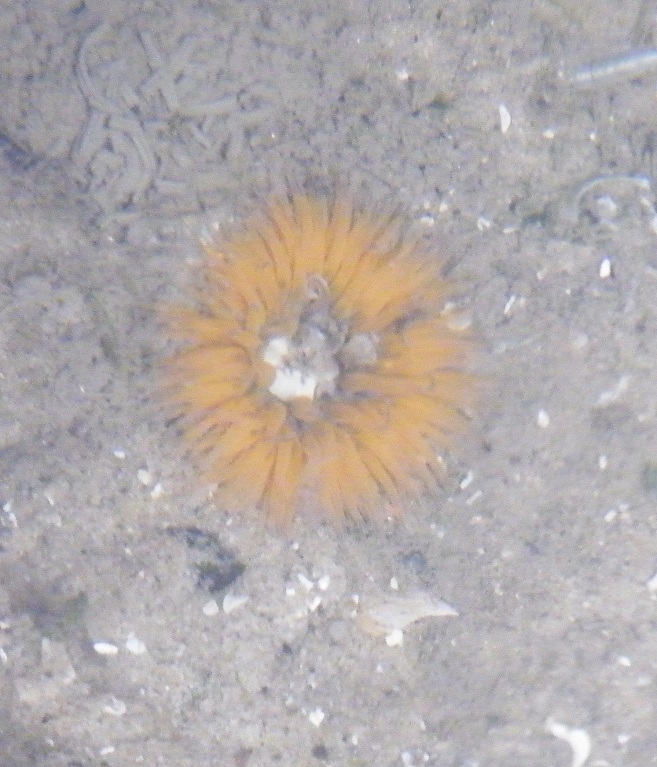
Another anemone was seen in the same pot, this one bright orange, Elegant Anemone, Sagartia elegans - thanks to  DB for the ID. Easier to get a pic of it from above the water surface even if the shutter speed is still too slow. 


A meander along the beach before the deluge arrived gave us plenty of Sea Potatoes, a few more Hermit Crab-free Edible Whelk shells and two clumps of Squid eggs.


With large drops of rain landing with decided thuds on the beach we thought it best to leave and let the fishermen down on the water’s edge be the target for any more lightning that might be around.


Where to next? A day off tomorrow then the weekend so anything could happen! Who knows- even the moth trap might get an airing!
In the meantime let us know how hot n sultry it was in your outback