Showing posts with label bull. Show all posts

Tuesday, 21 July 2015

Headed out east today

The Safari picked up BD quite late in the morning after a visit to the docs, we can feel a couple of hand operations coming along in the not too distant future. Our plan was to hit the high roads of the eastern hills and see if we couldn't pick up a couple or three year birds and find some other interesting stuff too.
All was going swimmingly until we got stuck behind an fully laden articulated tanker truck on the narrowest of country lanes, OK a bit of patience was required but every bend had on-coming traffic and some folk don't know the width of their vehicles! We lost a good ten minutes or more of valuable safari-ing time before the driver was able to let us past safely.
We got close to the turn to our destination and saw 'Road Closed' - darn it! Last time we wanted to come this way the road was closed for repairs too. An alternative had be found and quick. Fortunately BD has never been to this area before so we decided to bunk into the valley we used to visit regularly with Wifey and Frank when he could walk that far.
We parked in the village car park and had a wander to the river bank. We hadn't been out of the Land Rover more than a couple of minutes before the first Clegg came sniffing round. Out came the insect repellent; we'll be glad to get back to work tomorrow to allow the DEET to drain out of our system!
Once fully DEETed up we set off on our walk up the river and soon came upon a bush covered in caterpillar webs. On closer inspection little white dashes all over the outside of the webs were in fact adult moths, perhaps only just emerged.
There were hundreds of them and they were easily disturbed by the slightest movement but didn't really fly far before settling again.
We're fairly confident they might be Bird Cherry Ermine moths.
Like the Cleggs yesterday the Red Soldier Beetles were also out on the Creeping Thistles again today.
A Garden Warbler sang from a tree which also had a Blue Tit and a Robin.
It didn't take too long to find one of the alternative site's specialities, Heath Spotted Orchid.
There were lots of them along the trackside, only trouble was when we got back to Base Camp and looked them up in the Lancashire Atlas we discovered they were Common Spotted Orchids; Heath Spotted now only occur in five restricted areas of the county and this isn't one of them - dohhh.
Buoyed by our 'success' we pressed on onwards and upwards. A tatty Sparrowhawk cruised along the tree tops to our left and to the right we saw a Kestrel which when coming towards us looked so much like a Peregrine we made a schoolboy ID error. It flew around in an agitated manner for a while then went back from whence it came and had a tussle with another bird of prey hidden in the Heather. But what was it? B took his big camera over and fired away as we couldn't see anything with our bins.
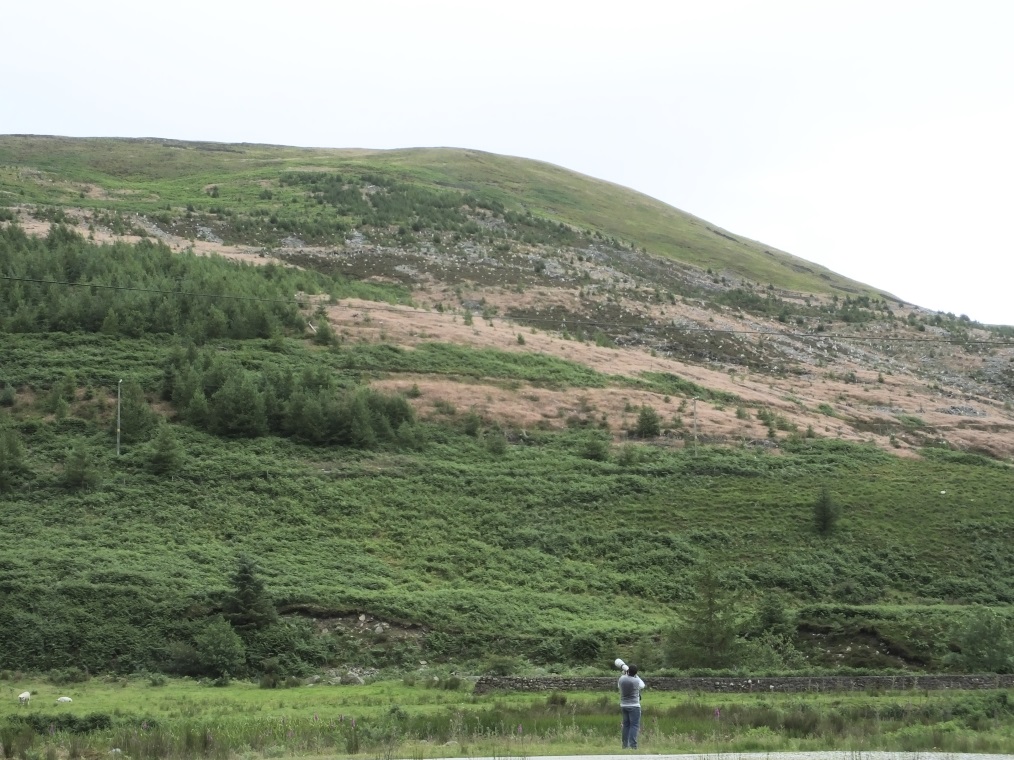
Whatever it is it's up there somewhere
What raptor did we see that could be hiding up there? A Hen Harrier perhaps? With no apparent joy we continued up the hill briefly stopping to get out of the rain behind a shed where B found a small Puffball just protruding through the grass
Looking at it closely and cutting it open inside was a slimy greenish sludge - euchhh, not like the firm insides of a Giant Puffball.
We looked for Common Lizards on the stony walls and doing so spotted a wasp around a patch of Figwort, it didn't look quite right for a normal Common Wasp so we both took some pics. 
It didn't give itself up lightly
Again once back at Base Camp it was identified via Twitter by none other than Richard Lewington, he of the field guide illustrations fame, as Figwort Sawfly which B discovered was a first for Lancashire until a few minutes later CR piped up with a not so fast me hearties, he's been waiting for confirmation of one he put on iRecord from the nature reserve a couple of years ago - the race is on!
We were looking at something and nothing, possibly the tiny flower Tormentil, when B called out 'lizard!', he'd only just gone and found his first ever British Common Lizard. Were very close to it and it disappeared down it's hidey-hole before we'd caught a glimpse of it and long before any cameras could be pointed in its direction.
A little further up the lane the Kestrel was back and appeared to be calling loudly.
It flew off and the calling stopped but we weren't convinced it was the Kestrel, it was something else, a very anxious Common Sandpiper was in the stream close by not at all happy that there was an aerial predator in its territory.
At the water's meet we watched House Martins, Swallows and a few Sand Martin's cruising around in the rain over the big weir. Looking down into the river we could see no fish in the strongly peat stained water. The water gets pulled off for drinking in several towns a few yards down stream and we pay in our water bills to have it cleaned. The staining comes from the over drained moorland used for driven grouse shooting. Surely the polluter should pay not us, even if their name does begin with Duke of....time for you all to support this year's Hen Harrier Day even if you're not a birder or don't care about the concerted illegal killings of a protected bird the actions of a few affect the many in several ways, mostly in our pockets, increased flood risk insurance premiums, climate change risks and all to kill as many Red Grouse as possible in a short a time as possible for as much money as possible.
Rant over - there was an impressive bull in the field by the weir - we're no cattle expert but we think he's a Belgian Blue or at least a BB crossed with something. Whatever he is he's a bit of a beast.
The rain came down heavier making the valley round the corner rather less photogenic than it usually is. Those cut fields have been silaged, in the old days they'd have been hay meadows and full of a huge variety of of wildflowers, now they probably contain Rye Grass, a few Dandelions and a Chickweed or two.
This is a one way in same way out walk and the way back was against the rain, we were soon soaked through.
Our friend the Kestrel was on the ground on a nearby Heather clad hillside.
Overhead soaring higher over the fellside was our third raptor of the day, a Buzzard...is it just us or are you seeing fewer Buzzards than expected?
The rain continued to pour down as we looked on the bank where the Common Lizard was and lo and behold it was still there despite the downpour. Again it did a bunk as soon as we spotted it and with the rain cameras were well tucked away so there was no chance of a pic. This is the closest we could get to it.
There were a few soggy sheep about too.
More plants were noted after our botanising trip on Friday when we found some different species of St John's Wort, here was a new one Square Stemmed St John's Wort.
Back at the Land Rover our safari wasn't quite over, a Mayfly was on the side of the car as we unlocked it.


Once again great wildlife and good company to enjoy and share it with...and no we didn't see any Hen Harriers, the mystery bird up the fellside turned out to be another Kestrel.
Where to next? National Whale and Dolphin Watch is coming up starting this weekend, hope the weather isn't too windy - see you there - - look under Cheshire, don't ask!
In the meantime let us know if there's any Hen harriers in your outback...ohhh there isn't why not??? Please sign the petition, let Them know we care and won't be fobbed off!


Tuesday, 26 May 2015

A Southside safari

The Safari picked up BD yesterday morning and we headed to the huge wetland reserve over the river. We had a bird or two to twitch. We stopped at a field close to our destination and the first thing we noticed was we'd left our trusty Swazzas at home...ohhh no an all day visit to one of the North West's top reserves and no bins!!! Our quarry here was Yellow Wagtails which we did see briefly but they disappeared into the ruts in a ploughed field almost as soon we pulled up.
Once through the doors and onto the reserve proper we could have hired some bins but chose not too ass we knew that much of the stuff would be distant and others would be so close as to not need the bins, but we won't be forgetting them next time that's for sure! We didn't need them to spot this huge Chicken of the Woods fungus. 
A look in the nearest hide wasn't too productive with just lots of nesting Black Headed Gulls and several Shelducks and a couple of pairs of Avocets. At the back of the pool was a small flock of Black Tailed Godwits, some in their summer finery but too far away for any pics. The trails are about as insect friendly as it gets with just a one mower width strip along the path edge cut for 'neatness'. Why can't all roadside verges be managed this way - it's not rocket science.Just look at that colour and visit next week and it'll probably be different as the next species in the succession comes into flower.
We arrived at the intended hide to learn the diminutive Temminck's Stint was in view but the other bird we'd hoped to see, the White Winged Black Tern, had done a bunk overnight. The bins would have been useless for spotting the stint it was miles away across the marsh, almost half way back to Base Camp it seemed, even with the scope wound up to full volume 70x it was still little more than a small dot although in the good light we could tell it was a summer plumaged dot. Temminck's Stint (165) on the list; a bonus species that wasn't really on the radar in our Year List Challenge with Monika. The old Dutchman Mr Temminck has fair few species named after him.
We shared our scope with several other visitors who only had bins with them to ensure they got the best views possible. One of those said she'd just seen a Merlin flying across the back fields as we were watching a distant Barn Owl hunting out in broad daylight. A Merlin here at the end of May would be unusual so we thought she may have seen a Hobby but couldn't relocate it.
Moving on back to the previous hide we stopped to have a good look at the superb variety of grasses and wildflowers on the bank amongst the 4-5000+ YO 'Bog Oaks' on display. It's amazing to think that these trees which look like they were felled recently were actually growing in the Middle Stone Age! 
From the hide there wasn't much to see but one of the punters there said they'd seen a Cuckoo not long since - that was probably what the 'Merlin' was, not a Hobby. 
Next stop was right around the far side of the reserve, you can't do a round circuit at this reserve. Here the water levels were down and lots of black sticky mud was exposed. A very dirty legged Redshank was the first bird seen other than the multitude of nesting Black Headed Gulls. We were a little disappointed to see the little islands that used to be covered in shingle were now well vegetated and so far less suitable for Common Terns and Little Ringed Plovers to nest on although the Black Headed Gulls and a pair of Oystercatchers were taking full advantage.
Phone-scoped
Eventuality we found the Little Ringed Plovers (166), more tiny dots well camouflaged and miles away on the mud.
Phone-scoped at 70x mag
Even further away was a small group of Whooper Swans unable to migrate to Iceland but they had strayed too close to a pair of Avocet's chicks and the adults were trying to drive them off, even giving them stamps on the back in one instance. We were able to get a family of youngsters to witness this through the scope - great behaviour for them to see first-hand. Also close by but not a threat to the Avocets were two Pink Footed Geese.
Outside the breeding season the marshy grasslands are grazed by a herd of Longhorn Cattle to get the grass the right length and tussockiness for the wintering geese and then the breeding waders. The bulls are impressive beasts.


Retracing our steps, as you have to, we stopped at the raised hide and had excellent views of a Blackcap and some Tree Sparrows. Somewhere in the thicket below us was a Whitethroat too but it refused to show itself.
Arty Tree Sparrow
A Blackbird sang its glorious fluty song non-stop for ages and looking at it more closely we saw it was ringed, probably on site. 
All of a sudden it dropped like a stone with an alarm call and milliseconds later a Sparrowhawk flashed through exactly where it had been - a lucky escape! Checking our photos on the puter later none of them show it to have two feet on the branch, nor do BD's pics.
The hawk put paid to the bird activity so on we went stopping a few yards further down the path to admire some large fungi which we thought were Puffballs at first but closer inspection by BD revealed them to have a thick, short stipe who thought it was more than likely to be St George's Mushrooom.
While admiring them we heard an unusual alarm call we couldn't identify, was it a corvid or a squirrel? But it was in the area where Tawny Owls hang out in the densely Ivy covered trees. Looking up we saw a blob in the open in one of the Scot Pine trees, a Tawny Owl (167), nice even if a poor view, we've only heard them or had very fleeting flight views in the car headlights in recent years.
Stepping back a few yards to try to get a better angle we came across its mate tucked up close to the tree trunk only a couple of feet away but not visible from where we were before.
Once again we were able to get lots of youngsters on to it, and after a little while this one went to sit next  to the other out in the open but the only view of them together was looking right up their backsides through lots of twigs. Tawny Owls love to roost up unseen in Ivy - another good reason NOT to clear it from the trees its growing up -it does no harm...we did see a bloke hacking away at some on our hols last week - - numpty, probably thought it's going to kill the tree or it just looks that nightmare word 'untidy'!
The cold wind meant there weren't many invertebrates about, an Early Bumble Bee early on in the day and a white buttterfly were all we could really muster until BD's sharp eyes found a fence post covered with flies all lined up facing the same way, like planes on an aircraft carrier - we tried to get pics of the unusual array but inched too close and flushed them, we don't recall ever seeing anything quite like that before. It was just after we disturbed them that BD found an Ichneumon Wasp and was able to catch it as it wasn't very lively in the cool temperatures.
Looking at our pic we now think it could be some kind of Sawfly rather than an Icneumon Wasp.
A food and coffee stop by the captive collection offered some super photo opportunities and we've always wanted to get a decent pic of the simple but stunning patterns on a drake Gadwall.
Almost mesmerising to look at for a long time
A look at the time showed us time was running short and with no further sign of the White Winged Black Tern we decided to leave and have a last look down the lane for the Yellow Wagtails. We were glad we did, they were very close this time. Thanks to DC for the gen on which field to find them too - cheers bud.
We had a final stop at the Common Tern colony at the docks on the way back to Base Camp where there weren't many terns in and they were mostly right across the far side. A Great Black Backed Gull played with something in the water, we thought it looked like a fish but on closer inspection seems to be a piece of twig or root, vegetable rather than animal anyway.
So another very enjoyable safari with plenty of great wildlife found and shared; and thanks to BD for the company.
Where to next? Last day of freedom tomorrow, hopefully we'll get out somewhere.
In the meantime let us know who's snuck off before time in your outback.