Showing posts with label marsh orchid. Show all posts

Sunday, 2 July 2017

#30DaysWild is over...or is it?

The Safari has been busy with all sorts of groups this week. We've played host to school classes, Rainbows, Brownies, Beavers, Guides and volunteers from the zoo doing their #30DaysWild challenge.


The schools pond dipping sessions have thrown up a couple of surprises. The first day the class watched a female Emperor dragonfly laying her eggs on vegetation in the pond right under the children's noses - none of them had ever seen a dragonfly before and didn't know insects could get that big, some even thought it was too brightly coloured to be an insect so must be a bird! Whether insect or bird it was an awesome spectacle for them to witness.
The following day's class the children watched a dragonfly nymph catch and devour a small 3-spined Stickleback - they found that awesome if a bit gruesome too. But generally apart from prodigious number s of Wandering Snails, darter sp dragonfly nymphs (probably Common Darter) and hundreds of 3-spined Sticklebacks there wasn't much for them to catch. Until one of them, and then others, pulled out a tadpole. Where had they come from surely the pond sides are too high for a Frog to jump up and over into the water. We surmise that someone nearby has a pond which was in danger of drying out during the hot spell last week and 'rescued' them in to our larger and deeper pond. One one of the last evening sessions a Brownie caught a Pond Skater, we've not seen one on there for a long time. But where are all the Bloodworms, Diving Beetles, Back Swimmers, Front Swimmers and Blue Tailed Damselfly nymphs? It's a funny old year in the pond!
The volunteers from the zoo had arranged to do a beach clean with us."We do like to be beside the seaside...but we don't like to see the beach covered in litter.
6 big bags of rubbish were eventually collected and taken off the sands - well done everyone
Perhaps the most disturbing piece of litter was this length of fishing tackle which had continued fishing after it had been snapped off and ended up killing a small Smooth Hound pup. We often find lost tackle with hooks and breakaway weights waiting to catch a fish, gull, dog's paw of child's foot. We think the anglers who lost their gear should come back as soon as the tide drops and try tto retrieve as much as they possibly can - that would be better than leaving in/on the beach - and while they were doing that they could pick up all the litter they leave behind where they stand too - Anglers are supposed to be protectors of the environment aren't they - well we don't think so!
The children's' best find was a tiny shell. So small we're quite surprised, but really pleased, that it was actually spotted and picked up. No not the pretty Sea Slug skeleton, the pink Acteon tornatitlis the other one. In all our years doing beach events with the children we've never seen anything as small as this so we went into detective mode and called on the expertise of our marine biologist friend DB who suggested it might be a Mediterranean/European Atlantic coast species that has been washed in  by the currents, Tritonalia aciculata. A quick search of the data-bases suggested that this could be a first for British waters - what an awesome find that would be for a Yr2 child!!!
Now not totally convinced with DB's ID we put the pic on the British Marine Life Study Society's Facebook page and they came back with a more likely ID of Netted Dog Whelk - albeit a very small one!
They also found several specimens of Dead Man's Fingers, which looks a bit like a Sponge but is actually a colonial polyp related to sea anemones and jellyfish.
At the end of the week we had a job to do at the zoo with Sustainability Officer LW, looking through some of the pics from their moth trapping event and a quick check of their data from the Native Species Bioblitz they did while we were away  in Cornwall.
Once we'd ID'd a few moth pics and asked for others to be sent on for more in-depth analysis (ie micro moths we can never remember the names of) LW said one of her keeper colleagues had found a rare orchid in the Dinosaur area and would we like to see it. Well we're never one to resist a rare orchid so of we went. We walked through the exhibit and back looking for what we supposed would be a Marsh Orchid and going bu the other Marsh Orchids locally were looking for a finished flower spike. We had no luck at all. LW then called her colleague who told us it was near one of the T. rex models. Again we looked and looked without success. Eventually JP was called out to show us exactly where it was. And no wonder we couldn't find it, it wasn't under the T. rex at all but a Pentasaurus!
No, we've never heard of a Pentasaurus either! And no it wasn't a Marsh Orchid spike so we were looking for the totally wrong thing. It was actually a battered and bruised specimen of a helleborine species but which one?
We initially thought it was probably Broad Leaved Helleborine but info from Twitter suggested it was much more likely to be the much much rarer Dune Helleborine which is found locally a few miles away, on the dunes of all places. We've arranged to get back into the zoo to monitor its progress and get some pics - an awesome find! And then JP casually mentioned "we've got some other orchids - would you like to see those?" Of course we would,, ta v muchly! He took us to a currently out-of-bounds area undergoing a large scale construction site refurbishment and there on the edge of a pool was a colony of Southern Marsh Orchids growing among the waterside rushes and reeds.
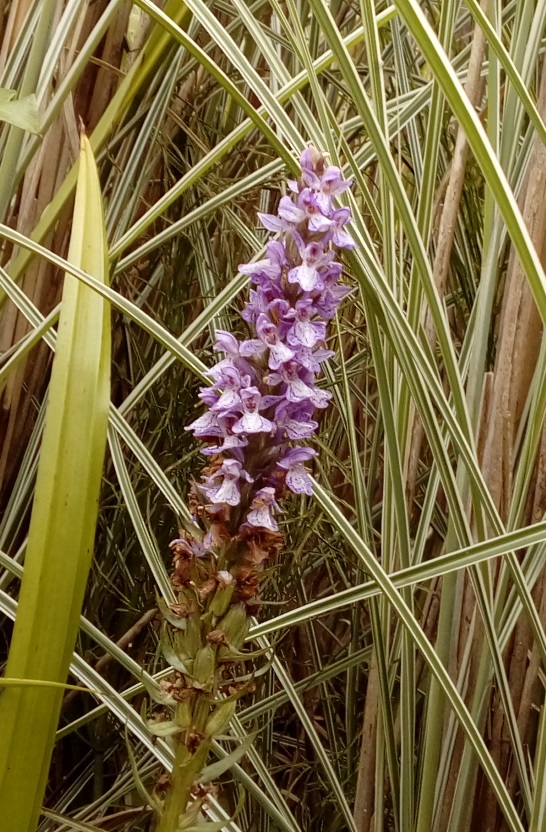
He then said "we've got some more too, follow me to the Capybaras". A few minutes searching between the viewing rail and the safety fence had us looking at a gone over Bee Orchid and then a smaller one still in flower. Who needs to look at giant rodents when you've got these beauties right next to them!
With that it was time to leave for Base camp at the end of a very busty week and so ended #30DaysWild for us and the Zoo team - see their Facebook page Blackpool Zoo - Wildlife Learning for all they got up to. Looks like they had a blast being wild - just as e did. And just because the 'event' is over doesn't mean YOU have to stop being wild...please carry on doing random acts of wildness, finding bizarre, exotic, beautiful, ugly, rare and common species in your own outback and don't forget to share them!
Where to next? We've got a Year Bird Photo Challenge to catch up on this weekend, some of the other challengers are posting like mad and we don't want to get left behind!
In the meantime let us know how wild you're going to be in your outback this month.


Saturday, 10 June 2017

Wet in the rain and the hope for a boar

The Safari wasn't able to do the dolphin watch we'd hoped to do for World Environment Day due to bad (= atrocious) weather, nor was there any chance to move it World Oceans Day a few days later due to solemn family duties. The following day we had a bit of a chill out day with Wifey to clear our heads and have a bit of a walk out with Monty somewhere he's not been before.
We had a walk along the river listening to mostly Blackcaps, Robins and Song Thrushes. We had to listen as we didn't see any birds at all in the dense woodland. There was a bird we did want to see and photograph, a Dipper or two, but arriving on site mid-afternoon the amount of doggy disturbance so far, which we added to to be honest, probably put paid to any chance of seeing them. 
Almost at the end of the woodland section of the circular walk we eventually came a across a real live bird, a Robin sat preening on a low twig possibly after having a bathe in one of the many puddles just off the edge of the track.
Once out of the woods the meadow was a picture of glowing gold from the myriad of Meadow Buttercups. Last time we were at this site was last year with BD (or was it the year before? - time flies when you're on safari) there was a team out with a heavy duty motorised scrub cutter clearing away the Alder and Willow scrub that was developing and beginning to over-run the meadow. Now we're all for reforestation and rewilding but there are limits. This work was being done to ensure the scrub didn't totally over-shadow the orchids that grew on the meadow.
The work had been a success as it didn't take long to find the first Southern? Marsh Orchid, nor the second or third, once you'd got your eye in there were thousands scattered among the buttercups.


 A wonderful sight!
Back at the car Monty was being cleaned off and we had a quick look at the apparently empty feeders in the corner of the car park. There was some food and there was a bird there in the deep dark shadows. We edged closer very carefully and fired off a few shots as we went.


Those stripes down the back and the buff wing bar gave the ID away, a Lesser Redpoll (162, YBC #138).
Sneaking a little closer and changing the settings on the camera we ended up with an almost decent pic showing it's lovely red head which gives the bird its name.
Once home we had a txt from CR saying he'd had a Blue Tailed Damselfly close to his pond which he didn't think had emerged from there but flown in from elsewhere. We took advantage of a bit of sunshine and went into the garden at Base Camp to find the same species almost immediately.
This one could well have emerged from our pond.
Later our Extreme Photographer sent us some very interesting pics. His neighbour had been at a friend's and she had brought back a bit of a specimen that her friend, knowing of our Extreme's interest in wildlife, had kept for him. 
The recently shed skin of a very large Grass Snake.
It's a big one, well over 1m long
The ventral scales were about 4 cm across!
What a great addition to his collection of wildlife bits n pieces.
We'd love to see one that big in Safari-land, we like to see one any size in Safari-land!!!
Last night on Twitter we saw a post about wildflowers and lawn-mowers that reminded us very much of Patch 1. So while we were out with Monty after the rain we took the opportunity to recreate the post. Here's today's pic. The field looks like this every day.
But it used to be cut less frequently until a couple of years ago and often looked like this, or white with White Clover and buzzing with bees.
Why do the 'Tidy Brigade' hate wildflowers and all their associated invertebrate life, especially pollinators, so much?
Most of the field isn't played on by the local kids and could easily be left uncut for longer, if absolutely necessary the margin against the paths could be cut to no more than a metre in. We're beginning to think all public green spaces, including, and perhaps especially, the roadside verges should be manged for pollinators and other insects and sod the 'Tidy Brigade'; sports fields would obviously be exempt but less tidy doesn't mean un-managed or uncared for and should be the norm. If people want tidy let them scalp their own lawns and leave the rest alone. What is it that they/we are so afraid of?
On the way back we saw a garden that had recently had some bedding plants put in. There were scattered plants surrounded by what seemed like acres of bare soil. Now the gardener obviously meant it to look like that and will spend ages all summer hoeing and weeding to keep it so. But we thought it just looked like a sounder of Wild Boars had had a rummage and accidentally missed or deliberately avoided a few plants - we can imaging the chaps absolute terror if a flock of Wild Boars had done that to his garden no doubt he'd be calling for a cull!!! They're a species that would do well at the riverside site we visited yesterday provided they could avoid all the doggy disturbance...as would Beavers up the river...heaven forbid!!! BUT the river managers had felled some trees directly into the river to reduce and deflect the flow in certain areas just as Beavers would do...
Come on Britain, pull your fingers out and lets get some wildlife back in our land, urban and rural!
Where to next? Back to the real world of work tomorrow but we do have an event on the beach in the evening to tell you about.
In the meantime let us know who's tidying up in your outback.

Sunday, 29 May 2016

Small victories in the war against ecocide

The Safari was able to sit outside in the sunshine on Saturday but for much of the time all we could hear was strimmers, lawnmowers, hedge trimmers and other power tools ripping into the local gardens without a second thought for what might be being destroyed either directly or indirectly like opening up the dense cover around a nest so that predation by eg cats/Magpies becomes inevitable - there's a Robin's nest nearby we've seen an adult skulking unobtrusively to and fro through the undergrowth at the bottom of the garden.
Cat owners please note that putting a bell on your moggie has no effect on reducing their slinkiness what-so-ever. This afternoon we were at peace with the world on the patio when we noticed a movement to our right. A be-belled cat had crossed the yard and climbed the half dozen steps to the patio in absolute silence. It's only when we spotted it and moved that it ran back down the steps that we heard the bell jingling.
All this feline activity didn't wake the sleeping Woodpigeon high and safe on the pergola. He waits up there for smaller birds to visit the feeders and spill crumbs down on the ground as he's not agile enough to reach them himself.
The other day we were thrilled to have a Jackdaw come down and visit the feeders, today we doubled our record count!
And were very pleased with more visits from the now regular but totally unpredictable male House Sparrow. His routine seems to be a quick snack on the feeder before a minute or two's search of the Silver Birch tree before heading off north to north east-ish - wonder where he's going too.
One particular juvenile Starling is another unpredictable visitor, coming in unexpectedly at any time for a quick suet top up or a bathe in the ornamental waterfall. Most of the birds seem to prefer this to the birdbath a yard away which we would think offered a bit more safety being raised up on a pedestal, only the Blue Tits seem to use it. The Starling never brings his parents or siblings.
Meanwhile down in the yard the orchid story in (literally) unfolding in front of our very eyes.
Here's the first fully open flower.
Apparently there are about 120 in flower at the nature reserve this week and no doubt more on the duneland nature reserve we also visit so we're thinking a spore or two may have hitched a ride with us and found the tub to their liking. We've certainly got down close and personal with them for pics at the nature reserve although that would invariably be when they were in full flower and not once they'd gone over and had ripe seed capsules. Maybe it is a one in a billion fluke. It must be almost 100 years since the garden was last farmland and there may have been/probably was orchids in the pastures and/or hay meadows at that time. Definitely one to ponder and enjoy and a very welcome addition to the garden flora wherever it came from. The tub was originally planted with ornamental Alpine plants into recycled peat-free compost, the Thrift is the only surviving original plant, the Cowslips have were seeded in deliberately from others in the garden. The blue Campanula was in the pot bust has 'escaped'.
Warm sunshine meant insects were on the wing and we had brief visits from the first Holly Blue butterfly of the year and a mature Blue Tailed Damselfly which we assume came from someone else's pond as we've not seen any tenerals around our pond at that point. And then a little later there was one right in front of us struggling in a spider's web.
Being soft hearted we did the wrong thing and deprived the spider of an enormous meal.
It soon fluttered off none the worse for wear from its very close shave.
Tree Bees and Early Bumble Bees visited the flowers on offer while a huge queen Bombus terrestris got trapped underthe pond net for a while being too big to fit through the mesh that keeps the Herons out.
Here's the view from our perch on the patio, somewhere to the right behind the garage there was a Blackcap singing very quietly a couple of gardens away. We tried to see where it might be from the back bedroom window. We've not looked out from there for a while and were shocked to see how much shrubbery has been lost from the surrounding gardens - they're mostly bare now almost habitat-free zones.We are very much an island of structural diversity in a sea of monotonous lawns and 'tidy' flower-beds.
But we bet even those tidy gardens have Greenfly and no doubt a futile ecocidal war will be waged against them. They're welcome on our notebook anytime.
All these little things, while barely significant in their own right, give us immense pleasure at a time we're invalided and unable to get further afield but are all little victories against the masses that seem to want rid of wildness for the sake of 'tidy' and in doing so make our world that little bit poorer. They don't seem to realise all species are interconnected including ourselves, we are a part of nature not apart from it and there is no Planet B!
Wifey came back from the shops late afternoon and suggested we have a drive out to the countryside for a bit of fresh air and to help us going stir crazy at Base camp. We felt up to it so in the car we got. We ended up at a favourite riverside walk where we heard a Garden Warbler (161) as soon as we opened the car door and Wifey spotted a Nuthatch on the feeders at the end of the car park.
The woods rang loudy with the songs of Song Thrushes, Blackcaps and Wrens but the river was devoid of birds apart from a family of well grown Mallards.
At the car park another visitor (probably spotting our bins) had told us too look for the pair of Mute Swans on the lake, "there's a bird-hide you know". Yes we knew, we've only been going there since the early 80s and never seen anything out of the ordinary from it! The best sighting we had was a shoal of large Chub when we looked directly down out of the window once many many years ago and we've seen a Roe Deer on the far bank once.
We had a look from the hide anyway not expecting much but as expected the pair of Mute Swans were feeding out in the middle of the lake. On a dead snag at the side of the hide was a Grey Wagtail with a beak stuffed with flies. It was agitated and calling like mad so we thought it might have a nest in or near the hide so we fired off a few shots and left it in peace. As soon as we'd gone the other came and landed on the branch next too it also with a beakful of food - time to leave them well alone.
The woods are undergoing some bizarre coppicing work, not sure by whom, but we did some Alder coppicing in the top corner all those years ago and this looks like an attempt to revisit that work although the trees seems to be chosen at random and some of the stumps have been left very long - all very strange...shoulda taken some pics. We should also have taken some pics of the dense wildwood a little further along the path away from the river. The trees are all shapes as they've competed for light and their boughs are gorgeously festooned with mosses, lichens and ferns. In places trees grow in the path and their roots have become exposed by the passage of countless feet - looks like a giant bonsai display.
Arty canopy shot through a not-so-invasive-here Norway Maple
The last time we were here the Rangers were cutting developing Alder scrub from the extensive meadow areas. We had hoped there would be an awesome display of Marsh Orchids and Cowslips but it wasn't to be, even the Buttercups weren't putting on as good a show as the un-managed area on the other side of the car park. Maybe we're a week to early still, but we did find a Common Twayblade just at the side of the path through the meadow - very vulnerable to being trodden on by the hordes of rampaging dogs that are brought for a 'walk'.
It was great to get out and the day was finished with a huge plate of fish and chips, the perfect end to a perfect day. Wifey added three birds to her year list, Garden Warbler, Nuthatch and Blackcap taking her total to 102, sadly we couldn't find her Kingfisher, Dipper or Little Ringed Plover (on the brand new pool that has been excavated over the road from the car park - looks mint for them).
Where to next? Back on our perch on the patio at Base Camp lapping up the sunshine and the wildlife sights in the garden. A Honey Buzzard will fly over - - plleeeeeeeaaasssse!
In the meantime let us know who's put in a surprise appearance in your outback.


Monday, 23 May 2016

Do starlings smell?

The Safari was back at the hospital this morning to get our wound checked over and fresh, and very much reduced, dressings - what a relief, much more comfortable and mobile now, so much so we are able to wield the camera almost effectively for short periods at least.
The stitches come out at the end of the week, then it'll throb a bit!
Before we went into hospital we did the newt/amphibian survey during which we saw our first Yellow Flags in flower.


A little more interesting were these tiny beetles we found on many of the leaves in the gathering gloom.
We'd had the pics on the phone since then and yesterday we were able to put them on iSpot. By morning those clever iSpotters had come up with an ID. A fairly obvious ID but very welcome, so what are they? Iris Flea Beetles was the answer.
Back at Base Camp the other day we discovered that the only used cell in our little bug hotel was open, its occupant having pupated successfully over winter, metamorphosed into an adult and cut its way out - will it bring some friends this summer?
Also spotted, this time in our old Belfast sink which used to have alpines in it but is now mostly self-sown Cowslips. At first we thought the flat bladed leaves were from perhaps a miniature Tulip but over the last couple of days we're now certain its a Marsh Orchid of some description. We'll have to wait a few more days to find out which species when the flowers open fully.
We've been enjoying sitting in the sunshine in the garden listening to the birds once the dire noise pollution from the rush-hour traffic has died down. There's always a Woodpigeon or two hanging around hoping for some more scram.
There are two rival Blackbirds who sing at each other almost all day long. This one is in the Rowan tree at the end of next door's garden behind our garage. His rival was singing from a nearby chimney pot, less than 50 yards away, small territories it would seem so they must be of good quality.
While we were listening to those two with the local Song Thrush giving his four-penneth too we heard our first Blackcap (Garden #26) at Base Camp this year. Interestingly we've had a few Starlings visit today, very scarce here. We had, with somewhat of a struggle, put out some fat squares and within minutes we had visitors. How did they know it was there? We'd seen none flying over so could they smell the new food source. How nosey is a Starling?


It wasn't just the Starlings that made an appearance on the Scarce List. We also had a visit from a male House Sparrow that shot over the garden and landed briefly on the other next door's feeders before returning the way it came over our garden again. Bizarrre, we didn't know there were any sparrows locally in that direction. Luckily it came back and spent no more than a couple of minutes in our garden hopping around our pot plants. 
With no further bird action we turned our attention to the plants. We tried some macro shots but it was too windy with most of the flowers shaking around like Whirling Dervishes. The Thrift in the same tub as the orchid was just about the only robust and sheltered enough specimen for a decent pic.
Later we just about managed to get the new beast out of its box but weren't able to attach it too the camera; there's no way we'll be able to use it for at least a week yet - sooooooo frustrating.


Where to next? We're hoping the sunny weather will last all week so we can sit out and soak up the wild outside.
In the meantime let us know who smells in your outback.


Sunday, 21 June 2015

There's an invertebrate or two about

The Safari is going to start with a rant, don't worry it won't last long and then we'll be on to the important wildlife stuff. The local area is expecting a decision from the authorities about franking for shale gas, a very controversial issue. As might be expected we're not too keen on it. Before we get into anything other issues the eco-systems on our planet just can't afford the extra carbon. Rather than continuing giving subsidies to the fossil fuel lobby we should be going all out for energy efficiency and well suited and sited renewables.
The map below shows our local area with a screenshot of the Waco area of Texas super-imposed over it at the same scale. Each white dot on the Texas map is a fracking wellhead! OK you shouldn't really compare the two areas because the geology will be different but it gives an indication of how industrialised our green and pleasant 'desert' could become. What little wildlife that's found in those fields and hedgerows now won't be there long if it all comes to pass like this - keep it in the ground please!

Rant over - let's hope the authorities see senses and don't permit it...can/will the company involved guarantee the finished sealed weels wil stay sealed for maybe up to 1000 years or more to prevent gas leakage? Didn't think so.
Let's crack on with the good stuff. We weren't able to get out with the new Friends of Marton Mere group and had to make do with bobbing down after lunch and meeting up with BD to have a look at the Northern Marsh Orchids. The summer might be cold but it's sure looking lush, the vegetation hasn't half grown up since we were last there. We had a look for a couple of locally scarce plants, Hop Trefoil and Hare's Foot Clover but had no success. Nearby there was a multitude of Hogweed in the scrub area that was strimmed in the winter - absolutely hoverfly heaven! 
Looking in our special place there was a female Great Crested Newt and a Toad.
The soundtrack was all the warblers, Chiffchaffs, Willow Warblers, Blackcaps, Sedge Warbler, Reed Warbler, Cetti's Warbler with Blackbird and Song Thrush singing too, not a bad accompaniment for the time of day. Better was our first grasshoppers singing we've heard this year but could we find one to get a pic of?
After a good wander round we mooched over to the orchid patch where BD was already camera in hand.
So it's not the biggest orchid patch in the world but it's impressive for these parts. Common Blue butterflies flitted around and our first Large Skipper of the year, neither were keeping particularly still
Although the Blue Tailed Damselflies are out at Base Camp we've not seen any others so the bright blue Common Blue Damsels were well worth pointing the camera at.
BD's keen eyes saw all sorts of fancy invertebrates but one that really stood out was a tiny snail on a Hedge Bindweed leaf. When we looked closely to photograph it we saw there were more, all on the bindweed.
BD has been able to identify it as Succinea putris...gotta be a new record for the reserve. We like the red margin to the bindweed leaves. Years ago we were 'frightened' of the bindweed as it does tend to be rampant but now we've seen so many years there we've come to realise it does little if any harm to the plants it climbs over and provides cover for the nesting birds and food for a whole host of invertebrates.
We enjoyed a good look round the top fields where we rarely tread but should do so more often. Back on the reserve proper we had a look at the meadow aka Reedbed now but there's going to back super show of Agrimony soon. From the hide we heard but didn't see a very close Cetti's Warbler and Reed Warbler. The Swifts tear-arsing around low over the water were spectacular though.
With time running out we took BD to see if the Great Crested Newt was still there as he's never seen one in the flesh. As we approached the area we heard the grasshoppers again and this time one kindly leapt in to the open. It's a Common Green Grasshopper with only one back leg.
Also about were more butterflies than we've seen so far this season. several whites, a couple of Small Tortoiseshells, several Speckled Woods and another Large Skipper that avoided the lens.
Our walk ended with Reed Buntings and Ragged Robin.
We've said it before and we'll say it again - this is a cracking little reserve with always something new to see if you look closely enough.
Where to next? Back to Patch 2 tomorrow.
In the meantime let us know looking all pretty in pink in your outback.
PS - we feel privileged to have been asked to contribute to FW's 13 Years Wilde blog series and so far have had the same birdwatching jumpers as all the other contributors except Lucy.