Saturday, 18 August 2012

A bit of this and not a lot of that

The Safari has had a variably quiet day today. Most of the morning was spent watching over a still sluggish Frank, he's still asleep but during the day has picked up a little bit and the covering over his wound has come off revealing a very tidy stitching job - should be for a 3 grand price tag!

Our Extreme Photographer was kind enough to come round to Base Camp and help make Frank some safe ramps for getting in and out of Wifey's car...some cunning designs and lots of second-hand carpet to make sure he doesn't slip or jump and hurt himself.
Footy season started today and 'Pool came home with a tasty 2-0 win away from home, 3 points on the board - only another 40 to avoid relegation but bring on another three points on Tuesday night to get the promotion campaign going.
OMG it must be getting close to Christmas - flamin X-Factor just appeared on the telly, that's Saturday nights ruined for the next four months! Is there no end to the sing-vote TV format??? And an advert for gaming in 3-D on a yet another new Nintendo got us thinking are some forms of birding not a very similar thing but in actual real life?
A Willow Warbler hweeted at the bottom of the garden and another was heard during the hot and sweaty - we need to get a lot fitter! - afternoon during the joinery extravaganza along with a very vocal Jackdaw on a neighbour's chimney.
Not much else was noted as most of the time we had our head down.
A little bit more pseudo scientific analysis, this time of species in the nearly widespread 'zone'
Red Legged Partridge - up 27% - won't be going on any of our lists though

Buzzard - up 75% - nice and not before time! Some folks will be getting unreasonably upset by this welcome rise in fortunes and no doubt try as many underhand tricks as they can to get it reversed from irrational smear campaigns to down-right murder! 

Kestrel - down 32% - Buzzards must have eaten them all - well Buzzards are now more widespread so there can't be any other explanation!

Lapwing and Curlew are both collapsing - not good - did we really read there were only 400 pairs of Lapwings left in the whole of Wales.

Good old feral Pigeons - down 13% - are these stats for real??? All those pesky town centre Peregrines must be hammering into the vermin with mucho gusto.

Stock Dove - nearly as big a rise as the ferals fell...and more widespread - we really need to get out more...or at least further afield. Obviously not enough raptors in thee wider countryside to keep these seed eating devils down...apart from Buzzards and Red Kites that is both of which would struggle to catch a cold if it was still alive...or maybe they are too busy decimating the really hard to catch smaller birds and stuffed away in cages Pheasant poults.

Cuckoo - a 50% fall in 25 years - no wonder we don't hear them so much these days. good money being well spent to find out the reasons why and then hopefully something can be done about it...still need more big juicy caterpillars in the countryside though even if that turns out to not be a major course of their decline.

Green Woodpecker - not quite the massive 141% increase of their Greater Spotted Cousins but 40% up ain't bad - colonising round here someday soon...now wouldn't that be a welcome addition to our birding safaris

Goldcrests are down by the same amount as Coal Tits are up, very interesting and a bit baffling seeing as how they share quite a lot of habitat...must be some niche separation working very differently on them, can't just be down to size can it?

Quite a lot longer ago than 25 years Long Tailed Tits were a rare bird in our area only occurring at specific locations within specific sites - now they are all over the place and with a 27% increase are set to spread further.

Meadow Pipits are down 23% - well they can't have been eaten by the Hen Harriers can they, probably burned to death in all those Heather/peat fires? 

We'll have a look at the scarcer, harder to find or more local species - found in 100 - 499 km squares of the 3000 or so surveyed - tomorrow.

Where to next? Moffy is all set up and ready to lure them in - even got the super-duper Mercury Vapour lamp out tonight courtesy of our away-on-holiday neighbours. Might get an hour at Chat Alley in the morning after the moth trap has been emptied.
In the meantime let us know who's bolted together like the bionic man in your outback.

Friday, 17 August 2012

Where are those pesky dolphins?

The Safari didn’t see much on the rising tide this morning, the flock of 52 Sanderlings most already in winter plumage was the most we’ve seen this autumn. A choppy sea meant it was difficult to count the Common Scoters spread out in the middle distance, we got about 150 but there could have been double that or more.
News from last night was that the ‘resident’(?) pod of 6 (more?) Bottle Nosed Dolphins had been seen not far to the north of us from a ferry so they are deffo hanging around – it’s just a matter of catching up with them. Which is no doubt a lot easier said than done...would like to bet they do a hat n cane routine just out of sight over the horizon.
A shortened lunchtime session produced a small flock of Common Terns and the same, but even less countable, Common Scoters. With spots of rain starting to fall we left the wall and headed for the camera to try to get some pics of an interesting looking hoverfly we’d seen in yesterday’s blistering sunshine.
No such luck, the rain didn’t pass over but grew ever heavier and our target hovers weren’t for playing out. A cold White Tailed Bumble Bee did it’s best to sup some nectar from the Ragwort flowers but was going nowhere in the dismal conditions. 


With no real news we’ll bore you with some pseudo-scientific analysis of the current state of play of Britain’s breeding bird populations.
First thing to note is just how many of the species reported are on the Red or Amber Birds of Conservation Concern list.118 species in total of which 18 are Red Listed and 37 Amber Listed, so a little under half  of all species in the report are ‘listed’.
So who are the winners and losers, movers and shakers this year (or more accurately last year)?
We’ll ignore the 10-11 figures as annual variation is bound to happen and concentrate on the 25 year trend (1995 – 2010) starting by having a look at some species with the highest sample size (>1000 squares) ie the common (not necessarily?) and widespread species.

Pheasant - up 35% wonder why? And what effect does that have on the rest of our native flora and fauna by way of competition for resources, actual predation by said Pheasants, availability of copious road kill, provision of supplementary feeding and habitat ‘creation’ eg game cover crops – a complicated one...

Woodpigeon – up 37%. Something obviously suits them! Plenty of sustainable meat on the hoof (wing?) there too.

Collared Dove – up 27%. Sparrowhawk numbers are slightly down yet this and Woodpigeons figure highly in their diet so you might expect Sparrowhawks to be doing better, something else must be at work on their population dynamics.

Swift – down 38% - time to make provision of suitable nest sites in all new build development and roof refurbs – wouldn’t cost much per development and would help Swifts enormously.

Blue & Great Tits are both up significantly - more Sparrowhawk food and not been ravaged by the 40% increase in nest hole opening Great Spotted Woodpeckers either.

We always imagined Swallows had declined but with a sample size of nearly 2000 and an increase of a 1/3 over the 25 years we were quite wrong in our assumption - just shows that going by local anecdotal evidence can be very misleading.

Nice to see a rise of 13% in Song Thrush numbers but a 50% fall in Starlings is very worrying.

The lovely, but retiring, Dunnock is doing nicely to - up 22%- sneaky little devils, how'd they do that?

Goldfinch numbers have almost doubled whereas the previously declining House Sparrow is fortunately holding its own with little change, again adding nest boxes to new buildings as a default design may well help their numbers increase...provided there was suitable habitat nearby.

Where 25 years ago you would have seen a hundred Linnets now there are only 80, the same fall as another farmland specialist, Skylarks. More widespread than we realised Yellowhammers fell by 15%. It wouldn't help the Skylarks but less hedge butchery might be beneficial for the other two.
We'll have a shuffy at less widespread species, those with between 500 and 999 squares sampled.
Where to next? A subdued and doped up Frank is back home so we'll probably only be safari-ing round Base Camp tomorrow. Very little chance of the moffy going out tonight unles we want to change it in to a rain guage that it!
In the meantime let us know who's winning or losing in  your outback.


Thursday, 16 August 2012

He got the chop

The Safari would like to thank everyone for their kind thoughts for Frank. He's had his op today and will currently be fast asleep chasing little green pixies in his meth induced stupor. A serious op and one we really hope he will never need on his other knee. We pick him up (no easy thing with him weighing 45kgs) to bring him home tomorrow late afternoon.
The only wildlife news we have today is of a cetacean sp seen to roll twice about a mile or so offshore from the seawall at lunchtime...possibly a Minke Whale; too choppy and swelly to see a Harbour Porpoise at that range and the jizz wasn't at all right for one of our 'regular' ( :-) ) Bottle Nosed Dolphins, fin too small in relation to the amount of back seen. Would have like better and longer views but two rolls were all we got. Very few seabirds were seen, a few tern sp and what was probably a small flock of feeding Kittiwakes way way out towards the horizon, if it's possible to put a name to dancing white pixels.
On the way back to Base Camp this evening a tern sp flew over the road by the big school heading towards the coast, sort of a strange direction to have come from unless it had been fishing/migrating along the River Wyre and decided to head directly to the coast rather than turn north with the river into the estuary.
The BTO's annual Breeding Bird Survey report landed with a gentle thud in the in-box this arvo so we might have a little peruse of the winners and losers with you tomoz.
Where to next? No mutt tonight so the Safari and Wifey are hitting the town.
In the meantime let us know what was lost in the swell in your outback.
Wednesday, 15 August 2012

Totally tropical

The Safari's 'adventure' with the Horse Fly came to a rather serious head today when mid afternoon we learnt that our sister-in-law had been bitten by one and then been rushed to hospital with anaphylactic shock - revenge???
On the way home to meet Wifey before she headed off to the hossy we drove through possibly one of the worst rainstorms we've ever encountered in Lancashire...beyond torrential - last time we saw rain like that was in Borneo!
Fortunately last night was much more clement and our group enjoyed a little over an hour exploring the beach in the early evening sunshine.
A couple of Beadlet Anemones were cruelly wrenched from the rocks. One of which did the decent thing and opened up in the tray.


We were rinsing the nets and had already released the contents of the trays as the tide started to lap at our ankles when one of the young girls came up arm outstretched and said 'What's this?'


Could we remember what it's called? - we've seen them before in SW Wales but just couldn't find the name.
This morning it came to us after a bit of trawling through the interweb...Acteon tornatilis, a cracking looking thing that wouldn't be out of place on a beach in Borneo.
Where to next? Have to take Frank to the vets for his op first thing tomorrow morning followed no doubt be a fretful day at work. Hopefully there'll be something of interest on Patch 2 although we won't get an early morning session in.
In the meantime let us know if the monsoon was unleashed in your outback.

Tuesday, 14 August 2012

Bring back the nature table

The safari's recent trip along the motorways, A-roads and byways of Lancashire had us seeing red...or not as the case will prove to be.
Why? The ‘tidy’ brigade had been out with their machinery and mile upon mile of (mostly Hawthorn) hedgerow had been trimmed hard and flowering roadside verge mown to huge blobs of rotting grass. In certain parts of our journey this was justified for very legitimate road safety purposes but for the most part was totally unnecessary and will have the inevitable result of a massive reduction in the number berries available in the autumn for our birds and animals. Not only that there is now reduced cover for them to protect them from the worst of any severe winter weather we might get. Judging by the freshness of the cuts and the debris on the left on the roadside much of this work had been done very recently and perhaps since the RSPB put out its annual plea not to trim hedges too early.

Already on this blog you’ve read about the B-lines project and the campaign to protect our roadside verges
And there is another campaign, more aimed at gardeners than local/highways authorities but relevant none-the-less as it is the time year when all the flowers are removed from Britain’s many miles of privet hedges. Bumble Bee Conservation’s Bee Kind plant-finder tells you what you could plant to help protect our diminishing bumble bee populations but that won’t help much if the flowers get cut off some of those species like the Privet and Hawthorn.

A few years ago we did a survey, with our primary school children, of the local House Sparrows and discovered that they were quite closely associated with areas of extensive Privet hedging and especially those hedges that had been allowed to become a little ‘unruly’.

The biggest problem we had to overcome was that almost all of the children had no idea what a House Sparrow was despite many of them (still) seeing sparrows every day.

These children are the decision making politicians, developers, architects, builders, roofers, planning officers, highways engineers, machinery drivers, gamekeepers, police officers, teachers, shop keepers, bankers, entrepreneurs, social workers, nurses etc et of the future but what future will our wildlife have if they haven’t a clue about it. They will no doubt recognise Meerkats which they’ll probably never see them in the wild but won’t have heard of Black Knapweed is even though it’s flowering all overt the country right now. (Older readers might recognise Constable Knapweed from the children’s programme The Herbs but he didn’t really look much like the plant.)
But the sad thing is that what they don’t know or never had they won’t miss. So perhaps no chirruping House Sparrows, exaltations of Skylarks, enigmatic Cuckoos, plopping Water Voles or sky dancing Hen Harriers for them in not too many years. Not knowing how to look is missing out on the thrill of shouting to their mates “What’s THAT???” and all gathering round some mysterious unknown insect and wondering what it is and what it does and why.

It shouldn’t be up to a few ardent ‘wierdo, greeny, bearded, sandal wearing, tree hugging, conservationists’ to ‘tell’ the rest what’s the best way forward, they should already know and use the conservation professionals to fine tune the plans.
A new development has been opposed on a brownfield site of little natural worth in the town centre but do the new homes have Swift bricks, bat bricks, House Sparrow nest holes as the default design or will the conservationists amongst us have to fight to get them added as an after-thought even if they will only cost a couple of quid extra per house. Will the gardens and public spaces be planted with species from the Bee-Kind list?

All the more reason to stimulate their natural curiosity and bring back the nature table in school, or even a virtual version of it – isn’t that what the brilliant iSpot effectively is...somewhere to share your finds and have someone help you identify them if you’re not sure or just - like us most of the time – don’t know. Would be great if it was a real part of the curriculum but even 10 minutes worth once a week before ‘proper’ lessons would be worthwhile
Then maybe they’ll see what the natural world has to offer and its value, but not its price, and learn of the interconnections and relationships within it and how we are part of it and apart from it - then we could have a real sustainable future
Yes there are still plenty of children who do that and many of those join environmental projects such as the Wildlife Trusts’ excellent Watch groups but wildlife is for everybody, from the inner-most areas of inner cities to the widest of countryside horizons there is something to be seen, identified, understood and most of all enjoyed for its own sake...and ours too!
No doubt lots of kids would be ‘lost’ during their teenage years but at least the seeds of natural history would be sown and as they grew out of the teenage lusts stage and evolved in to adulthood they would have an understanding of the world around them which seems to be so sadly lacking at the moment.

When all of us realise how much we impact on the natural (= our) world then maybe we’ll learn how to appreciate it and use it more sustainably and there won’t be the need for campaigns like this which arrived in the in-box this arvo while we were trying to find shells, crabs and jellyfish etc amongst the swathes of sewage related debris on the beach today – not particularly pleasant and most of it not from our town...thank you for your ‘deposits’ River Ribble...so don’t put anything down the bog you shouldn’t if you live up that way.

The most unusual thing found on the beach today was this cow, suitably cropped so as you don’t need to witness any of the McNasties that were lurking nearby.


Young Un JS saw a small pod of Bottle Nosed Dolphins just up the coast this morning we looked as hard as we could but they’d disappeared over the horizon by the time we were able to get out. But the reactions of the punters around us said it all; ‘they’ tell us dolphins are popular animals and the public ‘love’ them but no-one we told there were some to be seen could be bothered to even look over the wall at the sea – maybe they only like them close up and personal in a tiny tank performing tricks for a large entrance fee – how sad would that be if it were true...and it very possibly is.

We got out at lunchtime for a quick squint at some ducks that have been hanging around on a flood near the nature reserve and found one of the three + Garganeys (181).
When we stopped a Clegg must have flown through the open window of the Land Rover, now a Wasp in the car is scary but the thought of a Horse Fly landing on you whilst driving is down-right petrifying. We managed to swat it against the window behind us while we were stopped at some traffic lights...but when we opened the door later there was no sign of the carcass...nothing worse than a stunned, injured Horse Fly waking up and coming looking for some serious revenge - the stuff of nightmares!
Where to next? Back out on the beach in a bit with yet another group of young explorers and adventurures. Another re-visit to an interesting site in safari-land is on the cards for tomorrow afternoon - wonder what we'll find. 
In the meantime let us know what's on the nature table in your outback.


Monday, 13 August 2012

Back to black

The Safari and Wifey took Frank to the vets but had to bring home back again as it was discovered he had a couple of little infections that need to be sorted out before he goes under he knife.
We were close to some of our friends so dropped in on them. We were having a cuppa in the garden when a Little Egret flew over us...not a bad garden tick. They also have Bullfinches and Marsh Tits visiting their feeders fairly frequently...although not today.
Back at Base Camp we got a text from AB telling us of a Black Tern at the nature reserve...as soon as the rush hour traffic had died down we were on our way hoping it would still be there.
The reserve is only two miles away but the journey took 25 minutes of worry before we could park up and set off at a tidy pace on foot.
Stopping at the gate to the first hide we had a scan but couldn't see it...oohh errr. We went down to the hide and met TS in there who said it was still around and favouring the area right in front of us. Sure enough we soon picked it up low over the Yellow Water Lilies but rarely flipping up above the reedbed for a decent view.
It did eventually give some splendid binocular views but was a little far for the camera - we gave it a go but the results are 'record' shots only. Still a nice bird and ample recompense for yesterday's disasterous dip.
Black Tern BI no 180, MMLNR no 89 - Happy days!


Where to next? Back on the beach tomorrow and our eyes will be peeled for Bottle Nosed Dolphins as a pod of seven including a couple of calves has been seen off the South-side last Friday, not sure if that was from land, a boat or the rig.
In the meantime let us know what's ducking and diving round your outback.

Sunday, 12 August 2012

Are dips good for your pecs?

The Safari sorted the moths out first thing. Not as big a selection as yesterday probably due to the brisk  wind. New in were the first Lesser Broad Bordered Yellow Underwings of the year.


Common Rustics are always good value - you just never know which form you're going to get
And a male Buff Ermine was a welcome returnee - not had one for a three weeks.


Then it was in to the Black Mamba - aka Wifey's car - and we sped off over to the South-side for an appointment with an American.
It wasn't showing straight off and another birder had already been looking for it for over an hour without success so we were hopeful it wouldn't be a long vigil before it put in an appearance.
Lots of Black Tailed Godwits, Redshanks and Lapwings were on the flood with a really nice number of Snipe. It wasn't long before we had  little heart flutter but it turned in to one of three or four Dunlins we eventually found.
Two Greenshank were 'hidden' amongst the godwits but several Ruff in various stages of moult were much easier to pick out.
Ducks included a good number of Teal but no Garganeys. Gadwall and Shoveler were present in small numbers and we saw singles of both Wigeon and Pintail. A juvenile Little Grebe was getting some stick from one of its parents.
Not a bad view from your bedroom window!
 Can you see the Pectoral Sandpiper?
Couldn't find it? Neither could we :-(
The site had a bioblitz on so we popped in to the centre to have a look at what they were up to. On the walk in we were just in time to see tthem tip out this Wood Mouse from one of their overnight traps.


We came away a tad disappointed, not seen a 'Pec' for some years but dipped a few - too many!
Later in the day our Extreme Photographer came round for a chat and whilst sitting in the garden we spotted a mason wasp going in to a hole in the kitchen brickwork. Nearby he saw a Ruby Tailed Wasp which was lurking furtively. As soon as the mason wap came out of the hole the Ruby Tail went up to the hole and backed in to lay an egg - fascinating to watch! It's all happenin at Base Camp.
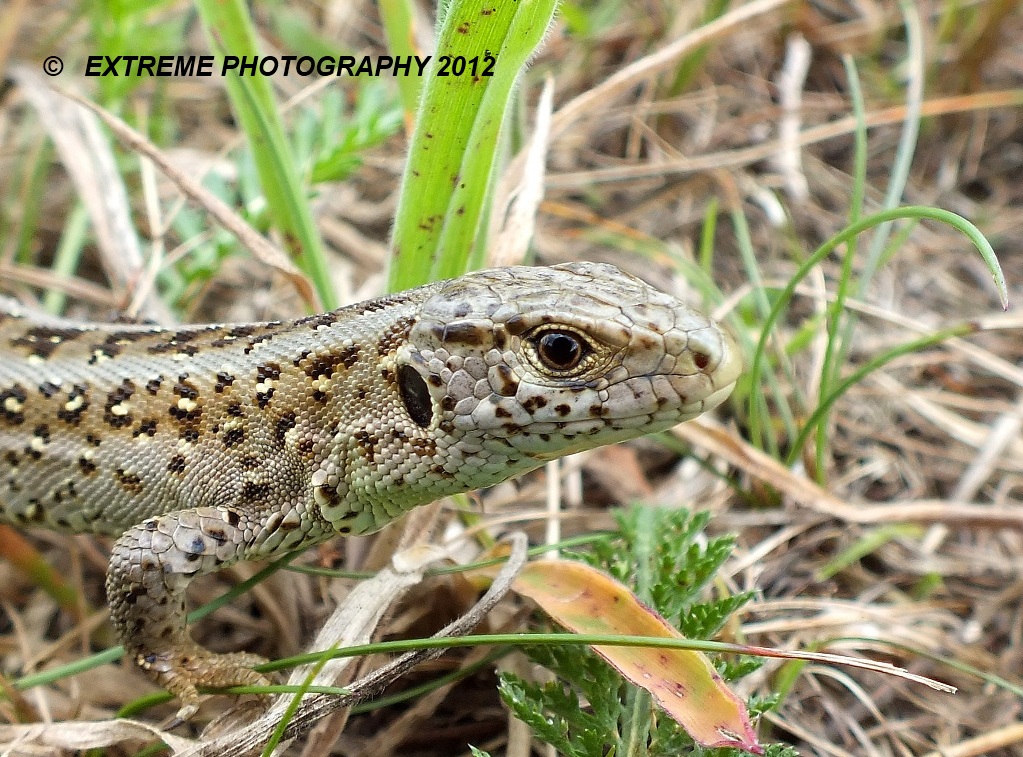
Our Extreme Photographer also sent us some pics from his uncle's garden. Wish we had something similar wandering around on our lawn! 


Where to next? Frank is going to the vets for his op tomorrow and we'll meet up with some friends once he's been dropped off with them and hopefully we'll see something of interest while we're with them.
In the meantime let us know what's scuttling around on your lawn.