Friday, 13 September 2013

Appreciating appreciation

The Safari is now wondering what you're wondering what on earth we're on about. Does that make sense?
Anyway it started with an email conversation with LMcR in which we said that saving the world is a serious business but we've all got to have fun doing it and sharing it. From there on the drive home we got to thinking about what exactly appreciation of the natural world is...oh ohhh we diving into the dodgy realms of philosophy...
Let's start with the sunrise we witnessed - gorgeous intense colours and splendid patterns in the clouds we couldn't help but stop and stare for a few minutes and who wouldn't, we really appreciated it. But what of the other folk around at that time did they see it and if they did did they take note and if they did was that enough for 'appreciation'? Appreciation is a weird thing; the Hedgehog we had a fleeting glimpse of made us give a little smile of appreciation. So why do we appreciate things and others not, the Hedgie is easy, there's a little reward of having seen something most people don't see - is that elitist? But the sunrise everyone can see, it happens everyday, it doesn't do anything to or for you or does it and if so what is that thing?
All getting a bit more weirder by the minute!!!
No wildlife news today, yes we were looking so no we didn't see anything to put in the note book.
Fun is what started this and not being too serious. Not wildlife this time but music...you shouldn't be too serious in the music business like the wildlife business, so here's a bit of local musical fun.
At 3.00 mins you can see our work in the background.


Then they go all up-market

Sadly their gig at the Big Park's bandstand this coming Sunday has been cancelled due to impending weather that could be useful for Leach's Petrels later in the week...no later than Wednesday please.
Where to next? Mothy is on for possibly the last but maybe the penultimate time this year...can't pot moths with a dirty great plaster cast on your right arm! And there may well be the first vis migging session of the season in the morning too.
In the meantime let us know what you've appreciated and why/how in your outback

Thursday, 12 September 2013

Perfectly poor

The Safari took Frank out this morning just as the sun was dawning. The low sun positively glowed making it look like everything was bathed in fire. A Hedgehog was a real surprise and very welcome too, missed by Frank hehehehe. By the time he'd done wot a dog has to do and we got back inside and wrangled the camera from its bag we'd missed the best of the sunrise; the red ripples weren't so defined by now.
We got to Patch 2 and it was absolutely mint, barely a ripple, hardly any swell and excellent light. Just a shame there wasn't anything out there apart from about 750 Common Scoters.
The tide hadn't quite covered the beach at lunchtime and 30 Sandwich Terns were persistent in trying to roost being washed off every few minutes and quickly running out of room. Several more were out to sea but there wasn't anything else of note.
After work we had our usual monthly site visit to find out if we do still have Water Voles and/or Grass Snakes in town.
The vegetation has really grown and getting in to the site is tricky and full of prickly trip hazards. However there are rewards, the Purple Loosetrife was spectacular even though it's going past its best now and the clash of bight yellow Toadflax really brightened the place up on a gloomy afternoon.
Also prevalent were spiders there were thousands of them everywhere but we only saw one of these green ones. It's Araneus quadratus, normally we see them when they are browner.
Most were the much more common and should be familiar to everyone at this time of year Garden Cross Spider.
No sign of our intended as ever...maybe one day!!
Where to next? Patch 2 has to produce something one day we just hope it's tomorrow!
In the meantime let us know who's hanging around in your outback.


Tuesday, 10 September 2013

Rubbish wind

The Safari had too much wind from the wrong direction today, consequently Patch 2 was pretty much rubbish with barely a bird or anything else seen.
Later in the morning we were able to get down onto the beach and have a look at what the tide had brought in. Disappointingly little after yesterday's good strand-line.
We prodded the largest clump of Bladderwrack with  our welly and saw there were several Idotea balticas lurking in its midst, including some small ones which we think may be juveniles but don't quote us on that!
A little further along we came across something we never like to see, a small but very dead Lesser Spotted Catshark, it will be scavenged and won't totally go to waste.
A lump of 'stuff' caught our eye but what type of stuff is it exactly - not totally sure but Sea Chervil, a Bryozoan colonial animal is what we think it is and quite a big colony at that.
Walking back to the office along the foot of the wall we looked for Grey Top Shells, a really scarce shell here - naturally we didn't find one; if anyone does find one would they be so kind as to keep it for us to put in our schools specimens box please.
Instead while we were looking for small things we found this little chap which we weren't positive about.
 We hoped it was something a bit exciting but DB told us it was 'just' a very tiny Edible Whelk.
As we were leaving work different DB popped by to show us some interesting finds from his recent trip to South Wales. First out of his bag a bird's beak, hmmm not sure about that one - a Manx Shearwater, thought they were shorter than that! Next out we recognised Harbour Porpoise vertebrae, then a real whopper of a vertebra - we mis-identified it as a small whale, Pilot Whale? - wrong - a bit bigger from a Minke Whale - impressive piece of bonery!
While we were chatter a flash of white caught our attention over on the big pergola thingy. A small brown bird was sat up on the top and through his bins DB was able to confirm its identity as a Wheatear. How rare are they in the works garden! Usually there's far too many dog walkers and we don't ever see them.
It hopped back down onto the ground out of sight and gave us the opportunity to sneak up on it with the camera.
All told a poor day turned out all right in the end - isn't wildlife wonderful!
Where to next? More Patch 2 stuff and with a change in the wind anything (or nothing) might be out there.
In the meantime let us know what's flashing its white bits in your outback.
Right, we're off now - small matter of an England match to watch.

Monday, 9 September 2013

The seasons do changeth

The Safari saw our as many Wheatears on the seawall at Patch 2 this morning as we saw all other birds on the sea. A grand total of one of each the aforementioned Wheatear bringing our Patch 2 total to 74 and a solitary juvenile gull on the sea. 
It took a while before anything else showed itself, four Cormorants flew north not too far out and a Sandwich Tern appeared to break the monotony.
We now know our Asian 'friends' have totally stripped all the Mussels from the outfall pipe as there's been no sign of them climbing all over it collecting them for several low tides. Musta taken them all leaving nothing for the birds and fish all winter - thanks a bunch!
Lunchtime wasn't a lot better but at least there was some activity to enjoy. Half a dozen Gannets swirled round but only dived very occasionally. The 10 or so Sandwich Terns seemed to having more success.
Stars of the session were the two individual Red Throated Divers the first we've seen since the spring which confirmed the seasons are on the turn and the chill of winter isn't too far away.
Back at Base Camp after work we took Frank out and heard a Willow/Chiff hweeting from somewhere around the back gardens of the nearby houses. Another one was heard near Magpie Wood and when it was pished out it turned out to be a yellowy juvenile Willow Warbler. 
Nothing else was found during our hour out with his nibs...he's definitely getting fitter and wanting to be much more active.
Where to next? More Patch 2y stuff tomorrow and we might be able to get on the beach for a look at the strand-line, there was plenty of seaweed washed up this morning so there might be something of interest.
In the meantime let us know what's diving around in your outback.

Sunday, 8 September 2013

Will(ow) we see the Yank?

The Safari picked up AB early mid-morning and set off down the motorway to a site we've not been to for at least 15 years. An hour later we stepped out of the Land Rover only to see another local birder EP walking down the lakeside path, she'd come by public transport which must have been brave on a Sunday morning.
Our quarry was an American duck that had been reported as 'well in moult' earlier in the week so it could only have been a matter of time as it can't go anywhere. The only worry was that there was going to be hundreds of Tufted Ducks to work through, or that it would be a long walk round and too much for Frank but he came good and enjoyed the longest walk he's done for quite a while, with hundreds of sniffing stops and plenty of other dogs to meet and greet he had a great time.
When we reached the general area it was a relief to see here weren't too many Tufties and no sooner had AB got his scope up he found it! Lesser Scaup (176)  in the bag.
Quite distinctive when compared to the male Tufties.
It drifted a round with them and at one point came very close being the nearest bird to us; tales had been told of it coming to bread but AB was unable to tempt it with the crusts off his butties, indeed when he approached the water's edge it turned and paddled out in to the lake.
Fortunately we avoided the downpours which was good cos we didn't have our waterproofs with us, but the light was generally poor. In between looking through the ducks we spotted a couple of Migrant Hawker dragonflies whizzing about overhead in the gap between the trees.
Ooohhhh look at the loverly vermiculations on that!
Once we'd filled our boots with the Lesser Scaup and scanned the rest of the lake, only Great Crested Grebes - lots of them - of any note we returned to the car park area, passing a family of Chiffchaffs on the way,  and went on to the feeding station hide where activity was hectic.
There were Blue Tits, Great Tits, Greenfinches and Chaffinches darting in and out of the cover on to the feeders everywhere but we missed the target species AB pointed out as soon as we entered the hide. Closer observation revealed Robins and Dunnocks including some young juveniles. At one point over 10 Greenfinches were on one table together!  Eventually male Bullfinch put in an appearance. The white 'tooth'-like thingy is a moulting tertial feather.
Rain  was lashing down in heavy showers, under the trees the light was awful.
A family of Stock Doves came in and vied with the Magpies for title of the 'Messiest eaters'.
It took a while but our hoped for species did appear. It darted in to the furthest table from us, grabbed a seed and darted out again...getting a pic was going to be tricky. It came in a few more times before we got the camera anywhere near it. when we did connect the results weren't brilliant but at least another earlier in the year dip was made good with Willow Tit now in the bag (177).
A look at the wader scrape only gave us a decent flock of Lapwings a couple of hundred strong with plenty of youngsters in it. The passing showers didn't drop the Black Tern we  hoped one of them might, in fact they didn't drop anything at all!
All to soon it was time to leave but we can guarantee it won't be 15 years before we're back - probably less than 15 weeks...hand permitting.
Where to next? Back to the joys of Patch 2 tomorrow where there are still target birds to be found before they disappear until next spring.
In the meantime let us know who's got the brightest waistcoat in your outback.
LATE EDIT - Two dead Badgers on the motorway verge today, very very seldom do we see those on this stretch of road. One was on the M55 only the second we've seen in 22 years of driving up and down that 15 mile stretch of road - coincidence????? The other was just south of the Leyland junction (28).

Saturday, 7 September 2013

A bit wet out there

The Safari has a request for you, there's something to think about and respond to from our lovely 'friends' at Defra. Here's a starter for 10...someone wants to build something on an Ancient Woodland. This is woodland that has been around since 1600AD and probably long before that so we'll give it an arbitrary age of 500 years. How would you go about 'offsetting' its destruction? Simple answer is you can't - how can you possibly replace the seed bank or the fungal associations in the soil. Maybe the developer should have to pay for a a team of ecologists and estate workers at the replacement site, cos that what they'll do knock over a hundred mature trees and associated habitat and plant 200 whips in a field nearby...but if they then had to pay for the team to look after and monitor it so that it did become Ancient Woodland, lets say £100,000/year in staff and material costs index linked at say 5% for 500 years paid upfront to an existing conservation organisation (no forming of sub-contractor companies like the jokers that manage Magpie Wood and it's surrounds) that's what I would call a sensible replacement to ensure an adequate outcome.
And just exactly would you offset in the marine environment, can you build Guillemot nesting cliffs, how long does it take for the seabed to recover after a Scallop dredger's ripped the habitat to shreds?
We've seen several examples of 'mitigation' locally and none have worked particularly well.
So get your thinking caps on and let them know. If no-one responds they'll think it's a great idea and rattle on with the destruction of what's left of our fantastic habitats and their amazing wildlife.
Talking of our amazing wildlife there was no chance of getting the mothy out last night bur instead of having a lie in we headed out to Chat Alley just after 06.00 to see if anything had been dropped on the cliffs by the overnight weather, we weren't too hopeful as it had been too bad for most of the night so probably not much was on the move.
Arriving at the top of the cliffs there were hundreds of Garden Snails making their way home after a heavy Blackpool Friday night of over-indulgence of the green kind.
We soon found a Swallow and then a couple more before it started raining...and boy did it rain heavy!
With the rain lashing down we decided to cut our full walk short at the highest point on the cliff and it was here we found a juvenile Wheatear trying its best to shelter in the lee of the steep steps that make their way down to the lower level. We also had a couple of Pied Wagtails flitting on and off the fence alongside the top patch - juts dropped by the onset of the rain?
The rain eased a little as we turned round but now each rain drop driven by the wind was stingingly cold through our soaked trousers, really felt like a proper winter's morning. And we seriously need to re-waterproof the not-so-waterprooof coat after it's been hanging unused on the highest hook in the hall for a couple of months.
Another Pied Wagtail went overhead and a couple or Swallows were hawking tight close to the cliff edge. That was the sum total of our soaking until we got the very end where we had another, or perhaps the same, Wheatear.
We gave up but had half a mind to nip up to our Vis Mig point on the railway bridge at the North Blackpool Pond Trail but seeing the enormity of the approaching band of black we thought better of it and went back to Base Camp for a warming mug of tea and loads of toast!
Here's some young gulls we phone-cammed earlier in the week
After a load of household duties we got out again for an hour or so after we heard from AB that he'd seen a Stonechat from his upstairs window away in the distance, ever hopeful Chat Alley would produce something a bit special.
As soon as we arrived we found a Wheatear but it was immediately flushed by a dog walker.
The weather was still dire, mid afternoon and almost twilight but at least we avoided another soaking.
The gulls provided some nice photo opportunities and well we just can't resist them...
 In between the gulls we saw a couple of Redshanks, one of which had an itch to scratch.
Back to the gulls
The sky was seriously moody at times
At other times the sun came out and the sky turned a pure azure
At the end of our route we saw another Wheatear as a family approached, we they push it towards us or would it flit up to the top of the cliff...b*gger the latter happened!
Not to worry we saw several more on the way back, at least five in all it was hard to keep a track of them as they passed us and we overtook them back.
A sharp shower just missed us but in the gloom we found a Pied Wagtail sheltering among the rocks.
A bit too dark!
Back to the stars of the show
Still a bit dark!


At last we managed to sneak up on one, still watched us like a hawk but allowed a single press of the shutter before it darted over the edge of the cliff.
We got much more safari-ing in than we thought we would today, so we're happy enough.
Where to next? Got a safari to just about the furthest south-easterly region of Safari-land tomorrow on the trail of a couple of species we've already dipped once this year - will it be a successful day or will it be another bad dip?
In the meantime let us know if you successfully dodged the wet stuff in your outback.
 

Thursday, 5 September 2013

When is a grass not a grass

The Safari isn't referring to snitches in the classroom or police informants, all will be revealed a few lines down the page.
We'll start proceedings with the Sandwich Tern pics from yesterday.
Coulda done with getting a few yards nearer before the incoming tide washed them into the air.
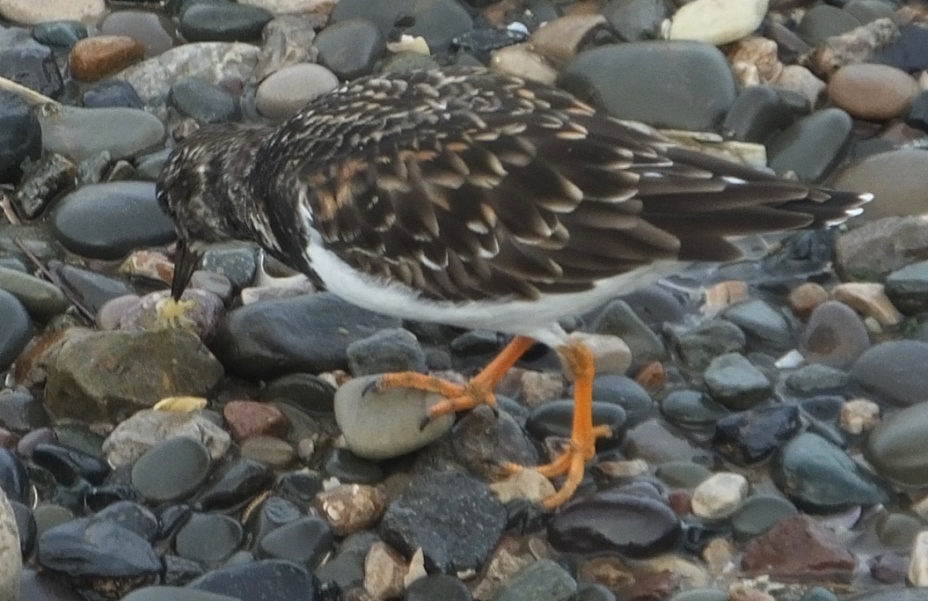
Nippin off the beach quickly up the slipway before we got our feet wet we saw a couple of Turnstones, just about the first of the season, turning stones at the bottom of the wall below us.
Not sure what this one has picked up, a bit blurred cos it was eating and walking at the same time and it was a bit dark under the wall.
We had a short seawatch but little was happening other than a similar number of Sandwich Terns as we had yesterday roosting on the beach. A bit of Swallow migration, 21 of them, was noted with a few Grey Wagtails going over too.
Young Un AB came round and we started to remove yet more 3-spined Sticklebacks from the pond, in the end we got about about 150!!! But saw no sign of the Koi Carp some numpty has 'donated ' to eco-pond.
In between bouts of de-stickling we did a bit of gardening in the wildlife area where we found a few items of interest including this unknown beetle.
Eagle-eyed AB spotted a Red Admiral hanging under a low window ledge which had just emerged from its pupil case - not seen many of those so far this year.
Big camera
Phone camera
A fresh Angle Shades moth was found lurking in the Spear Thistles we were taking out as they have gone over and the Goldfinches have already eaten most of the seeds. A Silver Y was also found hiding in the depths of the vegetation. Butterflies were represented by Small Whites and a Small Tortoiseshell.
Once we'd finished work we dropped AB off at home and he showed us his impressive collection of caterpillars he's growing on including some rather large Buff Tips and dapper Coxcomb Prominents.
His garden is a moth haven and he's already had over a third of the British species of butterflies even though he's only lived there a couple of months.
At the far end there is a (Japanese) Privet hedge which held a gigantic Garden Cross Spider which was wrapping up an unfortunate fresh looking Small Tortoiseshell.
The grass we referred to in the title is nothing like a grass, it has a big showy white flower.; it is of course Grass of Parnassus.
Another species we've not seen for a fair number of years but to be fair we've not really been out looking for it.
Where to next? Anything could happen tomorrow, probably on Patch 2; we wouldn't say no to  a bit of vis and we could do with catching up with some of the Curlew Sandpipers that have been gracing various shorelines up and down the country.
In the meantime let us know what's emerging in glorious technicolour in your outback.