Wednesday, 14 January 2015

Back on the beach at last

The Safari was able to get a few minutes down on the sands at lunchtime today. It was one of the highest low tides of the year and time was short before the incoming waters covered the beach again.
We had a target in mind but there wasn't much of anything about other than the larger than normal numbers of Common Otter Shells.
Other shells we found were a few Iceland Cyprines
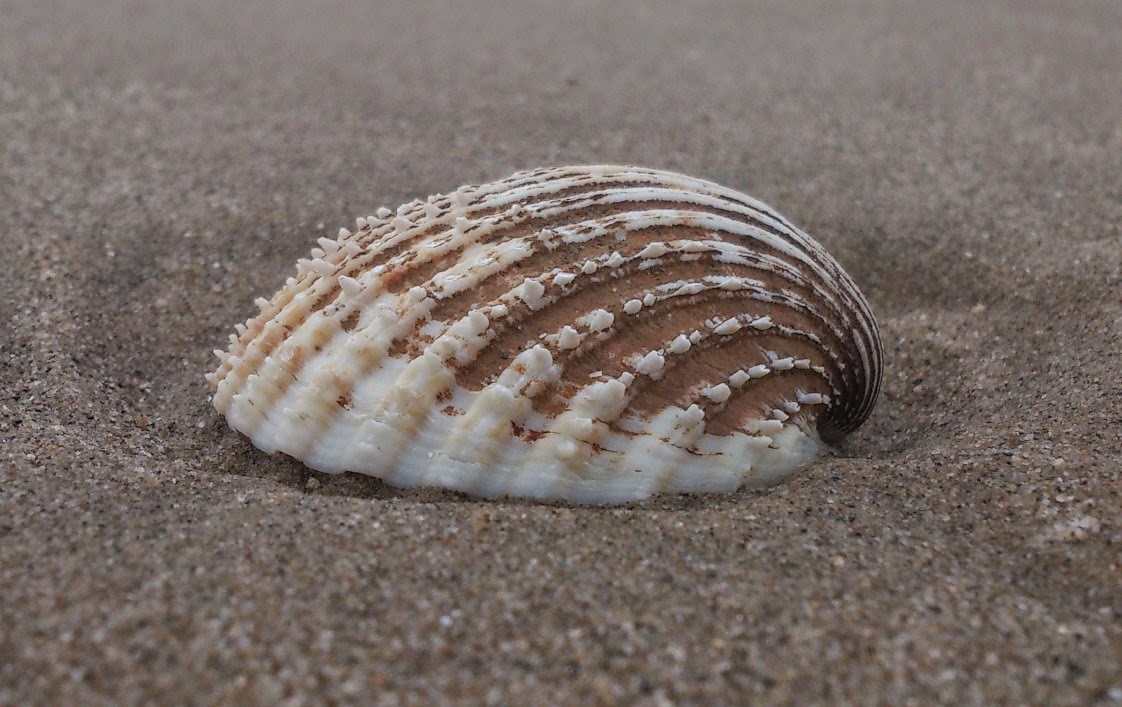
Lots of Prickly Cockles
and we found just singles of Tower Shell
and a gorgeous ?Queen Scallop
A large well worn Native Oyster was a nice surprise, been in the sea a long time. About 15cm long
Bits of seaweed lined the tideline, mostly Spiral Wrack with some strands of Egg Wrack mixed in.
Quite a few birds were on the beach including Patch 2's first Turnstones (P2 #17) and Ringed Plover (P2 #18) which might be somewhere behind the Black Headed Gulls in the pic amongst the Oystercatchers, there were about 30 unapproachable Redshanks too.
By eck it was cold out there! And we didn't find hardly any of our quarry - beach coal for the fire, we thought ther'd be loads after the storms but we only found a couple of bits other than this huge piece which wouldn't fit in Little Bertha. Its about 40cm long and 10 thick
Where to next? Might be back out there on the blustery chilly sands again looking to see what tonight's stormy tide has brought in
In the meantime let us know who's chilling out on the sands in your outback.


Sunday, 11 January 2015

Having a lark at the shore

The Safari was out at lunchtime as is usual on a Sunday - we can't get out any earlier - and our first port of call was to pick up BD in the town centre before turning the Land Rover round and heading north.
As we pulled into the car park there was a bloke scoping our quarry in the space between two vans - good job we hadn't sped in to the parking spot as we only saw him at the last minute and could have squished him!
Still he was decent enough to point out that amongst the dozen or so Turnstones (82) was the gorgeousness that is the long staying Shore Lark (83). We still haven't got a decent close up pic of it but do we really need to it's enough just to keep popping up here to enjoy it and long may it continue to stay - we could come everyday and still not get tired of seeing it.
Before we could get all the kit including camera out of the Land Rover a flippin dog walker flushed it over on to the beach. Off went to have a look for it. The wind the other side of the low dunes was fierce and cold, holding the bins still enough to see anything was tricky!
We tried our best but couldn't find it but did see a good number of Ringed Plovers hunkered well down behind the beach pebbles.

Two ladies arrived scopes in hand and asked if we'd seen the Shore Lark - we hadn't but all was not lost as after about five minutes searching B called out he'd got it and gave us rock by rock directions to it. Our ladies were well happy as their scope views were pretty good.
After a good look at the lark and enjoying some Turnstones also hunkered down with the plovers and a couple of Sanderlings working the incoming tide we had a quick look out to sea but the visibility was shocking so back to the car park it was.
And there was the Shore Lark, back on the grass with some more Turnstones...who'd have thunk it.
Our next stop was just along the way at the still drained marine lake where a number of gulls were roosting including two Great Black Backs. OK gulls are great but they weren't our main target here, that was somewhere in amongst the ranked masses of Redshanks and Turnstones. We couldn't see it at first and had to leave the shelter of the shelter and wander further along the bank of the lake to get a better angle 'round the corner' of the island where the roosting flock continued.
And amongst that flock was the smaller, darker form of one of the Purple Sandpipers (84). Not the best views as it had its back to us and its head under its wing fast asleep.
From there it was off to the nearby nature park (aka dog walking hell-hole) where not unsurprisingly we saw no other naturalists and shed loads of dog walkers - good job we had a dog with us then isn't it! The prime purpose of our visit here was to check out the pools and shed roofs for any out of the ordinary gulls. There were plenty of 'ordinary' gulls but no out-of-the-ordinary gulls, most of the gulls were flying around rather than roosting on the roof where it might have been a bit windy for them. 
A flock of small birds landed on the far side of the accessible pool and we sent B round to get a look/pic at them but somehow they'd vanished by the time he got round there - neither of us saw them fly off but they weren't there! They could have Linnets but there could have been a Twite or two with them or vise versa.
It was cruelly cold out there and once the gulls had decided not to give up their secrets we headed off elsewhere...the nature reserve to be precise. But we had a plan...we took BD the long way round to the waste depot with the Iceland Gull, the depot had just closed there were workers' vans about to leave and the machine was parked up in the shed making for zero gulls loafing around on the roof.
If there were any gulls on the mere they weren't in front of the FBC Hide, indeed very little was there.
There were a few Teal tucked against the reeds, still displaying despite the strong cold wind and driving rain, and  a few Coots, toughing it out on the open water. Across on the island were a handful of Cormorants, one really strikingly white headed, a some Mallards, the drakes now looking very dapper in their breeding finery.
In the reeds behind the island a Reed Bunting (MMLNR #46) dropped to roost and in an Apple tree beyond that at least 18 Magpies gathered before moving on to their main roost in the zoo.
And then the weather was too much for the pair of us and called it a day. Not the best day's safari-ing we've ever had but it wasn't all that bad  in the end, was it?
Where to next? Back to Patch 2 to see what the storms might have brought  in.
In the meantime let us know who's got their head down in your outback.

Saturday, 10 January 2015

Not sure if this counts as a dip

The Safari was worried that our fish would be blown out of the pond in the stormy gale last night - crikey it was fierce at times.
Shortly after lunch we were able to nip out to the nature reserve to look for the recent Firecrest. The walk across the field gave us a Fieldfare that was flying over being seriously buffeted by the still strong wind before it landed in the top of one of the Apple trees.
Once at the viewing platform we set about looking low through the low Brambles. In the ferocious wind we weren't overly hopeful but a movement in the 'wrong' direction gave us a Robin poking around amongst the leaflet and lowermost branches.
It was then we noticed that there were a good number of Bluebells starting to show some more than just starting to show too.
Another movement a little higher up this time got our juices flowing but it turned into a Goldcrest rather than the preferred Firecrest...not that there's anything wrong with Goldcrests they're lovely.
Once it had disappeared BD arrived so now there were two pairs of eyes looking.
Both the Robin and the Goldcrest reappeared but not the wanted Firecrest.
We had a look across the water and immediately picked up a Great Crested Grebe (MMLNR #42). Lots of Black Headed Gulls came through but there weren't many larger gulls with them and no sign of the Iceland Gull. A smaller bird near a female Goldeneye was sailing away from us but we knew it was a year bird, a Little Grebe (79, MMLNR #43). 
Out on the water the flotilla of Canada Geese still held the dubious Barnacle Goose which was a totally new bird for B although being totally dubious it won't be going on our year list.
We had a wander down to the see if any Long Eared Owls were showing, maybe not in the horrid weather - a hail storm just blew over but thankfully we were still under the cover of the trees. Yes the usual one was in its usual place but as usual only its body was visible and not its beautiful amber eyes.
It was a bit raw stood there out in the elements so back under cover for another look for the Firecrest we went. We had a quick shuffy at a different part of the reserve just in case but again without success although a Woodcock (80, MMLNR #44) was disturbed by something unseen.
Time to cut our losses and leave before more weather arrived, that meant walking back into the biting wind but it did give us the flock of Linnets (81, MMLNR #45) looking for somewhere sheltered to roost.
Just a couple of hours out in the weather but better out than in we say.
Where to next? We'll be out on safari again tomorrow probably somewhere northward.
In the meantime let us know who the imposter is in your outback.


Thursday, 8 January 2015

Little time for much at all

The Safari's attempts at wildlifing have been seriously compromised by the weather, the tide and work.
High tides in the middle of the day combined with heavy rain at times and strong winds have meant that our regular watch point on the wall has been a wash out this week.
This morning we did manage a few minutes at low tide. Not a great deal to report, the sea was very quiet but the beach held about 100 Oystercatchers, a handful of Redshanks (P2 #15) and 13 Sanderlings (77, P2 14).
A trip in to the town centre for a meeting had us looking out of the top floor window while we were waiting for the facilitator to arrive gave us a couple of Pied Wagtails (78) flitting over the roof tops and really good flight views of the gulls as they wheeled around the buildings at or below eye-level - good job we don't work there probably wouldn't get much done!
Gives a little flavour of how wet we could get if we were foolish enough to stand in the wrong place...ie just about anywhere really!
Where to nest? Could be a tad windy tomorrow but the visibility could be better over the sea so here's hoping for a wind-blown something or other. 
In the meantime let us know who's getting wet in your outback.


Tuesday, 6 January 2015

Choppy seas not good for seeing

The Safari was back to work after the Christmas break yesterday and greeted as we arrived by a bit of a  sunrise which looked as though it was going to deliver more than it did in the end.
Those con trails really pee us off - the sky would look so much better without them they're just 'wrong'
We were unable to get out for a Patch 2 look-see until lunchtime by which time the tide was almost full and the sea quite choppy in the stiff onshore breeze.
There were a lot of Common Scoters (74) out there, easily 2000 almost all flying north in big groups but not a lot else other than Common Gulls and a few Cormorants. Eventually we found a Red Throated Diver (75) flying between the troughs.
A pair of Great Black Backed Gulls came by and a younger bird further out, then bird of the day appeared out off the gloom an adult Kittiwake (76) moments before we were about to leave.
The drive back to Base Camp along the prom in a miserable dusk chad us watching the piers and not the road as first at least 7500 Starlings out on a cracking display at Central Pier followed by a less active 5000 more at North Pier with more arriving overhead.
This morning the rain came down and again we didn't get an early look over the wall.
By lunchtime the weather had improved but the wind was more brisk than yesterday and the waves were coming over the wall and got us smack in the face a couple of times so we didn't stay out long!
Nothing new for the year was added today, the first 'blank' day of many many more no doubt. Not totally blank as we did add a few more very common birds to the Patch 2 list like Blackbird and Feral Pigeon, our Patch 2 list has now reached the giddy height of 13 species.
As we left the office we saw that there were quiet a few more Daffodils in flower than before the holiday.
Apologies for the poor pic taken in the almost dark.
Tonight there was a sunset on the drive back to Base Camp and we were hopeful of a good Starling murmuration or two but there were very few swarming over Central Pier and none at North Pier at all; possibly the lighter evening meant they were staying out in the fields feeding later.
Where to next? All to play for tomorrow on Patch 2 before some serious wind sets in for the rest of the week.
In the meantime let us know who's swarming or not in your outback


Sunday, 4 January 2015

Last days of the hols

The Safari had a great trip up north with CR and his mate, Other Dave, yesterday. We had a few hours at the big RSPB reserve starting at the saltmarshes. Here there was a good sized flock of Lapwings of which only a small part in the pic.
A Spotted Redshank (48) was pick of the bunch slightly outdoing a distant Greenshank (51) in our desirability 'rankings'.
At the main part of the reserve we scoped a Jack Snipe (53) on the far bank which was flushed by a normal Snipe which wanted to sit on the same patch of ground just cos it was bigger before we could get the other two on to it. This Snipe is a different and much nearer one.
A Marsh Harrier (54) soared over the reed tops giving fine views.
Moving on to the more distant hides we passed these enchanting fungi growing on a fallen log. No idea what they are - there don't seem to be many fungi this season, at least not in these parts.
 We got to the furthest hide to be greeted by this beaut, a lovely yearling Red Deer.
Although distant he was aware of us quietly opening the windows.
After a few minutes a Heron strode up to him/her.
A male Bearded Tit appeared at the reed edge and flew from the far side of the pool right past the hide but again we weren't quick enough to get the gang on to it.Right at the farthest part of the reserve there were no Otters or Bitterns, very little other than an arty Snipe and more views of the Marsh Harriers and a Rat/Water Vole scurrying in the grass below the hide, didn't get a good or long enough look at it. Looked/moved more voley than ratty but we wouldn't like to put money on it.
On the way back to Other Dave's we stopped at Foulshaw Moss - don't think we've been there before but may have done in the mid 80s. What a cracking site and we're sure we'll be back in the spring and summer when it bursts into life and the very distant Ospreys are on their nest.
A Stonechat (64) at the end of the boardwalk positively glowing in the evening sunshine was a nice bonus as was a reasonable sized flock of Fieldfare (65) on the drive out of the reserve.
Stunning misty scenery across the fields on the drive back to town made a perfect end to a perfect day.
A great day and many thanks to CR for the offer and OD for the company and superb local info.
Today we got out at lunchtime and decided to have another go at the local Great Grey Shrike. On the way we passed the Iceland Gull's favourite hangout, the recycling depot, but being Sunday the gates were locked up and there wasn't a single gull on the roof.
At the shrike site we saw some cars parked on the track but went round to the industrial estate, a mistake as it happened. We put the scope up and saw several folk getting very close views in the distance. At least we saw it but were unable to get any pics unlike the others who looked like they were filling their boots and SD cards. Ah well maybe next time but for now Great Grey Shrike (62) is on this years list. We lost sight of it when it flew to our left towards the road. In the far distance a hint of movement alerted our attention, flippin eck two Roe Deer.
Can you see it?
Quite close to the main road!
 Then we spotted a third way up on a mound of rubble that's been there for a few years.
From there we headed further south to the marine lake where we expected to find a Scaup or two or more. Frank was in his element with all the other doggies out on a Sunday afternoon which made walking round to the best place to see the ducks from very long winded. And then we couldn't find any! Nor could anyone else we spoke to, seems it/they had nipped back onto the river overnight.
Walking very slowly back to the Land Rover we spotted a Common Catsear just about in flower for the BSBI New Year Flower Hunt
Because Frank had been soooo slowwwww there wasn't enough time to execute Plan A going north to twitch the Shore Lark et al, so it was Plan B and the nature reserve. It just so happened we had to pas the waste depot again and this time there were cars parked up on the adjacent minor road and a machine working in the compound. looking good.
A couple of lads from Manchester kindly pointed out the Iceland Gull (69) as soon as we drew up. What a beaut it is although once again we didn't get any pics. It hung around as long as the machine was working, sometimes sat in view on the front edge of the roof and sometimes flying around the yard. behind us we heard the call of a Grey Wagtail (70) and spun round to see it land on the car show room roof.
At the nature reserve a Wren (71) was new for the year - hang on Iceland Gull on the list before Wren!!! Otherwise the reserve was quite quiet from the hide we were in.
A young lady came into the hide, fairly new to birding but copped a Jay which we only saw for a split second as it disappeared behind the branches to our right - not good enough views for a nature reserve year tick unfortunately.
Frank has his own seat now.
Shame he always looks the wrong way...the birds are Behind You as they say in Panto
As we left an hour and a half later we heard a Goldcrest (72) in the bushes near the hide. Blimey - when we got back to Base Camp we learned there was a Firecrest on site somewhere...WOW and about time too, hope it sticks!
A huge pink moon rising inch by inch over the eastern fells made another perfect end to a perfect day in the field.
There was more to come, passing the big lake we briefly got a glimpse of the Great Crested Grebe (73) sailing serenely across thee chilly water.
And so ends a long and very wildlife filled Christmas break.
Where to next? Ohhh you don't know how much Patch 2 beckons, hope we get some time out there and we hope it's as good as we imagine.
In the meantime let us know who's king of the hill in your outback.

Thursday, 1 January 2015

And so it begins again

The Safari missed out on a few real sitters last year and looking at our records we haven't seen a Hen Harrier or Short Eared Owl since 2012!
So how well (or otherwise) did we do on our various patches?
The overall year target was 200 (the same as always) and we achieve a somewhat meagre 179 just 89.5%. Patch 2 was very close to this 81 out of 90 = 90%, our trips to the nature reserve ended up fewer than we'd hoped and gave us 90 out of a perhaps too 'enthusiastic' a target or 120 = just 75% (We've pruned it to a round ton for this year). The garden came up trumps with a 'just over' 46/45. The garden list does have some serious absentees though reflecting perhaps we had no time off work due to operations at migration time compared to previous years and/or some local species are getting scarcer due to the habitat destruction in the name of tidying up in neighbouring gardens. 
Missing were Coal Tit, Dunlin, Great Black Backed Gull, Common Gull, House Martin, Kestrel, Lapwing, Mallard, Mistle Thrush, Rook, Sand Martin, Siskin, and Song Thrush; We will up our target to 50 this year.
Our first bird of the year was a Robin heard as soon as we opened the door to take Frank out before 06.00 quickly followed by Blackbirds on the grass verge along the main road.
With a huge rise in overnight temperatures to double figures the garden feeders were very quiet all morning. We only had singles of Robin, Greenfinch, Goldfinch and Blue Tit with fly-overs of Herring Gull, Feral Pigeon and Woodpigeon. All a bit of dead loss really.
After lunch we hit the well worn trail to the nature reserve, the weather could have been a bit better but hey-ho out n about is better than sitting in doin nowt and those waterproofs have to earn their keep. The drive past the big park lake gave us only the easy Coot, Tufted Duck and Black Headed Gulls through the steamed up side windows of the Land Rover.
We had a little plan to kick start the year list but the birds weren't forthcoming in the quickly deteriorating conditions. At our first site Meadow Pipits rather than Snipe, Jack Snipe (not seen last year) or Stonechats were the entry in the notebook.
Acting on information received we stopped at a different part of the scrub to look for two new Long Eared Owls in increasingly heavy rains, we weren't sure exactly which tree to look in and couldn't find them but it would seem there are at least four and possibly five on site now. Our informant also saw a Barn Owl at dawn.
With the rain getting even heavier and starting to get driven sideways by the increasing wind we made haste to the NW hide, one that seems to be ignored in favour of the viewing platform except by those who enjoy exceedingly strong lager and illicit substances but it was dry and 'warm' seeing how the wind wasn't blowing through the windows the hide being sheltered by the adjacent scrub from south - to south westerlies.
We broke out the scope and settled in for a long afternoon - in that rain we weren't going anywhere!
All the regular waterfowl fell to the notebook except Pochard which was here yesterday and the Little Grebe which apparently we'd just missed.
Like the waterfowl the gulls were predictable again except the Iceland Gull which we had hoped would put in an appearance as the waste depot it hangs around is shut today. Pick of the gulls was a darkish backed dirty headed 'argentatus' type. The lousy light making reading the 50 shades of grey much easier.
When the rain desisted for a few minutes we made a dash down the path to the 'usual' Long Eared Owls where one rather dishevilled one hunkered as deep as it could get in it's tree. On the way back we had another look for the elusive two but again without any joy.
There was some daylight left so a quick visit to the Feeding Station was made. The rain had kept everything away hunkered down out of the cold and wet and just a Blackbird, a pair of Pheasants and a pair of Moorhens mopping up any fallen bits. Eventually a Dunnock, a Great Tit, a Blue Tit and a Robin.
An alarm call broke the silence and in to view shot a Sparrowhawk which promptly perched up near the left hand feeders looking all menacing and surreptitious.
The light fell even more and a flock of Starlings came over, roosting on the pier not in 'our' reedbeds.
That was our cue to leave, once out of the hide and a few yards down the path a Shelduck came through the gloom from the north and looked like it may have landed on the water. A good bird to get at the nature reserve on Day 1!
By the time we got back to the Land Rover it was just about dark so no chance of spotting anything on the park lake as we passed on the way back to Base Camp.
So 33 species for the day, we're sure many  folks locally will have got at least double that but they'll all be there tomorrow and the next day so there's no rush and you see what you see and enjoy it when you do. There's far more to our safaris than just  our Year List Challenge...but only of we win!
Today was the first day of the BSBI's New Year Plant Hunt - we got in various places during the day Gorse (only to be expected), Dove's Foot Cranesbill, Daisy and Dandelion. Only the Gorse was at the nature reserve but given the weather we didn't look as hard as we might have done in better conditions.
Where to next? A family trip to the South-side is on the cards tomorrow, so there might be something new to see on the journey.
In the meantime let us know who's terribly dishevilled in your outback.