The Safari has been out n about over the last six weeks or more - Honest!!!
Late summer brought a minor flurry to our Photo Year List Challenge with a surprise early birthday present in the form of a Garganey on the somewhat incongruous site of Stanley Park lake, we would have expected it to be happier out in the wilds at nearby Marton Mere Nature Reserve but no it was quite happy with walkers, dogs, cyclists, joggers, fishermen within a few feet. Not a new species to add to our challenge tally but a high quality replacement for the distant duffer earlier in the year.
A couple of days later some promising rough weather had us down on the cliffs looking for seabirds. The conditions promised a lot more than they delivered but we did just about manage a pic of one of the handful of Common Scoters (PYLC 158) that were just about in range of the scope on 50x magnification and the phone at 2.5x making 125x altogether.
The weather died down and our 60th birthday jaunt with CR and the Scouse gang was looking good until the morning arrived and our plans had to change from going to the South Lakes to look for snakes and reptiles to bunking in half way at RSPB Leighton Moss -yep it was cold and wet! Yuk!
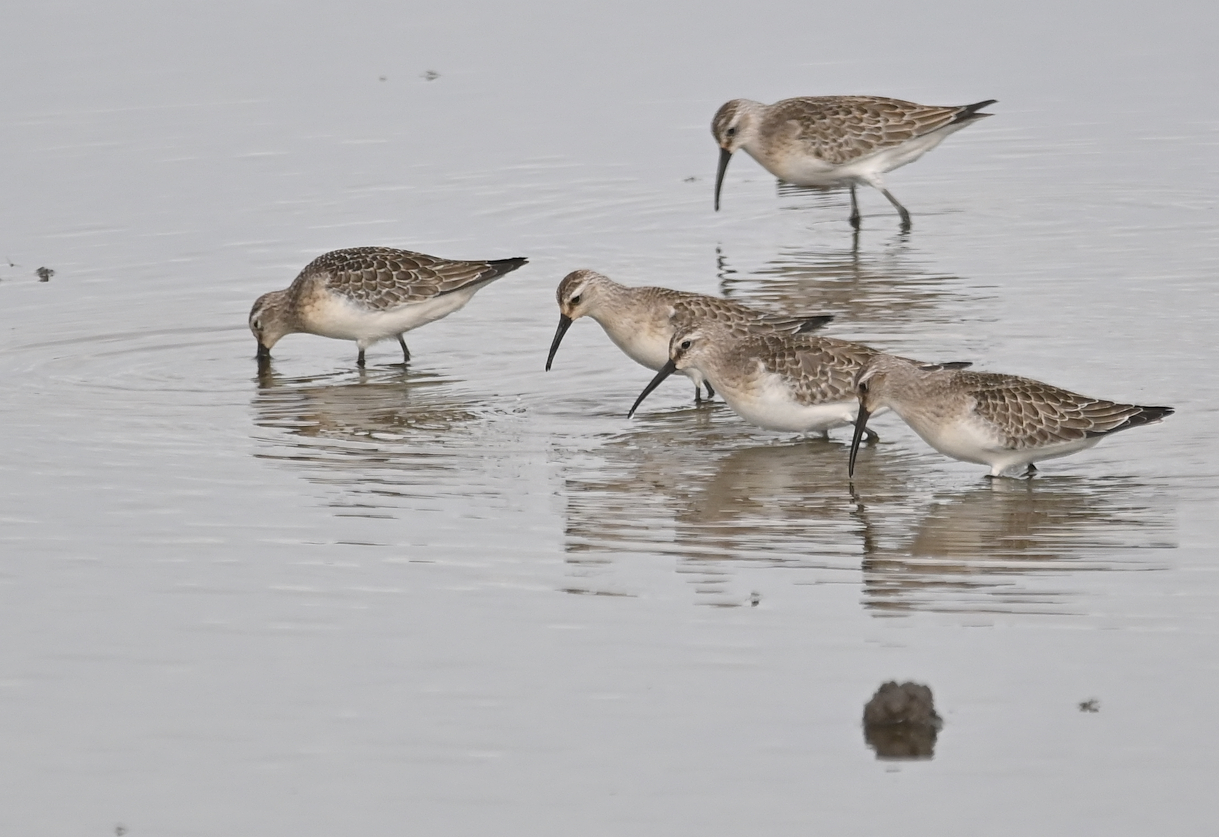
There was little on offer at the Allen Hide but just as we were thinking of upping sticks and moving on a small flock of small waders flew by, circled and flipped over the embankment on to the other pool. "Anyone else see that white rump?" we asked - Yep was the reply - - so off we all trotted tout suite to the Eric Morecambe Hide where we asked if anyone had seen the Curlew Sandpiper come in? No they hadn't but after a bit of searching we found one then another on the far bank.
 |
| Curlew Sandpiper (PYLC 159) |
The rest of our visit was spent dodging the rain and not seeing much at all with water levels after all the recent rain being a bit too high, still you'd have thought an Otter or an Osprey might have put in appearance. But never mind the lack of wildlife (there wasn't really a lack there was plenty to see just the 'specialities' didn't put on a show for us) it was still a great day out with great company and lots of laughs.
The following day saw us up Rossall Tower with the Wildlife Trust's Living Seas Team helping out with their monthly seawatch where it was a fairly quiet watch with just a couple of distant seals providing the mammalian action. A flock of Sandwich Terns flew by close enough for a few snaps and we got an improvement on our 'roosting a hell of a long way down the beach' shot earlier in the moth for our Challenge.
We really don't know why we struggle to get better pics of these as they're fairly common visitors to the coast here and often fish very close inshore.
September started with a bang when a couple of Fylde Bird Club stalwarts discovered an oddball Wheatear on the seawall near Pilling. Word on the street was it was a female Eastern Black Eared Wheatear but then doubt crept in, could it a female Pied Wheatear or even a hybrid???? It took a couple of days for us to be able to get the time to nip up the few miles taking CR with us. If it turned out to be the former former species it would be a British Isles Lifer for us, if not it was another good and unexpected bird for our Challenge.
When we arrived Leighton Moss's JC told us it was lurking under a rock and not looking that healthy so get a shimmy on! He was right it didn't look good at all.
But thankfully when the sun came out it perked up enough to leave it's roosting crevice and go foraging along the rocks defending the seawall.
There were several 'ordinary' Wheatears poking around the rocks too.
After a few days news broke that it was indeed a Black Eared Wheatear (PYLC 160) due to a tiny pale smudge being seen on a mantle feather showing in one of the hundreds of photos taken of the wandering stray.
Also present that day was a rather flighty juvenile
Cuckoo (PYLC 161).
From social media earlier in the spring we got the impression that Cuckoos were having a slightly better year compared to recent times but a quick look on Birdtrack shows they have been just about 'normal' this year with fewer reported in the second half of their short season. And that on the back of a major decline in recent years. For every one we see now there were four and five when we started birding - a sorry state of affairs for this iconic species. They need an upturn in their fortunes and quickly!
A sorry state of affairs for youngsters growing up having so few opportunities to hear them nowadays. With the State of Nature report showing an increasing lack of biodiversity in Britain we owe it to future generations that birds like the Cuckoo are not lost from our landscape and soundscape - that's if you can hear them above the noise of all the traffic pollution!
A few days later the weather had turned seriously for the worse again and that brought Leach's Petrels to our coast. We always look forward to seeing these tiny storm driven waifs but chatting to SD on one of the National hale & Dolphin Watches he said he'd actually rather not see them given weather and sea conditions they've have had to contend with to be spotted by land-bound birders and we totally get where he's coming from.
However out to the cliffs wrapped up in as many layers of waterproofs as we could muster we went. After an hour and a half of seeing nothing at all a dark speck briefly jinked over a wave - was it? Wasn't it? It was, out of a trough for a few seconds the little dark 2 oz scrap of feathers appeared before being lost in the tumult of the crashing waves again. No chance of a pic. But with the wind not letting up we got another chance with a visit to Rossall Point where we were lucky enough to get almost prolonged views of one as it came across the bay then dropped on to the sea for a rest in some sheltered slack water by the point before continuing on its way to the southern Atlantic.
 |
| Leach's Petrel (PYLC 162) |
From then on until we hit the sunny shores of Menorca in mid October we were unable to add any more birds to our Challenge tally.
Minutes after leaving the airport in the coach to our resort we picked up the first Red Kites, Egyptian Vultures and Booted Eagles of our holiday. All unphotographable as our camera was still stashed somewhere in the luggage.
We got to Cala Galdana, our temporary Base Camp for the next 10 days, around lunchtime and after a swift unpack we hit the beach - how good was it to get in the warm waters of the Med again although the water wasn't particularly clear as fierce thunderstorms had only just finished and a lot of floodwater had been torrenting down the hillsides combining with strong winds to make the water murky.
Still it didn't take long, a couple of minutes!, to find our first Audouin's Gull, or did it find us? Woodpigeons and Collared Doves poked around the tourists near the trees at the back of the beach and were to darker doves disappearing in to the tops of the pines and not seen again Turtle Doves?
The following morning we were on the beach before breakfast and found a couple of Audouin's Gulls on the prowl for left overs. They are a pretty gull, mus tbe the dark eye.
Like many gulls, they're not shy!
The
Yellow Legged Gulls however were shy and not pretty - must be that fierce looking pale eye.
Also in town were a handful of Bee Eaters but they were mostly frequenting the electricity cables that stretch high across the gorge so getting a pic without the 'hand of man' for the Challenge was tricky. For reasons of space and weight we'd only taken our 18-300mm lens and for these and some of the other species we came across the 150-600mm would have been a better choice.
we were told by other birders that they'd seen Blue Rock Thrush on the crags below the wires but despite lots of searching all week we never caight a glimpse of them.
One of the Target Species were the local Egyptian Vultures we seen in the barranco running north from Cala Galdana about 10 - 12 years ago on our last visit. We hoped they were still there. They were but we were getting up too early and the morning mists made spotting them on the distant crags very tricky. Towards the end of our stay we were able to get up the gorge in the afternoon when the mist was long gone and the birds more active even if still a long way off, especially for the 300mm lens. Heat haze now became the issue.
The Booted Eagles in the same valley were for some obscure reason very hard to get a decent pic of even though they were often nearer than the vultures and soared around a little closer and more slowly. Not sure how we failed to get pin sharp pics but we did.
Some mornings we walked through the woods to the neighbouring beach, Cala Maracella, where we came across numerous well hidden Sardinian Warblers and flushed this Hoopoe a couple of times from the side of the track before finally getting at least a hint of it on to the SD card after we'd followed it down a dark side track through the denser part of the oods early one morning.
An afternoon wander up to the barranco had us stopping to look mat the Bee Eaters again and in the bankside reeds along the oppostie side of the little river a movement caught our eye. There were two birds this one looked like a Reed Warbler but was maybe a bit richer in colour - could have been the Mediterranean light - and had orangy legs and was making all manner of odd calls we've never heard a Reed Warbler do so can only imagine it's probably a Marsh Warbler.
The other bird in the same bush turned out to be a
Chiffchaff and when that disappeared deep into the bush a small bird shot out and flew away over the reeds before dropping in which we thought was probably a
Fan Tailed Warbler but we'll never know for certain. We didn't see any others during our holiday.
One bird we did see frequently and were numerous up the gorge were Mediterranean Flycatchers.
They were tricky to get pics of for the Challenge as they often perched on man-made objects rather than the nearby trees and bushes, for example wire fences round the fields and the slide/climbing frame in the children's playground.
Even trickier were the ubiquitous Sardinian Warblers they just don't like to come out of deep cover at all. And when they do they're always against the light and constantly on the move.
A couple of days of car hire saw us on the road seeing the sights. One trip on a damp start and windy day took us up to the picturesque town/village of Fornells on the north coast where a lonely Shag was sat on a windswept rock. Thank goodness it allowed a fairly close approach as we'd totally failed to in frame in a very wavy Cala Maracella the previous day.
Back up the barranco we were having trouble photographing the local lizard catching Kestrel and both perched and soaring Booted Eagles when we saw this largish pale warbler skulking in a bush on the other side of the track.
Unsure of its identity we sent afew snaps to regular mainland Spain visitor AB who confirmed it as a Western Olivaceous Warbler, a World Lifer for us although we have seen the Eastern species in Greece.
Our final new bird photographed for the Challenge was probably the trickiest of them all. Seen daily and sometimes extremely well in lovely light but so so camera shy. As soon as we stopped and even thought about lifting the camera they were off, the only time they were anything like approachable was in the gloom of early morning. I give you one of the family of very twitchy Woodchat Shrikes. The extra reach of the 600mm would been a boon for this species.
All those goodies brought our Challenge tally up to 174.
It wasn't all birding after a slow tart we began to find numerous Italian Wall Lizards but totally forgot to look for snakes -how did we manage that???
Butterflies were numerous too especially Painted Ladies but with the warmth were flitting here and there very quickly but we did catch up with a couple of Clouded Yellows, a snazzily bright Iberian variety of our own Speckled Wood and most difficult of all the Long Tailed Blue.


Between refreshing dips in the hotel pool we spent an hour or so a couple of days watching the Hummingbird Hawkmoths going about their business.We took hundreds of pics and got about a dozen worth keeping. Here's a couple, have a look on our Flickr site (link on right) for the rest.


A Shieldbug type thingy was also lurking in one of the poolside flowerbeds.
The allure of Menorca are its fabulous coves and beaches and suffice to say we went snorkeling. Unfortunately the thunderstorms making the water murky wasn't conducive to underwater photography. Here's a couple grotty snaps - more should appear on our Flickr site in due course as we pull stills from the numerous video clips we took, there might even be some short videos for your delectation too.
 |
| Mixed fish |
 |
| Striped Sea Bream - these things nip if you stand still too long |
 |
Painted Comber - a fish that is both male and female at the same time
|
So that little lot brings us almost up to date, we hope you've enjoyed our Mediterranean musings.
Where to next? We've had a couple of local safaris since we got back to tell you about - if we remember to put finger to keyboard that is...apologies for gooing of fthe radar in recent weeks.
In the meantime let us know who's been soaring around your outback