Showing posts with label fox moth. Show all posts

Friday, 26 May 2017

To Botallack and back

The Safari has been away for a few days down to the far south west, just about as far south west as you can get. Since we've been back we've been on family duties with another terminal illness which ended with the inevitable conclusion yesterday. No matter how prepared you are it's still a shock to the system. Processing the holiday snaps and blogging has necessarily taken a bit of back seat. 
We went down to the Cornish tin mining village of Botallack in the heart of Poldark filming country, although he wasn't there at the time showing off his poor scything technique and 'his' mine is nowhere near there being half way between Helston and Falmouth. Cornish tin has been sought after since the Bronze Age over 4000 years ago and has its value led to the trade and immigration of people from all over Europe well into the Iron Age.
Most of what remains around Botallack is late 18th and 19th Century workings.
We were hoping to get several year birds and a good few pics for our Year Bird Photo Challenge but the weather conspired against us despite the sunny sunshine in the pic above, that was the exception rather than the norm. The norm looked more like this...
It doesn't look too bad in the village but out on the cliffs you couldn't see down to the sea much of the time. And when you could the light was very poor.
We did manage to add Fulmar (158) and Shag (159) to our  year list and we were very lucky to be alerted to the presence of a very swift Hobby (160) hurtling over the garden of our cottage by the alarm calls of the local Swallows.
Breaks in the weather enabled us to get very distant and grotty pics of
Fulmar (YBC #129)
Gannet (YBC #130)
Kittiwake (YBC #131)
 and
Manx  Shearwater (YBC #132)
We also go an awful pic of a House Martin (YBC #133) which we had to replace once back in Lancashire with a much better effort which at least shows their lovely blue sheen and white rump - the original didn't!
A couple of sunny days at the end of our week had us on the cliffs looking singularly unsuccessfully for Adders, which the locals repeatedly warned us about particularly with respect to sniffer here-there-and everwhere-Monty, we didn't even find a Common Lizard!
The wildflowers were good though with Bluebells still in good fettle, Red Campion coming through, the Gorse was a blaze of yellow and the scent of Coconuts from it was heady. Sea Campion and Thift were also in bloom.
One of the Gorse bushes was covered in the thin strands of the parasitic plant Common Dodder. unfortunately we were a couple of months too early to see the small white flowers.
 Birds up on the cliffs included a pair or two of Ravens
Innumerable Jackdaws our best views of sky diving Choughs - ever - - by a mile, but we had the wrong camera with us and nesting Fulmars.
Raptors were represented by a Peregrine Kestrels
A very foggy hour saw a loose flock of about 25 Swifts and a few Swallows going south hugging the edge of the cliff.

Also out there were a few Linnets and a family of very unapproachable Stonechats

Doh - right at the limit of the macro lens
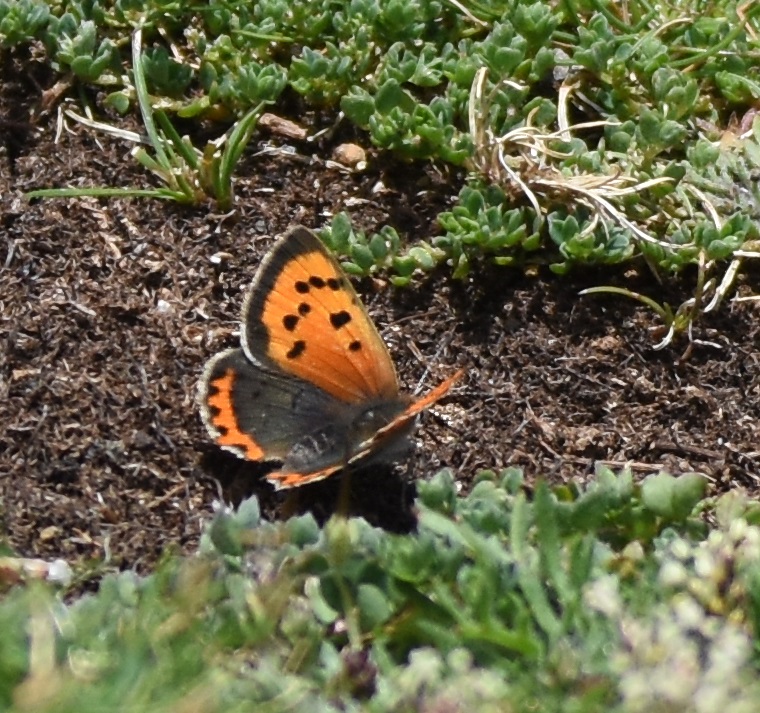
With the sun not being out much we saw few insects other than bumblebees. This Small Copper would have provided a better pic had Monty not wound his lead round our legs as we were trying to get in a better position to show both its wings.
We saw few other buttterflies up there, just a couple of Common Blues and a pair of very fast swirling brown things - (Small) Pearl Bordered FritillariesTalking of Monty we took him down to the dog friendly beach near Penzance most days where he had a whale of a time mashing up seaweed
While we watched his antics we had a go at some stone balancing
Shoulda gone for 15 layers + the base stone

Half way through our balancing act a Painted Lady butterfly flew across the beach and settled briefly  on a nearby Dandelion, we're pretty sure it had just come in off the sea after crossing from France! We grabbed the phone for a pic but after a very quick slurp of nectar was on its way again up and over the railway line and heading ever onwards to the north.

A day trip to St Ive's had us trying to do some serious art - well you have to in this artists' town

Fore Street - where it all happens
Arty harbour - must go when the tide is in next time!
Our last day in Cornwall had us chatting to the locals at the garden gate when something moving in the grass by our feet caught our eye. A Fox Moth, a bit bedraggled but not a bad find and apart from a couple of Light Brown Apple Moths and a White Shouldered House Moth (in the cottage - where else!) we saw no other moths.
On our last walk on the cliffs we spotted a bizarre wall, there's always a wall, why do humans have the need to build them everywhere? What on earth was the purpose of this one. A bit of a scary build for someone too we reckon.
It was high above the world famous and often photographed Crown Mines who's shafts extend out under the seabed.
Not a great place to be working in a fierce Atlantic storm
And our week away ended with a bit of a sunset
Keeping our usual journey statistics we had the following in our nearly 1000 mile round trip of mostly motorway, although the drive down wasn't good weather for raptors to be up and about:-
Kestrels just 1!!!!! Buzzards 16
Dead things: -  
Badger 8, 
Fox 4
Hedgehog only 6 - where are they - what have we done?????
Stoat 1
Our general appraisal of the English countryside is that it offers very little by way of habitat or food for much wildlife at all. The number-plate of the car had barely a squished insect on it on our return and we don't think we needed the windscreen squirter all holiday - where are all the insects - never mind the biodiversity, where is the bioabundance???? Green it might be but it's also a biological desert, there's probably more life in the depths of the Sahara!
Where to next? We've had a couple of extra days off and been a couple of places we can tell you about next time.
In the meantime let us know who's being digging all the holes in your outback


Monday, 28 September 2015

Last of the mipit migration

The Safari left Base Camp before 04.00 on Sunday morning and headed north west over the border to Yorkshire. 
About half way we nearly put an end to a Barn Owl which was hunting happily along the roadside verge until we were very close and it decided to try the verge on the other side of the road - silly bird! Also in the road, almost at journey's end were a Field Mouse and a Short Tailed Field Vole - although superficially similar they move very very differently out in the open.
The reason for our early morning exit was to meet up with young Alicia and see how she's been getting on with her ringing training. The meeting point was the middle of nowhere on the high moors in central Yorkshire. We got there just before sunrise.
We were eating a breakfast of egg and bacon butties when half of the Brisitsh Army turned up. They'd been roused early to go on manoeuvers and hadn't had their brekkie so looked on rather jealously - good job their guns were deactivated! 
The nets were set and we retired to the ringing station (the cars) and waited for the birds to arrive.
Checking the nets
There's one
 Alicia very gently and patiently extracted the birds from the net
It looks worse than it is and the birds aren't harmed
 Once back at the ringing station they get their bling and their vital statistics taken
The ring needs to be checked to make sure it is tight but not too tight
Wing length was measured along the longest primary feather
The weighing procedure is rather ignominious for the poor birds - most weighed about 17 - 18g, the heaviest a tad over 20g
The greater coverts are inspected to find out how many are old and how many have been replaced.
Once all the details have been taken the results are written in the notebook before the bird is given to the trainer for checking before it is released, hopefully to be found by another ringer or a member of the public and reported back to the BTO.
After checking the notes are transcribed onto the final data sheet.
Although Meadow Pipits were the main target of the session other birds were around with a couple each of Goldfinches and Reed Buntings finding the net.
The trainer also explain to us how to determine how much fat the birds were carrying for their long journeys and how to score it.
By now it was mid-morning and the catch rate died off and it was time to pack up.
In the distance Hen Harrier free grouse-moors were clad with colourful Heather. Thee are Black Grouse up there too but they've had a poor season with one gamekeeper up there catching no fewer than 81 Stoats in a short space of time, possibly the cause - or partial cause - of the failure to produce any young this season.
Also up there on 'our' grassy moor were some Skylarks, a Kestrel, a Sparrowhawks and a kettle of six Buzzards enjoying the breeze coming up over the brow of the hill, and about 200 Goldfinches feeding on the thistle seeds. 51 Pink Footed Geese came from the north then turned towards the east coast.
Invertebrates came out with the warm sunshine and we had a nice selection of butterflies, Small Tortoiseshells, a Peacocks and a couple of Red Admiral. A Larch Ladybird on the ringing table was a bit of a surprise but less so were some Black Darters whizzing around the pools.
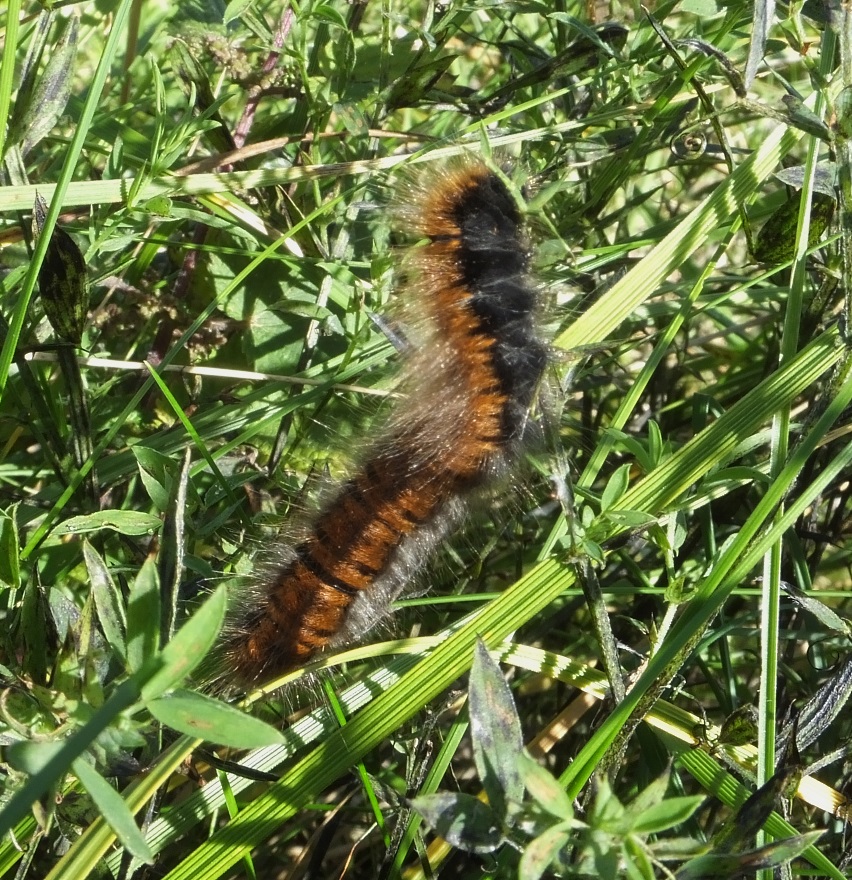
 A number of Fox Moth caterpillars were pointed out to us.
We managed to upset one and it rolled into a defensive ball.
Also nearby was a smaller caterpillar we think might be a Ruby Tiger.
Once all the ringing gear was packed into the vehicles, for the very last time as it was explained to us that Meadow Pipit migration up here was just about over now with catches dropping from 300 a day  last weekend to just 55 today, we were taken to Alicia's local nature reserve, Foxglove Covert, where we met up with her mum and sister and lovely dog Poppy for a picnic lunch and a walk around the trails.
The reserve isn't that big but it has a multitude of habitats, almost all you can think of except a coastline, desert, tropical rain forest and an ice cap!
Being mid-afternoon there wasn't much bird life around but a family of Little Grebes on the lake kept us entertained for several minutes guessing where they'd pop up next. In one of the hides another Larch Ladybird was found.
What a place, it can apparently be tricky to get in as it's right in the middle of an army barracks but we had no trouble at all. It's well worth a visit! 
Autumn colours were just beginning to show too.
We met one of the volunteers who was throwing some cut apples in to the ponds for the Water Voles while Alicia's dad kept himself occupied trying to get pics of Emperor dragonflies in flight. The volunteer told us that on Monday there was a training course about Mud Snails of which there is a good population on the reserve and at least one quite rare species. Reading the blog bout it today we discovered the training course was delivered by the same person as surveyed all our ponds on the North Blackpool Pond Trail - it's a small world!
All to soon our time in Yorkshire ran out and it was time to point the car back down the hill to Lancashire...we'll be back; it really was a superb place and well worth another visit to explore it in more depth with our friends.
Where to next? More Patch 2 stuff coming up.
In the meantime let us know who's habitatilicious in your outback.