Showing posts with label limpet. Show all posts

Friday, 19 July 2019

We'll glossy over that one!

The Safari met up with JG at the private reserve in south Cumbria last week and had a great day which started somewhat umpromisingly with some heavy drizzle. We set off along the trail passing the 'Adder' wall' but no Adders today , the rain keeping them well down in their burrows, a nice male Redstart which did a little bit of singing described by J as 'like a wonky Chaffinch' and when it sang again we could hear why she would think that...great description!
The ditch was disappointingly devoid of any insects, or anything else for that matter and apart from a family of Tree Pipits the moss area was quiet too.
At the bridge there were no Beautiful Demoiselles to be seen and the trail became 'interesting' to say the least
If we weren't on the raised boardwalk that vegetation would look even taller! We completed the curcuit of the second moss area again seeing not a lot but at least the rain had stopped and it was trying to brighten up.
Back at 'Adder wall' there were still no Adders but on a dead stump a little further back J spotted athis pair of 4-Banded Longhorn Beetles.
A sleepy Comma was nearby showing its underwing and how it came by its name.
We'd also managed to get a half decent pic of some Sundew which we failed to do on our previous visit, better still it's in flower now.
By now it was getting towards lunchtime so we headed back to the butties and took up position on the visitor centre's patio overlooking the reserve and in particular the Osprey's nest. We'd only just gone through the gate when we noticed a stick in the middle of the path that wasn't there earlier...and then it moved - "Stop" we shouted to J, it was our first Grass Snake of the day but had seen us coming and was speeding towards cover
During our lunch break we enjoyed a small herd of four Red Deer grazing the woodland edge below us and watched the antics of the Ospreys, they have a chick and it looked like a male was bringing in a fish - how we missed a getting a pic of him carrying his 'torpedo' we don't know but we did. But it seems like this male was from a different nest as it was seen off by the resident birds and disappeared into the woods on the far side of the valley.
Ravens cronked and a Sparrowhawk soared but Buzzards were notably absent and that meant there was no sign of the local Honey Buzzards either.
The weather was brightening up nicely now so we had another look for the Adders - again without success but we did find a Grass Snake very much hidden from view in the long grass beyond the wall that gave just about the worst views of Grass Snake, or even any snake anywhere in the world, we've ever had so with the sun coming out we decided to go and have a look at the pond. it maybe wasn't quite as lively as we'd hoped but there was plenty to keep us occupied like these Black-and-Yellow Longhorn Beetles.
Most of the blue damselflies we could see closely enough to identify turned out to be Azure Damselflies and there were still a good number of Large Red Damselflies on the wing. Last time out the Common Darters hadn't emerged but today there were several patrolling the pond and basking around its edges when the sun broke through.
A Golden Ringed Dragonfly kept doing circuits of the wooded island in the middle of the pond and eventually sat up on a reed
There were also at least a couple of Black Darters over the water (and we'd seen one earlier on the moss) and we saw another dragonfly briefly that we're fairly certain was a Downy Emerald but it disappeared round the back of the island and we never saw it again.
Having spent an hour at the pond we headed back towards the visitor centre for yet another look for the Adders. We passed a basking Small Tortoiseshell but there were no Grass Snakes out on this stretch of wall
It flew off and went over the gate beating us to the Adder zone where it sat up on a leaf for another bask, shame the Adders didn't feel like basking out in the open too!
We took another wander across the moss where by now there were Common Lizards aplenty getting their share of the sunshine and soaking up warmth absorbed by the dark timbers of the boardwalk.
Another visiting naturalist told us he'd seen several Adders earlier - that would have been while we were having lunch probably) but by now there were very warm and very active so much less likely to be spotted.
With time no longer on our side we headed back towards the visitor centre when J called out "snake", she'd disturbed on the wall by the warden's house. It had disappeared into a gap in the stonework so we sat on the low garden wall opposite and waited. Sure enough after a few minutes a little face appeared.
We were able to cautiously move round to get a bit better light on it from a better angle and a little bit closer too.
And that ended our visit - or so we thought. As J rounded the corner to the car park she called "snake" again! Another Grass Snake. It saw us and tried to sneak off and that was when we realised it was going nowhere and stretching itself out so much and was actually stuck fast in the crack in the path.
Without further ado we gently teased it to the right where the crack was a little wider and after a couple of minutes it was free and shot off to the left and the dark corner it was trying to reach when we rudely sprang out upon it. We suppose we could have lifted it up once it was free and got the 'selfie' but with all the struggling and hissing it had been doing it was obviously very stressed and probably would have played and  'stunk' us and that's not what we wanted two minutes before getting in the car so we left it find somewhere dark and quiet to chill out.
Yet another great day at this great reserve, can't wait to get back there.

A warm evening found us walking on the beach with Wifey and Monty when we spotted several jellyfish. Looking around we came across a couple of Blue Jellyfish, a species we've not seen before despite many years of regular beachcombing all along this coast. It can give a sting like a bag full of  Nettles but you can't deny it's a beautiful thing.
There were several Lion's Mane Jellyfish too, now they will make you go OWWW if they sting you, apparently it can be very painful and they are best given a wide berth on the beach as the tentacles can be long and invisible on the sand.
Later in the week we were told of a small mammal trapping survey organised by the Royal Society of Biology, well we just had to book place.
We arrived and had a little walk around the site with Monty before meeting DW who took us to the first tranch of traps down by the saltmarsh which had caught several Wood Mice.
It's not a tick but something from the food or bedding placed in the trap
The second tranch had been placed in a more wooded area and here Bank Voles were order of the day. We evn got the opportunity to wrangle on from the trap, first time we'd done that since we were small mammal trapping in Israel in 1978, thankfully we didn't embarrass ourself. And the third tranch was again close to the saltmarsh and here a Common Shrew was captured. unfortunately it was getting rather hot and Monty was beginning to get uncomfortable so we had to leave the group to it with about 50 more traps to inspect.

With the recent good weather the moth trap has been out at Base Camp on a regular, almost nightly, basis but catches have been worryingly poor, mostly small numbers of Heart & Darts and Dark Arches with little else and hardly a micromoth seen apart from a few Chrysoteuchia culmellas.
Excitement hit unpercedented levels when we found this Pebble Hooktip in the trap - a species we've not recorded at Base Camp before.
The same trap held a corking Poplar Hawkmoth too - always a joy to see these gentle giants.
More excitement followed the next morning when we saw a small micro sat on the top of the egg boxes. Carefully we potted it up to discover after some searching through the field guide it was a Eucosoma campoliliana, another new species for Base Camp.
And the excitement didn't stop with the moths! While watching our bee hotel we saw a small skinny wasp that appeared to watching when the bees were coming and going and sure enough when it had seen a bee go in to a tube backwards to lay its egg and then leave it would sneak in to lay its own egg! This watching behaviour gaver us the chance to get a few decent pics and identify it as a Five-Spotted Club-Horned Wasp - no we'd never heard of it either but it transpired that according to the NBN Atlas this is the most northerly confirmed record in the country, beating the previous by a couple of miles!!! No doubt someone from a few miles up the road is going to say ah yes we get them in the garden all the time but hey-ho it's quite an accolade until such a thing happens!
A more or less empty moth trap the other morning had this rather beautiful but somewhat unwelcome visitor, a Candy Striped Spider. Needless to say it was evicted!
A family visit to the Southside at the weekend took us past Marshside RSPB reserve where a Glossy Ibis had been in residence for a couple of weeks or so. We had just five minutes to 'tick n run' and luckily it was out in the open and not too far away. It had its beak out but as soon as we put the camera to the screen window it tucked it away and promptly went to sleep. the chap next to us said "well that's that for an hour or so" so we had to make do with pic of it snoozing for our Photo Year List Challenge which now stands at 156.
Interesting that we've seen one here in three of the last four years, is it the same one? I don't think they breed in Britain yet but could be wrong, if they do it'll still only be in very small numbers or just a single pair in any one year. 

Recently we worked with our favourite school group, from the Midlands, on the beach and they had some super finds
A lump of pyroclasic flow, a Curved Razor and a Barnacle encrusted Mussel
Mermaid's Purse from a Thornback Ray
Striped Venus, Pod Razor, Common Otter Shell
Iceland Cyrpine, Pod Razor, Bean Razor, Tellins, Mussels, Banded Wedge Shells
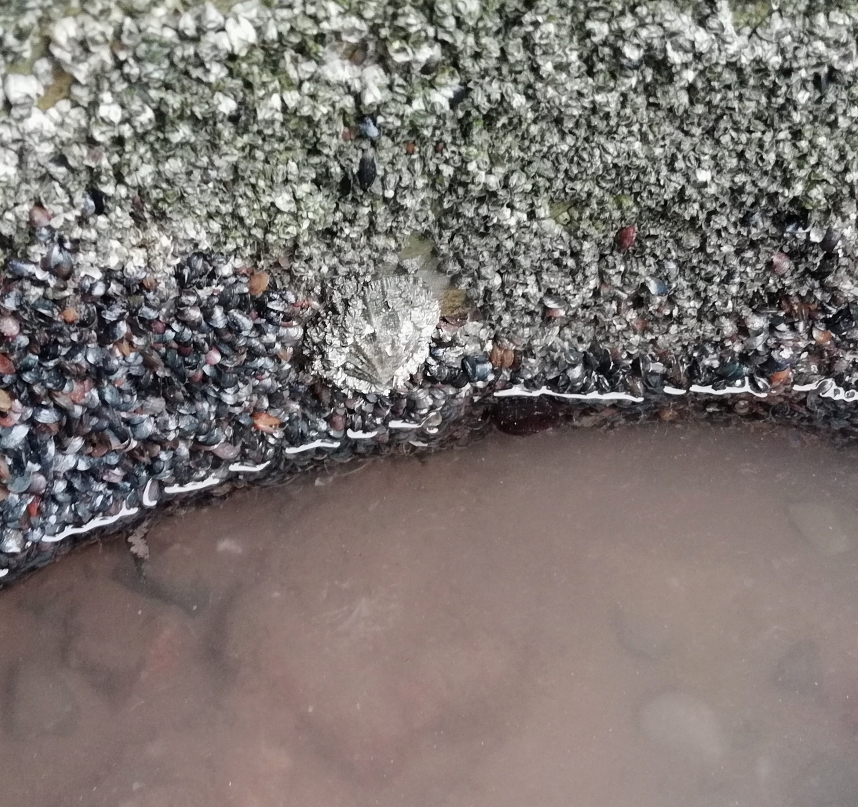
But we hit the jackpot when we found this Limpet. Nothing special about Limpets you might say and you'd be right they can be as common as muck but not on Blackpool's coastline they're not. We'd had a quick look to check the lie of the land before the children arrived and been lucky enough to find Blackpool's only Limpet in it's usual place close to and now just south of where the old storm water pipe used to go out to sea. It's bee na while since we last found it and today it was in more or less the same place so we're assuming it is the same one and we couldn't find any just to the north of the storm water overflow where we've seen it before so we think it probably is the same one. 
But the one in the pic is a new one - a second individual and it was found 100 yards or more north of the other on the north side of the slipway, never seen one that side before...and that begs the question how many more are there???
With this pic we've just doubled the local Limpet population
Great days on safari and as often as not you don't have to go too far to see some awesome wildlife.

Where to next? The Big Butterfly Count has started and National Whale and Dolphin Watch starts next weekend so we're going to be busy - Watch this space - Better still Get Involved

In the meantime let us know who's watching who in your outback

Saturday, 7 April 2018

The simplest things give the most pleasure

The Safari was walking Monty along the top of Chat Alley the other morning expecting to see a  Wheatear or Meadow Pipit or two and secretly hoping for something a little more exotic like a Stonechat or a, heaven forbid, Black Redstart or even a grounded Ring Ouzel. No such luck with the exotica but we did hear a couple of Meadow Pipits overhead. It was a no bins no camera dog walk and as can only happen when you're optic-less up pops a stonking male Wheatear on to the fence only a few yards in front of us...absolutely awesome; it stayed put giving ever closer views as we carefully inched forward towards it. The sort of sighting permanent memories are made of, but sadly not digital images - if we'd have had the big lens we'd have had to wind the zoom right in and still step back a few yards to get it all in the frame we were that close! Once we got as close as we dared without disturbing it we watched it testing the breeze before hopping off the fence and floating down the cliff in that most Wheateary way that they do with legs half dangling and that was the last we saw of it...well chuffed - it made our day and it wasn't even 9.30 yet! Saw our first butterfly of the year too, a Small Tortoiseshell, although we missed one at the Ring Ouzel in the park the other day.
Later in the morning we met up with GB and had a slow mooch along Fleetwood prom. The tide was out and with the weather being better than expected there were locals and Easter holidaymakers all over the place so there was virtually no wildlife on the beach at all save for a few gulls scattered here and there along some of the bigger channels.
We sat for a while on the sea wall at the Observation Tower from where we got two brief and inconclusive views of what was probably a Harbour Porpoise away to our left, a small flock of Eiders was well offshore in that direction too. As the tide rose more birds appeared, mostly small flocks of Oystercatchers heading for the 'new' shingle island and then a Ringed Plover came past close by and landed on the beach to our right. Our best sighting was a flock of a couple of hundred Knot that came from the left and landed on the advancing tide line joining a small group of Oystercatchers.
What we didn't do and perhaps should have done was take a look across the golf course behind us. From where we were sat we could hear Skylarks singing from there but learned later that there were perhaps as many as double figures of Wheatears scattered around the fairways. Still Monty was having a good run and plenty of fun and GB as out n about away from his 'puter for a good hour or so so it was mission accomplished even if we had lugged the camera all the way there and all the way back without pointing it at anything.
Yesterday we'd been invited by EP of the North West Living Seas team from the Wildlife Trust to join her as 'resident expert' on their family rockpooling event. not sure about the 'expert' bit - more knowledgeable than many on all things marine along our coast but we think we need a lot more practice before we get anything like worthy of the accolade of 'expert'.
There was a great turn out with several families coming along on a cool and blustery day. They were soon finding all manner of shells and dipping in the rockpools for creepy crawly things which were sadly lacking, the recent prolonged cold weather might have something to do with the dearth of crabs, shrimps and prawns. We only managed to spot one small Blenny darting for cover too, normally there's lots of them.
But as ever the more you look the more you see and it was evident that there were far more Beadlet Anemones than we normally see, some of them still covered by the water had their tentacles out. We gently prised one from the rock and let it grip to our hand with its millions of stinging cells. We'll post the pic at a later date when it's been downloaded from AN Other's camera. No it doesn't hurt, the stings are too small to penetrate any more than the top most layers of cells of our skin and their toxin is more for subduing microscopic plankton than 85kg mammals. Looks impressive though and is testament to how strong lots and lots and lots of tiny things can be.
While showing one group of children the difference between a Prickly Cockle and an Edible Cockle something on the wall of the adjacent rockpool caught our eye. Only a flippin Limpet! Not a massive one but not a particularly small one either - but you're thinking it's only a Limpet, rockpools all over the shop are full of them what's the big deal? Well in all the years we've been taking groups out rockpooling on this stretch of coast we've only ever seen one Limpet and we believe that was destroyed along with its habitat when the old storm water pipe was replaced with a new one a couple of years ago. This 'new' one was quite away from where the original one lived and was a totally different size anyway. Result - get in!!! That's the joy of wildlife - you really don't know what you're going to see from one day to the next, there's always a surprise waiting for you when you least expect it.
And there was another surprise to come, another family found another Limpet doubling the town's population! Another smallish one and a little nearer to where the original one lived but still definitely a different one.
Something made us wander to the pools on the south side of the slipway, maybe it was took look to see if there were any Green Shore Crabs there as there weren't any anywhere else but then as we approached the end of the pools and where the sea wall had been altered fro the new storm water pipe a little white dot caught our eye, could it be???????
Yes it was!!!!!


Tripled the Blackpool population of Limpets in the space of half an hour - well done guys! But how many more are there if there's three we've found?????
Now this one isn't far from from where we last saw the original one - sort of directly below the chap in the pic above. But is it the same one or is it a new one? Questions questions - we'd like to think that somehow it survived the habitat annihilation caused by the rebuilding of the wall. It's certainly big enough and has that white cast we remember when we last saw it a little over three years ago. Here's some pics from 2013 - what do think, same or different?
One thing that has changed and very probably due to the old storm pipe being removed is the flora and fauna on the rockpools. The old pipe was above beach level whereas the new one is buried and that seems to have had an effect on what grows where and how much. There is certainly much less Honeycomb worm in the rockpools now as well as very little Spiral Wrack seaweed, perhaps losing the breakwater effect of the raised old pipe is causing more sand scour so some species can't get or maintain a grip on the concrete walls. A species that is doing well is the Edible Mussel. Look at the two pics above there is a sharp dividing line between the white of the Barnacles and the black of teeming millions of tiny Edible Mussels, we've never seen that here before it's a brand new phenomenon! Another surprising surprise thrown up by our wonderful nature and just begging more questions to be asked and more observations to be made. Is it just in this locality, does it occur 'round the corner' where we very rarely look, does it occur further north towards the pier again we rarely look that far. A couple of years ago there was a Shore Search survey done by students from the local marine biology course, it would be very interesting to have it done again.
Eventually the tide came in and we all had to leave the beach - happy

Where to next? A wet weekend beckons but no doubt there'll be something to see

In the meantime let us know who's providing the surprises in your outback

Friday, 13 February 2015

First look in the rockpools of the year

The Safari has a couple of updates from yesterday for you. Yesterday we had two visitors to the office both required us to leave the office and go outside. Lucky for us as we had a Grey Wagtail ((P2 #30) on the first visit and a Robin (P2 #31) poking around the shrubbery on our second jaunt outside.
This morning we resolved to count the gulls, it was too murky out to sea to see much anyway. We also counted the Oystercatchers as they are about the same size ass the gulls. The dropping tide gave us about 60 of each slightly more Oycs than gulls - gulls counted generically not to species - a Bar Tailed Godwit (P2 #32) was with the Oycs away to the south.
We did it again this at lunchtime and the result was the other way round with about 65 of each but slightly more gulls than Oycs. Still hardly a big count - where are the big flocks of gulls? We want some Yellow Legged Gulls and argentatus Herring Gulls to gawp at...a lost Laughing Gull having a 25 mile wander from it's 'pontoon' on the lake would be more than welcome to put in an appearance.
The Bar Tailed Godwit had done a bunk but there were just a measly four Sanderlings and eleven Redshanks out there.
Mid-afternoon we were able to get out on the beach with our marine biologist friend DB to look at the proposed works to the outfall pipe this coming summer. The one and only Limpet on our length of coast is right in the firing line of the demolition gang -  a rescue plan is needed and we were sussing out somewhere safe to relocate it to.
From ARKive
Common limpets begin their life as males, becoming sexually mature at around 9 months of age. Most individuals undergo a sex change, typically becoming female at 2 or 3 years of age, although some remain as males. Spawning takes place once a year, usually from October to December, although the timing varies around the British Isles. Fertilisation occurs externally; the larvae spend their first few days of life in the water column, after which time they settle on the shore. Life-span varies, but is between 10 and 20 years.
Also lurking in the rockpools were a good number of Beadlet Anemones waiting for the tide to return. Some tiny little baby ones clinging on there too and a Common Periwinkle.
One of the pools had a fairly fresh Native Oyster washed in to it.
Probably the most unusual sighting was a very small blob of Edible Whelks eggs stuck to the side of one of the pots. We see much larger egg masses all the time rolling around on the beach but we've never seen them stuck to the side of a pot before. DB said that there's been quite a few Whelks on the beach recently.
The shell below the eggs looks to have a very square end rather than a more randomly broken end which would make it Sand or Blunt Gaper and not Common Otter Shell.
Good to be out on the sands again and not too cold sheltered as we were by the wall from the south easterly wind.
Where to next? Back on the nature reserve at some time tomorrow - there's a Bullfinch to get a pic of you know.
 In the meantime let us know who's been stuck to the wall in your outback

Friday, 30 January 2015

Stormy starfish carnage

The Safari wasn't able to get out early doors this morning and had to wait until lunchtime before venturing forth to the seawall. There was a reasonable number of gulls on the beach mostly Black Headed Gulls rather than Herring Gulls, it's usually the other way round by a mile at the mo. We couldn't find anything in amongst them but could see they were working their way through a particularly dense stretch of a long strandline.
There wasn't much happening out at  sea so we decided to take a shuffy at whatever the gulls were looking for.
It was pure carnage down on the sand, victims of the storms of the last several days.
What we couldn't see from our elevated vantage point was just how many Common Sand Stars there were, there must have been thousands of them, some still just about alive or at least very slow in the bitingly cold wind.
Looking at the strandline more closely we noticed there were quite a few Bristle Stars lurking there too.
Not only Bristle Stars but also some Cushion Stars too, it shouldn't be but it is amazing what you find when you start to look closely - just how much tonnage of life is out there? Everyone should really be looking at their surroundings closely at all times, there's just some much to see.
 Some of those Common Sand Stars were pretty sizable compared to our size 9s
Sat a little way apart from the rest of the carnage was a nice bright Queen Scallop encrusted with Dead Mans' Fingers, a relative of the anemones.
We posted a general pic of the carnage on Twitter and ended up with a bit of a challenge from LM another marine biologist friend
 Here's our tally
1 - Pod Razor
2 - Bean Razor
3 - Curved Razor
4 - Rayed Trough Shell
5 - Thin Tellin
6 - Common Cockle
7 - Necklace Shell
8 - Comon Sand Star
9 - Brittle Star
10 - Sea Potato
11 - Masked Crab
12 - Shore Crab
13 - Sand Mason Worm cases
14 - Fan Worm cases
15 - An unidentified worm (slightly top right of centre - any ideas anyone?)

Earlier this morning we learned that the Limpet was back in town although we should have received the message yesterday, the wonders of modern technology ehh!
So with a few minutes to spare we had a quick look, we were told roughly were it was. It didn't take long to find, stuck out like a sore thumb. 
Made a bit of a hole in the Enteromorpha there hasn't it.
Go on let us into a secret - where has it been for the last however many months? It's only inches from where we last saw it but it's not been near there in recent weeks - as far as we've been able to search at least.
Cold out there again in that cruel wind but a good bit of exploring well worth getting chilled to the bone for.
Where to next? It's the weekend and we've got a certain natty version of Goldcrests as a target.
In the meantime let us know who's all washed up in your  outback.


Wednesday, 20 February 2013

Got the slippery little sucker

The Safari has DB to thank as she was good enough to come down at lunchtime and show us and the Young Uns where the invisible Limpet was. Well she thought she knew as it wasn't where she first thought it was. No it hadn't shot off elsewhere but was slightly off to the side of where we'd been looking.
Local 1st in the bag! When will be find the next?
There was a chance this arvo when we set off with the vols to clean our stretch of the beach as part of the Love my Beach campaign.
No Limpets and thankfully not much litter. But some of that limited litter was just a little of the wall. Well more like off the shelves in the cabinet stood against the wall in the 1970s...
Not your usual dumped on the beach rubbish...we're off to the Antiques Roadshow! The wee house has lost a chimney...but bizarrely AB found it about 50 yards further sown the beach.
After the beach clean we attacked the work's pond to remove as many of the 30 or so 3-Spined Sticklebacks in there before the breeding season. You wouldn't believe it, we eventually pulled out 70!!! One of them actually attacked us with its spines, only a tiny tiddler but it did get a spine in as we were easing out of the net. It felt like a Bramble thorn and was strong enough to easily hold the fish upside down on the end of our finger. It did swim off in good health but shocked us - we didn't think a 1cm long fish's spine would be sharp/long enough to penetrate the skin on the end of our index finger, plenty enough to put a predatory fish off a meal. We've always said with this nature game you learn something new everyday, and today was certainly no exception.
The fish were released at the big park where after letting them go into a quite corner of the lake we had a quick look around the wooded area nearby. Worth it! We had some of the best views of a Treecreeper (106) we've ever had; it flew past us from behind and landed at nose height about 18 inches in front us. It went slow up the tree without going round the far side. It then flew back past us to another tree where it typically landed at the bottom and did the same, not going round the back. We watched it for about five minutes never more than a yard away, too close to get the camera out of its bag without flushing it...didn't need the camera the memories will last for ever...simply stunning. So close were we that we could see the tail feathers flexing as it shuffled up the tree.
Where to next? Gonna be hard to beat today as was a really cracking day but tomorrow we've got a surprise for you...we're traveling south out of Safari-land for a birding day with the Little C who's now quite big...really looking forward to having the day with him and being shown his local hotspots in a part of the country we just don't know.
In the meantime let us know what 'simple' wildlife gave the surprises in your outback.

Tuesday, 19 February 2013

Slip slidin away

The Safari reckons you can't beat a bit of Mr Simon.
We looked at Patch 2 for no more than 30 seconds today - total haze with no hint of horizon and in the absence of waves and/or ripples we couldn't tell what was sky and what was wet water.
To infinity and beyondddddd
We were on the beach to see if we could see the Limpet. we asked DB where it was found to narrow down the search area. She said it was somewhere here.
We slithered around on the extremely (dangerously) slippery slope with absolutely no success what so ever. The slipperiness is provided by this little Hydroid. It's an animal (or at least a colony of tiny animals)

How hard can it be to find one of the most common shoreline species in the country?
We asked again if it was a small immature animal but no apparently it's an adult. Narrowing the search area further led us here.
Tomorrow we'll find it even if we need help from DB. We'll be on the beach anyway as it's our second Love my Beach beach clean between 1 and 2pm when we'll be heading northwards towards the pier this time. Please join us if you can.
After our slip slidin session we headed off to the nature reserve to add our support to the Public Consultation Event for the lottery bid we are helping develop. Good to see a decent turnout on a weekday afternoon. The next one is tomorrow evening after work so no excuses for not putting your four-penneth worth in - see link on right for details.
After the event ended we met up with some of the birders and had a mooch round. We'd just missed the Bittern and there weren't many gulls on. To be honest we spent more time chatting about the future of the reserve than doing any serious birding. The weather was superb, the afternoon light making the ducks positively glow. The Coot were good value, starting their territorial disputes and have a right old do at each other, sharp clawed yellow feet flying everywhere!
A wander up the top end had Young Un AB beckoning us to hurry. we didn't and saw the briefest bit of a Bittern drop into the reeds at the far end from where we'd just come from. 
Again we hung around and chatted and would you believe it a second Bittern popped up out of the reeds and flew across the mere not far from where we were stood! Very nice to have more than one on site again.
Great to see everyone out enjoying the birds and the sunshine; not so nice to see the handiwork of an unknown number of drunken yobs who had totally trashed the Feeding Station and its hide - arsewipes the lot of em.
Where to next? Some gardening jobs with the Young Uns in the works garden for the first time this year and then back on the beach tomorrow.
In the meantime let us know if summer snuck in to your outback today.
Talking of summer two reports of Small Tortoiseshell butterflies came in today...must be summer!