Showing posts with label long tailed field mouse. Show all posts

Friday, 22 November 2019

We've never put our coat on so fast

The Safari was in the middle of the washing-up this morning when the phone rang. We couldn't answer it but a few minutes later listened to a voicemail from LGB telling us a Risso's Dolphin was heading slowly north past him down at Starr Gate and could well come past Chat Alley where he knew we'd be walking the dog sometime early morning.
We listened to the message at about 09.10 and immediately donned our coat, grabbed our bins and bundled Monty in to the back of the car for the fastest drive to the prom of his life!
It was now nearly 20 past, there was no sign - had we missed it? We kept an eye on the calm sea southwards with a few scans to thw northbut nothing was seen. A small flock of Common Scoters flew past close in, close enough to pick out the paler females with the naked eye - not often that happens here!
Still no sign of any blubber - we thought at least there might have been a Harbour Porpoise out there, we've not seen one for ages and some of the fishermen have been saying they've been catching Whiting, the Porpoises' favourite prey.
A dog walking friend came along and asked what we were looking for and it was while chatting about the news from South Shore that we picked up the Risso's Dolphin coming towards us quite slowly about 3/4 of a mile off North Pier. It surfaced a few times then made a longer dive before coming to the surface again a couple of times, getting nearer all the while. We saw the huge splash of a breach in the corner of our eye and are a bit miffed we missed seeing the animal leap out of the water. But from then on it surfaced much more regularly and now didn't seem so far out maybe only 1/2 a mile and not far beyond the low water mark. It wasn't to hard to spot with the naked eye now, but getting the other dog walkers on to it was difficult as there were no real landmarks (shouldn't that be sea-marks?) to point them towards and sadly neither of them managed to see it. Meanwhile we were getting quite good views in the bins, the blunt head was obvious and the sickle shaped dorsal fin was particularly hooked although it was still to far away to be able to make out the scarring typical of the species. We watched get closer to the yellow buoy but didn't see it pass it, it would have been closer to the shore than the buoy, and we didn't see it again. What a great morning and a huge Thank You to LGB for the head's up. A cetacean Lifer for us...well chuffed indeed.

In other news we've had the stealth-cam deployed in the garden at Base Camp with the hope of getting evidence of some unusual behaviour from fairly normal garden birds.
Here's a selection of the usual garden feeder visitors - apologies for the quality of our aging camera
Blue Tit
Coal Tit
Great Tit
A rather arty Great Tit
A nocturnal visitor, half expected - Long Tailed Field Mouse
What goes down...
...Must come back up
Wasn't expecting this male Sparrowhawk - they rarely come into the garden - - shame he couldn't have looked at the camera
Three Greenfinches - looking nice and calm, normally they're squabbling for the prime spot
And now the two pics we'd hoped for. A couple of years or so ago we got a pic of a Dunnock on this feeder taking sunflower hearts but hadn't seen one doing that since then until a week or so ago when it happened a few mornings in succession but every time we'd dashed off to get the camera it had gone not to return by the time we got back to the kitchen window. So we decided to be sneaky and set up the stealth-cam in the hope of snapping the evidence.
Success - but does anyone else get Dunnocks using this type of feeder clinging on like a Blue Tit?
But better was to come further down the SD card. We were surorised to open one of the images and see a Robin was doing the same, something we've not seen from the kitchen window. Again has anyone else seen Robins using wire feeders?

Isn't wildlife brilliant - a totally unexpected Lifer on one of our Patches and some unusual behaviour from 'ordinary' species in our own garden, doesn't get much better than that and no need to travel to far flung or exotic places...well actually Blackpool promenade is pretty exotic!

Last Monday was a dry, calm and sunny day wit ha bit of a frosty start. We've not had a full day out with Wifey for a while and seeing as how she was on a long weekend we decided to venture into Lakeland for a scenic low level walk. We picked her sister up on the way and headed to the well known beauty spot Tarn Hows between Coniston and Ambleside.
Beauty spot is an apt description, it was glorious up there. Cold and crisp with the frost on the grass lingering all day in shady glens and a bit of snow on the higher mountain tops. 
The bright blue sky and lack of breeze meant some reflection photography was order of the day.
There wasn't too much wildlife to be seen, a couple of female Goldeneyes and a female Goosander on the tarn and the odd Raven and Buzzard passed overhead.
The only slight dampener on the day was we couldn't walk the full circuit of the lake as the furthest third was out of bounds due to some serious tree felling. The Larches had contracted Phytopthera fungus and were having to be felled, 100m around each infected tree, this meant the peace and quiet was non-existent until the workers stopped for lunch then it was noticeable how quiet it was out there with just the 'tseep' of occasional Goldcrests and a Treecreeper in the remaining trees and the 'wacka-chacka' of a passing Fieldfare flock to break the deep silence - not even the few remaining leaves on the deciduous trees made a rustle.
Where the Larches had already been felled it looked devastating but the extra light reaching the woodland floor should allow a much more natural forest of Birch, Rowan, Alder, Holly, Oak and especially Juniper to reclaim their rightful place on the hills now the alien conifers have been much reduced. Although within the walk there were some Belted Galloway cattle, and much worse for any tree seedlings that might try to get established, Herdwick sheep.
There's a few more pics over on our Flickr page.

The hill with the dusting of snow in the distance is Wetherlam. Many years ago when we were in training to climb Mt Kinabalu in Borneo we were up there in much snowier conditions and managed to slip very badly on some sheet ice we were actually doing our best to avoid as we knew it would be tricky not far from the summit. We really thought we'd done a knee ligament in and were seriously considering having to call the Mountain Rescue team out to stretcher us down. Being mid-winter it was already going dark in the valley below us but somehow we managed to hobble/slide down the trails to the car parked at the foot of Coniston Old Man from were we had a horrendously uncomfortable drive back to Base Camp barely being able to press the clutch to change gear, think we only used second and fourth all the way back. A lucky escape!
Yes we did make it to the top of Mt Kinabalu, the conditions and view were much the same as those at the top of Wetherlam or Coniston Old Man most days - cold wet and windy with a view of the inside of a cloud!

Where to next? A bit of a sunset and a Starling murmuration to be a enjoyed means another visit to the prom.

In the meantime let us know who's clinging to the wires in your outback.

Saturday, 30 September 2017

Still searching for a Siberian sprite

The Safari has been diligently counting the birds in the park on Patch 1 most mornings much to Monty's annoyance as he would prefer to join his mates on the now very soggy field for a run around and rough n tumble before breakfast. So far we have had little migrant joy with mostly similar numbers of Blackbirds, Robins, Wrens and Goldcrests recorded each morning, although the first Song Thrush since they went quiet at the end of the breeding season could have been  from elsewhere rather than a local bird.
A morning visit to the nature reserve was a quiet affair, nice to hear several Skylarks, including a flock of 11, and Meadow Pipits going over though but not a lot else obviously moving - we still haven't had that 'big day' of visible migration.
A quick peek under the refugium gave us another juvenile Great Crested Newt, maybe we should have taken pics of their undersides so we would know if there have been three, four or five this week. A tiny Froglet was under there too.
From the Viewing Platform the light looking across the mere was simple dreadful so we didn't linger long, long enough to see there were no Otters and the Heron in flight over the reeds was 'just' a Heron and not a Bittern - AGAIN!!! The Willow tree next to us held a very camera shy couple of Long Tailed Tits.
Along the track there was little to trouble the notebook and the wader LR had told us about in the scrape not long after first light was long gone. So to was any hint of the Kingfisher down at the spillway, even the flooded corner of the farmer's field was devoid of life - there's always at least one Pied Wagtail on there.
It was so quiet bird-wise we took to getting pics of ageing farm equipment that was in the field. We're not toally sure but it looks like this old combine has got stuck in a wet patch
so this one has been brought in to finish the job

Walking back the way we came the scrub opposite the scrape was now alive with a flock of tits and other birds. We watched waiting for another chance of a Long Tailed Tit pic as a Chiffchaff sang from further back then it or another one began to give a Great Tit, twice its size and not normally to be messed with by lesser fry, a right royal chasing around the bushes for a good couple of minutes or more - we don't know what the Great Tit had done to deserve this but that Chiffchaff had attitude and wouldn't let it lie! We eventually were able to fire off a couple of shots at a Long Tailed Tit but they didn't amount to much.
The rest of the walk back was as quite as the walk down with only a couple of Great Spotted Woodpeckers in the distance and, following on from Patch 1, another Song Thrush breaking the monotony; that is apart from the numerous Migrant Hawker, a couple of Common Darters and a Brown Hawker dragonflies. There were also a couple of migrating Red Admirals flying doggedly south in the stiff southerly breeze and a single Small Tortoiseshell brightening up proceedings too. 
Family duties on the Southside enabled a quick visit to Lunt Meadows reserve. The drive down was a traffic nightmare but we did see at least four Jays, all carrying Acorns, flying over the congested motorway. Arriving at the reserve the first thing we saw as we drew to a halt in the car park was another Jay carrying its Acorn.
The sun was out and we were looking forward to brief but quality visit. Then the sun went in before we'd even reached the first screen. Looking across the pool there wasn't a lot to be seen, a Heron and a few Mallards and then the heads of some Snipe poking up from the far side of a low muddy bank.
A movement in the grass to the left of the water had us counting a family party of seven Moorhens and then another movement further left still had us suspecting more Moorhens but in fact it was three Grey Partridges, very nice to see again so soon after our last sighting not far from here recently we've been down to just one or two sightings a year of these once very common birds. One of them even stood up taller than the surrounding vegetation rather than hiding behind the only stalk like last time!
Moving round to the next screen overlooking the pool the light was against us but we could now see that the Snipes 'heads' were in fact about a dozen birds.
There were even more Snipe at the next pool which is where most of the other birds were too. Including three Ruff way over on the furthest mud.
Then we noticed some spitting raindrops making ripples on the water. It wasn't long before the spitting became a downpour and as we huddled the camera under our jacket tight to the screen the rain drove against our back ran down our jacket and legs and in a cold trickle in to our wellies - not a pleasant feeling!
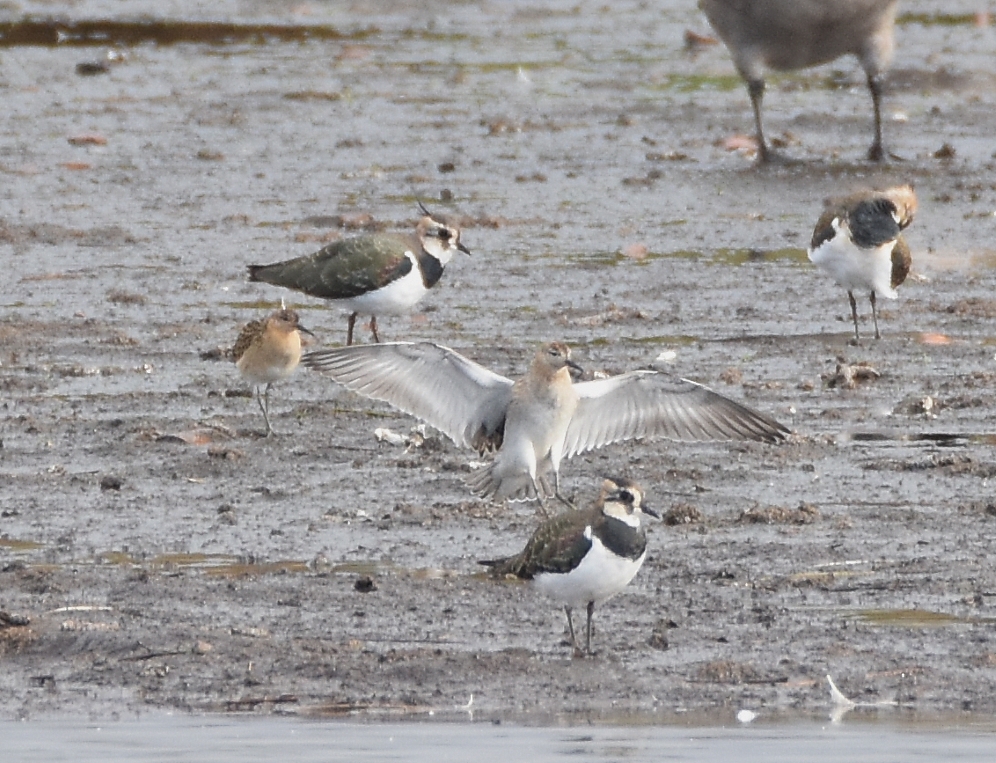
Thankfully the rain didn't last long and the sun came out. As far as we could tell nothing new had dropped in. The Snipe were looking good in the bright sunshine and the Ruff had a little fly round with the Lapwings landing a bit closer when something unseen spooked them briefly.
Looks like it's drop-kicking a Lapwing
An we just had to take a few snaps of  an incoming flock of Canada Geese.
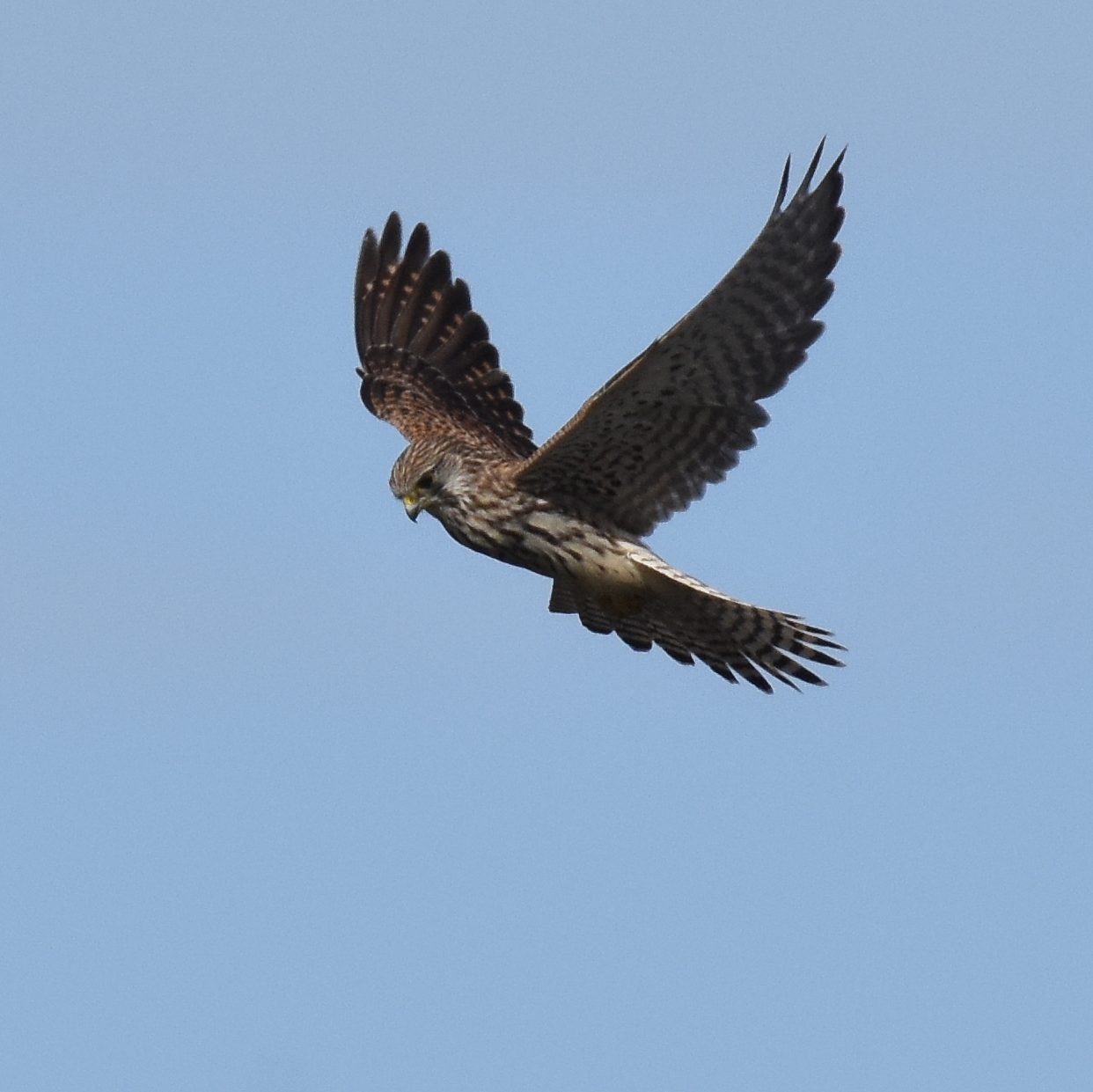
From the next screen we didn't see much but did notice a Kestrel hunting a little further along the track so of we went. And glad we did as this is easily our best Kestrel pic ever.
Good as it it we do hope to better it one day though.
The time had now come for us to get on with our family stuff so we had leave but we did call in at the first screen again to check on the Grey Partridges. They weren't there but there was an enormous flock of several thousand Pink Footed Geese in the distance probably over the Formby mosses, it was gazing at these we noticed the Lapwings were up over the other pool. But what was that white thing with  them getting grief from a Lapwing? At first glance it looked like one of those white Feral Pigeons rather than a gull but closer inspection revealed it to be a leucistic Lapwing and what a beauty it was too with it's black wingtips - wish we'd noticed it on the deck with all the other Lapwings - what a cracking looking bird! Apparently there is another less striking leucistic Lapwing too.
This morning we were back on Patch 1 doing our count and hoping for for something green with wing-bars and an eyebrow. our luck could have been in, there were a lot of Goldcrests today, at least nine and a flock of Long Tailed Tits, just the sort of activity that a lonely Yellow Browed Warbler could join in with but sadly it wasn't to be.
Back at Base camp a surprise awaited us. While making a cuppa we saw something on the feeder that didn't look like a Greenfinch or Goldfinch, indeed opening the blinds a little wider it didn't look like a bird at at all! Our first Long Tailed Field Mouse we've seen in the garden since last winter and the first we've ever seen clinging to the feeder. Nice one!
Where to next? A friend told us during the week that time in field equals birds so we'll be out somewhere on safari tomorrow looking for that elusive Siberian sprite - or something else equally exciting...or elusive.
In the meantime let us know who's eluding who in your outback.

Sunday, 18 June 2017

The trouble with barn owls

The Safari was out early on the hunt for a scarcish bird to hopefully add to our Year Bird Challenge. We were at the site with the scope set up only a few minutes after 07.00. All was peaceful, the sun was already warm on our back and almost all of the sounds were the sounds of nature. It was good to be out almost like being in a scene that might have been painted by John Constable.
We had a good scan for our intended quarry but to no avail. There were plenty of other waders and waterfowl but not the one we wanted...yet.
Lapwing
Oystercatcher
Redshank
 Overhead Skylarks serenaded us and from the hedge behind us a Whitethroat sang incessantly but the most obvious sound was the calls from the group of about four dozen Black Tailed Godwits feeding and resting in the pool right in front of us.

Further down the lane there was a Gypsy lad with a lovely modern horse-drawn caravan - we say Gypsy, he might have been any old bod just escaping the rat race - He came over to see what we were looking at before hitching up his horse and leaving. His caravan had metal cartwheels and made a serious drumming and rumbling noise on the road causing the cattle closest to us to stampede through the pool putting the Black Tailed Godwits to flight.
He also said he'd seen a big pale brown owl earlier which we expected would be back asleep in its barn by now. 
We kept on looking for the Little Ringed Plover that's been reported regularly recently but still had no luck so started to occupy ourselves while the birds moved around a bit by watching a family of Coots.
As luck would have it a Barn Owl flew overhead with prey heading back to its nest - where had that come from surely if it had been hunting in the cattle field we'd have seen it! As it disappeared in to the distance we didn't bother raising the camera to get a pic of its backside. And that was the end of that we thought as it was now nearly 08.00. But no, it snuck up on us again while we were engrossed in watching the tiny Shelduck chicks and the numerous mostly well grown Shoveler chicks. It didn't hunt 'our' field but skipped over the hedge and crossed the normally very busy dual carriageway.
Well what goes out a-hunting must come back and after a good length of time come back it did carrying a vole. Trouble is we very nearly missed it. You see that's the trouble with owls they fly silently and this one came back behind us and we were lucky to catch it in the corner of our eye but being behind us and that meant it was now on the wrong side of the light. We swung the camera round and fired away hopefully. Got it - just!!!

So really good to get a Barn Owl (YBC 139) on our our Year Bird Challenge. Unfortunately the Little Ringed Plover didn't show by the time we had to leave to get Wifey's breakfast on the go.
Later we were out again to try to find out if the local White Letter Hairstreak butterflies were on the wing as they'd been reported from the Southside yesterday, very close to where we'd been on our family duties. being a sunny Sunday morning the pollinator killers were out with their lawnmowers and hedge trimmers, we saw a lawn full of White Clover and Self Heal being scalped followed by a large Santolina bush losing its flowers - why on earth cut the colourful bit off? - and then a Buddleia bush having its unopened flowerbuds removed. We also saw the large grassy area behind the fence has been mown, at the end of last week it was a sea of yellow Buttercups. It really is no wonder the bees, butterflies, moths etc  are struggling. Why are we so terrified of flowers and colour?
It was already hot on Patch 1 and there were a few butterflies about. Most were Large Skippers and they weren't for stopping at all. We also had a few Speckled Woods, a similar number of Common Blues and singles of Red Admiral and Small White, no Meadow Browns yet and although we hung around 'the' tree we didn't see any White Letter Hairstreaks.
Also out n about was a rare 7-spot Ladybird, we've hardly seen any ladybirds this year.
Of more interest was this parasitic wasp
We've got a couple of possibles but are waiting for those clever iSpotters for a definitive ID.
On the way back we bumped into a dead Long Tailed Field Mouse lying on the pavement that wasn't there on the way out. Cat or heat? Or a mixture of both?
Where to next? Back to work tomorrow and we have another Brownie group in the evening so there might be something exciting they've found to show you later in the week. 
In the meantime let us know who's sneaking up behind you in your outback.