Showing posts with label pipistrelle. Show all posts

Sunday, 30 July 2023

Underwater moth trapping...in Witch country

 The Safari has been trying to do some moth trapping both at Base Camp and further afield.

Our first attempt was for the Royal Society of Biologists at a nearby Country Park. Good pal CP did a fantastic warm up act for us with a great talk on bats that had one of the attendees in stitches laughing at the thought of Bat Ladders. Then outside as dusk drew darker the bats came out to play and put on a great show for us sending our bat detectors into a heated frenzy of sound...a superb start to the evening. 

We were supposed to put the moth trap up on the green by the gardens once the bat excitement was over. Then everyone could sit round the sheets armed with a pot with which to catch the moths for us to identify as they came to the light. Well that never happened cos down came the rain by the bucketful. So 'indoor' moth trapping it was. The centre has a covered outdoor classroom at the back so it was in there that we set up out of the rain. The trouble with heavy rain is the moths don't like it and won't venture out - and who would blame them? A small number of hardy indivuals did appear, mostly Large Yellow Underwings and a few mico-moths. But we were trapping close to an Apple Tree which had attracted a goood number of Common Wasps. Fortunately we were using the sheet and light technique so could easily see them - it might have been a case of watch where you put your hands had we been coming to empty a box full of cold sleepy ones in the morning.

A few evenings later, after the rains had finished, we set the trap up at Base Camp and caught the grand total of ZERO moths - that's not in the rule books! The following night we tied again, rain wasn't forecast but we heard it lashing it down during the night - not a good omen -- just 6 soggy moths were in the trap come the morning. Things have got to get better, it's July for crying out loud!

For our next event we'd been invited by DSW, Community Engagement Officer for the Forest of Bowland AoNB Connecting People and Nature Project to lead a moth trapping and other wildlify bits n bobs event for one of her community groups...no way we could say no to that so with a car loaded up with all kinds of kit n kiboodle we headed off for the furthest reaches of East Lancashire aand the famous Witch country round the back of Pendle Hill.

We were taken to Clarion House, a community centre up in hills above the tiny village of Roughlee. To be honest the Safari has been to Australia more often than this part of east Lancashire so it's not surprising we'd never heard of the place until now. But what a lovely place and what a gorgous setting up on the hill overlooking the town of Colne down across the valley...that's if we could see that far, it was a grim old day.

Ever the optomists DSW and us set about putting up the moth trap. We decided the most sheltered area behind the building and under a substantial Birch tree was going to be the best option. Heavy rain and strong winds were forecast for overnight so we took the extra precaution of erecting a gazebo over the trap and tying that to the tree to stop it flying off over the hills towards Cheshire.

Back at Base Camp we were woken in the small hours by torrential rain lashing against the window driven by a howling gale. We spent the rest of the night worrying about the electrics-water and hot bulb-cold raindrops combos. Luckily we needn't have worried as in the end all was fine when we arrived back on site in the morning. And now with the group eager to see what had been happening overnight it was time to empty the trap. But before that we had a look on the laptop to see if the trail camera we'd set up overnight had caught anything.
We'd placed it along a track beside a woodland shelterbelt and close to a compost heap, something was bound to wander by, hopefully a deer, a Fox, a Badger, or maybe a Hedgehog or even a Rabbit? Nothing! Our fingers were well and truly crossed there wouldn't be a re-run of our zero moths escapade at Base Camp a few nights earlier given the weather was much worse this time. Thankfully there were moths and we got off to a flying (pun intended) start with a few on the sheet outside the trap.
Scalloped Oak


Lesser Swallow Prominent


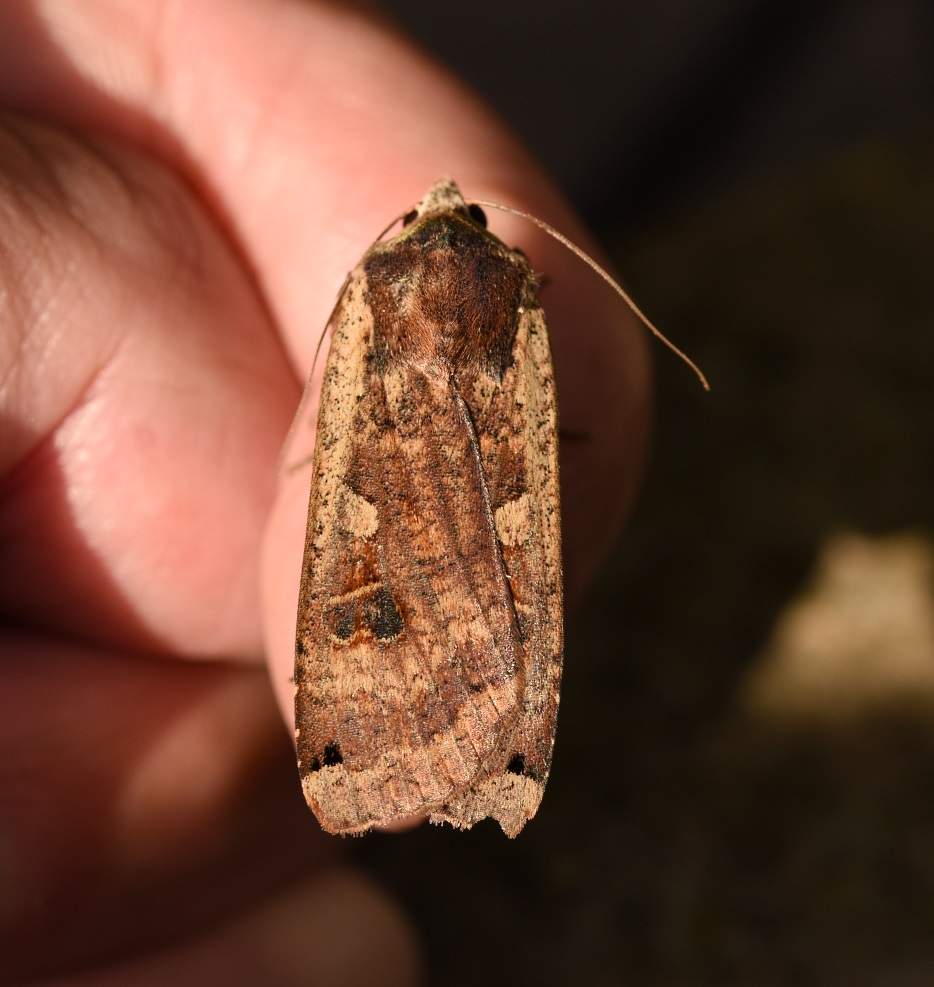
The pick of the bunch for us was this Gold Spangle which never having mothed up hill before was a new species for us.
The final tally was a small but better than expected given the weather 21 moths of 14 species plus a few unidentified micro-moths and a couple of escapees.
We'd also taken our bat kit so had a little talk about bats, their biology especially their hunting echolocation and bat detectors and the fact they are predators of moths.
As well as the real live plastic bat we'd brought along a long dead real live dead Pipistrelle for them to hold and get a feel of how tiny they actually are.
This one was found dead trapped in a chimney many years ago.
When we were told that Clarion House had a pond there was nothing else to do but put a load of nets and trays in the car. Never one to waste an opportunity for some pond dipping are we?
 
We found waterboatmen, diving beetles and lots of what weassume from the location to be Palmate Newt efts (newtlets) still with their gills

The grounds of Clarion House have a mix of habitats, rough grass, well mown grass, wildflower meadow with Heath Spotted Orchids, wet meadow and a bit of Heather and Bilberry moorland as well as a small formal garden.
All this attracts a great variety of wildlife even on rainy days.
Heath Spotted Orchid


Heather

Red Admiral

Ringlet

Small Tortoiseshell

The bee we think could be Colletes succinctus, Heather Colletes by vitue of its presence in an upland habitat but we could be wrong. And we added the Greenbottle fly in to show that flies are very important pollinators but often overlooked or even disregarded in favour of bees and hoverflies. This week is Big Butterfly Count Week (that's probally why it's so cold wet n windy!) so we've put some butterfly pics in for you too.

To close here's a lovely arty shot that sums up the day very well.

A fantasic safari at a superb location we hope to visit again with a great bunch of people we hope to meet again soon. Huge thanks to DSWfor inviting us and providing some of the photos as we forgot our camera, although were too busy to take pics anyway, and to group member B for the use of her pics too - thank you very much.

Where to next? The Safari will be heading north into the wilds of South Cumbria.

In the meantime let us know who's underwater in your outback.

Friday, 1 September 2017

What are we playing at?

The Safari hasn't had a lot of luck recently. We've been out n about but not seen a great lot to shout about...or get any pics of really.
Back on Patch 1 the big Parasol Mushroom from our Oddball Bat post now looks like this...or did look like that a coupla days ago, we didn't check it yesterday due to horrendous thunderstormy rain nor did we today either.
Having a bit more time to ourselves at Base Camp hasn't produced the goods although this Grey Squirrel is the first we've seen in the garden for quite some time, it was on next door's feeders for ages before it hopped over the fence.
Taken in the gloom through the double glazed kitchen window
Also over Base Camp was the first Meadow Pipit of the autumn, just the one - no sign of any migrant floodgates opening yet.
We had an early morning three hours round the nature reserve seeing very little at all and not once needing to raise the camera. Best of a very slow morning was a mixed flock of tits and warblers in which was a single Lesser Whitethroat. Insects fared a little better with at least four Red Admirals seen around the reserve and a cluster of four Small Tortoiseshells butterflies in the top corner nectaring on the abundant Hoary Ragwort flowers. At least something is abundant this year!
At the Viewing Platform therre was no sign of the Otter nor the Bittern - there never is for us! But in the still very leafy Sycamore trees above our head a small bird was flitting about we did our best to get the bins on it but it just kept disappearing behind the foliage to be relocated a yard or more away only to instantaneously disappear again. Was there a hint of red on its back end? Did we really see that or just think we did after the event? It called several times a loud strident soo-iit as it moved about the tree tops. After a minute or so of losing it among the leaves and Monty getting restless we moved on but had we just ignored a Redstart which would have been our first at the reserve for a number of years and our first self-found one for a long time?
A venture to the cliffs to look for Bottlenose Dolphins didn't go as planned when Monty legged it down to the beach so we had to abandon our initial plan and once got him back under control had a wander along Chat Alley where we successfully found some chats, five Wheatears, none of which would pose for a pic. They were very flighty but it was busy with joggers, cyclists, dog walkers and fishermen driving past to their favourite spots.
Yesterday we met up with GB after the storm. The initial plan was to head out east but with lost time we just stayed local and had a mooch along the northern prom. Worth it too. At least five Grey Seals one of which was very close in but due to the earlier very heavy rain we hadn't brought the camera out....dohhhhh...and it didn't rain and we were over-dressed in our waterproofs! On the golf course and beach we counted 9 and three Wheatears respectively but reckon that there were almost definitely many more. It's be interesting to see how many more and what we missed when Fleetwood Bird Observatory post their tally for 31st August. We did get a good count of at least 120 Sandwich Terns fishing very close inshore catching Sand Eels and then roosting on the beach, joined by eight Turnstones, the 'largest' flock we've seen so far this autumn. Out in the bay it was just coming up to low tide and there were a lot of Cormorants roosting on the recently formed King's Scar (labelled as Rosmic Island on Google Maps - would be much better if people kept off it though as we've been told that good numbers of Grey Seals have been seen hauled out on it recently.) an impressive shingle island, how big is it going to get in the years to come??? There were several Cormorants in the middle distance fishing but we failed to find GB any Harbour Porpoises - he reckons he jinxes us, he could be right as conditions were bob on for spotting any cetaceans that might have been out there.
The local Love my Beach beach cleaning volunteers were out doing their thing and had put some interesting and too-large-for-their-bags items on the sea wall. One of those items of interest was a gull skull
Another thing we noticed was the large number of Garden Snails out for a slime along the prom, most but not all were heading towards the beach. Was it something to do with the overnight rain, do they eat seaweed, did this one have a towel and windbreak to take advantage of the sunny weather down on the sand??? All very odd, you'd think the osmotic potential of the salty sand and vegetation (not that there's much of that just a few leaves of Sea Lyme Grass and even lesser amounts of other species) would be enough to do a snail in but headed beachwards they were.
We know where it's going but why - Answers on a postcard please
This morning we were supposed to join CR on a jaunt to the big wetland reserve on the Southside but once again our plans were thwarted by poor Monty honking up in the most wretched way all night. So insead of heading towards exotic birds we're heading tto the vets instead.
We took him for a quick trawl round Patch 1, you could tell he's under the weather as his tail was down all the way round. It's usually up like a flag and wagging non-stop. The earlier light rain hadn't dropped anything exciting and nothing was heard or seen going over but we did come across a Great Spotted Woodpecker, they seem to have moved back again after being lost when their favourite dead tree was cut down, a Coal Tit, a Goldcrest, a Blackcap and a small flock of Long Tailed Tits. Not a total dead loss then.  
Here's a quiz for you - who else do you know wanders round with, bins, a camera, a dog and occasionally peers into roadside gullies? And then finds one to photograph as it has a bit of self-contained jungle growing in it. Go on own up - you do it too, don't you?
We received some pics from one of our recent Moth and Bat Nights from organiser HP today, we're sure he won't mind us posting them on here.
A good crowd of eager wildlife enthusiasts
Feeling how soft and velvety the fur is on a mummified Pipistrelle bat
Just how well can moths see in the dark? Look at the tapetum on that! Well it's probably not actually a tapetum in the vertebrate sense but it serves the same function
If anyone would like the Safari to do local-ish wildlife events, guided walks, talks for groups, schools etc for a reasonable fee please get in touch.
And there endeth our second week of retirement. What have we learned? Even though we have loads of time nothing seems to go to plan and if it can go wrong it will go wrong...Things can only get better - sounds like that could be a good title for a song!
Where to next? We can feel a bit of seawatching coming on tomorrow morning, after a just post-dawn mooch round patch 1 of course.
In the meantime let us know who's going down the drain in your outback.


Monday, 21 August 2017

All change!

The Safari has reached one of those life moments - we've just gone and taken early retirement! With the pretty rotten last twelve months we've decided that life's too short and having just missed yet another close encounter with the surgeon's scalpel we felt it was time to ditch the daily grind and enjoy some quality Safari-time and look after Monty while Wifey continues to bring home the bacon...well we really hope she will cos being a poor pensioner now if she doesn't we'll starve.
And so ends an era...and sadly it is also the end of Patch 2 as we won't be down that way very often from now on, our seawatching will be done much closer to home from the cliffs at Chat Alley from now on. Patch 2 ended on 56 species.
Talking of seawatching we came across this little snippet from the  Cornwall Bird Watching & Preservation Society

Lizard Point, Introduction to Seawatching 08:00 – 10:00: 6 Cory’s Shearwater, 3 Balearic Shearwater, 9 Sooty Shearwater, 1700 Manx Shearwater, 650 Gannet, 1 Storm Petrel, 1 Greenshank, 1 Ringed Plover, 4 Sanderling, 1 Black-tailed Godwit and 3 Chough.

Blimey that's just a two hour 'introduction' to seawatching - that lot would take us two lifetimes and more to come across at Patch 2 or Chat Alley!

Our first assignment as a retiree was to lead a moth and bat night for a local Friends group at their park. We've done them there before around this time of year but have been dreadfully unlucky with the weather. Last night it seemed the curse would continue, rain threatened, the wind howled and it wasn't very warm. But the gods were with us, the train kept off and the crowds turned up eager to learn about the bats and even hopefully get to see some. At least they'd see a couple as we'd brought along our rubber 'Halloween' bat help point out all the animal's salient features, we also had a our mummified Pipistrelle Bats that have been donated by a couple of friends over the years so that they could see how small bats are and how velvety soft their fur is.
Here's a pic of young E demonstrating how his patent bat-attracting-stick works. We had to use a length of rush as there wasn't any suitably long grasses nearby and were worried that the greater thickness of the rush's stem would keep the bats away...should we even find any.
As the darkness gathered we switched on the bat detectors and led the group to the most sheltered area of the park down by the big hedge. There's a bit of a ditch too which helps as it's a breeding ground for all those little midges the bats feed on. Fortunately it didn't take long before the first clicks of a passing bat were heard on the detectors. Then more were heard and the first bat seen. By now excitement was rising and almost all the group got to see bats close up as the patent bat-attracting-sticks we'd given to the children came in to play and did what they are supposed to do. It's magic - pure and simple!  Better still with more sophisticated bat detectors available now between the group we managed to determine that both Pipistrelle and Soprano Pipistrelle Bats (our 10th mammal species of the year) were present.
We're led to believe there's definitely a bat in this pic - Thanks to @OhNoItsSteve for this and the pic above
Once we'd had our fill of bats it was time to turn the bat attracting lamp on and wait to see what it might bring in. Large Yellow Underwings didn't disppoint, the children loved them - big and gaudy so far superior to the many dowdy Common Rustics and slightly more interesting Flame Shoulders. Catch of the day was a cracking Burnished Brass sadly no photo for you as we forgot to take either our camera or phone.
The following morning the trap was checked - we'd taken it out of the car overnight - but not having put a cover on it there had been a mass exodus leaving just a single Large Yellow Underwing behind.
Later getting into the car a Copper Underwing sp flew out! Didn't see that one arriving last night.
A morning trip to the nature reserve felt birdy, in fact it felt like an Osprey sort of a day. But after a couple of hundred yards it was evident it was going to be a rather unbirdy sort of a day. Autumnal with Dunnocks peeping and Robins ticing but other than that it was very quiet, even the now laden with  ripe berries Elderberry bushes were devoid of birds. A Sparrowhawk drifted south and Mallards sat quietly on the water as a single Snipe did a quick fly round before plummeting back in to the reedbed. No sign of the recent Otters or the Bittern this morning.
Down at the far end a female Reed Bunting posed nicely.
Not long after watching her a Magpie flew past us carrying what looked like a Shrew sp.
In the scrub even the normally hyper-active Whitethroats were keeping a low profile until this one popped up in front of us and stayed on its perch long enough for the camera to be pointed at it.
Back at the Elderberry bushes there was still nothing happening and we were thankful that this lovely Small Tortoiseshell came to the nearby Buddleia bush for a refuel on its abundant nectar.
Arriving back at Base Camp for breakfast we were please to see a lone House Martin (Garden #28) swooping around over the garden and after breakfast we heard the gulls making a commotion while we were doing some chores so we grabbed the bins  and dashed outside hoping to see an Osprey going over - close but no cigar, 'just' a Buzzard being seen on its way by those gulls.
That afternoon we took Monty to his favourite riverside walk and he was taught to swim by a friendly black Labrador. It was very busy with humans and their dogs and not very busy with any wildlife at all. But where some children were playing in the river we had a brief sighting of a Dipper (166) fly past them so a result, a dog that can now swim and a new bird for our year list - no chance of a pic of it for our Year Bird Challenge though.
So all in all not a bad day after all.
Where to next? Could be anywhere the world is now our oyster! But it'll probably be back to the nature reserve for starters before we get too adventurous.
In the meantime let us know who's been swapped for lesser goods in your outback.


Saturday, 6 June 2015

Brilliant bats and miserable moths on World Environment Day

The Safari wanted a worthy wildlife encounter for for our #30DaysWild on World Environment Day, we had a bit of a wait but got two in the end although we did struggle for a pic.
Patch 2 was dire over the low tide in the morning and the cold wind meant we didn't stop out long. But it was all change on the rising tide at lunchtime - by eck was it different! It was still windy but the tide wasn't high enough up the wall yet that it splashed over. We set the scope up and had a scan, a sailing yacht was moored out by the Gut Buoy and in front of it two Manx Shearwaters careened southwards at speed. Scanning north to see if any more were following we picked up a couple of Sandwich Terns heading our way and a flock of very close auks came into the field of view and landed on the water - five Guillemots, we never get close flocks like this. So we had a look where they'd dropped in from...a feeding frenzy was going on!!! At least 20 Gannets and more Common Terns were fishing like mad only a couple of hundred yards off the end of the sea wall, never seen Gannets that close before. They were fishing over the beach, the water was so shallow they were dropping into it from less than 10 feet up with not enough time to fold their wings properly. We stood and watched in awe, if only they'd been right in front of us we could have got some fantastic video. We never saw them come up with any fish, it was very choppy in the strong wind and if the fish weren't too big they'd be swallowed underwater anyway - Whiting???? watching the Common Terns we couldn't pick out any Arctic Terns - still need them for the Patch list - but far better was a diminutive Little Tern (P2 #55) that had a brief spell at fishing before moving on northwards past us - by far the best Little Tern views we've had on Patch 2. This was beginning to be like being in the middle of a David Attenborough documentary, we stood there lapping up the spectacle for the best part of half an hour and it was still going on when we had to head back to the desk. Work really is the bane of the birding classes but those few minutes rank amongst the best wildlife spectacles we've witnessed on Patch 2...and not a mammal in sight!
Still struggling for a pic the walk back along the corridor had us looking through the windows at our wild area being blown around like Billyo in the cruel cold wind. But we did see the sun catch the Cranesbills and wow how intensely blue did they look - camera time!
Looks like it's smiling and sticking it tongue out at us
In the evening we were at a Bioblitz on the estuary with the moth trap and bat detector. We set up the trap in a glade between the trees where there was a bit of shelter from the fierce cold wind and away for the other trap near the visitor centre so as the two lamps wouldn't be in competition. Day gave way to dusk and a few moths began to flutter through the nearby long grass. We netted one, a nice male Common Swift. Only minutes later there were hundreds, this was going to be a good night -  despite the wind. A bat fluttered overhead, then another one, time for the bat detector. We made a bat attracting 'fly' out of a long stalk of grass turned the detector on and held the 'fly' up. Well the next two hours was bat heaven. With the light from the moth trap behind us we had spectacular views of the bats as the circled the 'fly' some even tried to wrench it from our hand - never had it work so well in the at least 25 years we've been employing this trick. in simple terms we were awestruck - how many times did we gasp or saw wooowwww out loud, our grin was as wide as the river on very a full tide. no chance of any pics in the dark although one of our fellow bioblitzers tried a bit of video on her phone but it was too dark. Almost all were Pipistrelles, certainly the ones investigating our 'fly' were, Our detector isn't sophisticated to distinguish the calls of Soprano Pipistrelles but we're sure we did get some feint connects with Brown Long Eared Bats and one of the first we saw looked Noctule-big as it disappeared round the top of the tall trees above, shame we didn't get a better/longer look at it.
The moths however were worse than poor. Those Common Swifts were just about all that was about. while batting we'd been keeping an eye on the sheets around the trap but the only things fluttering across it were bits of leaves torn from the trees. A few Flame Shoulders appeared at almost packing up time as did a couple of other species yet to be identified which we potted for identification in the morning but it was hard work. As we were leaving we chatted to the other moth trappers to find they had exactly the same experience - virtually no moths. They were running their trap off the visitor centre mains electricity rather than a genny like we'd done so were able to keep it running over night hopefully they'll have caught a reasonable selection of species to show all the visitors in the morning.
On a slightly different note we had superb views of the International Space Station as it passed over looking down on our amazing mothless planet. From their lofty position 230 miles up they get the best overview of the world there is and they see what should be obvious to all of us but certainly doesn't seem to be - there is only one Earth, there is no Planet B - we've got to take far better care of the one we've got not just on World Environment Day but every day, that's today, tomorrow and all the other tomorrows yet to come until the sun explodes.
Where to next? Back at the bioblitz to lead a kiddies mini-beast safari - can tell you now it's gonna be good and there'll be lots of #30DaysWild fun to be had.
In the meantime let us know who's spying on your outback from above


Monday, 2 December 2013

Well that's that lot cleared up

The Safari is very pleased to be associated with A Focus on Nature; what a great bunch they are and inspiring not only to their own generation but us oldies too. Please read the blogs, the quality of writing and subject matters are excellent and thought provoking, keep up with all the news on Facebook and watch the films they produce...a short one of which is down at the bottom of this post. They are a breath of fresh air and have encouraged us to have a much more positive outlook for the future of our fantastic wildlife, they are all so committed. There is also a junior section were the enthusiasm is if anything even higher!
We came to be involved by spotting something on Twitter or a blog somewhere, Mark Avery's? about older naturalists mentoring the next generation and after a chat to Wifey who encouraged us to take the plunge we sent an email off. Lo and behold we were accepted and our safari down to London to meet our 'mentoree' we'd been paired with, TP, was it's first manifestation, hopefully there'll be more opportunities to explore her part of the world and get her traveling northwards to safari-land. It's quite a responsibility but something that is very close to our heart so we'll do our very best.
Yesterday we had a late start and met our Extreme Photographer at the nature reserve where the plan was to get to grips with a bit of voluntary work but we got side tracked in the hide by a small group of Teal attracted much closer than normal by some wheat that a Bird Club member had thrown down on the mud.
Again the light was against us but we gave it a go anyway - aren't they beautiful.
 Males aren't too bad either
 In the distance someone was burning something they really shouldn't have been
It's coming from beyond the farm but we couldn't work out exactly where - that amount of black smoke is deffo illegal.
After getting all Tealed out it was time to get down to the feeding station and turn our Extreme Photographer into an Extreme Sickler and get the vegetation slashed down and raked up. Poor RL had to do all the grafting cos of our hands - still we don't mind supervising!
We'd brought some small feeders and found some of the old vandalised ones that could be repaired so there is now food available and just in time, there's supposed to be some weather on the way.
Once we'd finished and locked up we made our way back towards the hide and saw several birders on the vantage point for the reed-beds...only one thing they were waiting there for - a Bittern. we joined them but had no luck after half an hour and gave up - we shouldn't have done it flew across the reeds five minutes after we'd left. Perhaps far more unusual than the Bittern was the bat, probably a Pipistrelle, that flew over our heads.
Checking the stealth-cam we had a big surprise - guess which way the pond is - - - exit stage right!
Our walk with Frank gave us the Peregrine asleep on his usual roosting ledge and just before reaching the gate at Base Camp a large moth flew close by, pretty sure at this time of year there's not a lot of choice so either December Moth or Mottled Umber...now if we'd have had the net we could easily have caught it but who in their right mind carries a butterfly net while walking the dog three weeks before Christmas...maybe tomorrow!
Please have a look at the film it's a bit better than our effort above.


Where to next? Back to Patch 2 tomorrow, not much there this morning.
In the meantime let us know who's been removing the vegetation in your outback