Showing posts with label ring billed gull. Show all posts

Monday, 3 August 2015

Lightning can indeed strike the same place twice

The Safari has had a rather mixed weekend. For starters the weather looked good overnight Saturday into Sunday so we put the moth trap out but then when we woke to take Frank out it was lashing down with rain and the trap was awash, all we could do was pull the plug on it so as not to get electrocuted and throw a sheet of ply-wood over it to keep out any more of the wet stuff and we hoped none of the incumbents would try to do a runner until we got to it later. The rain lasted well into the early morning and gave us no chance to go and investigate its contents as we had the final session of National Whale and Dolphin Watch to set up.
Arriving at Chat Alley all looked as good as it can get. There was a light offshore breeze and the sea had calmed down to little more than a rumpled carpet, there was no sun so no black shadows to confuse the issue, this was going to be a blubber-fest at last!
A chap came paddling by in his kayak, an indication of how calm it was, we've hardly seen any of these guys this year.
So we scanned and scanned again hopeful that one or more of the six Bottlenosed Dolphins seen just over our northern horizon a couple of days ago would put in an appearance. They didn't and there was little bird-life out there to give any clues to the whereabouts of any fish shoals.
A Grey Seal was found early on but it drifted round the old boating pool on the incoming tide and was soon lost to view.
The bird-life was poor other than about 1500 Common Scoters with more seeming to join the stretched out flock from inside the bay, had they been in there all the while just out of sight or had they over-landed at height following the river valley and dropped to an inch above the sea once over the water?
Nothing much else moved, even the local young gulls just mooched about aimlessly until someone arrived behind us with a loaf of bread. Eventually a young Gannet appeared drifting casually northwards without breaking off in any direction to suggest there might be something scaly about.  A Bar Tailed Godwit went past southwards, then a Curlew and after some time eight Golden Plovers it really was as exciting as that!
Menacing dark cloud grew to our south and with it came light flecks of rain, meanwhile out to sea a cluster of gulls began to gather with a bit of animation but it as the excitement grew so did the cloud and nearer it came until first the distant rig then the tug boat off Patch 2 disappeared in the wall of rain and visibility dropped to a couple of miles. A few more minutes and those flecks of rain had become rather large and more numerous droplets not long afterwards we could barely see the sea and were now soaked so abandoned ship again. What a disappointing end to such a promising start to the session.
Once back at Base Campit was another couple of hours before we could go and look in the moth trap. Fortunately this turned out to be far better than the blubber watching. Some local moth-ers have been reporting catches in the hundreds of individuals of dozens of species but our sessions so far this season have been ultra poor. Today's was easily our best yet! 15 moths, 12 species including a new for the garden, the very small and nondescript micromoth Bryotropha terrella, and over half new for the year with NO Large Yellow Underwings! We were expecting to be deluged by them.
Clay
Grey Dagger
A different view of Scalloped Oak
So the day might have been a bit of a washout but it wasn't lost altogether.
Then later in the evening we saw news of a Ring Billed Gull at the Common Tern nesting site a few miles away and to far to think about going three and then. We resolved to go at the earliest opportunity even though it's quite likely to hang around for a while.
This morning we had a children's holiday group mini-beast hunt on Patch 1. Just before we were about to leave the office the rain in a similarly dark and ominous looking cloud to yesterday's hit the window with a vengeance, ah well we thought, another soaking coming up!
Thankfully it wasn't to be and the kids that turned up had a great time finding Red Soldier Beetles, Honey Bees, Carder Bees, lots of different hoverflies, Large White, Speckled Wood and Small Skipper butterflies. They found tiny 'money'  spiders on cobwebs, Woodlice in the leaf litter heard a young Sparrowhawk begging for it's breakfast and they saluted chattering Magpies. They watched Iris Sawfly caterpillars devouring the reeds in the pond, had a look at huge Ramshorn and Great Pond Snails but their best find was a couple of the tiniest little Frogs you ever a did see.
The hour came and went and lunchtime drew near as the weather warmed up bringing out the  little horrors that are known in 'Latin' as 'Blood Drinkers of the Rains', the Cleggs so the parents decided the little ones had had enough and some dinner was needed. It had been a great session! They went their separate ways and we decided to head gullward. If we could get out of town to a point of no return in good time we'd continue if not then once we hit that pint then we'd veer back to the office. The stars (and stripes) must have been aligned in our favour for once as we made it out of town very easily and not too many minutes later were pulling in to the car park with eager anticipation.
It was as we approached the binoculared and camered crowd that we realised the stars and stripes had been aligned very much in our favour. A lad walking away told us exactly where to look and said he'd been waiting ages and it only showed up five minutes earlier - well past the time he should have been back at work by!
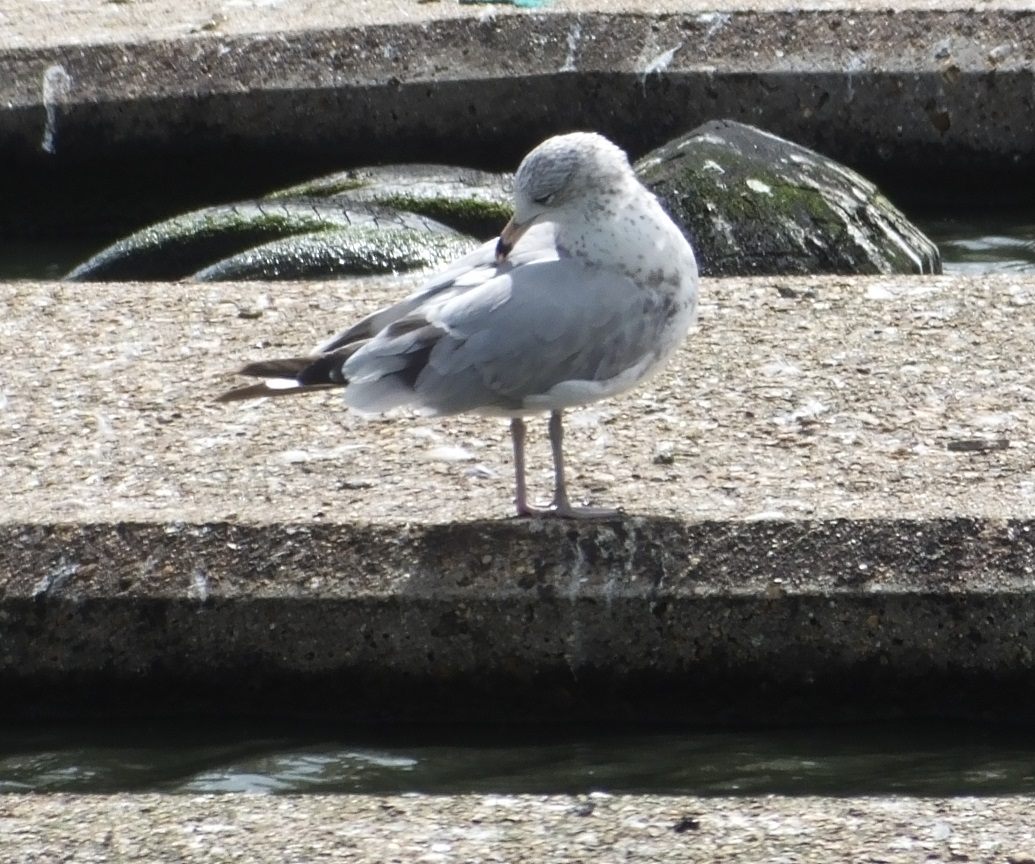
First three pics - camera

Next four digiphonescoped
One first summer moulting into second winter all American Ring Billed Gull (173) - almost to the inch from where we saw our first one way back in 1991. Lightning certainly does strike the same place twice!
It might be the 'easiest' American species to find over this side of the Atlantic, although some might say Pectoral Sandpiper is, but it's very welcome all the same.

Where to next? Not sure what's on the menu tomorrow
in the meantime let us know who's crossing ponds in your outback.


Wednesday, 8 January 2014

Weird or what???

The Safari invites you to have a look at these gull pics sent to us last night by LC from one of his local sites in the Midlands - he didn't say which one. At first glance it looks like a Ring Billed Gull - good find!
The keen eyed and laroholics amongst you will already have spotted it's not quite right for a Ring Billed Gull but what is it. It's mantle is far too dark and look at that tertial crescent way too wide for an RBG.
The pics aren't up to his usual standard, not sure why perhaps his scope was being blown around by a gale so it doesn't make IDing it particularly easy.
We thought we could make out a bit of red on the gonys on the original full size pics and suggested a small 4th winter Yellow Legged Gull but what about the smaller and slighter, and with perhaps with a better marked bill, Armenian Gull - go on admit it how many of you have never head of Armenian Gulls or at least until Collins ed2 came out? Here some good pics from the superb Ma'agan Michael fish ponds in Israel - wish we'd known about all these different species of gulls when we were studying the waders there way back in 1978, our notes just says Herring and Lesser Black Back Gulls!
No it's not an Armenian Gull - shame - it's something even more odd ball. Apparently it's a hybrid but between what do you imagine? It's possibly a cross between Ring Billed Gull and a Lesser Black Back Gull a bird that was seen in the same general area last year - weird or what. Pound to a penny you didn't get it, we certainly wouldn't have come up with that combo. How on earth did they get to hook up - is there any evidence for it in North America where Lesser Black Backs are starting to spread quite widely? Common Gull might be the more a more natural thought but obviously the RBG didn't think so, maybe they aren't as closely related as they look, but it has happened! Or is it that gulls are just the new ducks?
So there you go a few minutes of your time wasted on a load of waffle about some really iffy pics. Fun weren't it! If you have anything to add please do.
Nothing to report from Patch 2 or anywhere else in Safari-land for that matter.
Where to next? No early Patch 2 visit tomorrow morning and not sure about lunchtime either.
In the meantime let us know what's making a mess of the sensor on the cameras in your outback.

Monday, 30 December 2013

The pemultimate day and it's neck and neck-ish

The Safari is still one species behind Monika in our annual birding challenge as we're sat here rattling away on the keyboard typing this rubbish the rain is lashing horizontally against the sitting room window so there may be little chance of getting out today to get those all important two species - always assuming she hasn't been out birding an got lucky over the holidays and not reported her find(s) yet.
We had a chance to draw level yesterday when we visited the family on the South-side and took them down to the beach to look for the Ring Billed Gull which has been seen there late afternoon for the past few days. Today the gulls were well down on the tide line and although there were a lot of them an it was 'probably' there we didn't have time nor a scope to go through them properly so we dipped out. The nieces and nephews had great fun helping to further demolish the storm damaged dunes.
The drive back from Yorkshire gave us a flock of about 30 Red Grouse fly over the car, possibly the most we've ever seen in one place at one time, the culprit for this airborne spectacle was a soaring Buzzard - ooohhh errrrr, good job it was over National Trust land and not a shooting estate but it's probably still not safe. A little further on we spotted a splattered Red Grouse on the side of the road and half expected a gamekeeper to be hidden behind the roadside wall taking pot shots at the passing murderous traffic!
Another Buzzard was seen over the edge of the moor as we neared civilisation and a third in inner city Manchester as we sped along the motorway. A fourth was also seen, this time near Liverpool on a the motorway verge lamp-post. Just one Kestrel was seen all week, not long after the last Buzzard. A Buzzard was also seen near our farmhouse over an active grouse moor. Our last early morning 'out' with Frank at the farm gave us a calling Little Owl from the neighbouring farm.
At Ma 'n; Das the recent purge on trees by the newer residents in the street has left the area looking very bleak and open compared to the view we had from our bedroom window in our early teenage years - no chance of the regular Tawny Owl that used to sit on the telephone pole outside the bedroom window anymore. A Mistle Thrush on a neighbours chimney was a reasonable sighting, our garden notes from 1977 suggest they were infrequent back then.
So we have one day left to get that last speccies...or two - that'd be good!
Locally we have a chance tomorrow - weather and Land Rover permitting (will it start after a week being parked up in the cold and damp) - of some of the 'supposedly easy' species that somehow we've successfully managed to avoid so far this year like Smew, Scaup, Barnacle Goose, Corn Bunting, Short Eared Owl, Hen Harrier and Brambling. And then we missed all those Glossy Ibisssss.
After a week away a check of the feeders here at Base Camp revealed we'd had hardly any visitors - not good.
Well if we don't get that last one or two species there's always next year, and don;t forget it's just for fum the important thing is we both enjoy whatever wildlife experiences come our way and neither of us know what they might be in 2014.
Where to next? Garage for the Land Rover's jump leads!!!
In the meantime let us know what was missed that shouldn't have been in your outback.

Monday, 16 January 2012

Real winter arrives; but for how long?


The Safari woke up for the third morning in a row to a crisp heavy frost. Hardly last winter or even the winter before but for this 'winter' it’s as cold as it’s been so far.
A quick dash round the first half of Patch 1 only gave us a few Robins, ticking again now that its gone colder rather than singing like they were last week, three Blackbirds were arguing over first dibs on some crumbs thrown on the verge, Frank nearly had the final say! At the Golden Triangle the now regular Song Thrush was giving it plenty...always a pleasure to hear.
At Patch 2 the tide was well out but the beach was almost devoid of life, barely a gull to be seen. But we spotted a bit of movement by the side of the outfall pipe and counted a site record 92 Knot feeding away in the slimy oozy mud to be found there. A single Turnstone clambered about through the encrusting Mussels on the top of the pipe while with the Knot there was a lone Sanderling. Oystercatchers weren’t counted but there weren’t that many anyway.
At sea despite the excellent early morning visibility and light swell we only had a couple Great Crested Grebes and scattered small flocks of Common Scoters – pretty much an empty sea.
By lunchtime the tide was rising and the Knot’s feeding area was covered so they had left, nothing else was on the beach apart from dogs and their owners – by the look of the prints in the sand it had been a busy morning down there with bikes, horses, dogs etc etc all leaving their mark.
No sign of the wished for Ring Billed Gull that had followed the tide up yesterday further to the north – how we’d like to find one of those on Patch 2; it’s a long time since we’ve picked one out at the nature reserve too – again we were hoping the roost on the ice might have given us a slightly higher than 0.00000000001% chance – there’s one at the southern end of the South-side too, unless it was the same bird relocating a little northwards.
The glare of the sun on the water was too strong to safely look southwards at lunchtime but for the rest of the sea there were scattered flocks of Common Scoters everywhere, probably in excess of 500. Two Great Crested Grebes were close in a few hundred yards apart with three more together at some distance out. Four Red Throated Divers were seen – not the most inspiring session.
A fisherman arrived for his high tide session and told us that there were several Rays (Thornbacks?) washed up at our southern border; unfortunately the Land Rover was in dock today undergoing the first installment of its MoT repairs so we couldn’t nip down for a look-see. With a bit of luck they might not have been washed away too far by the tide and our marine biologist friend D will be able to investigate after work now that the nights are starting to draw out a bit...find out tomorrow morning if she's been successful.
Where to next? Have to make the most of the calm conditions at Patch 2 tomorrow as by Wednesday the weather is forecast to back to its normal wet and windy self.
In the meantime let us know what desperately hoped for species wasn’t seen in your outback but snuck in round the back a little ways off.
Sorry no pics today - a gorgeous sunset tonight but just as we were getting the camera we had a call to collect the Land Rover - more repairs tomorrow...:-( So have a blimp at this one from PL he took yesterday while we were chatting, this one shows the dedication of a real laridophile.