Showing posts with label sawfly. Show all posts

Wednesday, 3 June 2020

Highlights from Weeks 9 and 10 of not-really-lockdown-at-all-anymore

The Safari has spent a little more time away from our immediate area now that travel restrictions have been lifted but we've still not bit the bullet and ventured very far away from the Fylde coast. With summer-like weather conditions many places have been bombed out by 'Covidiots' getting far too close to one another in huge numbers so we've played it safe and kept well away, we're quite happy not to risk becoming a statistic in the Second Wave.
A pleasant morning on the dunes early in Week 9 had us looking for lizards, only two very brief sightings, and butterflies which were more obliging in that the few we saw did actually keep still.
Common Blue
While we were there the biggest butterfly in the world turned up and flew directly over our head as it did a few training passes practicing almost landing at our small airport.
RAF A400M
In recent years we've not been seeing many Small Heath butterflies at all an it's been several years since we last got a pic of one so we were especially grateful to see a good few today particularly this one that settled long enough for a quick snap.
Back on the cliffs one morning we watched an angler bring in a Bass, too small to keep so had to be returned to the sea. However, his treatment of his catch was abominable. He left it flapping around on the concrete for nearly five minutes while he faffed around getting a new rig back in the water. Surely as an angler your first responsibility is to your catch whether you're going to take it homer for tea or release it back to the water.
Bass vertebrate photo challenge #149
But this chap seriously abused the fish while trying to unhook it. There's a cloth there could he not have held the fish to get a good look at what his disgorger was doing rather than trying to flick the hook out while the fish was in mid-air with the inevitable gravity-induced consequence when the hook did eventually dislodge.
The poor fish's traumatic time wasn't over even then. It was dropped over the wall probably onto the sloping concrete apron below as the tide was on the ebb, the guy never bothered to check never mind walk the 15 yards to the nearest steps and gently let it swim off. Disgraceful behaviour and sadly he's not the only one to act like that.
Fortunately the fisherman who caught this Lesser Spotted Catshark had it unhooked and back in the sea within two minutes.
Back at Base Camp it was good to see a brood of two recently fledged Greenfinches in the garden. This one hasn't quite got the hang of feeders but you'll be pleased to know it sussed how they work not long after the pic was taken.
A safari to Marton Mere gave us the opportunity to take about 300 snaps of the Swifts cruising around about double tree-top height just to get this one almost usable shot. We've hardly seen any Swifts this year and it's fair to say we've seriously missed the screamy sky-scthyers.
Photo Year List Challenge #150
Another bird we've not seen many of is the Kestrel so it was nice to have one fly past us quite low down, might have helped the composition of the pic if it wasn't quite so close and was coming towards us instead of going away but hey-ho a little stunner whichever way they're going.
Not far away deep in the undergrowth a Wren blasted out his song and for a few brief moments sat out in the relative open. It always amuses us that something so small can produce so many decibels.
Getting back towards the car the farm buildings had a few Swallows and House Martins tazzing about, trying to get one in good light was another matter
House Martin PYLC #151
During week 10 we spent more time in the garden watching the bee hotel where the Blue Mason Bees are still active. The males hang around resting on the nearby plant pots in the sunshine 
waiting for new females to emerge, like this one that's pushing a blob of the mud seal of its cell in front of it.
The Red Mason Bees are still busy too. So busy they have to cleave their growing brood cells backwards and upside down.
Beneath the bee hotel our God-only-knows-where-they-came-from Madeiran Orchids have come into full bloom.
Back at the bee hotels there's been a lot of interest in them from this parasitic wasp, Sapyga quinquepunctata. We've seen it several times hanging around on the sides or tops of the hotels, it seems to be waiting for the right moment to make its dastardly move.
Always keeping an eye open for other stuff around the garden we saw this Sawfly land on a nearby rose leaf where it appeared to be ovipositing on the top surface of the leaf - we'll have to keep an eye on that particular leaf to see what, if anything, transpires...
lso creeping around was this Zebra Spider, one of several in the garden now.
And noticing a flutter had us chasing this pristine only just emerged Mint Moth round the plant pots beofre it finally settled in a suitable spot for a snap.  Who said moths are just butterflys' boring cousins, this one would knock many butterflies into a cocked hat if only it were 3/4/5x bigger.
In the heat we decided to take the mutt round Heron's Reach where he could stay a little cooler in the shade of the trees. We were surprised to see so few bees and butterflies around the flowers - has the very dry weather affected nectar production? There were some good sightings though including our first Emperor dragonfly which flew off as soon as we lifted the camera - many thanks to the photographer who pointed it out to us. We did get the lens up in time for our first Azure Damselfly pic of the year.
Chiffchaffs were singing all over the shop, by the time we'd realised we'd heard about half a dozen we thought we really should have been counting them - similarly the Blackcaps too, just how many are there round there these days?
Back with the invertebrates we saw this damselfly in somewhat lumbering flight and once it settled could see it had captured a rather substantial prey item.  Once stationary we could see it was a Common Blue Damselfly and not another Azure Damselfly.
We'd seen a Large Skipper butterfly sitting on a small patch of Nettles and while trying to get a pic managed to disturb it and then not be able to relocate it. But while trying to re-find it we spotted this unusual beetle. We managed a couple of half decent phone pics and later discovered it to have the rather long winded name of Golden Bloomed Grey Longhorn Beetle and that it could be the first record of the species in the Fylde.
Further on a Song Thrush sat up nicely for us.
A very good morning's walk but the mutt did get too hot despite being in the shade of the trees most of the time - it was a very warm day!
Back at Base Camp the Sapyga quinquepunctata was still to be seen lurking furtively around the bee hotel.
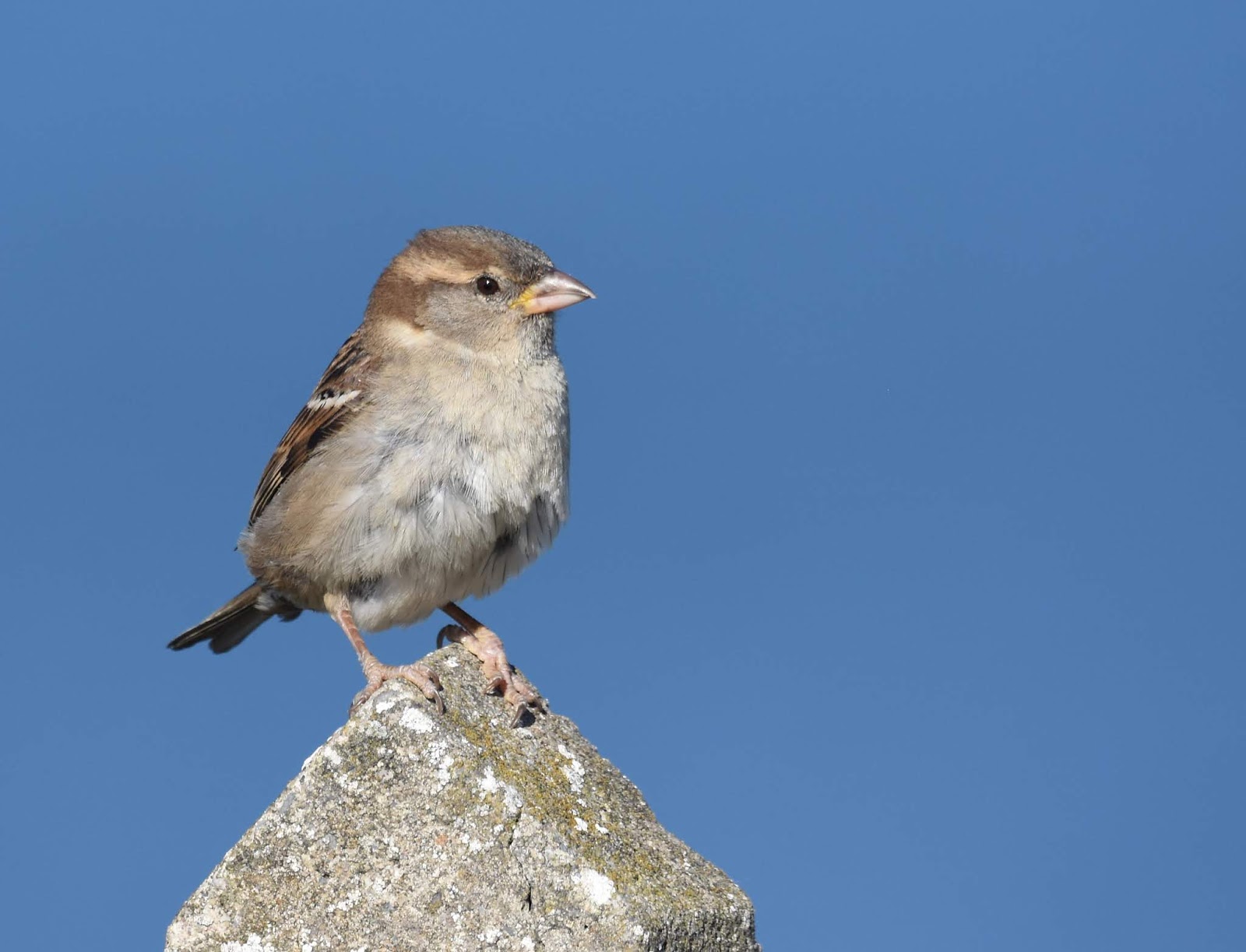
Bottlenose Dolphins had been seen a couple of morning's on ther trot down at the coast so we gave that a go knowing full well that if we took the big lens they wouldn't show. You guessed right they didn't. At least the local House Sparrows aren't so camera shy. This one has seen something moving in the grass and was about to fly down to snaffle it up to take back to its nestlings across the road. Their eyesight must be phenomenal because what ever it was was too small for us to make out in its beak as it departed - how on Earth did it spot something so small tucked up in the grass from about five metres away?

There wasn't much else about although one of the local Pied Wagtails was very confiding and allowed close approach and for us to get down low for an eye-to-eye shot.
On our return, almost back to the start, we spotted a black dot in the water a long way down towards the pier. We knew what it was and wished it was neared, Our first Grey Seal along this section of the prom of the year - can't believe they've been so few and far between, we would have expected to have seen a t least a few by now given that it's the end of May. But at least it's blubber even if it;s not a dolphin.
Grey Seal PYLC #152
The bee hotel is now under constant attack from the wasp and it's venturing across the front inspecting the holes.
Elsewhere in the garden the pond has been very quiet this year until the last few days when we've been seeing Bumble bees dropping in for a drink...what was that we were saying about the dry spell and nectar production earlier...
We've not had any Blue Tailed Damselflies emerging yet, really hope they've not become extinct in there at the hands of the fish - or should that be mouths of the fish?
The garden did turn up this rather wonderful Red Legged Robber Fly which we though tat first might be one of the Spider Hunting Flies. Turns out it could be another first record for the Fylde although having said that the NBN maps we check on can be notoriously out of date for many species.
Much bigger than the tiny Zebra Spiders that scurry around the trellis is this Tegenara Spider that has set up home in one of the plant troughs by the garage wall.
While looking at more bees coming in to the pond fro a drink we spotted this larva moving around, we guess it's some kind of hoverfly larva but could be horribly wrong.
Another fruitless dolphin search did give is a female House Sparrow to compliment the male from a couple of days earlier.
And finally we managed, or nearly managed, to get a pic of the parasitic wasp leaving one of the active nesting holes in the bee hotel, Blue Mason Bee is the victim in this case.
This type of parasitism is the reason why bee hotel tubes should be at least 10cm deep and preferably 15cm. The females bees are produced at the back leaving the males at the front much more vulnerable to attack but the females are much more valuable to the population as a whole, one male can fertilise several females so it doesn't matter if many/most get parasitised. On the other  hand if most of the females get parasitised because the holes are too short then the bee population will start to decline. So take care when buying bee hotels from the likes of supermarkets and garden centres, make sure they are at least that important 10cm deep. Better still make your own but again you'll need long enough drill bits or bamboo tubes.

So there you have it, plenty has been happening almost far and wide.

Where to next? The weather has taken a big turn for the worse so some of our favourite places further afield may be less busy and we can give them a try.

In the meantime let us know what's been seen in your locked down outback.

Stay socially distant - stay safe.


Sunday, 26 June 2016

Always a good day when you learn something new about nature

The Safari was a bit disappointed to find so little in the moth trap this morning after recent double whammy NFGs, just 10 individuals, almost half of those were Heart & Darts, of only six species. Riband Wave was the only one new for the year.
Mid-afternoon we were able to meet up with BD to have a look for White Letter Hairstreak butterflies on Patch 1, they'd been reported from a reserve in the nest town so while it was 'early' for them it was worth a look. We heard two Chiffchaffs in the main area of the park and had a look at the bottom lake but other than lots of litter, Duckweed and lots of Poecilobothrus nobilitatus flies dancing there was nothing there. At the butterfly zone there were several Large Skippers and a few Meadow Browns, the first we've seen this year, and a couple of very fresh smart looking Speckled Woods. The butterflies were mostly inactive hiding away as the sunshine turned minute by minute to more cloudy conditions.
With no sign of the White Letter Hairstreaks and the top of their favourite tree being shaken round quite madly by the increasing wind we decided to have a look at what else was on offer then wander down to the rough field.
BD pointed out something we've never heard of before, Sycamore Leaf Aphids spread themselves remarkably evenly across the underside of the leaf, usually we think of aphids as all bunched together at the tip of a plant.
Flitting around the grass nearby and generally refusing to stay still was this colourful Sawfly, Tenthredo sp?
We also found a bee that had made a grave mistake!
Not much nectar there mate!
It had probably got caught out by the sudden much cooler, cloudier and windier weather. 
Down at the far end of tthe field BD showed us something else we've not seen bef ore or certainly not noticed if we have seen it before. After looking at a few Yellow Meadow Ants' nests, one of which was huge, maybe about 3 feet (1m) across, he found some Ragwort plants being sucked by aphids white Black Ants in attendance milking them for their honeydew. A closer look revealed the ants had build their nest around the base of the plant, all the better to defend their 'herd'.
The whole base of the plant is completely encrusted with the ants nest
He also found us the first of this year's Grasshoppers and we showed him the local plant specialty Ploughman's Spikenard although it'll be another week before it comes into flower. As in previous years it was sad and upsetting to see wheelbarrow loads of garden rubbish tipped here, as usual mostly all over the big patch of Birds-foot Trefoil smothering most of it so not so many Common Blue butterflies this year - Yet another reason why basic education about the natural history, ecological relationships and what can be found in your local area is so vital.
With no butterflies on the wing now we walked back through the park to the car as a Great Spotted Woodpecker flew past us, the first sighting we've had here since their nesting tree was felled. It flew across the field and landed in the trees at the edge of the park where a Sparrowhawk immediately attacked it and it was lucky to escape - an amazing sequence of events to witness. Going through the wooded edge of the field BD spotted some weird looking fungi growing out of an old felled tree stump.

Later identified by the world famous and font of all knowledge woodland and beyond AB @HesistantWeasel - well if he isn't world famous he should be - as emerging Dead Mens Fingers. The Council's budget cuts have made it necessary to do much less grass cutting and the lower area of the park is no longer a cutting priority and has been left - it looks great, lots of different colours and textures of grass flowing like waves in the gentle breeze under the trees. There were even some kids enjoying playing in it!
Mostly Yorkshire Fog
Just needs a more flowers to make it that little bit more exciting, but after decades of being scalping twice a week through the summer there's probably precious few taller species left in the turf.

From Patch 1 we drove a couple of minutes up the road to a site we've only visited a couple of times before. It has - or at least had - Common Lizards but the area they were last seen in is now perhaps too well vegetated, if they are still there hopefully they'll have been able to move somewhere more suitable. Seeing the Common Lizards would have brilliant but they weren't what we were hoping for, that was something altogether rarer and harder to find and probably hasn't been at this site for tens of the best part of a hundred years - well you can dream! What we were after was a Grass Snake! Earlier in the week PT had told us one had been seen at a pond near here and the lad that found it had somehow tried to drown it??? That pond is very isolated so was the ID good, where had it come from, how many are there, are they anywhere else nearby - questions questions. Apparently the ID was correct but the other questions still stand...was it a pet someone had released - where do you get and how could you keep a pet Grass Snake, maybe they didn't like the smell? Anyway we didn't find it, the weather was against us as it stayed cold and cloudy and the sun didn't come out to encourage any that might be there to bask. The pond had a family of Coots and a family of Moorhens as well as a sinister looking Heron - not good news for any nearby Grass Snakes! It was the longest of long shots and of course we were unsuccessful, but it's a site that warrants closer and more regular inspection. 
In the grassy area we found a Meadow Brown that was far more accommodating than those at Patch 1.
And a Nursery Web Spider 
By the pond as we walked through the bankside vegetation we disturbed many Blue Tailed Damselflies and some bright blue ones all of which that stayed still long enough to ID were Azure Damselflies.
From there we went the couple of hundred yards to where the Grass Snake was seen and had a quick look round but the most exciting thing to be seen in the pond was a bicycle wheel.
All good things come to an end as did our time and we turned for Base Camp after a very enjoyable coupla-three hours out on safari not seeing what we hoped we'd see but seeing other wondrous stuff instead.
Where to next? We'll be out n about on safari somewhere tomorrow - but where, that the $64,000 question and probably weather dependent.
In the meantime let us know who's not slithering around in your outback.
 

Tuesday, 21 July 2015

Headed out east today

The Safari picked up BD quite late in the morning after a visit to the docs, we can feel a couple of hand operations coming along in the not too distant future. Our plan was to hit the high roads of the eastern hills and see if we couldn't pick up a couple or three year birds and find some other interesting stuff too.
All was going swimmingly until we got stuck behind an fully laden articulated tanker truck on the narrowest of country lanes, OK a bit of patience was required but every bend had on-coming traffic and some folk don't know the width of their vehicles! We lost a good ten minutes or more of valuable safari-ing time before the driver was able to let us past safely.
We got close to the turn to our destination and saw 'Road Closed' - darn it! Last time we wanted to come this way the road was closed for repairs too. An alternative had be found and quick. Fortunately BD has never been to this area before so we decided to bunk into the valley we used to visit regularly with Wifey and Frank when he could walk that far.
We parked in the village car park and had a wander to the river bank. We hadn't been out of the Land Rover more than a couple of minutes before the first Clegg came sniffing round. Out came the insect repellent; we'll be glad to get back to work tomorrow to allow the DEET to drain out of our system!
Once fully DEETed up we set off on our walk up the river and soon came upon a bush covered in caterpillar webs. On closer inspection little white dashes all over the outside of the webs were in fact adult moths, perhaps only just emerged.
There were hundreds of them and they were easily disturbed by the slightest movement but didn't really fly far before settling again.
We're fairly confident they might be Bird Cherry Ermine moths.
Like the Cleggs yesterday the Red Soldier Beetles were also out on the Creeping Thistles again today.
A Garden Warbler sang from a tree which also had a Blue Tit and a Robin.
It didn't take too long to find one of the alternative site's specialities, Heath Spotted Orchid.
There were lots of them along the trackside, only trouble was when we got back to Base Camp and looked them up in the Lancashire Atlas we discovered they were Common Spotted Orchids; Heath Spotted now only occur in five restricted areas of the county and this isn't one of them - dohhh.
Buoyed by our 'success' we pressed on onwards and upwards. A tatty Sparrowhawk cruised along the tree tops to our left and to the right we saw a Kestrel which when coming towards us looked so much like a Peregrine we made a schoolboy ID error. It flew around in an agitated manner for a while then went back from whence it came and had a tussle with another bird of prey hidden in the Heather. But what was it? B took his big camera over and fired away as we couldn't see anything with our bins.
Whatever it is it's up there somewhere
What raptor did we see that could be hiding up there? A Hen Harrier perhaps? With no apparent joy we continued up the hill briefly stopping to get out of the rain behind a shed where B found a small Puffball just protruding through the grass
Looking at it closely and cutting it open inside was a slimy greenish sludge - euchhh, not like the firm insides of a Giant Puffball.
We looked for Common Lizards on the stony walls and doing so spotted a wasp around a patch of Figwort, it didn't look quite right for a normal Common Wasp so we both took some pics. 
It didn't give itself up lightly
Again once back at Base Camp it was identified via Twitter by none other than Richard Lewington, he of the field guide illustrations fame, as Figwort Sawfly which B discovered was a first for Lancashire until a few minutes later CR piped up with a not so fast me hearties, he's been waiting for confirmation of one he put on iRecord from the nature reserve a couple of years ago - the race is on!
We were looking at something and nothing, possibly the tiny flower Tormentil, when B called out 'lizard!', he'd only just gone and found his first ever British Common Lizard. Were very close to it and it disappeared down it's hidey-hole before we'd caught a glimpse of it and long before any cameras could be pointed in its direction.
A little further up the lane the Kestrel was back and appeared to be calling loudly.
It flew off and the calling stopped but we weren't convinced it was the Kestrel, it was something else, a very anxious Common Sandpiper was in the stream close by not at all happy that there was an aerial predator in its territory.
At the water's meet we watched House Martins, Swallows and a few Sand Martin's cruising around in the rain over the big weir. Looking down into the river we could see no fish in the strongly peat stained water. The water gets pulled off for drinking in several towns a few yards down stream and we pay in our water bills to have it cleaned. The staining comes from the over drained moorland used for driven grouse shooting. Surely the polluter should pay not us, even if their name does begin with Duke of....time for you all to support this year's Hen Harrier Day even if you're not a birder or don't care about the concerted illegal killings of a protected bird the actions of a few affect the many in several ways, mostly in our pockets, increased flood risk insurance premiums, climate change risks and all to kill as many Red Grouse as possible in a short a time as possible for as much money as possible.
Rant over - there was an impressive bull in the field by the weir - we're no cattle expert but we think he's a Belgian Blue or at least a BB crossed with something. Whatever he is he's a bit of a beast.
The rain came down heavier making the valley round the corner rather less photogenic than it usually is. Those cut fields have been silaged, in the old days they'd have been hay meadows and full of a huge variety of of wildflowers, now they probably contain Rye Grass, a few Dandelions and a Chickweed or two.
This is a one way in same way out walk and the way back was against the rain, we were soon soaked through.
Our friend the Kestrel was on the ground on a nearby Heather clad hillside.
Overhead soaring higher over the fellside was our third raptor of the day, a Buzzard...is it just us or are you seeing fewer Buzzards than expected?
The rain continued to pour down as we looked on the bank where the Common Lizard was and lo and behold it was still there despite the downpour. Again it did a bunk as soon as we spotted it and with the rain cameras were well tucked away so there was no chance of a pic. This is the closest we could get to it.
There were a few soggy sheep about too.
More plants were noted after our botanising trip on Friday when we found some different species of St John's Wort, here was a new one Square Stemmed St John's Wort.
Back at the Land Rover our safari wasn't quite over, a Mayfly was on the side of the car as we unlocked it.


Once again great wildlife and good company to enjoy and share it with...and no we didn't see any Hen Harriers, the mystery bird up the fellside turned out to be another Kestrel.
Where to next? National Whale and Dolphin Watch is coming up starting this weekend, hope the weather isn't too windy - see you there - - look under Cheshire, don't ask!
In the meantime let us know if there's any Hen harriers in your outback...ohhh there isn't why not??? Please sign the petition, let Them know we care and won't be fobbed off!