The Safari was very pleasantly surprised the other day, wehappened to be looking out of the window when a family of Greenfinches dropped onto our feeders. That might not be a big deal to many readers but they were the first actually IN the garden since we moved here 2 1/4 years ago, our only other records have been single fly-overs in each of the previous autumns. Unfortunately two off the feeders were empty, the House Sparrows are eating us out of house and home at the moment, and the only one that was nearly full was the nyger feeder, the holes of which are almost definitely to small for a Greenfinch to get its chunky beak through so it was unsurprising that they didn't stay long - we wonder how long it'll be before we get our next IN the garden record.
The following day we had another surprise, a fun one but at the time not so welcome. We've had a pair of
Herring Gulls nesting on the roof again this year and thankfully neither of the chicks have fallen off and had to be chucked back up. Both chicks fledged successfully, unlike previous years when only two out of the three survived to fledging. One of them had returned overnight and in the morning we found it our small wildlife pond have a right old sploosh.

Whether it had deliberately flown down for a bath or got blown off the roof and decided to make the most of a bad situation we don't know. We do know that it struggled to get enough lift to fly over the fence in the morning but a stronger breeze blew up after lunch and when we went to check on it it had gone saving us having to get a soft blanket to throw over it and take it to the beach.
The recent more settled weather also encouraged us to get the moth trap out. The selection of weather forecasts we look at suggested a dry muggy still night so there should be a good chance of a decent catch. No such luck, when we got up the following morning we saw it had rained overnightand the trap was very wet inside, fortuantely the electrics hadn't blown or tripped out. The catch wasn't anything to write home about either just nine moths of only six species. However, one of them was a new species for us, the tiny
Argyresthia geodartella. A stunning shiny wee beasty, it's a shame that some these micros are so small and overlooked by 99.9% of the population; if only they were the size of butterflies then those folk would be able to see how absolutely wonderful they are and might appreciate them more.
The following day CR very kindly took us to Brockholes at the other end of the motorway just beyond Preston where we'd arranged to meet up with IH again. We arrived first and had a few minutes to wait so headed to the floating visitor centre to look for
Roe Deer and
Great Crested Grebes from the open air viewing/pinic area. There was a single distant Great Crested Grebe but there could have been more
Roe Deer than there are
Wildebeest on the Serengeti, the vegetation had grown up so tall anything smaller than an
Elephant would be impossible to see - one of the few woes of summer! The floating platform makes for great fish watching when the water is still. There's a large shoal of either
Roach or
Rudd or probbably both right under your feet no doubt waiting for a passing sandwich or pie crust to be dropped in.

While we waited for IH to arrive the
Great Crested Grebe came a lot closer but sailed right past us.
But then it did the decent thing and caught a fish, a
Dace by the look of it.
And took it off to its young at the far end of the lake.
IH appeared as the grebe paddled off into the distance and likewise the three of us would toddle off into the distance starting with a wander along the riverbank. Before we got to the riverbank there's a bit of a woody patch to go through which gave us the first of the many millions of IH's least favorite plant, Himalayan Balsam.
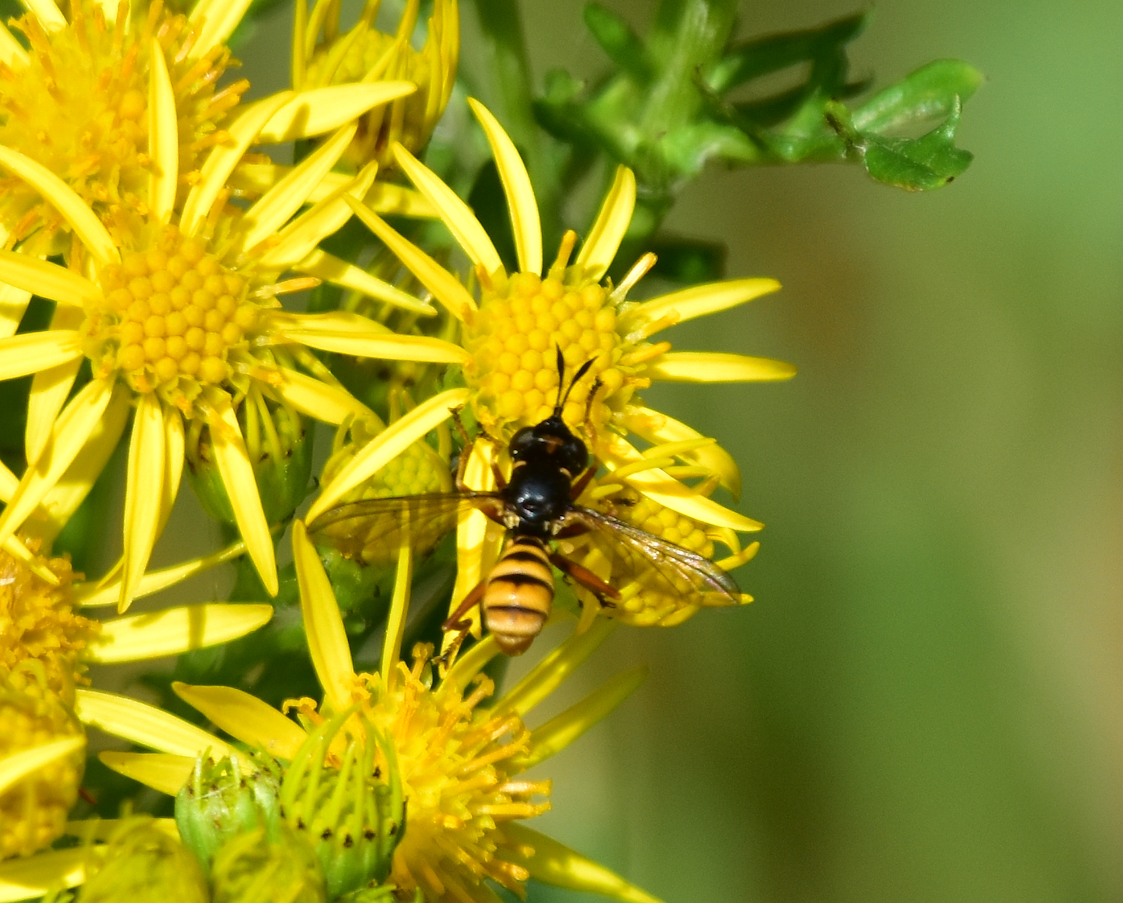
A Common Darter dragonfly and then a female Black Tailed Skimmer landed on the path for a bit of warmth but we were too slow for a pic. Would these early dragonflies and their kin bring out one of the day's target species? A yard further along the path the sun shone on a little glade where several insects buzzed around a few Ragwort plants. We looked for Cinnabar moth caterpillars as we've not seen any so far this summer. None to be seen. Among the mostly Eristalis sp hoverflies around the flowerheads was a small black and yellow 'wasp'. On closer inspection it wasn't a wasp but a Conopid fly, probably Conops ceriaeformis.
Back under the dappled shade of the trees a
Speckled Wood sat on a leaf wonderfully backlit.
Along the riverbank we hoped to find an Osprey but didn't, at least IH was happy to see his first
Heron of the morning. As the morning warmed butterflies began to flit around the grassland, mainly
Meadow Browns and
Gatekeepers with a supporting cast of a couple of
Red Admirals and, a little more surprisingly, a
Painted Lady. A female
Mallard dabbling mid-stream in the river turned out to be a
Shoveler when we looked through our bins, what an odd place for one of those with all the still water around the site, not really a species you associate with running water.
Just away from the bankside vegetation CR found this pait of mating
Gatekeers
From the riverside we walked up the hill back towards the main path and a specific location for the other of our main target secies for the day. Slowly walking along the edge of the trees we heard a Whitethroat 'chrrrrr' from the solitary Hawthorn bush in the field behind us but that;s not what we were after. We really wanted to find a little bronzy butterfly, a bit like this Small Skipper but one that flies much higher.

Bizarrely this was the only skipper we saw all day, there should have been loads of them in the grassland we'd just walked through. Anyway there were quite a few Meadow Browns and Gatekeepers to keep us occupied as well as a couple of Large Whites and Small/Green Veined Whites too - the now strong warm sunshine meant butterflies weren't for settling much. And then we spotted our quarry, small, fast, bronzy gold and high up towards the tree tops, it can only have been a White Letter Hairstreak and a few minutes later a second (or the same one doing a circuit) flew past us at height. Leaving the other two patrolling that area of treeline we went on a bit further to the White Letter Hairstreak hotspot by the bench and path junction in the hope that one might get altitude sickness and come down to our lowly height for some nectar but when we got there we knew this wasn't going to happen as there we no Thistles in flower and all the Brambles had gone over to become proto-blackberries. We walked back to join CR and IH to learn they'd had no further sightings. Not the best sightings we've ever had of these elusive little butterflies but a bit of a relief in a funny old summer to know they are still about.
The cool of the woods was a welcome relief from the now blazing sun, at this time of day and at this time of year the birds go very quiet and there was little to be seen or even heard. Logs tied to trees provided an interesting diversion.

We assume they are to attract
Willow Tits. As the logs rot the
Willow Tits will be able to excavate a nest cavity as they do this rather than use an existing hole like other members of their family. The trees with logs were all
Poplars, a very soft wood that should break down pretty quickly. Even if no
Willow Tits appear,we're not sure if there are any in this area, the logs will be great habitat for a wide range of invertebrates. Coming out of the woods past the smaller pools it was very hot it was very noticeable how few insects were about even on plants like
Hogweed which are normally teeming with life. A handful of
Common Darters and a few
Brown Hawkers were the only dragonflies we saw and they were keeping low over the vegaetation, what we wanted were some high fliers waiting to be picked off by a
Hobby (or two!). There were no dragonflies acending to any height at all which would suggest there were no midges or other aerial plankton up there for them, no
Sand Martins either (or
Swifts or
Swallows) again suggesting a lack of food up there. Even the butterflies along this stretch of the path were limited to a handful of
Gatekeepers (below) and
Meadow Browns.
The corner where the open path turns back into the woodland was busy with a family of
Chiffchaffs, the youngsters keeping ma n pa busy collecting and delivering tasty morsels to hungry mouths, a
Treecreeper briefly flitted through too.
At the first viewing screen overlooking the water there were no birds in sight so we checked the path edges for invertebrates and found this rather unusual form of Gatekeeper. We've had a good ole trawl through Google Images and Flickr and found only a tiny number showing either two black dots on the forewing or the small white centred dot on the hind wing and none showing both these features! It's a female too with no scent brand on the forewing.
Rejoining the main drag a little way along was a bit of a clearing on the right with some big white blobs at the back, a look through the bins revealed them to be massive, really massive fungi. It's hard to tell if they're growing on a fallen log or out of the ground but they are certainly impressive, each one being well over a foot in diameter. We're useless at fungi so we've no idea which species they are.
We were now getting towards lunchtime and thoughts were turning to the joys of pies and other goodies but there was still a couple of hundred yards to go before we got back to the cars. We'd not gone much further when a small white moth landed on a leaf right in front of our noses. It turned out to be a Bird Cherry Ermine, we should have cast our shadow over it when getting the pic, we never realised how reflective they are, it didn't look anything like that reflective to our naked eye.
One more viewing area overlooking the lake to visit before we could lay our hands on our butties. Here the nesting raft for the Common Terns looks more like some kind of prison but the terns seemed to like it.
There were still at least four adults hanging around but no sign of any juveniles so we don't know if they've been successful or not this season. Out on the lake there was a flock of a dozen or more Tufted Ducks, another pair of Great Crested Grebes with a youngster, too many Canada Geese and a good few Mute Swans. The island held several Lapwings and a noisy Oystercatcher.
With nothing close enough for his lens CR had taken hinself off to check the sunny path edges for macro subjects and called us over to have a look at a good find, probably a
4-Barred Major fly,
Oxycera rana. Another wasp mimic.
A quick look at the
Sand Martin nesting bank didn't give us any photo opportunities although if you look closely there are two juveniles peeking their heads out of their burrow right of centre.
Lunch now called more strongly than wildlife!!!
After feeding our faces we were off again and on route to putting our bags back in the cars we passed a couple of 6-Spot Burnet moths having a tussle over a Creeping Thistle flower. There should have been many more insects on this flowery bank but it was almost devoid of other invertebrate life.


Walking back to the the lake we'd just left for a look from tyhe big Lookout hide we stopped when CR found a small number of Cinnabar moth caterpillars on their Ragwort foodplant. These were the first we've seen this year and not for want of looking there just aren't any around Base Camp despite there being plenty of Ragwort. We've not seen an adult yet - is this going to be the first year in probably well over 50 we've not seen one?!?!
Another plant a few feet away had some too but they were the exception rather than the norm as we hadn't seen any on the plentiful Ragwort all morning and that was with keeping an eye out for them since we've not seen any this year.
The afternoon was getting proper hot and more butterflies were on the wing, this
Comma stopped right by us and started to furl and unfurl its tongue.
The only insects we'd seen in any numbers all day were
Eristalis sp
Drone Flies, even they weren't visiting as many flowers as they ought to have been and blue damselflies the lattter not really wanting to settle in convenient places for a pic. When a
Common Blue Damselfly did deign to settle in front of us we muffed the shot a bit.
Along the path coming away from the big hide CR spotted a Swollen Thighed Beetle, a female - without the swollen thighs! A species we don't see on the Fylde for some reason...lack of looking??? A look on the NBN Atlas shows they are a mainly southern species so might not have made it this far north and west yet. The nearest dot to us is here at Brockholes and there are only four dots to the north of us of which only one is a confirmed sighting, just over the border into Scotland

As we mentioned earlier it was getting hot, must have been over 25°C in the sun, the butterflies were flitting about very rapidly. We'd already seen a few Ringlets but finding a stationary one was another matter until this one kindly stopped for us.
Rounding a little bend in the path we stopped in our tracks, a female Blackbird was full on sunbathing right in front of us, all it needed was a sunlounger, sunscreen and a cocktail and it could have been on the beach in Benidorm.
It wasn't for moving but eventually was disturbed by a family coming from the opposite direction, that gave us the opportunity to move on. We were making our war back to 'Hairstreak Corner' when we met JB, a stalwart volunteer at the reserve and keen entymologist, he told us some good places to look for his favoured dragonflies and also that so far this year he'd only seen one, yes ONE, Common Blue Butterfly here, it should really be teaming with them. This year's weird poor weather has had a dreadful effect on our already severely depleted invertebrate populations. Needless to say we'd not seen any here yet.
He pointed us in the direction of a field pond noted for it's dragonflies and on the way to find it we passed a chirpy little Robin.
And then came across the best sighting of the day so far, a
Red Admiral 'feeding' on dung, probably
Fox dung as dogs aren't allowed on the reserve.
This is something we've seen other species do on the telly but don't ever recall seeing it in Britian in real life before. That's one of the wonders of nature, you just never know when you're going to see something new. We found JB's pond and saw a couple of
Brown Hawkers flying over it but we didn't fancy the walk through the thick vegetation to reach it - it just smacked of too many bitey
Cleggs. To be fair we'd hardly seen any all day and folk much more scantily clad than us didn't appear to have bite marks all over their exposed flesh - another sign of the current Insect Apocalypse?
After giving JB's pond a miss we continued to 'Hairstreak Corner' and soon found several
Meadow Browns and
Gatekeepers low down, but we wanted to spot things high up. Which we did after a few minutes, not bronzy gold but paler, we thought it might have been a Holly Blue but IH saw it settle and told us it was a
Purple Hairstreak. It buzzed around a few more times always settling out of view, one of these times it was passed very swiftly by what was probably a
White Letter Hairstreak that disappeared into the canopy never to be seen again. Eventually the
Purple Hairstreak did do the decent thing and find a leaf in full view to rest on.
It's a rare day out on safari when you see two species of hairstreaks even if one of them only gave brief flight views. Our bad hand was now getting swollen and uncomfortable with all the walking and the heat so we made our way slowly back to the cars via the riverside walk. It was busy with summer holiday picnicers now so we didn't linger too long, just long enough to find our first
Banded Demoiselle of the day.
And the last
Heron of the day, although they had been ahead in the Herons v Egrets Stakes they were overwhelmed when a flock of three
Little Egrets flew up river. The river also held a huge shoal of small to medium sized fish which repeated scattered in a surface breaking swirl. We couldn't see a submarine predator and they could have all been trying to chase down a tasty morsel being brought along in the current. We think (=guess) that given the size and number of them they were
Dace. The
Heron was stood in the wrong part of the river! More food than he could shake his beak at was 50 yards up river, or he'd eaten his fill!
On the fishy theme a last look around the edge of the visitor centre didn't give us any more fishy photo opporunties with the big shoal of Roach/Rudd as the wind had now ruffled the water too much. In the more sheltered parts we saw lots of small fry and some very small Jack
PikeAnother day of quality over quantity
left us musing over the distinct lack of insects as we headed back to Base Camp. As for our targets, yes we got brief flight views of the
White Letter Hairstreak but there was no sign of any
Hobbys to add to our Challenge tally so still nine species required for our target.
Where to next? Probably on the trail of more insects up north but anythinig can happen between now and then - keep your eyes peeled folks.
In the meantime let us know who's missing from your outback