Friday, 13 June 2014

Greens, grass n sand

The Safari has been otherwise engaged of late and hasn't had a lot of time to put fingers to keyboard for you. Last night we had another gaggle of brownies on the beach and they had a good session rummaging in the pools and scouring the beach for shells. 

As with the previous evening's group they couldn't catch any of the extremely quick Sand Gobies but we managed to catch them a baby Dab, more by luck than skill and between us we caught what we think might have a been a Sand Smelt, not sure how variable they are but the general consensus is that that they are pale olive green on the back and ours was decidedly darker than that. No photo as the Brownie who found t was ever so possessive of it and wouldn't let us anywhere near it with the camera, wouldn't even allow us to transfer it from here castle shaped blue bucket into one of our larger white ones for a better look at it.
A crab they picked up caught our eye too having great big flat paddles on its rearmost legs, obviously a swimming crab of some sort but with a broad carapace not the 'usual' Pennant's Swimming Crab we find occasionally.
Not the best pics and we're not sure if the blue is true or an artifact of the camera or reflection from the net handle. A species in the genus Liocarcinus seems favourite at the moment.
Now identified as Liocarcinus holsatus
Whatever it is it's the first of its kind we've seen here! Well done the Brownies!
Today we were able to have a little much round the gardens seeing as Patch 2 was pretty quiet. just a Grey Seal and some very hazy Gannets and gulls at a distant bait ball.
The sun wasn't strong but with hazy cloud the light was good so we concentrated on the front lawn where the scent from the White Clover is heady.
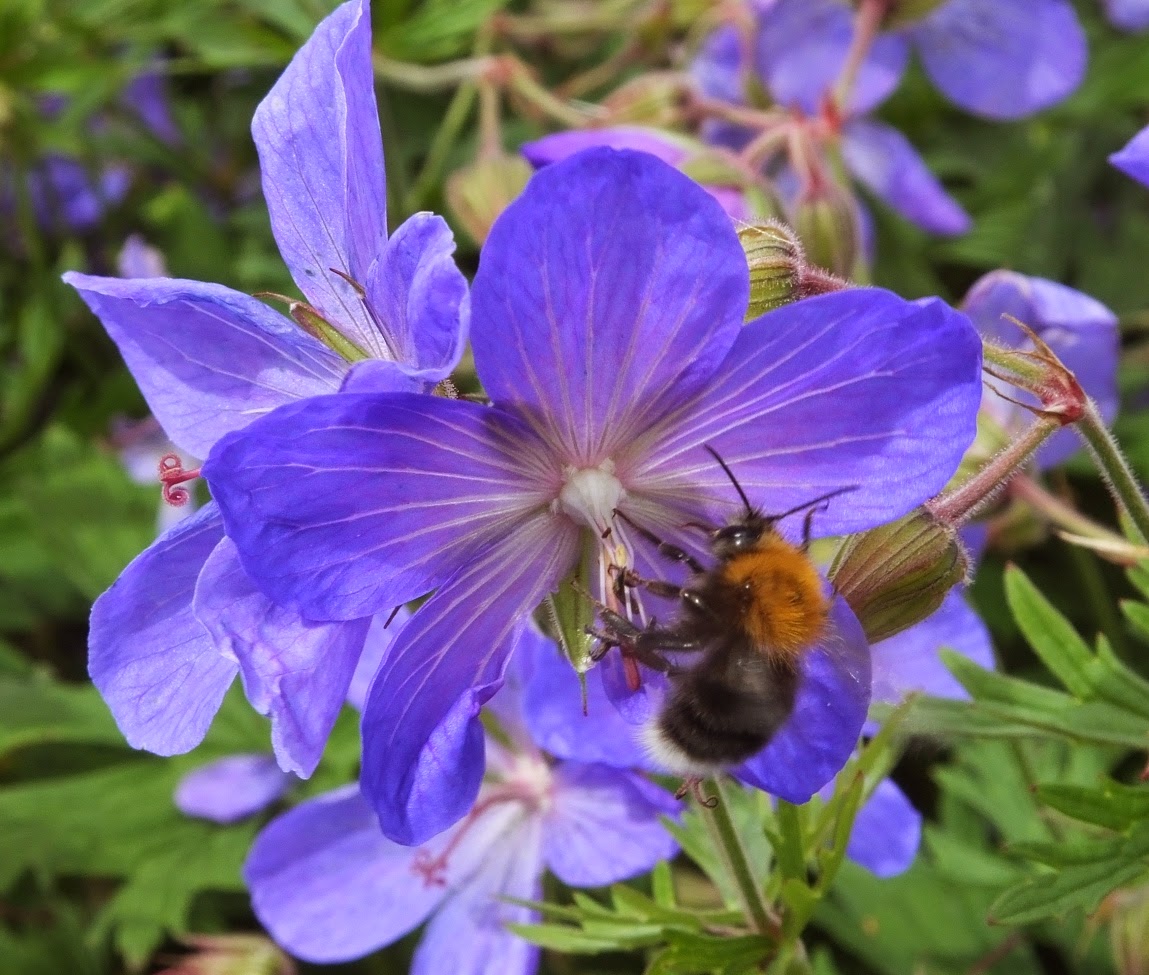
We wandered round the back to the patch of Meadow Cranesbill were the bees were busy, busy, busy.
Bombus terrestris
Male Early Bee - note the yellowy facial hairs
Tree Bee
In our wild garden we spotted a hoverfly doing a good job at  mimicing the Tree Bees
Mooching back round to the front there was what seemed to be a fairly freshly emerged female Common Blue butterfly.
After work we went back onto the beach to watch the tide drop and see if we could find the swimming crab and the dark backed fish again. Neither were findable but there were several whole Sea Potatoes, the smaller ones remarkably still had their hairs, yes for Sea Urchins they are a bit unusual in that they are hairy and not spiky, and our first jelly fish of the summer, a Moon Jelly. 
A walk along the runnel gave us several sightings of the goboes but not of the (?)smelt. We did manage to catch one of the smaller Sand Gobies, took some doing and again was more by luck than judgement.
Lots of Brown Shrimps were netted but numbers were paltry compared to the hordes lifted by the Brownies yesterday.
Not a bad day in the 'field' at all, really enjoyable!
Where to next? The weekend is upon us and the moth trap is out!
In the meantime let us know what was captured at the eleventh hour in your outback.

Tuesday, 10 June 2014

Flash bang wallop

The Safari enjoyed a warm evening of Brownies, Garden Snails, Ladybirds including a 14-Spot Ladybird and Pill-bugs. As they were being dropped off by their parents we saw the light was shining on the pond lighting up one of the Water Lily flowers just nicely. Maybe a bit too nicely for the phone cam to capture - really must work out how to use the white balance on it properly.
All manner of Black Ants, Red Tailed Bumble Bees, Tree Bees, Damselfly nymphs, Greater Pond snails, Ramshorn Snails and 3-spined Sticklebacks were either potted or netted and thoroughly inspected.
Best find of the night was as we were finishing off. The Brownies had dispersed to the playground and we'd put away most of the gear when a Brimstone moth flew past - crikey they can't half go no chance of running after it and catching it up, had us well beat. A very common moth but a real rarity at work - actually it might not be as we're not there at that time of night all that often.
This morning we put an app on our phone for recording bumble bees - so easy to use don't even have to ID the trickier ones down to species level but it's still a great addition to citizen science and getting anyone with a smartphone involved.
We gave it a try round the work's garden and came up with a good tally of most of the main groups apart from Common Carder Bees, loads at Base Camp but not so many at work this year.
Several clusters of plants were festooned with bees, notably the Hebe bushes, our wild garden with its Borage and Perennial Cornflowers and the Meadow Cranesbills at the end of the raised beds.
Here's an Early Bumble Bee on the Meadow Cranesbills.
The warm morning gave way to heavy showers and at lunchtime we got out to Patch 2 to see precious little. A few Gannets were circling around in the distance doing not very much. The showers got heavier and more prolonged and the skies grew darker.
This black menace chased us all the way down the prom before it unleashed a couple of bolts of lightning but sadly not as many as we had hoped for.
Where to next? Last week's Brownies are back again tomorrow evening this time they're on the beach investigating the rockpools.
In the meantime let us know where Thor's hammer is being flung about with gay abandon in your outback.


Sunday, 8 June 2014

Where better to be on World Oceans Day

The Safari didn't get out til late this morning, we rarely do on a Sunday. So the choice was here, there or where. Eventually we plumbed for the cliffs as the lure of the chance of Bottle Nosed Dolphins was too strong to resist.
We decided on a two hour timed watch and in that time didn't see much. A few Gannets mooched about but very little active fishing was going on. A few Sandwich Terns passed by and we saw a small flock of Common Scoters and that was about it, nothing blubbery at all unfortunately.
Not much seen but the 'sea'nery was quite spectacular - it's not often we get the full turquoise treatment here.
Our original's not that saturated; not sure what Blogger has done to it
After a cuppa back at Base Camp we went back out onto the North Blackpool Pond Trail to see if we could find anymore Bee Orchids.
We did, we upped our count of about 16 to nearly 25. Sadly many of those we found yesterday were now broken probably trodden on by dogs running after balls, seems the only people who use this part of the trail are dog walkers and the odd (some might say very odd) plant photographers.
Little stunners aren't they, we never get tired of them. Sady it doesn't look like we'll be able to get further north in Safari-land to see the Ladies Slipper and Fly Orchids amongst other botanical marvels - oh to be retired and independently wealthy!
The warm afternoon sunshine brought out a few invertebrates. Half a dozen Common Blue butterflies were on the wind and we also had singles of Large White and Small Tortoiseshell, we had hoped for a Meadow Brown or Large Skipper - have to wait until later in the week for those two perhaps, they can't be far away now.
This big Sawfly was tucking into a smaller insect but if we'd moved round to get it's face in shot our shadow would have fallen on it and off it would have gone.
Finished it
We had a look at the Cowslips but the seeds aren't ripe yet, as we were walking out of the longer stuff a jump caught our eye - the first Grasshopper of the year, things are starting to come along rather nicely.
Where to next? will Patch 2 produce or not and if not what will the Brownies find tomorrow evening?
In the meantime let us know what's looking all turquoise in your outback.


Saturday, 7 June 2014

Back to wet n windy

The Safari was stuck indoors almost the whole day long today - it barely stopped raining all day and then only for a few minutes at a time. Really we wasted the day doing begger-all. A look at the Springwatch web-cams from time to time, a bit o scoping down the garden at the feeders but nothing really constructive or instructive but at least we won't have to water the garden and the water butts will have been topped up.
With reports of thunderstorms around, can't beat a good bit of lightning, we found this website which shows where all the strikes are - clever stuff - and followed the progression and eventual petering out of the storms across the fens of west Norfolk.

Here's some clips of our bees having a feast of golden syrup, a little too much middle leg waving argy-bargy don't you think!


We don't seem to have many young birds yet. In the morning while out with Frank we see Blackbirds collecting beakfuls of worms but we've seen no youngsters yet. Only the Greenfinches seem to have fledged any young so far cos we've seen a juvenile on the feeders, the Goldfinches visit regularly but only adults. There must be a pair of Robins close by as one is in and out of the garden very frequently often taking sunny seeds but again no speckly young seen yet and it's about this time of year when we see our only House Sparrows at Base Camp when a local family appears briefly at the feeders.

male Goldfinch - phonescoped through double glazed window in the rain
Scruffy Blue Tit - swingin in the rain
It's World Oceans Day tomorrow - even if you're not near the sea you can help keep it clean pee poo and paper only down the loo and watch those fats going down the sink, they harden into fatbergs in the drains and can contribute towards flooding and cross contamination. 
Eat fish? Make sure you choose sustainably caught species. Go fishing? Take your litter home too many don't on Patch 2.
Enjoy your beach, have a paddle or a swim just be careful and watch those tides! Join us for one of our rockpooling or cetacean watching events to learn what's in the 'ocean' here. Follow us on Twitter @DaveyManMcG for news of events.
Where to next? Hmm could be weather related but a sea watch for more Bottle Nosed Dolphins could well be on the cards if it dries up by lunchtime.
In the meantime let us know who's looking a bit rough round the gills in your outback.

Friday, 6 June 2014

Days like this don't come along often

The Safari turned up at work this morning in mild sunshine to see that a Poppy had flowered on the edge of the rough path near the car-park.
It reminded us what day it was today and we thought about how absolutely terrified we'd have been had we been there hearing the machine gun bullets rattlinng off the door of the landing craft that was about to be lowered and let us out and them in...we're a sensitive soul and not the bravest of folks at the best of times.
Our next door neighbour was there, he died a few weeks ago with a piece of shrapnel still lodged in his back. Richard was taught to drive by being shown how to reverse an army truck into a certain sized space - a few short weeks later he was reversing his trucks side by side onto one of those landing craft and was ready to drive them off at the other end of the journey.
Today we salute his many fallen comrades who did what they had to to end a tyranny and give us the freedoms we now take for granted.
Patch 2 was dire, a cold but calmer empty sea, there was nothing out there apart from a couple of Common Terns from the colony in the docks round the corner down the river.
A lengthy morning had us wishing to get out again, if only for some fresh air. The time came and out we went. It was no better, we scanned this way and that seeing nothing but a few gulls on the beach and a couple resting on the gentle waves behind the almost non-existant surf. About to give up we scanned one more time and thought we saw a dark shape, perhaps the fin of a Harbour Porpoise, then we saw it again - not a porpoise but a Bottle Nosed Dolphin!!! Game on, and then there was another, smaller - a fairly well grown calf perhaps. The next half hour was pure and unadulterated joy with breaches, headstands, tail-slaps. In the end we counted at least five and maybe as many as seven. They stuck around long enough for a friend to drive down and join us and we also got a passing family on to them - to the usual 'What??? Dolphins you don't get them round here do you?'
A Grey Seal was completed upstaged by the other mammals and birds were eventually represented by a flock of 10 Shelducks and tow flocks of about 15 Common Scoters each.
Unfortunately all the action was far too far out for any hope of  photos.
Our afternoon at work wouldn't go fast enough either as we had a mission to complete - a bit of a treat for helping out at an event recently.
The appointed hour came and we made our way to the zoo where we were taken to feed the Giraffes - what fantastic creatures, we've always had a soft spot for them ever since Daktari and Animal Magic (if your under 45/50 you'll have to use that new fangled google thingy). we don't know what it is about them, is it the bizarre patterns that are actually fantastic camouflage in their natural habitat, where we'd love to see them one day, or the bizarre gait that makes them look like their moving in slow motion but can easily out run a horse, maybe it's the blue prehensile tongue or perhaps just their calm enigmatic face? whatever it is they sure are wonderful animals and we were privileged to be able to feed them...Brambles and Nettles!!!


Thanks to our host LS for taking all the pics.
After all the excitement we stopped off on the way back to Base Camp and went to search for the lcal Bee Orchids.
It didn't take long to find the first of what would eventually be 16
What a quality day...and then we were told Wifey had some great news too! Time to crack open the Champers!
Where to next? No moth trapping tonight, rain forecast but we might find something somewhere tomorrow.
In the meantime let us know who's browsing on the browse in your outback


Thursday, 5 June 2014

Short n sweet today

The Safari had a short Patch 2 watch today in somewhat wintery conditions, cold wet and windy! not many birds about but was a bit weird...a Common Scoter (wintery), a Red Throated Diver (wintery, a Gannet (summery) and a Fulmar (P2 #59) (don't see many of these at all and it wasn't really that windy!).
Here's a few from the weekend
Snail Killing Fly
Probably Berberis Sawfly
A Barkfly - miniscule
Halictus ridibundus - female
Epinotia bilunana - new for garden
Tachysola acroxantha - new for garden
A cold and wet session pond dipping and mini-beast safari-ing with the Brownies didn't produce much of any excitement - indeed didn't produce much at all, too cold!
Where to next? More from Patch 2 tomorrow and a nice surprise on the way back to Base Camp.
In the meantime let us how many seasons were in your outback today.

PS those pesky bees are drinking over 100ml of golden syrup a DAY!!!


Tuesday, 3 June 2014

National Garden Bioblitz 2014

The Safari had an interesting weekend pottering around in the garden at Base Camp doing a bit of recording of all the natural wildlife we could find for this year’s National Garden Bioblitz.
We participated in the event last year but couldn’t recall how many species we found; we uploaded them to the website but rather remissly didn’t write them all down in our notebook, so we set ourselves a, perhaps slightly low, target of 75 species. It was suggested we might cheat if we got to 99 by counting Frank on the mammal list – we didn’t need to in the end.
There was also something else of interest going on at the same time and related to the fun and games but we can’t tell you about it just yet, it’s all a hush-hush mystery for you to ponder.
Moths were trapped, the pond was netted, bushes tapped, plants are nice and easy cos they don’t move round – much – the birds were a bit iffy as we were wandering up and down in the garden into areas we seldom visit – it’s a jungle up there - and that seems to have prevented some of the regular ones coming in and finding their way onto our list, Wifey’s pots and tubs were lifted and even the old pooter had an outing.
The moth trap was a little disappointing due to the weather overnight, it was too clear and the temperature had dropped, the previous night was more productive.
As the morning warmed up invertebrates started to move around particularly the local bees who have discovered our invertebrate feeder in a big way! Maybe too big a way cos they’re spending too much time slurping Golden Syrup and not doing the pollinating job they’ve evolved to do – actually they haven’t evolved to pollinate it’s a by-product of their foraging they do that the sneaky plants have evolved to take advantage of.
Tally sheets were filled up and it didn’t take too long to pass our target of 75 species, particularly as we had over 30 species of ‘weeds’, sorry - wildflowers, growing in and around the place.
The warm afternoon had us flagging a bit, well we’d been on the go since early doors, but that didn’t stop us having a couple of last flails with the shrubs broom handle over a white tray to see what dropped in...worth it too, we gained our first and only Common Earwig and a few tiny insects barely visible with our naked eye.
In the end we entered 130+ species on to the website after several had to be posted on iSpot for and identification – where would we be without those clever iSpotters, many thanks to them for all their help over the years. Some where instantly queried...like Wood Mouse, Early Bumble Bee and Meadow Buttercup, are they really that hard...
Would you believe it? In that 114 verified species there wasn’t a single Ladybird and a couple of aquatic species we found easily in the pond last year never came to light – surely they must still be in there somewhere.
What was most interesting in the pond was when we were looking for any of the Frogs we disturbed something but didn’t get a good look at that swam very sinuously and as it banked over the planting ledge to dive to depths it showed a flash of orange...ohhhhhhh was that a newt...we thought so and grabbed the net and did some serious swishing but to no avail. 
You might get some pics tomorrow
Where to next? Patch 2 better produce something, sure it will as we have a Brownie group causing mayhem on the beach in the evening.
In the meantime let us know who's causing the ID blips in your outback.