
The Safari is desperate to go and look for scaly and slithery things but despite it being mid April and six weeks into 'spring' it's still very much winter here. Outside the window right now it's blowing a 40+ mph (65 kph) hooley and only 8C (46F), that's the average daily maximum for February! We need some warm sunshine and soon. Last week we did get a bit of a break in the weather although still windy enough to drive us inland away from our local patch. We headed for the relative shelter of Stanley Park where we soon came across several recently arrived Blackcaps singing their heads off. They proved elusive until one eventually broke cover. #131 for our Challenge and on the move again after our hiatus last week.

Also singing were several Willow Warblers, again recent arrivals - bet they wished they'd stayed in Africa another week or so. Like the Blackcaps they too were mostly elusive until just one showed itself long enough to be captured by the camera. #132
 What other goodies might there be??? A Dunnock popped up right in front of us and began to sing, totally unphased by our presence just a few feet away and gave us what's probably our best ever pic of this species.
 Not so subtley hued, one of the many Ring Necked Parakeets that had been flying around noisily all mornning dropped in for a photo shoot.
 Just a few slow paces further on we came acrosss a Blue Tit checking out a potential nest hole.
  All around us we could hear Robins, Wrens and Nuthatches singing but failed to get the camera on any of their number.


After wanding through the wooded area of the park we had a walk down the lakeside path to see if we could see the pair of Great Crested Grebes that had been displaying recently as we'd seen on the good ole social media. No sign of them but the Herons were very active around their nests flying in and out with more sticks or food for hungry nestlings, lots of bill clattering going on suggested the nestlings were anxious to be fed. Some adults fished the margins of the lake while others went further afield into the adjacent countryside ponds and ditches.
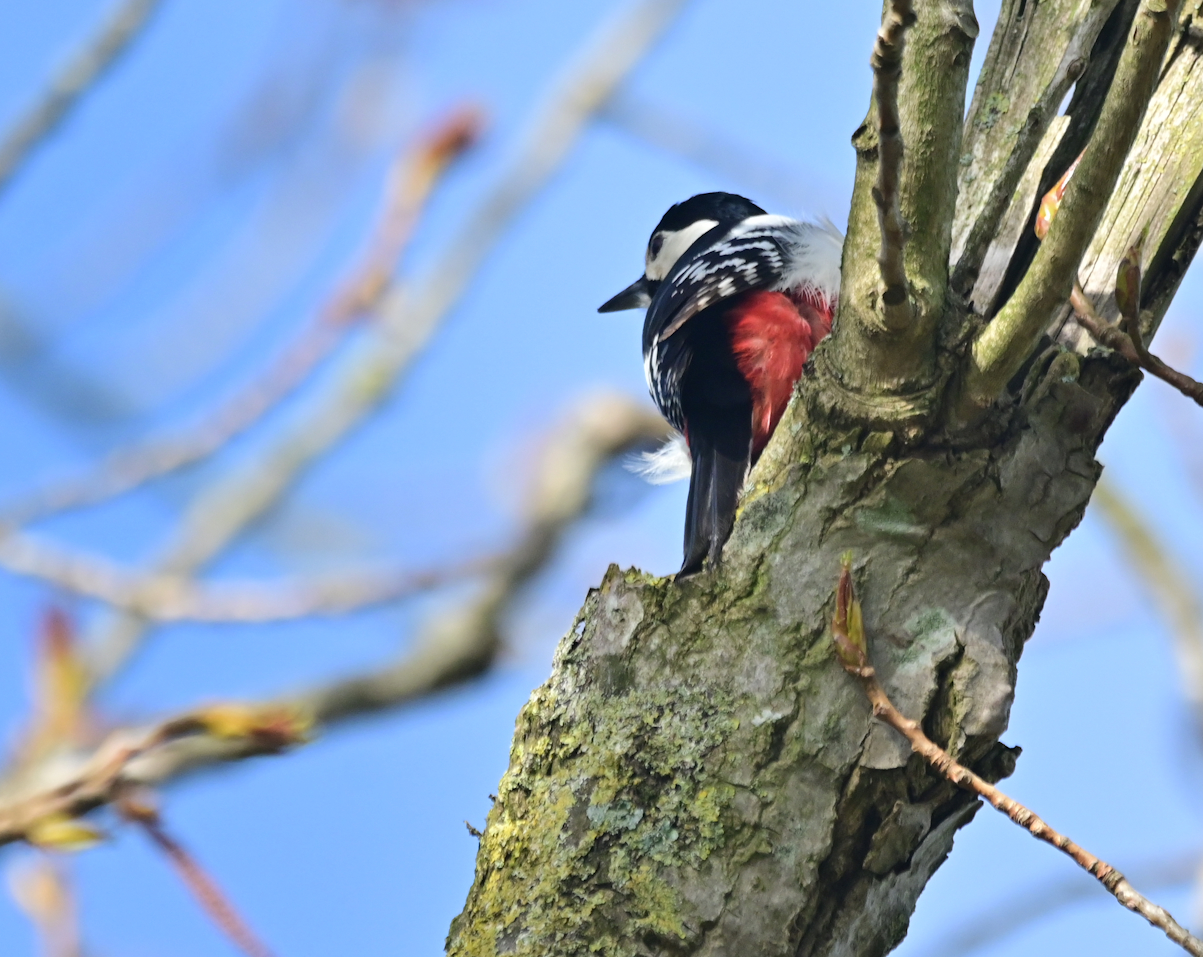
 After circumnavigating the lake we headed back to the car but were waylaid by a Great Spotted Woodpecker investigating a dead snag in rather heavy shade.
 It rattled and tattled, bored and battered the stump for several minutes and then flew off high into a top of a nearby Poplar tree where we briefly lost sight of it until it moved trees again and landed a little more in the open.
 We managed to get a few passing dog walkers on to it. We reckon the woodpeckers are the dog walkers second favourite bird after those darned parakeets which are well down our list of favourites.


Back to base Camp for a bit of breakfast and a warming brew we went; not a bad morning in the park, definitely less windy than the prom and we got two Challenge pics to boot.
Early afternoon news broke of a Ring Ouzel down the coast at Fairhaven Lake, we were in the middle of household duties but thankfully more positive news followed a little later and we loaded up camera and dog and set off. The traffic was a nightmare, what should have been a 25 minute drive took 45. We arrived on site to find a birder peering through the fence into the water board compound where the bird had been seen. He told us it had been out on the grass five minutes earlier but was now sheltering under the expance of solar panels. Nothing for it but to wait...and hope it wasn't too long a wait. More birders arrived and the chatting began until one of our number gave the shout that it was out.

 It didn't come out far and soon went back under again, but happy days, a species we didn't see at all last year. #133. More chattering went on as waited to see if it would come out again and maybe onto the grass to give a more aesthetically pleasing pic but it didn't. However, EJ told us he'd seen a Common Sandpiper around the lake a couple of minutes walk away and as t'mutt was getting bored hanging around off we went for a look see. We looked on the seaward side of the island but saw nothing but Canada Geese and Mallards, then retraced our steps and had a look at the landward side but again just the same and a few Tufted Ducks and Grey Lag Geese, where was it, hopefully not flown right down to the far end of the lake. We decided to have another check of the seaward side of the island as EJ had said it was with the Canada Geese ands most of them were round that side. As we walked on we heard one call from close by and then saw it fly from right under the bank we were walking along - yes it had been unseen right under our nose five minutes ago. As it flew, we do like their stuttery lowing winged flight, a second flew off the island to join it. Unfortunately they didn't land on our side but back on the island which was a bit distant.
 Bit of a rubbish pic for #134 but all in all a good day with four new additions to our tally.


A couple of wild and windy days later news broke of a really good bird at Marton Mere, a Red Rumped Swallow - we'd missed the previous one there some 20 years ago. Again positive news followed so we gave CR a shout and arranged to pick him up. We parked up grabbed the gear and set off at a brisk pace. We were almost at the reserve gate when our phone told us it had left to the west, must have gone over our heads and we didn't see it, to be honest we hadn't seen or heard much as a) our heads were down as we made haste along the path and b) there weren't many birds showing otr calling in the cold stiff breeze. We arrived on site were a small gathering of birders had gathered only to be regaled with tales of you should have been here five minutes ago, it must have gone right over your heads to the park, and such like. But we hung around looking at the Sand Martins flying around with a couple of Swallows, the former a new species for our normal year list. PE turned up and within nore more than a couple of minutes had relocated it, the lovely little thing had swung round and come back. Getting a pic was double tricky we could hardly see it in the view finder as it jinked and turned all over the place. We thought we might have got it when we focused on a Grey Lag Goose that seemed to be on a bit of a flight path for the hirundines but only managed to get a coupel of out of focus Sand Martins in any of the frames we took. #135 The Red Rumped Swallow did a couple more passes then flew high off to the west as it had done earlier and like then returned but only for a brief moment when, as the weaher lifted and the sun began to shine, it headed off high to the south never tro be seen again. An opportunity lost for the Challenge, if we're to reach or even, fingers crossed, surpass our target we'll probably need to get a few odd-ball unexpected species in the next few weeks assuming spring ever starts.

Our next safari was also determined by the weather, we had hoped to go north but the forecast suggested south would be a drier and less windy option so south we went, to Pennington Flash where we hoped there might be some Kingfishers to keep us occupied.
The first hide gave us some nice Tufted Duck reflections


Everything else here was distant and with a self-pact not to take any more shots of Tufted Duck or Grey Lag Geese and with no Kingfishers on offer we moved on to the Feeding Station hide. Here there was no food, either it had all been eaten by the hordes of Grey Squirrels and Mallards or none had been put out as it's alledgedly now spring, or the feeding team couldn't access the feeders cos the ground was badly flooded. A pair of Bullfinches came briefly to the almost empty table, Stock Doves and Moorhens searched the available dry ground for anything remaining but it was mostly quiet.
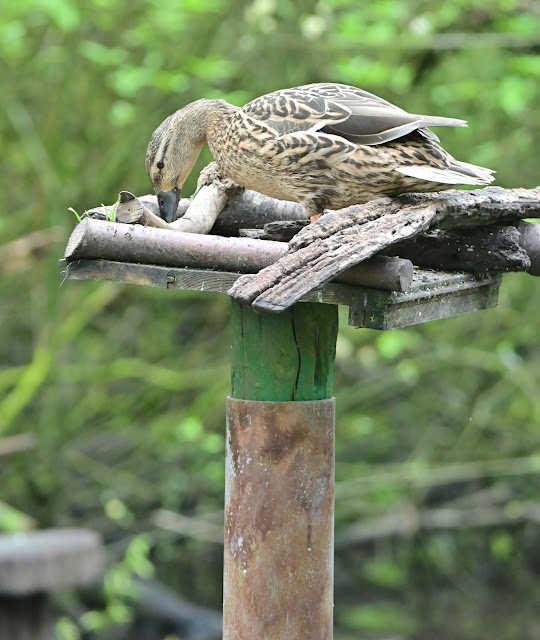 That maybe why there was hardly any food on offer, although the hanging feeders there's no way a Mallard could ever access were empty too. We didn't stay long pushing on to the 'Goosander Island' hide only to find the Goosander island was underwater. There was only one Goosander present and she was miles away on the far side of the lake. With little on offer we were ruduced to taking pics of a Black Headed Gull on a post - why???
 A Little Grebe sailed into view so we had a go at that. At least it was a bit nearer than those we saw last time we were here.
 Again we didn't stop long pushing on round the trail. We'd heard a few Cetti's Warblers on our travels this morning but as ever none had played ball and shown themselves until IH spotted one flitting around the former tree-top twigs and branches of a fallen tree. It was distant across two horribly boggy areas and a stream but at least it was showing and more importantly hanging around...we fired off hundreds of shots as it continued to sing and do some dispaying in the hope that at least one would be in focus.


They're not the best but job done #136, we can ignore them now...lol. Apart from a flitty Goldcrest and an evasive Blackcap the rest of our wander round was very uneventful. The promised sunny spells were warm enough to bring out a butterfly or two but the wind still had a bit of nip about it and we didn't see any. IH also spotted us a jay but it flew before we could lift the camera, getting two of our Challenge bogey birds within ten minutes of each other would have been an incredible feat but it wasn't to be. We tried to track it down along the muddiest path the site has to offer but never saw it again.
Lunch beckoned and as we devoured pies n stuff it was decided to bunk off to somewher more productive...anywher would do...IH had heard our talkes of fairly close Cattle Egrets at Martin Mere and decided he'd like a look at those. We wouldn't mind another look too, especially if they a bit closer than last week.
45 minutes later we were in and off for a look at some Cattle Egrets, but this time the cattle were on the main mere and a long way off. Our best count of white dots that were probably Cattle Egrets was only six compared to last week's 15. Herons on the other hand were doing well, our morning at pennington Flash had only given us one Little Egret but several Herons so for our usual Herons v Egrets safari score herons for a welcome change were well out in front. With six Cattle Egrets egrets were on a roll and catching up. But we managed to find a couple more Herons to maintain their lead. At the Ron Barker Hide a snazzy well plumed Little Egret put on a show.

As did a flock of Black Tailed Godwits feeding on the soggy fielfd where the cattle had been on our previous visit.
 Most of the wintering duck have left and the water levels too high after all the rain for most of the waders so there wasn't much to see apart from the snazzy Little Egret.


Back we went to the Discovery Hide to have a look at the nice and close Black Tailed Godwits, we'd made another pact...take no more Black Tailed Godwit pics unless they're engaged in some unusual behaviour - we've got more than enough 'portrait' shots to last a lifetime. IH wondereed how long it would take us to find the Mediterranean Gulls...about 30 seconds! To be fair they hadn't moved more than a few inches since last week. We couldn't find the second pair that are here though. Our regular two were still defending their patch of island against all comers.
 Strangely most of the Black Tailed Godwits (no pics!) were still in their grey winter garb while those we'd photographed on the pasture earlier were much more coloured up, wonder why??? There was little in the way of interactions or other behaviour going on so we moved ogff to the feeding station.

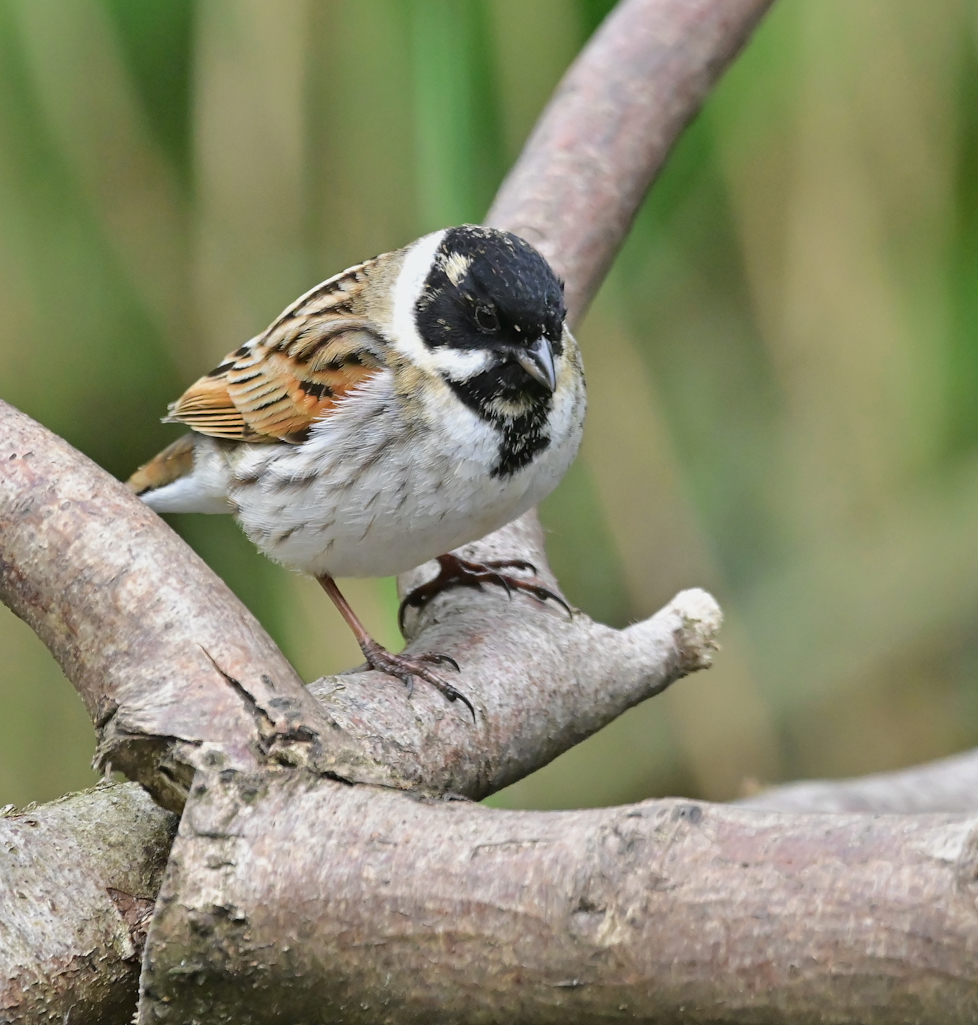
Not a great lot happening here apart from yet more Grey Squirrels, the management should really get behind the local Red Squirrel prottection project and do some (= a lot) of out of hours culling. After having a giggle at the Mallard on the table this morning we had anther giggle when a Moorhen flew up on to this one. Not much else about until a fine male Reed Bunting appeared.



From our next vantage point there wasn't much to see and we digressed into our herons v egrets game again. Honours ended up almost even, we can't remember who pipped who but there was almost definitely some measure of double counting going on for both teams.
So ended a rather quieter than anticipated safari, you can't have it all all the time, that's just being greedy. And there's always tomorrow...
Where to next? We've got some more local safari's lined up for you.
In the meantime let us know who needs warming up in your outback


