Showing posts with label Gooden's nomad bee. Show all posts

Monday, 4 May 2020

Lockdown week 6 brings a little belter to the garden

The Safari was struggling with the poor weather early in the week especially in the garden. On Monday only a Buzzard low over the chimney pots made it into the garden notebook and Tuesday's only entry was of a Blue Tit collecting dog hair for its nest again. We made no further entries until Sunday! The camera didn't see much action most of the week either.
Highlight of Day 1 was four high flying Whimbrels heading seawards early morning and a few minutes later a Sparrowhawk flew across the main road heading to the park with prey in its talons. 
On our exercise walk round the park - about a dozen times - we had a Whitethroat and Lesser Whitethroat on the rough field but otherwise it was quiet.
Tuesday was a bit of a better day and we took our exercise walk the other way along the North Blackpool Pond Trail. It was lively enough.  Pick of the bunch were two Lesser Whitethroats, three Whitethroats and a showy Sedge Warbler but we hadn't taken the camera - dohhhh. A shed load of butterflies too, don't think we've ever seen so many Orange Tips in one place in Blackpool before, we also got our first Speckled Woods of the year too.
A modicum of excitement was had in the garden when a female Blackbird dropped in for a quick dip in our little waterfall. It was very wary keeping tabs on us as we raised the camera cautiously from behind the kitchen window's blinds.
The following day we had another change of scenery with a visit to the prom. It was cold and blustery with very little on offer either out to sea or along the cliffs. Out to sea was marginally better half a dozen Gannets and a male Eider versus a couple of flighty Wheatears along the cliffs.
We were back there again on Thursday, not entirely sure why it was always going to be pretty dire. Easily the best sighting was of four Gannets diving for fish just beyond the low tide water's edge, four Sandwich Terns were there too. Again no camera but they would have been too distant anyway. Along the cliffs we had another Wheatear and a Swallow heading north as well as one in the side street where they nested last year.
May arrived on Friday and once again we were up at the cliffs. Slightly better today with a flock of 11 Gannets followed by a few others. On the return leg we stopped for a scan and hit a bit of jackpot - way out on the horizon we spotted the unmistakable cruciform shapes of careening Manx Shearwaters. In the few minutes we stood watching we counted over 50, there could have been many more out there we couldn't see with just our bins.
In the afternoon we broke the rules a bit and went out again with Wifey and the mutt, we made sure we kept well away from anyone else, we prefer five metres rather than two anyway. This time we went up to the North Blackpool Pond Trail and came across our first brood of cutesy Mallard chicks.
A Robin was 'cock of the rock' singing from the top of the tallest tree in the area. We didn't have much opportunity to point the camera at anything else but as you can see from the colour of the sky it was a very pleasant hour out.
Saturday saw us having an earlier start down at the park. Not taking our phone was a mistake as when we got back to Base Camp we learned we'd missed a couple of Hooded Crows only 200 hundred yards away over the road. Found by the same lad who found the Redstart we dipped for the very same reason. Once is unlucky, twice is a bad mistake, thrice is just plain stupid - there'd best not be a third time!
The afternoon was warm and sunny and saw us in the garden at Base Camp hunting down whatever invertebrates we could rummage out.
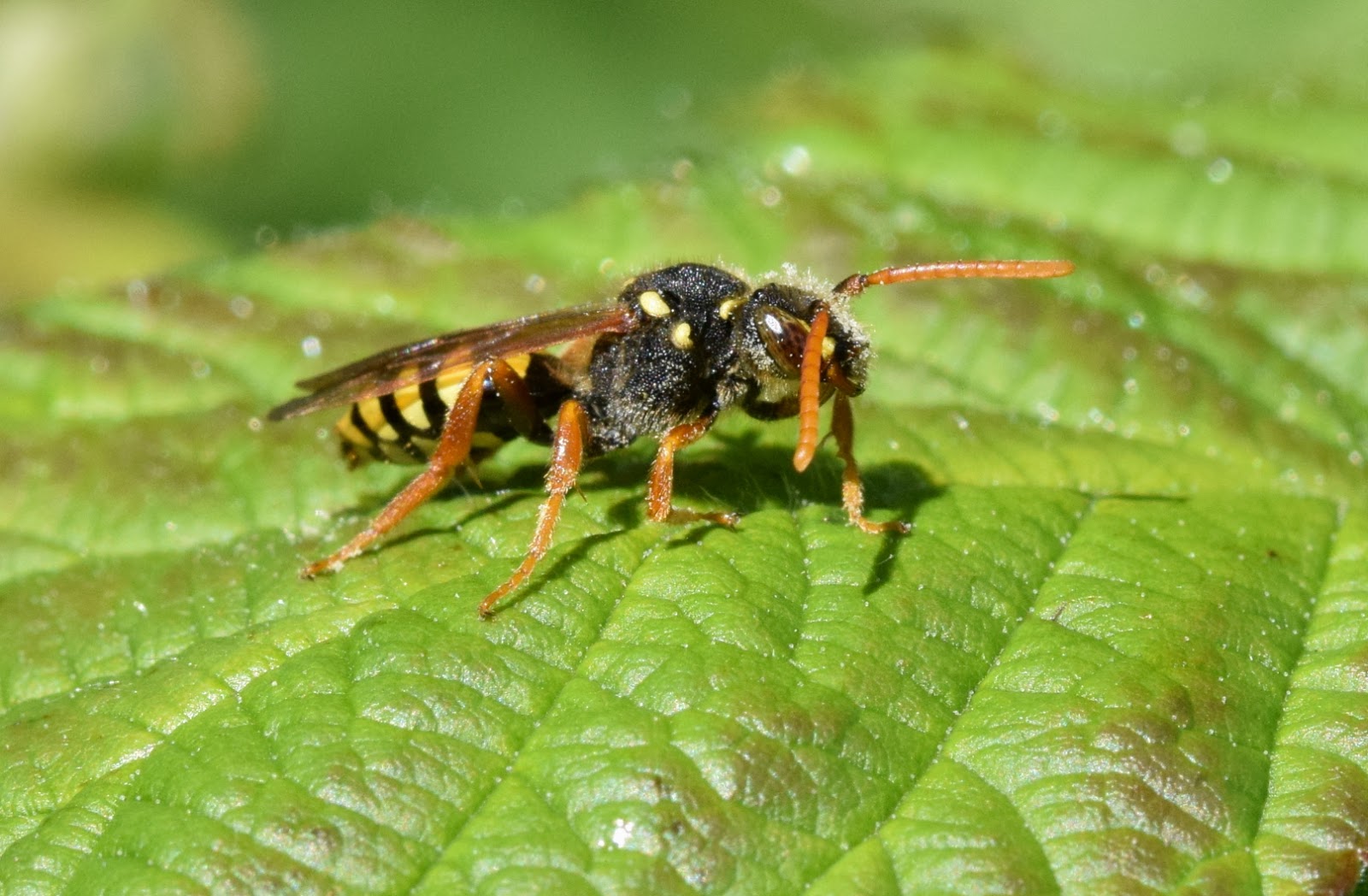
There's still a few a few Gooden's  Nomad Bees about.
While watching the bees we spotted a Green Shieldbug, then another then another, four in all.
Their underside is pretty impressive - don't think we've ever noticed it before
Also out n about were the first Honey Bees we've seen this year, that's bees plural we did see a solitary one a few days ago.
Other solitary bees included this long thin dark Andrena species - as yet unidentified. Any one got any ideas.
Much easier to identify, especially now we've got used to them, are these bonny male Blue Mason Bees.
The only bird to report wasn't seen by us but 'discovered' on a friend's Facebook page - a Cuckoo calling at the crem along the North Blackpool Pond Trail - - that'll need further investigation next week for sure. Fingers crossed it sticks around.
The morning started cool but it warmed up just before lunchtime and while out in the garden we spotted a row of faces peering out of the Bee Hotel. We dashed inside to get the camera but by the time we got back out they'd all left bar one.
Red Mason Bee checking the coast is clear before launching in to the clear blue beyond
The compost heap is a good place to watch spiders, mostly Wolf Spiders, but further inspection had us looking at a dangly thing which when we touched it the spider shot out to defend its nest or at least check it wasn't damaged by the huge lumbering oaf of a human. The dangly thing looks like it's made from a Nettle leaf, the spider is most likely to be Tetragnatha extensa, quite a beauty when inspected closely. 
In the dark so not so a bit too grainy even with the flash
The other spiders out in the light don't hang around for their pics to be taken they're always on the move.
Some looking for prey, some looking for mates.
Judging by the way this one is signalling it would rather be the latter than the former.
After getting the pic of the tiny Ichnumeon Wasp last week we've been keeping our eye out for some more. We'd seen a few tiny flies when we saw another that looked a bit different so we fired a few shots off, but without our specs couldn't really see what it was on the screen. Downloading the pics on the laptop we saw it was a beetle, indeed a Longhorn Beetle, but which? CR offered an ID Grammoptera ruficornis. Turns out to be quite a little find - emphasis on the little - not recorded in the Fylde before (or if it has it's not reached the NBN maps yet) and there is quite a big hole in Lancashire away from the Morecambe Bay limestones.
We're confident C has got the ID right but have put it on iNaturalist to see if we can get a confirmation or two. Not a bad (but very lucky) find in a small garden that's just been left a little to wilderness. 

Where to next? Lockdown continues so it'll be more close inspection of what's on offer at Base Camp and the same three walking sites where something is bound to turn up, after all it is May and anything can turn up anywhere.

In the meantime let us know who's turning up in odd places in your outback

Stay safe - stay socially distant - enjoy the wildlife on your doorstep, it's out there for you to find all you need to so is look..and have a bit of luck.


Monday, 13 April 2020

The third week of lockdown local wildlife safaris

The Safari has had a rather productive week despite being on Lockdown. Last week ended on a high too with our first ever spring record of a Rook flying over Base Camp, they are very infrequent in the autumn, usually tagging along with flocks of Jackdaws on passage.
An early morning visit to the prom last Monday gave us a distant flock of Eiders heading south and the day got better still when a Chiffchaff dropped into the Base Camp garden staying a while to have a  little bathe in our ornamental waterfall. That gave us just enough time to grab the camera and fire off a few shots through the increasingly dirty kitchen window - time for the mop, bucket and Windowlene. Number 32 on our 1 mile from home challenge which was a two week challenge but has now been extended to six weeks - we get the impression it might be expanded even further yet too.
It wasn't the only bird having a spruce up that day, a Blackbird was in there too.
The following day we were back in the park this time we'd taken the camera to see if we could get a pic of the local House Sparrows that hang around the perimeter of the field where it backs on to the neighbouring gardens. Crikey it took some doing they were either very flighty not allowing any sort of close approach or keeping hidden in the dense Ivy or thick twiggery of the bushes. It took several circuits to finalyy get one submitted to the SD card for #33.
On a further lap of  the fields we heard a commotion of Sparrowhawk yikkering coming from the Butterfly Zone. We headed over that way to see what all the racket was about only to find the pair mating in one of the Sycamores at the edge of the scrub but requiring a very tricky shot through plenty of intervening branches and twigs.
Flamin out of focus twigs!
Job done and off...
The female
Never seen that before and very lucky to witness we guess. 
Nearby Green Alkanet was flowering in a sunny glade
Bright sunshine, warm too, brought a Peacock to nectar on the Aubretias in the garden tubs. Our first and so far only butterfly pic this year.
The fine weather got us to thinking about doing a bit of gardening so out came the stout gloves and secateurs and we ventured into the Bramble-infested no-man's land behind the garage. Now Brambles aren't that bad and provide habitat and food for a humungous number of invertebrate species but in a very small garden it's easy to have too much of a good thing. While doing a bit of snipping we heard the gulls go up in alarm and looking up we saw about a dozen of them chasing an Osprey almost directly over our head, tantalisingly close to being a Garden Tick but at least we'd joined the Osprey-from-the-garden-during-Lockdown club. We dropped the secateurs and tried to remove our gloves as we sprinted back down to the kitchen where the camera lay waiting. Too late - by the time we'd grabbed it the Osprey as nowhere to be seen, obscured by all the neighbouring houses. We called CR but sadly he missed ti too. There's a moral here - if you go up to the furthest reaches of the garden take the flippin camera with you!!! A Blackcap was singing very close to Base Camp much of the day too but never ventured in to the garden.
That takes us to Thursday. Leaving Base Camp for the early morning quick dog walk we had a skein of about 90 Pink Footed Geese fly over us. Later, on the proper exercise/dog walk we heard or first  Coal Tit for a long time, singing away in the line of tall conifers by the water tower and further on in the park the Chiffchaff and Blackcap now seemed to be settled in the Butterfly Zone which incidentally is so far devoid of butterflies.
Base Camp's moth trap has been dire, a combination of the Super Moon, neighbouring high intensity security lights and severe local habitat destruction aka garden tidying has butchered the local moth populations. A tatty Hebrew Character was a welcome find but we're getting to the stage of How many kilowatt hours per moth!
The Super Moon - we were out too late to find it in all its pinky glowing glory
Good Friday was a good day on the prom early morning, out on the beach we came across a Green Leaf worm in a little puddle, not something you see ervyday and it soon buried itself in the soft sand. A few yards further on a recently deceased Lesser Spotted Catshark lay on the beach. Probably a victim of the anglers that are still out angling abeit in much smaller numbers than usual.
When we got up to the top of the cliffs at the furtheest point of our walk there was a bit of passage going on. We counted at least 35 Meadow Pipits and 21 Linnets going northwards, five Pink Footed Geese heading NW out to sea, got our first Swallow of the year, quite late we've ususally come across one in the earliest days of April rather than into the second week and a Blackbird was singing from a promenade rooftop - most unusual, the first we've heard along here in several years of 'treading the beat'.
Back at Base Camp several Nomad Bees were flying around and a Sparrowhawk soaring away to the north got the gulls going and our pulse racing again.
Easter Saturday started well with 50 Pink Footed Geese going north and a few minutes later we heard our first Willow Warbler of the year, which, like the Swallow, was quite late for us. We heard the conifer Coal Tit singing again and followed it up with a second this time in the big conifers in the park.
Most unexpected, although at migration time birders should always expect the unexpected, a pair of Shelducks flew towards the sea just east of the park - a Patch Tick!
In the garden a female Light Brown Apple Moth graced the trap and up to four Greenfinches graced the feeders.
Best sighting of the day was a female Orange Tip butterfly, really scarce here, flying through the gardens just round the corner on our very quick lunchtime dog-pee walk. In the afternoon another good sighting was had, a Red Mason Bee, a new species for the garden, was discovered when we ventured behind the garage to bash some Bramble again.
A Common Quaker and a large Crane Fly were in the moth trap on Easter Sunday.
And a review of the stealth-cam revealed the Hedgehog is still about if only an occasional visitor this week. we've repositioned the camera to see if we can get a better view of him for next time.

In other news the sunny week has given us lots of invertebrate photo opportunities at Base Camp - here's a selection of what we've seen.
Buffish Mining Bees - from the 'colony' at the corner of our street
Several Eristalis Drone Flies take up positions around the garden. We've not had a proper look at them but guess they'll be E. pertinax.
Some of our plant pots have more moss than plant!
In the latter half of the week Gooden's Nomad Bees became regular visitors but they're a nightmare to photograph as they just won't settle for more than the briefest moment - here's a few of the hundreds of pics we've tried to take of them.
Another good find in the 'Bee-line' was this Tawny Mining Bee sunning itself on the fence, a rare find in the garden.
While watching our first Zebra Spider of the year clamber about on the the trellis 
we spotted this tiny Hoverfly flitting around the flowers by our knee - no idea which species, one of the Sphaerophorias perhaps.

Where to next? More of the same - here's hoping the weather stays fine for daily Base Camp safaris and there's still the opportunity to take the dog for his walks round the park and occasional visits to the beach which he loves.

In the meantime let us know what's in your very much restricted outback. Stay Safe - Keep your distance!!!