The Safari had a Mothers' Day wander along the prom at Rossall with Wifey and Monty. The tide was well out but the distant sea as flat calm, perfect for spotting any Harbour Porpoises or Grey Seals that might have been out there. We saw neither but did see a large raft of Eider ducks but too far away to count effectively or see if there was anything else with them.
We did bump in to the local flock of Linnets (PYLC #97) at the far end of our walk

and a few steps in to our return walk looking the other way across the beach watched a Grey Plover fly in and land not too far away.

Monty had fun, always on the lookout for other doggies to play with.

A Stonechat was unusual in that it was hopping about on the dog walking field rather than sitting on a fence post between the thin strip of dunes and the golf course.
Monday first thing out with Monty gave us a very late Patch 1 tick in the form of a singing Wren (P1 #26) surely we must have overlooked them down there so far this year, mid March before the first one can't be right! Later that morning saw us along Chat Alley again with Monty. The conditions looked good for a bit of migration although it was a bit chilly, the wind was south easterly though so you never know.
There wasn't much about at all. A couple of local Pied Wagtails and a small number of migrating Meadow Pipits overhead, a couple being seen coming in-off the sea but most were 'heard onlys'.
Here and there were Turnstones scattered around finding any pickings washed up by the high tide or more likely left by the recently left anglers

Just after we took the pic above something caught our eye down by our boots. A deceased Bumble Bee, emerged too soon and got caught out by the return of the cold weather and lack of nectar bearing plants, there's hardly a Dandelion to be seen yet and even the Coltsfoot flowers on the cliffs aren't particularly advanced yet.

The tide hadn't gone out enough for the Redshanks to leave their roost on the old boating pool wall.

We'd walked the full length of the Chat Alley from Gynn Square to Norbreck Castle and back without so much as a sniff of a Wheatear.

Tuesday saw us on safari with CR beyond the Southside across the Mersey and just into Cheshire. The weather forecast was for fine weather but the drive down the motorway was through heavy rain, we weren't hopeful it would stop. But our luck changed and the rain dried up as we left the motorway and by the time we arrived at Moore nature reserve the sun as trying its best to shine through the thinning cloud.
We spent a good few minutes at the nearest hide to the car park where a Little Grebe was giving us superb close views, when it was on the surface. It dived repeatedly and for long periods searching for what turned out to be Caddisfly nymphs, C getting some pics of it surfacing with them in its beak.


After a while it was time to go and look for the star attraction. We walked down the lane and we explained to C that finding our quarry could be tricky unless we hear it calling or drumming first. He asked what they sound like and we said a bit like a Kestrel and then a billi-second later we said 'just like that!' The call came from the usual corner of the woods 100 yards in front of us and two other birders came round the corner pointing towards the tree tops.
They'd seen it earlier but lost it but knew roughly where it went. A couple of minutes or so later we picked it up high in the upper branches of a large tree. It showed well and we got stupendous views in our bins but it was tricky to get pics of as it probed the bark for food never turning its face away from the woodwork for us.


Very lucky too as once we'd lost it it wasn't seen again all day at all by anyone we spoke to.

The sound track of the day was a notoriously invisible Green Woodpecker (119) probably more than one and perhaps more than two even trilling Little Grebes and later once the sun strengthened mewing Buzzards.

Walking round the rest of the western part of the reserve we didn't see much else, certainly no early Chiffchaffs were in yet.
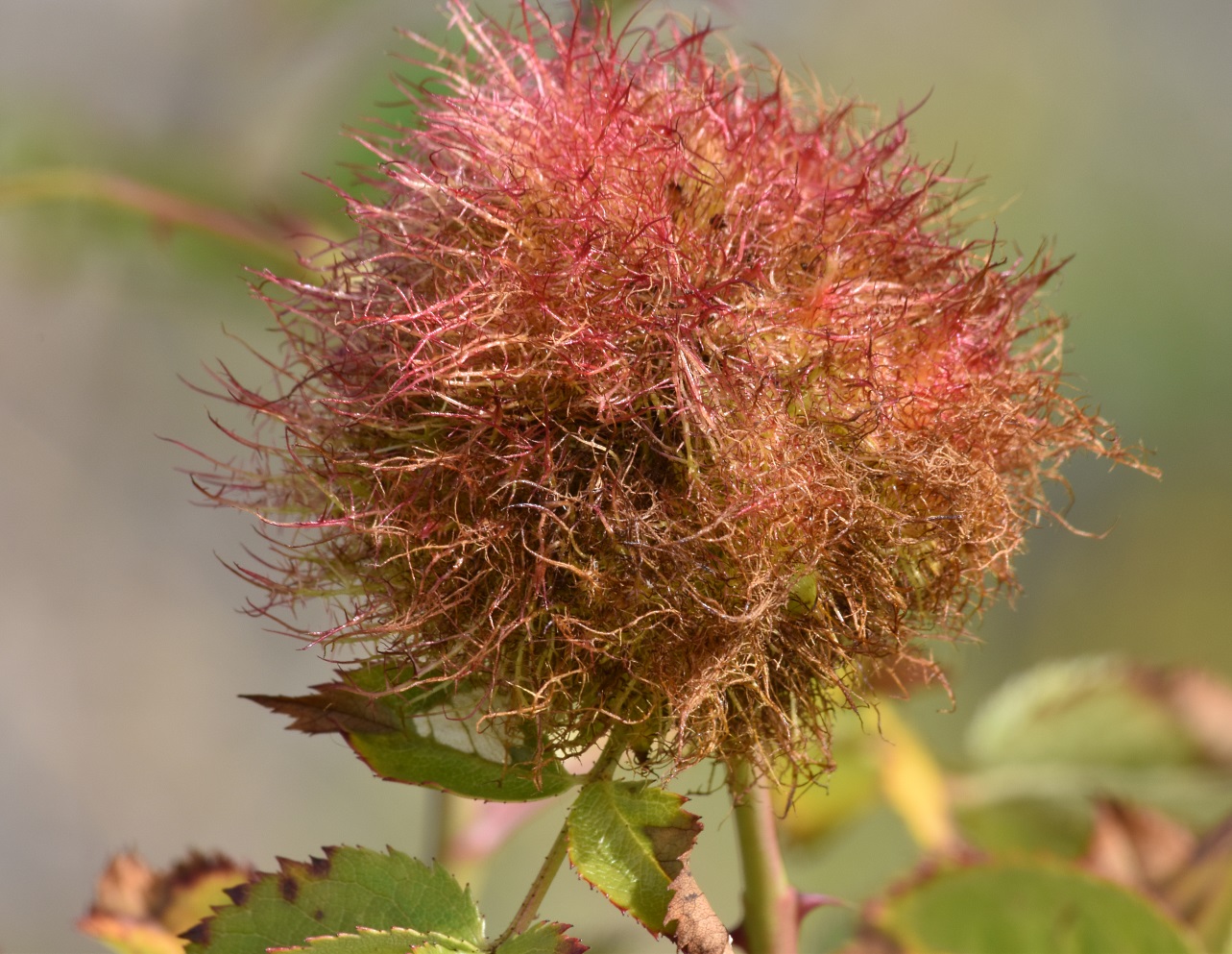
The thicket of Gorse on the way up to the Raptor Watchpoint hadn't been warmed enough to smell of Coconuts but there was a big splurge of Yellow Brain Fungus (or is it a Slime Mould?) on one of the stems.
After lunch in the car park we hit the eastern half of the reserve. The pools were quiet, just a few Tufted Ducks and a couple of pairs of Goldeneyes on the first one. The Birch woods were even quieter, in fact the main things we noted here were the numerous fungi. odd for 'spring' perhaps as they're more normally associated with autumn.
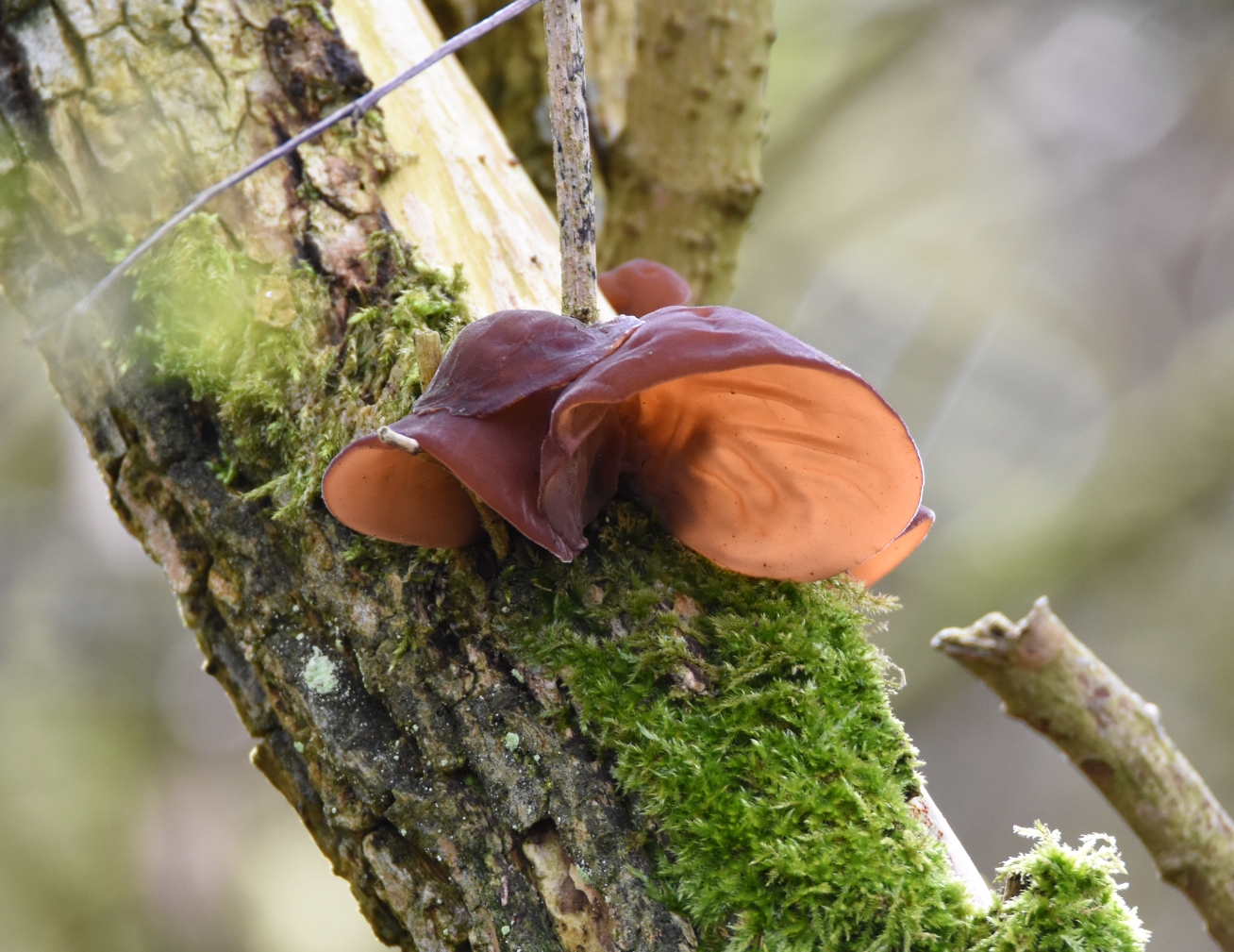 |
| Jelly Ear on Elder - still can't get used to this 'new' PC name for this species |
 |
| Unknown species on Silver Birch |
But the star of the show was covering a fallen log on the woodland floor. The fairies have been hard at work there. A shed load of Scarlet Elf Cups dazzled in a shaft of light. What a stunning thing they are - wildlife doesn't have be feathered or cute n cuddly to be awesome - just look at the colour of those little beauties!

A chat to a couple of passing birders told us that the pair of kingfishers at the Eastern Reedbed were showing well and chasing each other around. But when we got there there was little to be seen, a couple of Little Grebes, a Great Crested Grebe down at the far end of the pool, a Green Woodpecker was heard from the fringing line of trees...again! and a pair of Shovelers shoveled but not a Kingfisher to be seen.
Then we heard a distinctive whistle and a flash of electric blue shot across the face of the reeds across the pool in front of us. Unfortunately it landed just a little too far away. Who cares, we got cracking views as it looked for fish below; its head staying almost motionless as the reed it was perched on waved about in the gentle breeze.
The all black bill tells us this is a male Kingfisher (PYLC #99)


Our next safari was with our children's group when we were out on the hunt for Frog spawn. The ponds we looked in were very full of rain and cold snow-melt water and we had no luck in finding any spawn. But that's not to say our nets didn't pull out anything at all from the ponds.
 |
| Backswimming Water Boatman |
 |
| Brown Lipped Banded Snail - found in the grass not a pond |
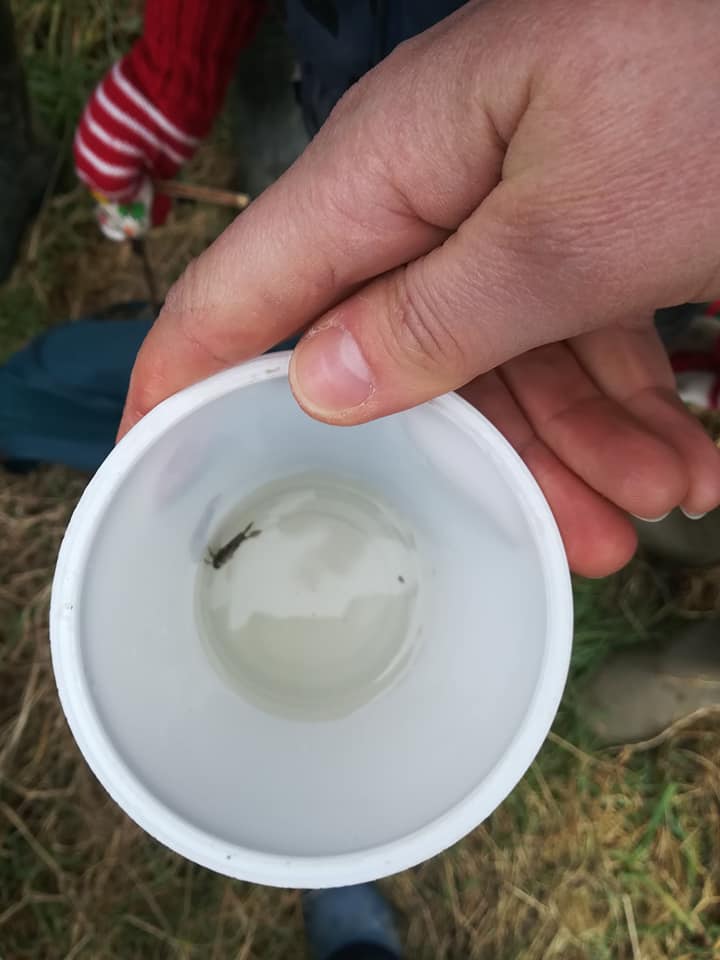 |
| A damselfly nymph |
 |
| Ramshorn Snails |
 |
| At last a Frog - found in the wet grass close to the pond |

 |
| And then there were two |
 |
| Safely released in to the edge of the pond where they were not going to get trodden on |
It was a cold day and there weren't many signs of spring although the shiny golden flowers of this Lesser Celandine brightened up proceedijgs.

As we led the group to our last pond one of the mothers called us back as her very young son had just spotted a little bird in a Bramble thicket and it was eating a huge caterpillar. We'd totally walked passed it but as our eye level was very different to his that's perhaps not so surprising! Anyway we turned back to find a Goldcrest (PYLC #100) wrangling a sizeable green caterpillar. The camera was set up for small close things in white buckets so our hastily taken pics aren't quite the best but we were thrilled that group got to see this interesting piece of behaviour from a bird most of them, if not all, had never heard of before.


An awesome find for someone so young. Before too long, sadly, we'll need another David Attenborough; could he be the one???
The last pond gave us a very interesting sighting, no Frogs but something much more unusual and rarely seen. At the edge of the pond there was a floating thing which we recognised as a giant shell of a Swan Mussel. It was just about reachable with the longest handled net in the group and a bit of risky stretching down a steep bank on our part.
When we lifted the shell from the net the animal fell from it - yuk - rank!!!


 |
| The boy in the blue hat poking out above the shell is the lad who spotted the Goldcrest |
But what a cool find, then one of the group spotted a second in the pond but that was well out of reach. They are probably victims of the cold spell last week. We certainly didn't expect to find those but that's what going out on safari is all about - you just never know what you're going to come across and that's what makes watching wildlife so exciting, there's always something new to see and learn.
And learning about wildlife is something we all need to do. while we were on site there was a Community Payback team cutting down the adjacent hedge to its roots. They are supposed to be on reparation work for their crimes and yet someone had instructed them to do work that was actually forcing them into breaking the law - a ridiculous situation but we're not blaming the lads rather the site manager who has apparently been told about this before...a case for Vicarious Liability perhaps?
The following day saw us out to the east for a riverside mooch with GB and Monty, it was a wildlife, geography and history sort of a walk.
 |
| Brock mill |
We took some other pics but they are for another blog, perhaps a guest blog on another blogger's site, at a later date.
The river gave us good views of a Dipper and Grey Wagtails but we weren't expecting to hear a Tawny Owl (120) hooting in the middle of the day.
Yesterday we took Monty for yet another walk along Chat Alley in the afternoon and this time we struck lucky even though it was late in the day there were two Wheatears (121) on the cliffs, they have usually passed through along here by mid morning.
Then just to prove migration can be all day thing we heard Whooper Swans (Garden #18) going over Base Camp as we sat at the 'puter - probably the 13 seen by SD minutes earlier a mile or so to the south of us and reported on Twitter.
So yet another great week out on safari and we're thrilled to get the ton-up for our Photo Year List Challenge beating last year to 100 by five days, the Stanley Park Chough on 19th March last year. The front runners are approaching 200 but they do have the advantage of having had a foreign holiday to sunny climes away from the northern snows, two other challengers are a little ahead in the low hundreds and two are nipping at our heels in the high 90s...still all to play for and it's all a bit of educational fun, we're certainly enjoying seeing pics of birds we've never heard of before and learning about the birding in places we'll almost definitely never visit.
Where to next? Not sure what's happening this coming week we have family duties on the Southside that may give the opportunity for a stop off somewhere and then there's a bit of a trip coming up.
In the meantime let us know who's doing the quality wildlife spotting in your outback