Saturday, 10 June 2017

Wet in the rain and the hope for a boar

The Safari wasn't able to do the dolphin watch we'd hoped to do for World Environment Day due to bad (= atrocious) weather, nor was there any chance to move it World Oceans Day a few days later due to solemn family duties. The following day we had a bit of a chill out day with Wifey to clear our heads and have a bit of a walk out with Monty somewhere he's not been before.
We had a walk along the river listening to mostly Blackcaps, Robins and Song Thrushes. We had to listen as we didn't see any birds at all in the dense woodland. There was a bird we did want to see and photograph, a Dipper or two, but arriving on site mid-afternoon the amount of doggy disturbance so far, which we added to to be honest, probably put paid to any chance of seeing them. 
Almost at the end of the woodland section of the circular walk we eventually came a across a real live bird, a Robin sat preening on a low twig possibly after having a bathe in one of the many puddles just off the edge of the track.
Once out of the woods the meadow was a picture of glowing gold from the myriad of Meadow Buttercups. Last time we were at this site was last year with BD (or was it the year before? - time flies when you're on safari) there was a team out with a heavy duty motorised scrub cutter clearing away the Alder and Willow scrub that was developing and beginning to over-run the meadow. Now we're all for reforestation and rewilding but there are limits. This work was being done to ensure the scrub didn't totally over-shadow the orchids that grew on the meadow.
The work had been a success as it didn't take long to find the first Southern? Marsh Orchid, nor the second or third, once you'd got your eye in there were thousands scattered among the buttercups.


 A wonderful sight!
Back at the car Monty was being cleaned off and we had a quick look at the apparently empty feeders in the corner of the car park. There was some food and there was a bird there in the deep dark shadows. We edged closer very carefully and fired off a few shots as we went.


Those stripes down the back and the buff wing bar gave the ID away, a Lesser Redpoll (162, YBC #138).
Sneaking a little closer and changing the settings on the camera we ended up with an almost decent pic showing it's lovely red head which gives the bird its name.
Once home we had a txt from CR saying he'd had a Blue Tailed Damselfly close to his pond which he didn't think had emerged from there but flown in from elsewhere. We took advantage of a bit of sunshine and went into the garden at Base Camp to find the same species almost immediately.
This one could well have emerged from our pond.
Later our Extreme Photographer sent us some very interesting pics. His neighbour had been at a friend's and she had brought back a bit of a specimen that her friend, knowing of our Extreme's interest in wildlife, had kept for him. 
The recently shed skin of a very large Grass Snake.
It's a big one, well over 1m long
The ventral scales were about 4 cm across!
What a great addition to his collection of wildlife bits n pieces.
We'd love to see one that big in Safari-land, we like to see one any size in Safari-land!!!
Last night on Twitter we saw a post about wildflowers and lawn-mowers that reminded us very much of Patch 1. So while we were out with Monty after the rain we took the opportunity to recreate the post. Here's today's pic. The field looks like this every day.
But it used to be cut less frequently until a couple of years ago and often looked like this, or white with White Clover and buzzing with bees.
Why do the 'Tidy Brigade' hate wildflowers and all their associated invertebrate life, especially pollinators, so much?
Most of the field isn't played on by the local kids and could easily be left uncut for longer, if absolutely necessary the margin against the paths could be cut to no more than a metre in. We're beginning to think all public green spaces, including, and perhaps especially, the roadside verges should be manged for pollinators and other insects and sod the 'Tidy Brigade'; sports fields would obviously be exempt but less tidy doesn't mean un-managed or uncared for and should be the norm. If people want tidy let them scalp their own lawns and leave the rest alone. What is it that they/we are so afraid of?
On the way back we saw a garden that had recently had some bedding plants put in. There were scattered plants surrounded by what seemed like acres of bare soil. Now the gardener obviously meant it to look like that and will spend ages all summer hoeing and weeding to keep it so. But we thought it just looked like a sounder of Wild Boars had had a rummage and accidentally missed or deliberately avoided a few plants - we can imaging the chaps absolute terror if a flock of Wild Boars had done that to his garden no doubt he'd be calling for a cull!!! They're a species that would do well at the riverside site we visited yesterday provided they could avoid all the doggy disturbance...as would Beavers up the river...heaven forbid!!! BUT the river managers had felled some trees directly into the river to reduce and deflect the flow in certain areas just as Beavers would do...
Come on Britain, pull your fingers out and lets get some wildlife back in our land, urban and rural!
Where to next? Back to the real world of work tomorrow but we do have an event on the beach in the evening to tell you about.
In the meantime let us know who's tidying up in your outback.

Sunday, 4 June 2017

On the trail of the lonesome bee orchid

The Safari was out yesterday morning joining a guided wildflower walk just a few hundred yards from Base Camp. The sun shone and the small group wandered around the Community Orchard to begin with before moving further afield.
After ticking off the obvious species like Nettles, Cow Parsley, Cleavers and Cock'sfoot grass in the orchard we spent time looking at Red Clover, Ox-eye Daisies, Lesser Trefoil and Crested Dog's Tail grass out in the open. On the hard clay of the open plateau is where the Bee Orchids can be found. Indeed we knew there were at least half a dozen or so lurking on the edge of the denser vegetation as we;'d found them earlier in the spring. But today try as we might we couldn't relocate them and it should have been easier as they ought to be in flower by now. Eventually we did find one and it took some serious tracking down as it was looking very much worse for wear. Perhaps the long dry spell had put paid to them.
All was not lost though as we did come across three spikes of the chlorophyll lacking parasitic Common Broomrape, we've seen it here before but not for a few years. We're pretty sure it parasitises the Red Clover here. It is very local and only ever appears in the same few square yards despite the Red Clover occurring across the whole area. 
With family duties to attend to we had to leave the group early so we went back today for another look this time without Monty so we were less hindered for taking some pics.
Before that, in the morning, we'd taken him round Patch 1 where we heard a couple of Chiffchaffs, one of the Blackcaps and saw the Whitethroat which although we couldn't see if it was carrying food must surely be nesting by now.
The highlight of our visit wasn't the birds though as we spotted four Common Blues
Heavily cropped phone pic
and our first Large Skipper of the year.
ditto
As well as this cheeky three-some
Not entirely sure what #3 is up to here, the other two are probably not impressed
Back at the wildflower area after lunch we heard a Whitethroat and two Chiffchaffs there too as we walked in. The first thing we wanted to check was the dyke that we noticed yesterday had been cleaned out recently - right at the worst time of year, we're not sure if that would have been legal, certainly the bush with the breeding Reed Buntings is no longer there!
Surely everyone knows work like that should be done in the winter and certainly by March at the very latest. The waste is piled up on the edge of the County Biological Heritage Site which is a long way from Best Practice too although it would have allowed any aquatic animals to get back into the water but buried much off the local patch of Meadowsweet/ It's hardly as if it was essential work as it's barely rained a drop for the best part of a month or more. Fortunately the other end of the dyke which is far more floristically diverse than this section hasn't been touched - - - yet??? 
Back at the Broomrapes we were able to get a few pics in the sunshine.
Despite its weirdness it's deffo a proper job flowering plant
The third one, unopened
Although it was sunny there weren't very many butterflies on the wing just a couple of Common Blues and this Speckled Wood in the Community Orchard
Pick of the afternoon's fimds was this mating wheel of Blue Tailed Damselflies.
A very pleasant fourth day (already!!!) of #30DaysWild out finding wild stuff and none of it more than a short walk from Base Camp
Where to next? Looks like torrential rain and strong winds are going to put the kibosh on tomorrows planned whale and dolphin watch for World Environment Day
In the meantime let us know who's doing what they perhaps shouldn't be in your outback


Saturday, 3 June 2017

It's June so it's #30DaysWild again

The Safari has been struggling to get out as much as we'd like due to work and family stuff but when we have got out we have had some great sightings.
A brief look at the sea on Patch 2 the other lunchtime had us watching a flock of about 40 Gannets diving for fish. They were very distant though and the terns with them were little more than a couple of shiny white pixels in the telescope. Chasing them with ultra agility was a slightly larger dark speck, an Arctic Skua (161, P2 #51). Much closer in and away to the south was a bottling Grey Seal.
Last weekend we had a visit to the nature reserve to try to add some more species to our Year Bird Photo Challenge. We had in mind Blackcap and Reed Warbler with the hope for Swift if conditions were right. Standing nearr the end of the causeway at the wetland we had stereo Reed Warblers but in the damp and windy weather they were staying low in the reeds and we couldn't see them. The slightly iffy weather did mean there were parties of Swifts moving through most of the time we were there but trying to get a pic proved difficult especially as we were on the wrong side of the light for photographing fast moving dark shapes against a pale background. Male Blackcaps seemed to be singing from every other bush but again we didn't see a single one.
Along the reserve's embankment we managed a pic of a singing Reed Bunting but the numerous Reed Warblers down there still eluded us, one teased us by showing well at the edge of the reeds for a few second, until we raised the camera of course.
At the bridge we were slightly better positioned with regard to the light to get some Swift shots, which we did. (YBC #137)
Crikey they're tricky! So flippin quick!!! Eventually we got the pic we wanted but at ISO stupid it's still not perfect
With Swifts in the bag and little else doing we went round to the big park to look for the Treecreepers. We're not sure there's any left in there after so many of the larger trees full of nooks crannies and niches have been removed but word on the street is there is still one pair left. Of course we didn't find them but did see a few cheeky Grey Squirrels demanding peanuts from everyone passing by.
A trip out to the countryside with Wifey and Monty had us failing to find any of the hoped for Tree Pipits, although the time of day was wrong. There were lots of lens voiding Siskins but no Green Hairstreak butterflies, we might have missed those by a week or so, it was a lovely afternoon so they should have been on the wing.not far away there's a lovely riverside walk where we took Monty for a splash to cool off. While he was playing in the very low stream a Grey Wagtail dropped in on the rocks on the far bank to collect food fore its youngsters.
Back at Base Camp thundery weather brought screaming Swifts (Garden #27) into earshot but they were very very high. That is one of the quintessential sounds of summer but has sadly just about gone from Base Camp now. A decade ago it was heard daily with small flocks racing round the rooftop in the evening the last couple of years we've heard them  just once or twice a summer and the wheeling flocks are long gone - very sad and our home life is very much the poorer because of their loss. young children growing up round here now will never know them and think that is normal - all part of the Shifting Baseline syndrome and collapse of bio-abundance.
Best not get too maudlin as there is still some great wildlife to enjoy, what we need to do is appreciate and cherish it so that the baseline starts to shift upwards rather than downwards and the biodiversity we keep hearing about becomes ever more abundant.
At Base Camp male Greenfinches have suddenly appeared gorging on the sunflower seeds they've ignored all winter - there must be some broods of chicks not too far away.
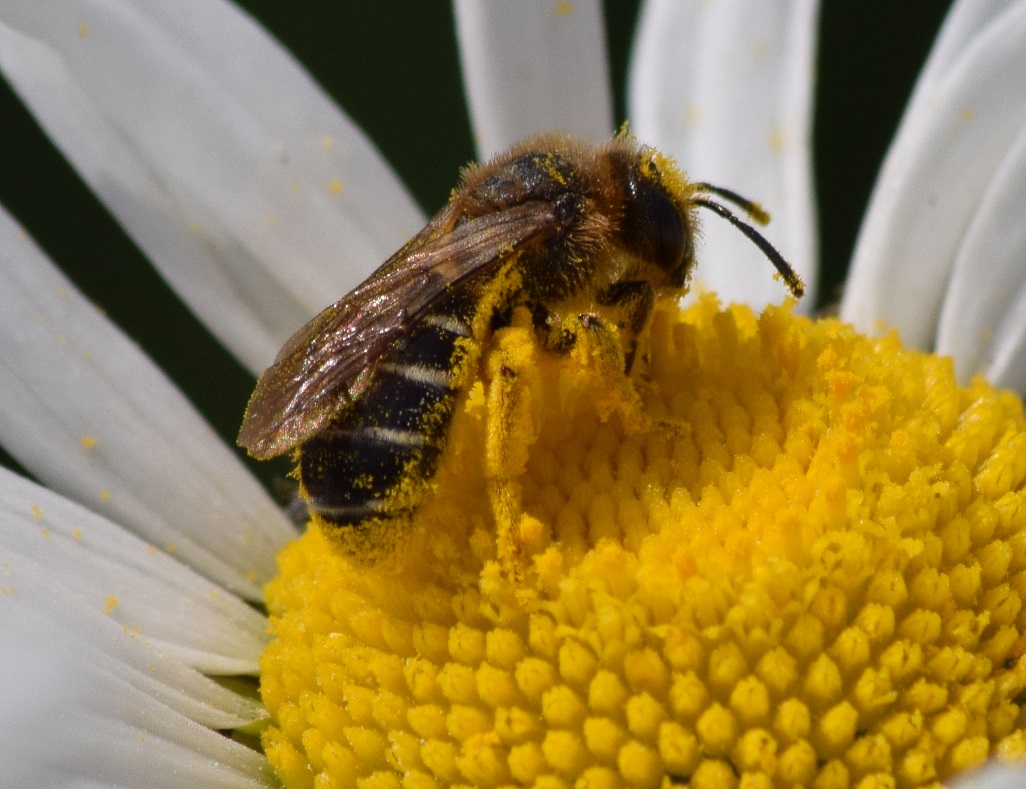
And at work we spotted a tiny Nomad Bee/Potter Wasp buzzing around the Ox-eye Daisies went to get the camera but it had gone never to be seen again by the time we got back. We did see a different solitary bee collecting pollen from the Ox-eye Daisies.And by eck did it collect a lot of pollen!
At first we thought it was probably Colletes daviesanus but it was eventually identified via Twitter as Halictus rubicundus by none other than Steven Falk, author of the recently published field guide to bees. Amid the drivel, nonsense and adverts on social media it's great to have almost instantaneous access to real experts who are willing to give their time and expertise to help out anyone who asks.
It's now June and once again the wildlife Trusts are asking us to find and explore our inner wild and share our experiences on social media. With all the guff around the General Election it's a blessed relief to have some uplifting posts about people interacting with wildlife braking up the time-lines. Only one of the parties mentions the environment yet without a healthy environment to support us all their other policies and especially GDP so loved by the tories (SPIT) are nothing - why can't they see that???
So show the politicians of all persuasions that the environment is important to you by getting stuck in to #30DaysWild and sharing your experiences.
Here's some of the suff we've come across so far
Mating Small Whites on Meadow Cranesbill in the work's wildflower area
What's round the next bend? Let's explore
This beautiful lady was!
Yes we do have a licence to molest them like this
There were also a couple of Toads and a single Smooth Newt under that piece of rubbish. Always worth turning over anything that's been lying around awhile but remember to turn it back once you've finished.
Yesterday afternoon we took a half term family group down onto the beach to do a bit of rockpooling, their best find was this huge Mermaid's Purse
Eggcase from a Thornback Ray
Where to next? We'll be out looking for something wild today - what will it be??? We hope you'll be out in your outback looking and sharing too.
In the meantime let us know what you've already #30DaysWild-ed


Sunday, 28 May 2017

Sitting at the dock of the bay

The Safari was able to get an hour down at the old dock where mooring pontoons have been commandeered by a colony of nesting terns. Actually there wasn't anywhere to sit so we were standing against the railings.The terns are sat on their nests right below your feet!
and offer crippling views 
as they come and go
sometimes bringing food for egg incubating mates
Right by the huge Mute Swan's nest was this Arctic Tern sitting tight. The swan's nest is constructed between heaps of driftwood.
The Common Tern's nest in the first pic got trodden on by the male Mute Swan as he clambered aboard the pontoon to join his mate. Somehow he only managed to kick a bit of cardboard over the eggs and managed not to crush them. Not the best place to build your nest - bit like pitching a flimsy tent in the inside lane of the M6 and hoping the trucks won't squish you.
On the way back to Base Camp we stopped briefly at the neaby marsh where a number of House Martins were busy collecting mud for ttheir nests. Is it just us or do numbers of these little beauties and Swifts appear well down this summer?
We had a quick scan of the muddy margins of the pool but found only a few Redshanks, Lapwings and snoozing Mallards.
Then out of cover close by, perhaps worried about the barking from Monty as we'd left him in the car and he wasn't happy, came a family of Shovelers. Good to have them nesting in our area, let's hope at least a couple of the ducklings survive.
Back at Base Camp the garden is blooming after our holiday and now we have two spikes on our Northern Marsh Orchid in the tub by the sitting room window.
Herb Robert self seeds into every available space buut we don't mind as it's cheery and the bees and other insects love it.
And finally here's a few mmore from Cornwall we've managed to get round to processing.
Botallack's Meeter-n-Greeter in-chief - - no-one was allowed to pass without giving him a tickle on the chin
Bumblebee sp on Gorse
Common Blue
Black Lipped Banded Snail - yellow un-banded form
Garden Snail
Navelwort - very common on the dry stone walls around the village and cliffs, in fact it grow where-ever it could find the tiniest toe-hold

Mine chimney built with granite
Cape Cornwall - originally thought to be Britain's most westerly point until someone measured Land's End properly - - there's five Grey Seals in the cove bottling just behind the surf
Cape Cornwall again
Where to next? Back on Patch 1 for a couple of days before we go back to work.
In the meantime let us know who has to be seen in your outback.